The stages of labor describe the process your body goes through during childbirth:
from the first contractions to the delivery of your baby and placenta.
For many pregnant women, labor is one of the most anticipated and mysterious parts of pregnancy.
You spend months feeling your baby grow, attending appointments, and preparing for birth.
Yet when people talk about labor, the descriptions often sound vague.
“You’ll just know when it’s time.”
“Trust your body.”
“It all happens so fast.”
While these comments are usually well-intentioned, they do not always help women understand what labor actually feels like or what is happening inside the body.
Quick Answer
Labor is the natural process that prepares the body for childbirth. It typically occurs in four stages: the first stage (early labor, active labor, and transition), the second stage (pushing and birth of the baby), the third stage (delivery of the placenta), and the fourth stage (early postpartum recovery). Understanding each stage can help expectant mothers feel more prepared, confident, and informed about what to expect during childbirth.
As a women’s health physiotherapist,
I often find that understanding the stages of labor helps reduce fear and uncertainty.
When you know what your body is trying to accomplish during each phase, contractions begin to feel less random and more purposeful.
Labor is not a single event.
It is a carefully coordinated process involving the uterus, cervix, hormones, pelvic floor, and baby working together to bring your child into the world.
Although every birth is unique, labor generally follows a predictable pattern known as the stages of labor.
Key Takeaways
- Labor is a gradual process that usually progresses through four stages.
- Early labor often begins with mild, irregular contractions and cervical changes.
- Active labor involves stronger, more frequent contractions and faster cervical dilation.
- Transition is typically the most intense part of the first stage but often the shortest.
- The second stage of labor is when the baby moves through the birth canal and is born.
- The pelvic floor stretches significantly during the pushing phase.
- The third stage involves the delivery of the placenta.
- The fourth stage focuses on recovery, bonding, and postpartum adaptation.
- Movement, breathing, and position changes may help improve comfort during labor.
- Every labor experience is unique, and labor progression can vary considerably between women.
Labor Is More Than Just Contractions
Many people think labor is simply a series of painful contractions.
In reality, contractions are only one part of a much larger process.
Labor involves:
- Cervical softening
- Cervical thinning (effacement)
- Cervical opening (dilation)
- Hormonal changes
- Baby’s descent through the pelvis
- Pelvic floor stretching
- Uterine contractions
- Placental delivery
Each stage has a specific purpose.
Understanding that purpose can make the experience feel less intimidating.
What Happens Before Labor Begins?
One of the biggest surprises for first-time mothers is that labor often starts gradually.
Movies frequently show a dramatic gush of water followed by an immediate rush to the hospital.
Real life is often different.
Many women experience subtle signs days or even weeks before labor begins.
Baby Drops Lower Into The Pelvis
Toward the end of pregnancy, many babies move deeper into the pelvis.
This process is often called lightening.
Some women notice:
- Easier breathing
- Increased pelvic pressure
- More frequent urination
- Changes in walking patterns
Cervical Changes Begin
Long before labor starts, the cervix begins preparing for birth.
The cervix gradually softens and becomes thinner.
This process may occur over days or weeks.
Early Warning Signs
Some women notice:
- Irregular contractions
- Increased vaginal discharge
- Loss of the mucus plug
- Mild backache
- Cramping sensations
These signs do not always mean labor is imminent, but they often indicate that the body is preparing.
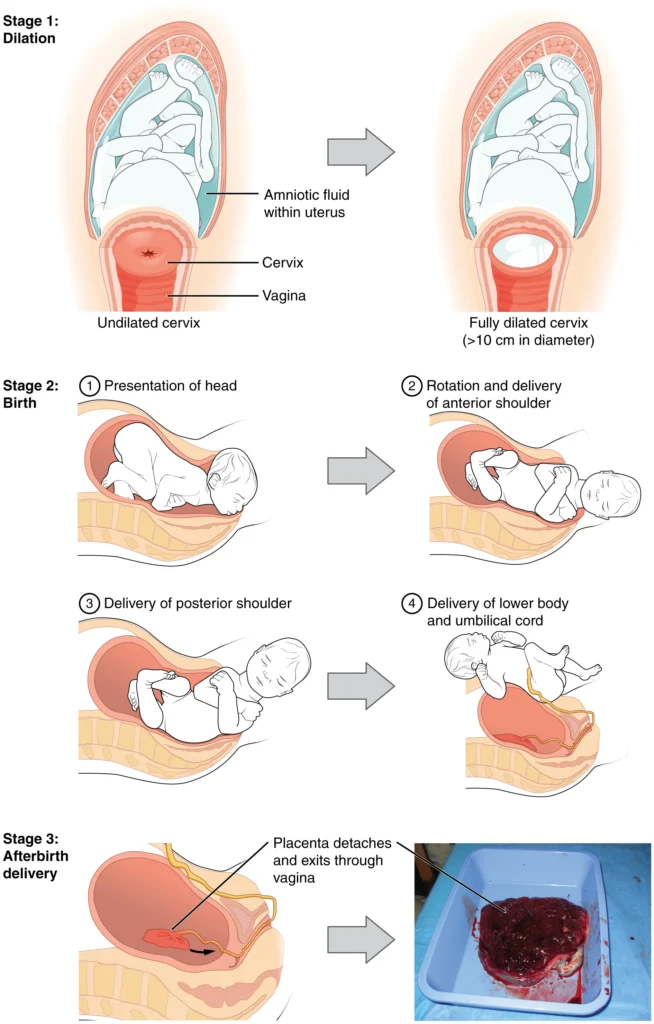
The First Stage of Labor
The first stage of labor is usually the longest stage.
Its primary purpose is to prepare the cervix for birth.
The cervix must open from completely closed to approximately 10 centimeters.
This stage is often divided into three phases:
- Early labor
- Active labor
- Transition
Early Labor
Early labor is often the most unpredictable phase.
For some women, it lasts several hours.
For others, it may continue for more than a day.
What Is Happening?
The cervix begins:
- Softening
- Thinning
- Opening gradually
Contractions start becoming more organized.
What Does It Feel Like?
Many women describe contractions as:
- Menstrual-like cramps
- Tightening sensations
- Lower back discomfort
- Waves of pressure
During early labor, contractions may still be irregular.
You might comfortably talk through them.
You may even wonder if labor has actually started.
A Physiotherapist’s Perspective
One of the biggest mistakes women make during early labor is using too much energy too soon.
Early labor is often a marathon, not a sprint.
Resting, eating, hydrating, and conserving energy can be extremely valuable.
Helpful Strategies
- Walking
- Gentle movement
- Warm showers
- Breathing exercises
- Relaxation techniques
These activities may help you stay comfortable while labor progresses naturally.
Active Labor
Active labor begins when the cervix is opening more rapidly.
This is often the point when women become confident that labor is truly underway. (Cleveland Clinic)
What Happens During Active Labor?
Contractions become:
- Stronger
- Longer
- More frequent
- More intense
The cervix continues opening toward full dilation.
What Does It Feel Like?
Most women find active labor requires significantly more focus.
Conversations become shorter.
Breathing techniques become more important.
Many women naturally begin concentrating inward.
Why Movement Matters
Research suggests that freedom of movement during labor may improve comfort and help women cope more effectively. (World Health Organization 2018)
Positions That May Help
- Standing
- Walking
- Leaning forward
- Sitting on a birth ball
- Hands-and-knees positions
- Side-lying positions
Different positions may feel helpful at different times.
There is no single perfect labor position.
Transition: The Most Intense Phase

Transition is the final part of the first stage of labor.
It occurs as the cervix approaches full dilation.
Although it is usually the shortest phase, many women describe it as the most intense.
Why Transition Feels Different
Contractions are often:
- Very strong
- Close together
- Demanding
Women may experience:
- Shaking
- Nausea
- Emotional overwhelm
- Self-doubt
- Increased pressure
An Important Reassurance
Many women reach a point where they think:
“I can’t do this anymore.”
Ironically, this often means transition is occurring and birth is getting closer.
A Physiotherapist’s Observation
When tension increases, breathing often changes.
Women may hold their breath or tighten their shoulders and jaw.
Relaxing the jaw, shoulders, and hands can sometimes help reduce unnecessary muscular tension throughout the body.
Did You Know?
Many women report feeling emotional, shaky, nauseous, or overwhelmed during the transition phase of labor. While these sensations can feel intense, they are often signs that the body is approaching full dilation and that birth may be getting closer.
The Second Stage of Labor
The second stage begins once the cervix reaches full dilation.
This is the stage many people imagine when they think about childbirth.
It is the pushing stage.
What Happens During This Stage?
The baby gradually moves through the birth canal.
The uterus continues contracting while the mother works with those contractions to assist the baby’s descent.
The Role Of The Pelvic Floor
One fascinating aspect of birth is how much the pelvic floor changes.
Throughout pregnancy, these muscles support the growing baby.
During birth, they must lengthen dramatically to allow the baby’s passage.
Research has shown significant stretching of pelvic floor structures during vaginal birth. (Ashton-Miller et al. 2009)
What Does Pushing Feel Like?
Many women describe an overwhelming urge to bear down.
Others require coaching and support.
Both experiences can be normal.
Is There A Perfect Way To Push?
Not necessarily.
Current approaches increasingly encourage women to follow their body’s natural urges rather than relying solely on prolonged breath-holding techniques.
Helpful Positions For Pushing
Different positions may support comfort and progress.
Examples include:
- Side-lying
- Squatting
- Hands-and-knees
- Upright positions
- Semi-reclined positions
The best position is often the one that feels most effective and comfortable for you.
The Third Stage Of Labor
Many women are surprised to learn that labor is not over when the baby is born.
There is still one more important step.
The delivery of the placenta.
What Is The Placenta?
The placenta is the temporary organ that supported your baby throughout pregnancy.
Once the baby is born, the placenta is no longer needed.
What Happens Next?
The uterus continues contracting.
These contractions help separate the placenta from the uterine wall.
The placenta is then delivered.
This stage is usually much shorter than the previous stages of labor.
Why Uterine Contractions Continue
After birth, contractions help:
- Reduce bleeding
- Support uterine recovery
- Begin the process of involution
Involution refers to the uterus gradually returning toward its pre-pregnancy size.
The Often Forgotten Fourth Stage
Many childbirth discussions focus on getting the baby out.
Yet one of the most important stages of labor occurs immediately afterward.
The first few hours after birth are sometimes called the fourth stage of labor.
What Happens During This Period?
The body begins adjusting rapidly.
Hormones shift.
The uterus continues contracting.
Breastfeeding may begin.
Bonding occurs.
Recovery starts.
Why This Stage Matters
The fourth stage is often physically and emotionally intense.
Women may feel:
- Joy
- Relief
- Exhaustion
- Excitement
- Vulnerability
All of these emotions can be normal.
A Physiotherapist’s Perspective On Labor
One misconception about labor is that success depends on being perfectly prepared.
In reality, labor is unpredictable.
What helps most is having tools rather than rigid expectations.
Focus On Breathing
Breathing will not eliminate labor pain.
However, it can:
- Reduce tension
- Improve focus
- Support relaxation
- Improve oxygen delivery
Keep Moving When Possible
Movement can:
- Improve comfort
- Encourage pelvic mobility
- Reduce stiffness
- Support labor progression
Conserve Energy
Labor can be physically demanding.
Rest when opportunities arise.
Eat and hydrate according to your healthcare team’s recommendations.
Trust Adaptability
Birth rarely follows a script.
The body is designed to adapt.
Flexibility often becomes one of the most valuable skills during labor.
When Should You Go To The Hospital?
This question depends on individual circumstances and your healthcare provider’s advice.
General reasons to contact your healthcare team include:
- Regular contractions
- Rupture of membranes (water breaking)
- Significant vaginal bleeding
- Reduced fetal movements
- Intense pain
- Concerns about labor progression
Always follow the recommendations provided by your healthcare provider.
Physiotherapist’s Advice
Labor is a physical event that benefits from movement, breathing awareness, and energy conservation. Walking, changing positions, using a birth ball, practicing relaxation techniques, and focusing on steady breathing may help improve comfort and support the body’s natural labor process.
Final Thoughts
Labor is one of the most remarkable processes the human body can perform.
Although it can feel unpredictable, each stage has a purpose.
Every contraction, every cervical change, and every adjustment within the pelvis is part of a coordinated effort to bring your baby into the world.
As a physiotherapist, I believe that knowledge can be incredibly empowering.
Understanding what your body is doing during labor does not remove every challenge, but it can replace uncertainty with confidence.
Rather than viewing labor as something that happens to you, it can be helpful to see it as something your body actively participates in.
Your body has been preparing for this journey throughout pregnancy.
Labor is simply the final chapter before meeting your baby.
Frequently Asked Questions About the Stages of Labor
How many stages of labor are there?
Labor is generally divided into four stages: the first stage (early labor, active labor, and transition), the second stage (birth of the baby), the third stage (delivery of the placenta), and the fourth stage (immediate postpartum recovery).
How long does labor usually last?
Labor duration varies significantly. First-time mothers often experience longer labor than women who have given birth before.
What is the most painful stage of labor?
Many women describe the transition phase as the most intense part of labor because contractions are often stronger and closer together.
When should I go to the hospital during labor?
Follow your healthcare provider’s recommendations. Generally, regular contractions, water breaking, significant bleeding, or concerns about fetal movement warrant contacting your healthcare team.
Can movement help labor progress?
Yes. Walking, changing positions, and staying mobile may improve comfort and support labor progression for some women.
What happens during the pushing stage?
The baby moves through the birth canal while the mother works with contractions to assist the baby’s descent and birth.
What happens after the baby is born?
The placenta is delivered, the uterus continues contracting, and the body begins the recovery process known as the fourth stage of labor.
Is every labor experience the same?
No. Labor experiences vary widely between women and even between different pregnancies for the same woman.
Stay tuned with us for more health related topics.
Follow us on LinkedIn and Instagram for more.
More Read





Medical Disclaimer!
This article has been reviewed and written under the guidance of our Head Physiotherapist, Dr. Kruti Raj (PT, MUHS,CPT,CMPT). The information shared is intended for educational purposes only and should not be considered a substitute for personalized medical advice, diagnosis, or treatment.
Please consult us or any other qualified healthcare professional before beginning any exercise program, especially if you are experiencing pain, recovering from injury, or managing a medical condition.