


Pregnancy changes the body quickly.
One week you feel energetic and normal, and the next week even turning in bed feels like work.
Many women expect the baby bump, cravings, and fatigue.
What they do not expect is the strange hip tightness, tailbone pain, pelvic pressure, or that heavy pulling feeling after standing for too long.
This is usually the stage where a birth ball becomes more than just a labor room accessory.
In physiotherapy clinics, birth balls are often recommended long before labor begins.
Not because they are trendy, but because they genuinely help many pregnant women move better, sit more comfortably.
It also helps reduce pressure on the spine and pelvis without aggressive exercise.
What surprises most women is that the biggest benefit is not “fitness.”
It is movement quality.
A lot of pregnancy discomfort happens because the body slowly becomes less mobile.
Hips stiffen. Rib movement reduces. Glute muscles weaken.
The lower back starts overworking.
Women who sit for long hours often develop pelvic tightness without realizing it.
A birth ball gently interrupts that pattern.
Instead of forcing the body into rigid exercise routines, it allows subtle movement.
Tiny shifts in posture. Controlled pelvic motion.
Better spinal unloading. Improved breathing mechanics.
And those small things matter more during pregnancy than most people realize.
Research over the last few years has also moved beyond simply calling birth balls “helpful during labor.”
Studies are now looking at pelvic biomechanics, maternal comfort, fatigue reduction, anxiety levels, and movement efficiency during pregnancy and childbirth.
(Lin et al. 2025) discussed how movement-based birth ball programs may improve maternal comfort, pelvic mobility, and labor support outcomes.
The important thing, though, is using the ball correctly.
A lot of online articles simply say:
“Sit and bounce.”
That is not physiotherapy.
Quick Answer
Birth ball exercises during pregnancy can help reduce lower back pain, improve pelvic mobility, ease stiffness, support posture, and prepare the body for labor naturally. Physiotherapists commonly recommend gentle movements like pelvic rocking, hip circles, figure 8 movements, and forward-lean stretches because they improve movement quality without placing excessive stress on the joints. The key is slow, controlled movement rather than aggressive bouncing.
Women in the second and third trimester often find birth ball exercises especially helpful for relieving pelvic pressure, reducing tailbone discomfort, and improving overall comfort during daily activities and labor preparation.
Some women actually worsen pelvic pain by bouncing aggressively or sitting with collapsed posture for long periods.
Others unknowingly tighten their pelvic floor muscles throughout pregnancy, which may contribute to discomfort later.
This guide is different.
Instead of generic exercises copied from pregnancy blogs, this article focuses on how physiotherapists actually use birth balls in real prenatal care.
Key Takeaways
- Birth ball exercises help improve pelvic mobility and reduce stiffness during pregnancy.
- Gentle pelvic rocking and hip circles are often more effective than aggressive bouncing.
- Many pregnant women experience less lower back pressure while sitting on a birth ball compared to a chair.
- Birth ball movements may support posture, circulation, breathing mechanics, and relaxation.
- Women with desk jobs often benefit from small mobility breaks using a birth ball.
- Over-tightening pelvic floor muscles during pregnancy can increase discomfort, and gentle movement may help reduce tension.
- Figure 8 pelvic movements are commonly recommended by physiotherapists during late pregnancy.
- Birth ball exercises should never cause sharp pain or worsening pelvic symptoms.
- The best results usually come from short daily sessions rather than intense workouts.
- Birth balls are commonly used during labor to improve comfort and encourage movement.
Why Birth Ball Exercises Feel So Good During Pregnancy
Most pregnant women are not looking for intense workouts.
They just want relief.
Relief while sitting. Relief while sleeping. Relief after walking.
Relief from that constant pressure in the lower back or pelvis.
A birth ball changes the mechanics of how the body holds weight.
When you sit on a chair, the pelvis becomes relatively fixed.
On a ball, the pelvis can move naturally in multiple directions.
This small difference changes how muscles around the spine, hips, and pelvic floor behave.
Many women instantly notice:
- less stiffness
- easier posture
- reduced tailbone pressure
- improved hip mobility
- less “heavy” feeling in the pelvis
The effect becomes even more noticeable during the third trimester.
Something Most Pregnancy Articles Rarely Mention
One of the biggest hidden issues during pregnancy is over-bracing.
Many women constantly tighten their stomach and pelvic muscles because they are trying to “support the bump” or protect themselves from discomfort.
But excessive gripping creates more tension.
In physiotherapy practice, this is common in women with:
- pelvic girdle pain
- tailbone pain
- urinary urgency
- painful turning in bed
- hip tightness
Gentle birth ball mobility can sometimes help these muscles relax instead of constantly guarding.
This matters because the pelvic floor is not supposed to stay tight all day.
It needs both support and relaxation.
(Physiopedia) discussed the importance of pelvic floor muscle coordination rather than constant tension.
Choosing the Right Birth Ball Actually Matters
A poorly sized ball can make posture worse.
Here is a simple guide physiotherapists commonly use:
| Height | Ball Size |
|---|---|
| Under 5’4” | 55 cm |
| 5’4” to 5’10” | 65 cm |
| Above 5’10” | 75 cm |
When sitting:
- feet should stay flat
- knees should be slightly lower than hips
- shoulders should remain relaxed
- the pelvis should not tuck excessively backward
If knees are higher than hips, the ball is usually too small.
The Best Birth Ball Exercises During Pregnancy
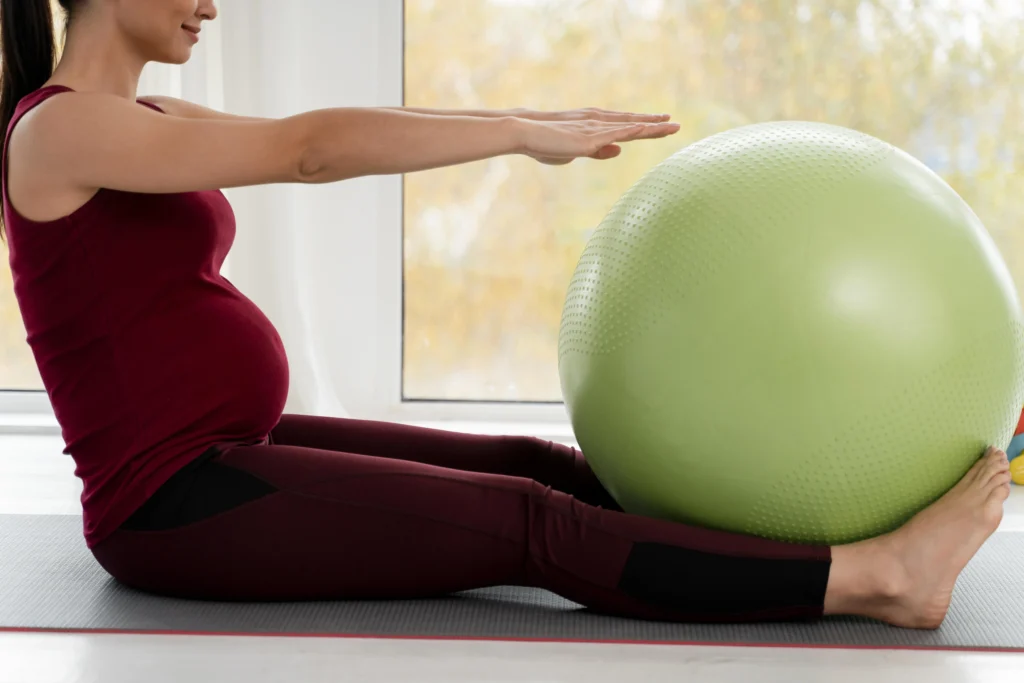
1. Pelvic Rocking
This is one of the simplest but most effective movements.
It looks easy.
But biomechanically, it helps reduce stiffness in the lumbar spine and pelvis.
How to Do It
- Sit comfortably on the ball
- Slowly tilt the pelvis forward
- Then gently rock backward
- Keep shoulders relaxed
- Breathe normally
Do not force large movements.
Small controlled motion works better.
Why Physiotherapists Like This Exercise
Women with desk jobs often develop a stiff lower back and tight hip flexors during pregnancy.
Pelvic rocking introduces movement without strain.
Many women also notice less pressure near the sacrum after a few minutes.
2. Hip Circles
This exercise is commonly recommended during labor, but it is equally useful during pregnancy.
How to Do It
- Sit tall on the ball
- Slowly move hips in a circular motion
- Change direction after several repetitions
The movement should feel smooth, not rushed.
What Most Women Notice
Hip circles often reduce that “stuck” feeling in the pelvis after prolonged sitting.
Women in the third trimester sometimes describe immediate relief around the tailbone area.
3. Figure 8 Pelvic Movement
This is less commonly discussed online, but physiotherapists use it often because it encourages multidirectional pelvic mobility.
How to Do It
Imagine drawing the number 8 with your hips while sitting on the ball.
Move slowly.
The goal is fluidity, not speed.
Why It Helps
Pregnancy gradually reduces rotational movement in the pelvis.
Figure 8 motion helps restore some of that natural mobility.
This can feel especially relieving late in pregnancy.
4. Supported Wall Squats With a Birth Ball
This is one of the few strengthening exercises many pregnant women tolerate well.
How to Do It
- Place the ball between your lower back and the wall
- Slowly squat halfway down
- Return gently
Keep knees aligned with toes.
Why This Exercise Is Useful
Weak glutes during pregnancy often increase strain on the lower back and pelvis.
Wall-supported squats help strengthen:
- glutes
- thighs
- pelvic stabilizers
without excessive pressure.
5. Forward Lean Stretch
Many women naturally move into this position during labor because it feels relieving.
How to Do It
- Kneel on a soft mat
- Hug the birth ball
- Lean forward comfortably
Take slow breaths.
What This Position Does
This reduces spinal compression and often relaxes the lower back muscles.
Women with late-pregnancy back tension usually love this stretch.
6. Side-to-Side Pelvic Shift
This movement looks basic but can reveal asymmetry.
How to Do It
- Sit upright
- Slowly shift weight from one side to the other
Notice if one side feels tighter.
Why This Matters
Many pregnant women unconsciously load one side more heavily.
This becomes common with:
- carrying toddlers
- standing unevenly
- sitting cross-legged repeatedly
- sleeping mostly on one side
Small side shifts can improve awareness and mobility.
7. Gentle Bouncing
This is the most overused birth ball movement online.
And honestly, it is not always the best one.
Gentle rhythmic bouncing can feel calming for some women, especially late in pregnancy.
But excessive bouncing may irritate:
- pelvic girdle pain
- pubic symphysis discomfort
- tailbone sensitivity
Small relaxed motion is enough.
More is not better.
What Research Actually Says About Birth Balls
A lot of internet advice exaggerates claims.
Birth balls are helpful, but they are not magic.
The evidence is strongest for:
- reducing labor discomfort
- improving maternal comfort
- encouraging movement
- reducing anxiety
- improving pelvic mobility
(Sujata Jha and her team mates et al. 2023) found that birth ball exercises during labor reduced pain intensity and improved maternal satisfaction.
A review in Midwifery also noted that upright movement and pelvic mobility during labor may improve comfort and labor progression. (PubMed)
Another interesting area of research is maternal fatigue.
Women who remain static for long periods during pregnancy often report more discomfort than women who perform gentle mobility-based activity throughout the day.
That does not mean intense workouts are necessary.
Sometimes small movement done consistently works better.
A Physiotherapist’s Observation Most Women Relate To
Women often say:
“I feel worse after resting too much.”
That is actually common.
During pregnancy, prolonged immobility can increase:
- stiffness
- swelling
- pelvic pressure
- back tightness
Gentle movement usually helps circulation and joint comfort.
This is why many women feel surprisingly better after sitting on a birth ball for 10 minutes instead of lying down all evening.
When Birth Ball Exercises May Not Feel Good
Not every exercise suits every pregnancy.
Some women feel worse with:
- wide hip opening
- deep squats
- aggressive bouncing
- prolonged sitting on the ball
This happens especially in women with:
- pubic symphysis pain
- hypermobility
- severe pelvic girdle pain
- sacroiliac irritation
Pain is not something to “push through.”
If an exercise increases discomfort, modify it or stop.
Third Trimester Tips That Actually Help
By the third trimester, most women are not looking for workouts. They want positions that reduce pressure.
These usually help:
- leaning forward onto the ball
- hip circles before bed
- sitting on the ball while watching TV
- pelvic rocking after long car rides
- gentle figure 8 movement before sleep
A surprising number of women say the ball becomes their “favorite chair” late in pregnancy.
What About Using the Birth Ball During Labor?
Many labor wards now encourage movement instead of prolonged bed rest.
A birth ball may help during:
- early contractions
- back labor
- resting between contractions
- breathing exercises
- upright positioning
Some women naturally find their own rhythm:
- swaying
- rocking
- leaning
- circling hips
The body often prefers movement during labor.
That instinct is normal.
Small Safety Tips That Matter
Use the ball on a non-slippery floor.
Do not suddenly sit down heavily.
Wear comfortable clothing.
Keep feet apart for balance.
If getting off the ball feels difficult, place it near a stable surface.
And probably the most important tip:
do not copy advanced social media pregnancy workouts.
Many online routines are too aggressive for average pregnant women.
The Emotional Side Nobody Talks About Enough
Pregnancy discomfort is not only physical.
When the body feels stiff or heavy all day, stress levels rise too.
Many women describe birth ball exercises as calming rather than “exercise.”
That makes sense physiologically.
Rhythmic movement can reduce nervous system tension and improve breathing patterns.
Some women even use gentle pelvic rocking while practicing labor breathing techniques in the final weeks.
Final Thoughts
The best birth ball exercises during pregnancy are usually the simplest ones.
Not intense routines.
Not complicated workouts.
Just gentle, regular movement that helps the body feel less restricted.
That is the real value of a birth ball.
From a physiotherapy perspective, the goal is not to train harder during pregnancy.
It is to help the body adapt more comfortably to rapid physical change.
And honestly, many women do not need more exercise pressure during pregnancy.
They need:
- less stiffness
- less tension
- better movement
- better breathing
- more comfort
A birth ball can support all of those things when used correctly.
Frequently Asked Questions
1. Are birth ball exercises safe during pregnancy?
Yes, birth ball exercises are generally safe for most pregnant women when done with proper posture and controlled movement. Women with high-risk pregnancies should consult their doctor or physiotherapist first.
2. Which birth ball exercise helps most with back pain?
Pelvic rocking, hip circles, and forward-lean stretches are commonly recommended for pregnancy-related lower back tension and stiffness.
3. Can birth ball exercises help prepare the body for labor?
Yes, gentle pelvic mobility exercises may help improve comfort, movement, posture, and relaxation during labor preparation.
4. Is bouncing on a birth ball safe in the third trimester?
Gentle bouncing is usually safe for many women, but excessive bouncing may worsen pelvic discomfort or pubic pain.
5. How long should I sit on a birth ball during pregnancy?
Most women comfortably use a birth ball for 10 to 30 minutes at a time with good posture and proper support.
6. Can birth ball exercises reduce pelvic pressure?
Many pregnant women report reduced pelvic heaviness and improved comfort after gentle mobility exercises on a birth ball.
7. What size birth ball should I buy during pregnancy?
The correct size depends on height. Most women use either a 55 cm, 65 cm, or 75 cm anti-burst birth ball.
8. Can I use a birth ball every day during pregnancy?
Yes, many physiotherapists recommend short daily sessions to improve movement, posture, and overall comfort during pregnancy.
Stay tuned with us for more health related topics.
Follow us on LinkedIn and Instagram for more.
More Read


Medical Disclaimer!
This article has been reviewed and written under the guidance of our Head Physiotherapist, Dr. Kruti Raj (PT, MUHS,CPT,CMPT). The information shared is intended for educational purposes only and should not be considered a substitute for personalized medical advice, diagnosis, or treatment.
Please consult us or any other qualified healthcare professional before beginning any exercise program, especially if you are experiencing pain, recovering from injury, or managing a medical condition.


