


Can You Push a Disc Back Into Place, or is that just a common myth?
Back pain can make even simple activities feel overwhelming.
Whether you are struggling to get out of bed, bend to tie your shoes, or sit comfortably at work, it is natural to search for a quick fix.
One of the most common questions patients ask me in the clinic is:
“Can you push a slipped disc back into place?”
It sounds logical.
If something has “slipped,” shouldn’t it simply be pushed back where it belongs?
The answer is much more interesting than that.
As a physiotherapist, I often explain that the phrase “slipped disc” is actually misleading.
Your spinal discs rarely slip out like a bar of soap.
Instead, they may bulge, tear, or allow some of their inner gel-like material to protrude outward.
Understanding this difference completely changes how we approach treatment.
Quick Answer
No, you cannot physically push a slipped or herniated disc back into place. Modern research shows that a herniated disc heals through the body’s natural healing processes rather than being manually pushed back. Physiotherapy, proper exercise, posture correction, and staying active help reduce pain, improve movement, and support recovery. Many people recover without surgery, although severe cases may require specialist treatment.
Fortunately, modern medical research has brought good news.
Most people with a herniated disc recover successfully without surgery through a combination of education, movement, physiotherapy, and the body’s remarkable ability to heal itself.
The goal is not to “push the disc back” but to create the right environment for natural recovery while reducing pain and restoring normal movement. (Spine And Brain India)
Key Takeaways
- You cannot manually push a disc back into place.
- Most herniated discs gradually shrink through natural healing.
- Physiotherapy helps reduce pain and improve spinal function.
- Movement is usually better than prolonged bed rest.
- Many people recover without surgery within several weeks to months.
- Healthy lifestyle habits significantly improve long-term spine health.
Understanding What a Disc Really Is
Before answering whether a disc can be pushed back into place, it helps to understand how spinal discs work.
Think of each spinal disc as a natural shock absorber sitting between two vertebrae.
Every time you walk, lift something, twist, or even cough, these discs distribute forces evenly throughout your spine.
Each disc contains two important parts:
The Outer Ring
The outer portion, called the annulus fibrosus, is made of strong layers of collagen fibres arranged like the plies of a car tyre.
These fibres provide stability while allowing the spine to bend and rotate.
The Inner Core
Inside lies the nucleus pulposus, a soft, gel-like centre containing large amounts of water and proteoglycans.
This inner material behaves like a hydraulic cushion, helping absorb pressure throughout the day.
Together, these structures allow the spine to remain both flexible and remarkably strong. (Standring S. Gray’s Anatomy; Adams MA, Roughley PJ. Spine.)
What Does “Slipped Disc” Actually Mean?
One of the biggest misconceptions in healthcare is the term slipped disc.
The disc itself almost never slips completely out of position.
Instead, one of several things may happen:
- The outer ring weakens.
- Tiny cracks develop.
- The inner gel pushes outward.
- The disc bulges.
- Part of the gel escapes through a tear.
Doctors may describe these as:
- Disc bulge
- Disc protrusion
- Disc extrusion
- Disc sequestration
Each represents a different stage of disc injury rather than the disc physically sliding out of place. (Neuro Biocenter)
Can You Actually Push a Disc Back Into Place?
The short answer is no.
No massage.
No chiropractic adjustment.
No exercise.
No stretching.
No spinal manipulation.
None of these physically push the disc material back inside the disc.
This surprises many people because they often feel immediate relief after treatment.
However, pain relief does not necessarily mean the disc has moved back.
Instead, several other beneficial changes occur:
- Muscle guarding decreases.
- Joint stiffness improves.
- Pressure on irritated nerves may reduce.
- Blood circulation improves.
- The nervous system becomes less sensitive.
- Inflammation gradually settles.
These effects can dramatically reduce symptoms even though the disc itself has not been mechanically repositioned.
Why Do Some People Feel Better Immediately After Treatment?
This is one of the lesser-known facts about back pain.
Pain is influenced by far more than the position of a disc.
Modern neuroscience shows that pain depends on many factors, including:
- Inflammation
- Muscle tension
- Joint movement
- Nerve sensitivity
- Stress
- Sleep quality
- Fear of movement
- Brain interpretation of pain signals
A skilled physiotherapy session may improve several of these factors within minutes, making patients believe their disc has “gone back into place.”
In reality, your nervous system has simply become calmer, allowing muscles to relax and movement to improve.
The Amazing Way Your Body Repairs a Herniated Disc
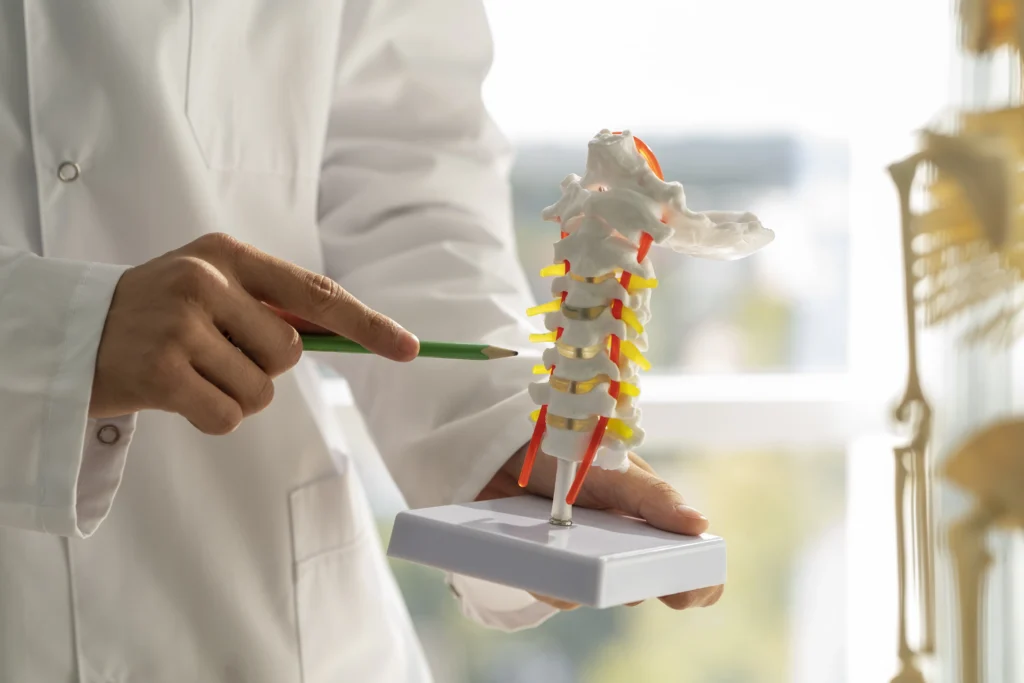
One of the most fascinating discoveries in spinal research is that the body can actually remove part of the herniated disc naturally.
This process is called spontaneous disc resorption.
Rather than pushing the disc back inside, your immune system identifies the protruding disc material as abnormal and begins breaking it down.
Several biological processes happen:
Inflammation Starts the Healing Process
Although inflammation often gets a bad reputation, it plays an essential role in healing.
Special immune cells called macrophages travel to the damaged area and begin clearing away disc fragments.
New Blood Vessels Grow
Normally, spinal discs have very little blood supply.
However, after a herniation, tiny new blood vessels develop around the injured tissue, allowing healing cells to reach the damaged area more effectively.
The Herniation Gradually Shrinks
Over weeks and months, the protruding disc material often becomes significantly smaller.
MRI studies have repeatedly shown that many large disc herniations partially or completely disappear without surgery,
explaining why patients often improve even though no one physically “pushed” the disc back. (PubMed)
Lesser-Known Fact: Bigger Herniations Sometimes Heal Faster
This finding surprises even many healthcare professionals.
Research has found that larger disc extrusions and sequestrations often have a greater chance of shrinking naturally than small bulging discs.
Why?
Because the immune system can recognize the exposed disc material more easily, triggering a stronger healing response.
Ironically, some of the most frightening-looking MRI scans may have an excellent long-term prognosis with conservative treatment.
This is one reason physiotherapists always treat the patient, not just the MRI image.
A scan that looks severe does not always mean the outcome will be poor.
How Physiotherapy Helps If the Disc Cannot Be Pushed Back
One of the biggest misunderstandings I hear is:
“If the disc cannot be pushed back into place, then what exactly does physiotherapy do?”
The answer is that physiotherapy focuses on helping your body recover naturally while reducing the mechanical stress placed on the injured disc.
Instead of trying to force the disc into position, we improve how your entire spine moves, strengthen the muscles that support it, reduce nerve irritation, and gradually restore your confidence in movement.
Modern clinical guidelines consistently recommend physiotherapy as one of the first-line treatments for lumbar disc herniation because;
it addresses both the symptoms and the factors that contributed to the injury in the first place.
Conservative care is successful for the majority of patients, especially when started early and followed consistently.
What Happens During Physiotherapy?
Every patient is different.
There is no single exercise or treatment that works for everyone because disc injuries vary in size, location, symptoms, and healing stage.
A physiotherapist first performs a detailed assessment to understand:
- Which movements increase your pain
- Whether the pain is coming from the disc, joints, muscles, or nerves
- If the symptoms travel into the leg (sciatica)
- Muscle strength and flexibility
- Walking pattern and posture
- Work-related and lifestyle factors
This assessment helps create an individualized treatment plan rather than relying on generic exercises found online.
Research shows that personalized rehabilitation tends to produce better outcomes than one-size-fits-all exercise programs. (JOSPT)
Pain Relief Techniques
During the early stages, the goal is to calm the irritated tissues rather than aggressively strengthening the spine.
Depending on your symptoms, treatment may include:
- Gentle spinal mobilization
- Soft tissue release
- Nerve gliding exercises
- Heat or cold therapy when appropriate
- Postural correction
- Movement education
These techniques help reduce muscle guarding and improve movement without forcing the injured disc into any particular position.
Evidence suggests that maintaining gentle movement is generally more beneficial than prolonged immobilization.
Progressive Exercise Therapy
As pain settles, exercise becomes the most important part of recovery.
A rehabilitation program may gradually include:
- Core stabilization exercises
- Lumbar mobility exercises
- Hip strengthening
- Gluteal strengthening
- Walking programs
- Balance training
- Functional lifting practice
The goal is not simply to strengthen the back but to improve how the entire body shares load during everyday activities.
Research consistently shows that regular therapeutic exercise improves pain, disability, and quality of life in people with chronic and recurrent low back pain. (NCBI)
Can Exercises Push the Disc Back?
This is another common myth.
Exercises do not physically reposition the disc.
Instead, they help by:
- Improving spinal stability
- Reducing repeated stress on injured tissues
- Improving circulation around muscles
- Restoring normal movement patterns
- Reducing stiffness
- Helping nerves move more freely
- Preventing future episodes
Some patients experience a phenomenon called centralization, where leg pain gradually moves back toward the lower back during certain exercises.
This often indicates that symptoms are improving, but it should not be interpreted as the disc literally moving back into place.
Can Massage Push a Disc Back?
No.
Massage works on muscles, fascia, and soft tissues, not the disc itself.
However, massage may still provide meaningful benefits by:
- Relaxing tight muscles
- Reducing muscle spasms
- Improving circulation
- Decreasing stress
- Making movement more comfortable
For many people, muscle tension contributes significantly to pain, so reducing that tension can make daily activities easier.
The improvement comes from the surrounding tissues rather than the disc being repositioned.
Can Chiropractic Adjustments Push a Disc Back?
Many people report feeling better after spinal manipulation,
but current evidence does not support the claim that chiropractic adjustments physically push a herniated disc back into place.
Spinal manipulation may temporarily:
- Improve joint mobility
- Reduce muscle stiffness
- Decrease pain perception
- Improve movement confidence
However, imaging studies have not demonstrated that these treatments mechanically reposition herniated disc material.
Patients with severe neurological symptoms, worsening weakness, or signs of spinal cord or cauda equina compression should avoid delaying medical evaluation in favor of repeated manipulation.
How Long Does a Herniated Disc Take to Heal?
Recovery varies widely depending on:
- Size of the herniation
- Overall health
- Smoking status
- Physical activity
- Occupation
- Age
- Adherence to rehabilitation
A general timeline is:
| Time | What Usually Happens |
|---|---|
| First 2 weeks | Pain and inflammation are often at their highest. |
| 2 to 6 weeks | Many people notice steady improvement with conservative treatment. |
| 6 to 12 weeks | Daily activities become easier, and pain often decreases significantly. |
| 3 to 12 months | Disc resorption and tissue remodeling continue, with many patients achieving substantial recovery. |
MRI changes often lag behind symptom improvement, meaning you may feel much better even if imaging still shows a disc bulge. (Chiu CC et al. PMC)
Lesser-Known Fact: Your MRI May Look Worse Than You Feel
One of the most eye-opening findings in spinal research is that many people with no back pain at all have bulging or herniated discs visible on MRI.
Large imaging studies have found that age-related disc changes are extremely common, even in healthy individuals without symptoms.
This means:
- A disc bulge does not automatically cause pain.
- MRI findings should always be interpreted alongside your symptoms and physical examination.
- Treating the MRI instead of the patient can lead to unnecessary anxiety and interventions.
This is why physiotherapists focus on your functional abilities, movement patterns, and overall presentation rather than relying solely on imaging reports. (Brinjikji W et al. American Journal of Neuroradiology: NCBI)
Things You Should Do During Recovery
Recovering from a herniated disc is about making consistent, evidence-based choices rather than searching for a miracle cure.
Stay Active
Complete bed rest is no longer recommended for most people.
Gentle movement helps maintain circulation, reduces stiffness, and supports recovery.
Walk Every Day
Walking is one of the safest and most effective exercises for many people with disc-related back pain.
Start with short distances and gradually increase as tolerated.
Learn Proper Lifting Technique
When lifting:
- Keep the object close to your body.
- Bend at your hips and knees.
- Avoid twisting while carrying weight.
- Tighten your core before lifting.
These strategies reduce unnecessary stress on the lumbar spine.
Sleep in Comfortable Positions
Many people find relief by:
- Sleeping on their side with a pillow between the knees.
- Sleeping on their back with a pillow under the knees.
These positions may reduce strain on the lower back during sleep.
Follow Your Exercise Program Consistently
Consistency is far more important than intensity.
Doing your prescribed exercises for 15-20 minutes most days is generally more effective than performing strenuous workouts once a week.
Things You Should Avoid
Certain habits can delay recovery or increase stress on the healing disc.
Avoid Prolonged Sitting
Sitting for long periods increases pressure within the lumbar discs.
Try to stand, stretch, or walk for a few minutes every 30–45 minutes.
Avoid Heavy Lifting Too Soon
Returning to intense lifting before tissues have healed can aggravate symptoms and delay recovery.
Progress gradually under professional guidance.
Avoid Smoking
Smoking reduces blood flow, slows tissue healing, and has been strongly associated with disc degeneration and persistent back pain.
Stopping smoking is one of the best long-term investments you can make for your spine.
Avoid Fear of Movement
Many patients become afraid to bend, twist, or exercise because they worry they will “push the disc out further.”
In reality, avoiding all movement often weakens muscles, increases stiffness, and prolongs disability.
Gradual, guided movement is usually much safer than complete inactivity.
Can a Herniated Disc Be Prevented?
Not every disc injury is preventable, but healthy habits can significantly reduce your risk.
Maintain Strong Core Muscles
Strong abdominal, back, and hip muscles help distribute forces more evenly across the spine.
Keep a Healthy Body Weight
Excess body weight increases the mechanical load placed on spinal structures over time.
Stay Physically Active
Regular exercise improves spinal flexibility, muscle endurance, and overall function while lowering the risk of recurrent back pain.
Improve Workplace Ergonomics
Simple adjustments can make a big difference:
- Keep your computer screen at eye level.
- Use a chair with lumbar support.
- Position your feet flat on the floor.
- Avoid prolonged static postures.
Lift Smart, Not Hard
Many disc injuries occur during repetitive lifting rather than one dramatic event.
Learning safe movement patterns early can protect your spine for years.
Lesser-Known Tip: Hydration Matters More Than Most People Think
Although drinking extra water will not “reinflate” a damaged disc, maintaining good hydration supports the health of the body’s connective tissues and overall physical function.
Combined with regular movement, adequate hydration may help maintain tissue elasticity and encourage healthier movement habits throughout the day.
While spinal discs naturally lose water with age, overall healthy lifestyle practices remain an important part of long-term spine care.
When Is Surgery Needed?
One of the biggest fears people have after being diagnosed with a herniated disc is that surgery is inevitable.
Fortunately, that is not true for most people.
Research consistently shows that 80-90% of people with lumbar disc herniation improve with conservative treatment, including physiotherapy, activity modification, pain management, and time.
Surgery is usually reserved for a relatively small group of patients whose symptoms are severe, progressive, or do not improve after adequate non-surgical treatment.
Your doctor may recommend surgery if you have:
- Progressive muscle weakness
- Severe, disabling leg pain that does not improve after several weeks
- Loss of bowel or bladder control
- Numbness around the groin or saddle area
- Evidence of cauda equina syndrome (a medical emergency)
The most common procedure is a microdiscectomy, in which the surgeon removes the portion of the disc pressing on the nerve while preserving as much of the healthy disc as possible.
This is very different from “putting the disc back into place.”
Red Flag Symptoms You Should Never Ignore
While most cases of back pain improve with conservative care, some symptoms require immediate medical attention.
Seek urgent medical care if you experience:
- Sudden loss of bladder or bowel control
- Numbness around the inner thighs or buttocks
- Rapidly worsening weakness in one or both legs
- Difficulty walking because the leg gives way
- Severe back pain following major trauma
- Fever, chills, unexplained weight loss, or a history of cancer with new back pain
These symptoms may indicate conditions that require emergency assessment rather than routine physiotherapy.
Lesser-Known Facts Most People Don’t Know
Your Disc Has Very Little Blood Supply
Unlike muscles, spinal discs receive very little direct blood flow.
They obtain nutrients mainly through diffusion from nearby vertebral endplates.
This partly explains why disc healing is slower than muscle healing and why regular movement is so important to encourage nutrient exchange.
Morning Discs Are Slightly Bigger
During sleep, spinal discs absorb fluid and become slightly more hydrated.
As a result:
- You are usually 1-2 cm taller in the morning.
- Discs are under greater internal pressure shortly after waking.
- Heavy lifting immediately after getting out of bed may place additional stress on the discs.
This is one reason many physiotherapists recommend avoiding heavy lifting or intense spinal flexion during the first hour after waking, especially if you have a history of disc problems.
Pain Does Not Always Match MRI Severity
Some people have a very large disc herniation with only mild discomfort.
Others have severe pain despite relatively small imaging findings.
Pain is influenced by many factors, including:
- Inflammation
- Nerve sensitivity
- Muscle guarding
- Sleep quality
- Stress
- Previous pain experiences
This is why treatment should always focus on the whole person, not just the MRI report.
Sitting Isn’t Always the Enemy
Many people are told, “Never sit if you have a slipped disc.”
The truth is more nuanced.
Prolonged sitting without movement can aggravate symptoms, but sitting itself is not harmful.
The key is to:
- Change positions regularly.
- Stand and stretch every 30-45 minutes.
- Maintain good lumbar support.
- Avoid slouched postures for long periods.
Movement variety matters more than maintaining one “perfect” posture all day.
Common Myths vs Reality
| Myth | Reality |
|---|---|
| A slipped disc can be pushed back manually. | No treatment can physically push the disc back into place. |
| Surgery is always necessary. | Most people recover successfully without surgery. |
| Complete bed rest speeds healing. | Gentle movement generally leads to better recovery than prolonged bed rest. |
| Pain always means more damage. | Pain often reflects inflammation and nerve sensitivity, not ongoing tissue injury. |
| Once you have a herniated disc, you’ll always have back pain. | Many people return to full, active, pain-free lives after appropriate rehabilitation. |
| MRI findings always explain pain. | Imaging findings do not always correlate with symptoms. |
My Clinical Insight
As a physiotherapist, one of the most reassuring conversations I have with patients is explaining that a herniated disc is not a life sentence.
Many people arrive at the clinic believing their spine is permanently damaged or that they must avoid bending, exercising, or lifting forever.
These fears often create more disability than the disc injury itself.
What I’ve consistently observed is that patients recover best when they:
- Understand what is actually happening inside their spine.
- Stay active instead of avoiding movement.
- Follow a structured rehabilitation program.
- Build confidence gradually.
- Focus on improving function rather than chasing a pain-free MRI.
Healing rarely happens overnight.
Instead, it is the result of hundreds of small, consistent decisions made every day.
Physio Prescription
If I could prescribe just a few habits for someone recovering from a herniated disc, they would be:
- Walk every day, even if only for 10-15 minutes initially.
- Perform your prescribed physiotherapy exercises consistently.
- Change your sitting position frequently.
- Strengthen your core, hips, and gluteal muscles.
- Sleep well and prioritize recovery.
- Manage stress, as chronic stress can amplify pain perception.
- Maintain a healthy body weight.
- Stop smoking if applicable.
- Stay patient. Healing takes time, but progress is usually gradual and meaningful.
Final Thoughts
So, can you push a disc back into place?
The answer is no.
A herniated or bulging disc cannot be manually pushed back through massage, stretching, spinal manipulation, or exercise.
The encouraging news is that it usually doesn’t need to be.
Your body has an extraordinary ability to heal itself.
Through a process called spontaneous disc resorption, the protruding disc material often shrinks naturally over time.
Combined with evidence-based physiotherapy, regular movement, posture education, strengthening exercises, and healthy lifestyle habits, most people experience significant improvement without surgery.
Rather than searching for someone to “put the disc back,” focus on helping your body recover the way nature intended.
Recovery is not about finding a magic adjustment.
It is about understanding your spine, trusting the healing process, and giving your body the right conditions to heal.
Frequently Asked Questions
Can you push a disc back into place?
No. A herniated disc cannot be physically pushed back through massage, stretching, chiropractic adjustments, or exercise. Recovery occurs through the body’s natural healing process.
Can a herniated disc heal without surgery?
Yes. Most people recover successfully with physiotherapy, exercise, activity modification, and time without requiring surgery.
Can walking make a slipped disc worse?
For most people, gentle walking is beneficial and helps reduce stiffness while improving circulation and function.
How long does recovery usually take?
Many patients improve within 6 to 12 weeks, although complete healing may continue for several months.
When should I see a doctor immediately?
Seek emergency care if you experience bowel or bladder problems, severe leg weakness, saddle numbness, or rapidly worsening neurological symptoms.
Stay tuned with us for more health related topics.
Follow us on LinkedIn and Instagram for more.
More Read


Medical Disclaimer!
This article has been reviewed and written under the guidance of our Head Physiotherapist, Dr. Kruti Raj (PT, MUHS,CPT,CMPT). The information shared is intended for educational purposes only and should not be considered a substitute for personalized medical advice, diagnosis, or treatment.
Please consult us or any other qualified healthcare professional before beginning any exercise program, especially if you are experiencing pain, recovering from injury, or managing a medical condition.


