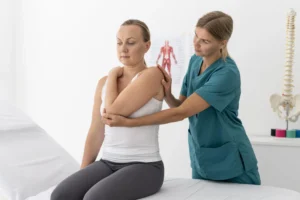
A woman may notice breast pain while pressing the area, wearing a tight bra, lying on her stomach, or simply checking a spot that feels tender.
That tenderness can be unsettling, especially when it feels like the pain is coming directly from the breast.
Quick Answer
Yes, breast pain that occurs when pressing the area can sometimes come from the chest wall rather than the breast tissue itself. Muscles, ribs, cartilage, joints, and connective tissues underneath or around the breast can become tender. However, persistent or unexplained breast pain should be assessed by a healthcare professional, especially if other breast changes are present.
But sometimes, the breast is not the actual source of the pain.
The ribs, chest muscles, connective tissues, and cartilage underneath and around the breast can also become tender to touch.
This is often described as chest wall pain, and understanding where the tenderness comes from can make the symptom less confusing.
Key Takeaways
What Does Pain With Pressure Mean?
Breast pain that appears on pressing a particular area is sometimes called tenderness.
Tenderness can occur when muscles, joints, cartilage, or other tissues become irritated.
The chest wall lies directly beneath and around the breast, so pain from these structures can feel very similar to breast pain.
For example, pressing over an irritated rib or muscle may reproduce the same discomfort that you initially thought was coming from the breast.
Musculoskeletal chest wall pain can be associated with physical activity, movement, pressure, or irritation of structures around the ribs and chest (Cambridge University Hospitals)
However, tenderness alone cannot tell you exactly what is causing the pain.
A proper assessment becomes more important when the pain persists or is accompanied by other breast changes.
The Chest Wall Beneath the Breast
The breast sits over the chest wall.
Underneath it are muscles, ribs, connective tissue, nerves, and other structures.
The pectoral muscles form an important part of this underlying region.
The ribs also move constantly as you breathe.
Because these structures are so close to the breast, irritation in the chest wall can sometimes be perceived as pain within the breast itself.
This is particularly common when the painful area can be reproduced by pressing, stretching, or moving the upper body.
Could It Be a Chest Muscle?
The chest muscles can become sore after activities that place repeated stress on them.
This may happen after strength training, swimming, pushing heavy objects, carrying a child, or suddenly increasing upper-body exercise.
A person may notice tenderness when pressing over the chest.
Moving the arm across the body or reaching overhead may reproduce the same discomfort.
The pain may also extend toward the shoulder or armpit.
Chest wall problems can occur in physically active people because repetitive or strenuous activity may place increased stress on the muscles and surrounding structures (Gregory et al., 2002).
The important clue is often the relationship between the pain and movement.
If the discomfort changes when the shoulder, arm, or upper body moves, the chest wall may be contributing to the symptoms.
Intercostal Muscle Irritation
The intercostal muscles sit between the ribs.
They help the rib cage move during breathing.
A sudden twist, heavy lifting, coughing, or demanding workout can irritate these muscles.
The resulting pain may be felt along the side of the chest or underneath the breast.
Pressing between the ribs may reproduce the tenderness.
Taking a deep breath, twisting, or reaching can sometimes make it more noticeable as well.
A mild muscle strain may settle with appropriate activity modification and gradual return to normal movement.
Costochondritis Can Cause Tenderness
Costochondritis involves irritation around the cartilage connecting the ribs to the breastbone.
It commonly causes pain and tenderness toward the front of the chest.
The discomfort can sometimes be felt around the breast area.
Pressing over the affected region may reproduce the breast pain.
Deep breathing, coughing, sneezing, or certain movements may also make the symptoms worse.
Costochondritis is usually diagnosed through the clinical history and physical examination while other causes of chest pain are considered (Mott et al., 2021).
This is why simply finding a tender spot does not automatically mean that someone has costochondritis.
The location and pattern of the symptoms matter.
Rib Joint Pain Can Feel Similar
The ribs connect to the spine through small joints at the back.
These joints contribute to the movement of the rib cage.
If the upper back or rib joints become stiff or irritated, discomfort can sometimes travel around the side of the chest.
A person may then notice tenderness near the bra line or underneath the breast.
The pain may change when twisting, reaching, sitting for a long time, or taking a deeper breath.
This is one reason a physiotherapist may assess the upper back and rib cage when someone reports breast-area pain.
Why Does Pressing Make It Hurt?

When you press a painful area, you apply mechanical pressure to the underlying tissues.
If those tissues are already sensitive, the pressure can reproduce the symptoms.
This can happen with irritated muscles, joints, cartilage, or connective tissues.
However, pain with pressure does not automatically prove that the problem is muscular.
Some conditions can coexist, and some breast-related problems may also cause tenderness.
That is why the complete symptom pattern matters more than one isolated feature.
Can Your Bra Cause Chest Wall Tenderness?
A poorly fitting or very tight bra can increase pressure on the tissues around the chest.
This may be particularly noticeable after wearing it for several hours.
The discomfort can sometimes appear along the lower breast, sides of the chest, or around the rib cage.
Underwire pressure may also irritate an already sensitive area.
This does not necessarily mean the bra caused an underlying injury.
It may simply make an existing area of sensitivity more noticeable.
Changing to a comfortable, well-fitting bra and avoiding prolonged pressure can sometimes help identify whether external compression is contributing to the discomfort.
What Does a Physiotherapist Look For?
A physiotherapist will usually start by asking how the pain began.
They may ask about exercise, lifting, coughing, posture, work activities, or a recent change in routine.
They may also ask whether pressing the area, moving the arm, twisting the body, or breathing changes the symptoms.
During the examination, the therapist may assess the chest wall, shoulder, upper back, and rib movement.
They may gently check for tenderness and observe whether particular movements reproduce the pain.
The goal is to understand how the different structures around the chest are contributing to the symptoms.
How Is Chest Wall Pain Treated?
Treatment depends on the underlying cause.
If the pain appears to be related to muscle overload, temporarily reducing the activity that triggered it may help.
This does not mean avoiding all movement.
Gentle movement is often preferable to keeping the shoulder and chest completely still.
A physiotherapist may introduce appropriate mobility exercises for the upper back, shoulders, and rib cage.
If muscle tension is contributing to the problem, treatment may also focus on gradually restoring comfortable movement.
The return to exercise should be gradual.
Going straight back to heavy chest workouts while the area remains tender can continue irritating the tissues.
Should You Keep Pressing the Painful Area?
It is common to repeatedly touch a painful area to check whether the pain is still there.
But doing this several times a day can make a sensitive area feel even more irritated.
Instead, notice the symptoms without repeatedly provoking them.
Pay attention to whether the pain changes with movement, exercise, breathing, or rest.
These patterns can provide more useful information than repeatedly pressing the same spot.
When Should Breast Pain Be Checked?
Most breast pain has a number of possible explanations, and breast pain alone does not necessarily indicate a serious condition.
However, persistent or unexplained breast pain should not simply be assumed to be chest wall pain.
Seek medical assessment if you notice a new lump, nipple discharge, nipple inversion, skin dimpling, significant skin changes, redness, swelling, or a persistent focal area of pain.
Clinical assessment and, when appropriate, imaging are guided by factors such as age, symptoms, and examination findings (Expert Panel on Breast Imaging, 2017).
A healthcare professional can determine whether the symptoms appear to arise from the breast itself or from the surrounding chest wall.
When Is It More Urgent?
Breast tenderness and chest wall pain are different from symptoms that may indicate an urgent chest problem.
Seek urgent medical help if chest or breast-area pain is accompanied by sudden difficulty breathing, fainting, severe dizziness, cold sweating, coughing up blood, or pain spreading toward the arm, jaw, back, or shoulder.
These symptoms should not be attributed to a muscle strain without medical evaluation.
Myth vs Fact
Myth: If breast pain hurts when I press it, the problem must be inside the breast.
Fact: The ribs, chest muscles, cartilage, nerves, and other chest-wall tissues sit directly underneath and around the breast and can also cause tenderness.
Myth: Pain that can be reproduced by pressing the area is always harmless.
Fact: Tenderness can suggest a musculoskeletal contribution, but it does not by itself rule out other causes of breast or chest pain.
Myth: I should keep pressing the painful spot to check whether it is getting better.
Fact: Repeatedly pressing a sensitive area can keep irritating the tissues and make tenderness more noticeable.
Lesser-Known Fact: Breast Pain Can Come From Outside the Breast
One interesting feature of chest wall pain is that the painful structure does not always sit directly beneath the point where the pain is felt.
Nerves in the chest wall can transmit signals from muscles, joints, ribs, and surrounding tissues.
The brain then interprets those signals based on the information reaching it.
This is one reason why pain from the ribs or chest muscles can sometimes feel like it is coming from the breast.
It also explains why a physiotherapy assessment may examine areas around the breast rather than focusing only on the breast itself.
Can You Reduce the Risk of Chest Wall Pain?
Sudden changes in physical activity can place extra stress on the muscles and joints around the chest.
If you are starting strength training, increase the resistance gradually.
Give your body enough recovery time between demanding upper-body workouts.
It can also help to change positions regularly if you spend long periods working at a desk.
Carrying heavy bags on the same shoulder every day may also create repetitive strain around the upper back and chest.
Small changes in daily movement can sometimes make a noticeable difference.
Final Thoughts
Breast pain that appears when pressing the area does not always originate from the breast itself. The chest wall underneath and around the breast can also become tender.
Muscles, ribs, cartilage, and joints can all contribute to pain that feels like breast tenderness.
If the pain persists, changes, or occurs alongside other breast symptoms, getting it assessed is the safest way to understand the cause.
Conclusion
Breast pain that appears when pressing the area can sometimes come from the chest wall underneath or around the breast.
Muscle strain, intercostal irritation, costochondritis, rib joint problems, and external pressure are some possible contributors.
Pain that changes with movement or can be reproduced by pressing over the chest wall may suggest a musculoskeletal component.
However, tenderness alone cannot establish the cause.
A physiotherapist can assess the chest wall, ribs, upper back, shoulders, posture, and movement patterns to identify possible musculoskeletal contributors.
At the same time, persistent or unexplained breast pain should be medically assessed, particularly when accompanied by a lump, nipple changes, skin changes, or other new symptoms.
The goal is not simply to determine whether the pain is muscular.
It is to understand where the pain is coming from and make sure more important causes are not overlooked (Mayo Clinic, 2025).
Frequently Asked Questions
Why does my breast hurt when I press on it?
Breast tenderness can have several causes. Sometimes the discomfort comes from the breast tissue, while in other cases the ribs, chest muscles, cartilage, or surrounding tissues may be responsible.
Can chest wall pain feel like breast pain?
Yes. The chest wall lies directly beneath and around the breast, so pain from muscles, ribs, cartilage, or joints can sometimes feel as though it is coming from the breast itself.
Can a pulled chest muscle cause breast tenderness?
Yes. Chest muscle strain after exercise, lifting, pushing, or repetitive activity can cause tenderness around or underneath the breast.
Can costochondritis cause pain when pressing the chest?
Yes. Costochondritis can cause localized chest-wall pain and tenderness, which may become more noticeable when the affected area is pressed.
Should I keep pressing the painful area?
Repeatedly pressing a sensitive area is generally not helpful and may keep irritating the tissues. Instead, observe whether the symptoms change with movement, activity, or rest.
When should breast pain be checked by a doctor?
Persistent or unexplained breast pain should be assessed, particularly if you notice a new lump, nipple discharge, nipple inversion, skin dimpling, redness, swelling, or other new breast changes.
Stay tuned with us for more health related topics.
Follow us on LinkedIn and Instagram for more.
More Read


Medical Disclaimer
This article is intended for general educational purposes only and should not be considered a substitute for professional medical advice, diagnosis, or treatment. Breast pain can have several possible causes. If you have persistent, severe, unexplained, or worsening symptoms, or notice a new lump, nipple changes, skin changes, or other concerning symptoms, consult a qualified healthcare professional for an appropriate evaluation.