


Ankle pain from high heels can happen because elevated heels change the position of your ankle, alter how you walk and increase the demand placed on the calf, Achilles tendon and surrounding joints.
High heels can change the way your foot meets the ground, how your ankle moves and how your body maintains balance.
The higher the heel, the more the ankle is positioned in plantarflexion, requiring the lower-limb muscles to adapt to a different mechanical demand.
Quick Answer: Can High Heels Cause Ankle Pain?
Yes. High heels can contribute to ankle pain by changing ankle position, increasing plantarflexion, altering balance and increasing the demands placed on the calf and ankle muscles.
The risk is more relevant when heels are very high, worn for long periods, or combined with previous ankle injuries, reduced ankle strength, stiffness or poor balance. Physiotherapy can help improve ankle mobility, strength, balance and proprioception while helping you manage footwear-related strain.
For some people, wearing heels occasionally causes temporary foot or calf discomfort.
For others, frequent use may contribute to ankle stiffness, muscle fatigue, instability or pain, especially when combined with previous ankle injuries or reduced lower-limb strength.
From a physiotherapy perspective, the important question is not simply whether high heels are “bad” for your ankles.
It is whether your ankle has enough mobility, strength, balance and control to tolerate the demands placed on it.
Key Takeaways
- High heels position the ankle in greater plantarflexion and can change lower-limb biomechanics.
- Higher heels can increase the demands placed on the calf and ankle muscles.
- High heels can affect balance and make walking on uneven surfaces more challenging.
- Previous ankle sprains may increase the likelihood of recurrent instability.
- Physiotherapy can assess ankle mobility, strength, balance, proprioception and movement control.
- Calf strengthening, ankle strengthening, mobility work and balance training may be useful depending on the underlying problem.
- You do not necessarily have to stop wearing heels, but reducing prolonged wear and choosing more stable footwear can reduce unnecessary strain.
How High Heels Change Ankle Mechanics
When you stand or walk in flat footwear, your ankle moves through a relatively natural range during each step.
Raising the heel changes this position and affects the mechanics of the entire lower limb.
High heels increase plantarflexion at the ankle and can change the way forces are transmitted through the foot.
Research has also demonstrated increased forefoot loading and changes in lower-limb movement as heel height increases (Snow et al., 1994)
More recent evidence shows that these effects extend beyond the ankle.
A systematic review and meta-analysis of 81 studies involving 1,501 participants found that high heels alter lower-limb biomechanics, shift plantar pressure towards the forefoot and are associated with poorer static and dynamic balance compared with flat shoes or barefoot conditions (Zeng et al., 2023)
Why Can High Heels Cause Ankle Pain?
Ankle pain after wearing heels does not have one single cause.
Several factors may contribute, including prolonged plantarflexion, increased calf muscle activity, altered balance, reduced ankle movement and the length of time spent standing or walking in the shoes.
The ankle muscles also have to make continual small adjustments to keep the body stable.
When these muscles become fatigued, maintaining control can become more difficult.
Heel height matters as well.
Research comparing different heel heights found that heel elevation increases lower-limb muscular effort, particularly around the calf, while functional mobility becomes worse at higher heel heights.
Standing balance also deteriorated as heel height increased (Hapsari et al., 2016)
This may explain why someone can feel comfortable when first putting on a pair of heels but develop ankle or calf discomfort after several hours.
What Happens to the Calf and Achilles Tendon?
The ankle is only one part of the picture.
High heels keep the calf muscle-tendon unit in a relatively shortened position.
With regular exposure, the tissues can adapt to this repeated positioning.
A study comparing regular high-heel users with non-users found shorter gastrocnemius muscle fascicles and greater Achilles tendon stiffness in the regular high-heel group.
The researchers concluded that long-term high-heel use was associated with changes that reduced the ankle’s active range of motion (Csapo et al., 2010)
This does not mean that every regular heel wearer will develop an Achilles tendon problem.
However, it may help explain why some people experience calf tightness or ankle stiffness when they remove their heels or suddenly switch to flatter footwear.
Can High Heels Affect Your Balance?
Balance is one of the most important considerations when discussing high heels and ankle health.
A high heel reduces the effective base of support beneath the foot and changes the position of the body’s centre of mass.
The ankle and other lower-limb muscles therefore have to make continuous adjustments to maintain stability.
A 2024 study examining ankle muscle activity and postural control found that high-heeled shoes produced significant changes in postural sway and ankle muscle activation.
The researchers identified high heels as an important external disturbance to static balance, particularly when visual information was reduced (Silva et al., 2024)
This becomes particularly relevant when walking on uneven ground, using stairs, stepping off a kerb or changing direction quickly.
Can High Heels Increase the Risk of an Ankle Sprain?
High heels can create conditions in which an ankle injury becomes more likely, particularly when balance and ankle control are already reduced.
An ankle sprain can happen when the foot suddenly moves beyond the range that the ligaments, muscles and nervous system can adequately control.
Because high heels change ankle position and reduce the effective base of support, an unexpected step or sideways movement may be harder to control.
A systematic review examining high-heeled footwear found associations between high-heel use and musculoskeletal pain and first-party injuries.
However, the researchers also highlighted limitations in the available evidence, so high heels should not be considered the sole cause of every ankle injury or pain (Barnish et al., 2016)
The issue becomes more important if you have previously sprained the same ankle.
A previous ankle injury can leave reduced strength, altered joint-position sense or poorer balance even after the original pain has disappeared.
This is one reason why recurrent ankle rolling should not simply be ignored.
Who Is More Likely to Develop Ankle Problems?
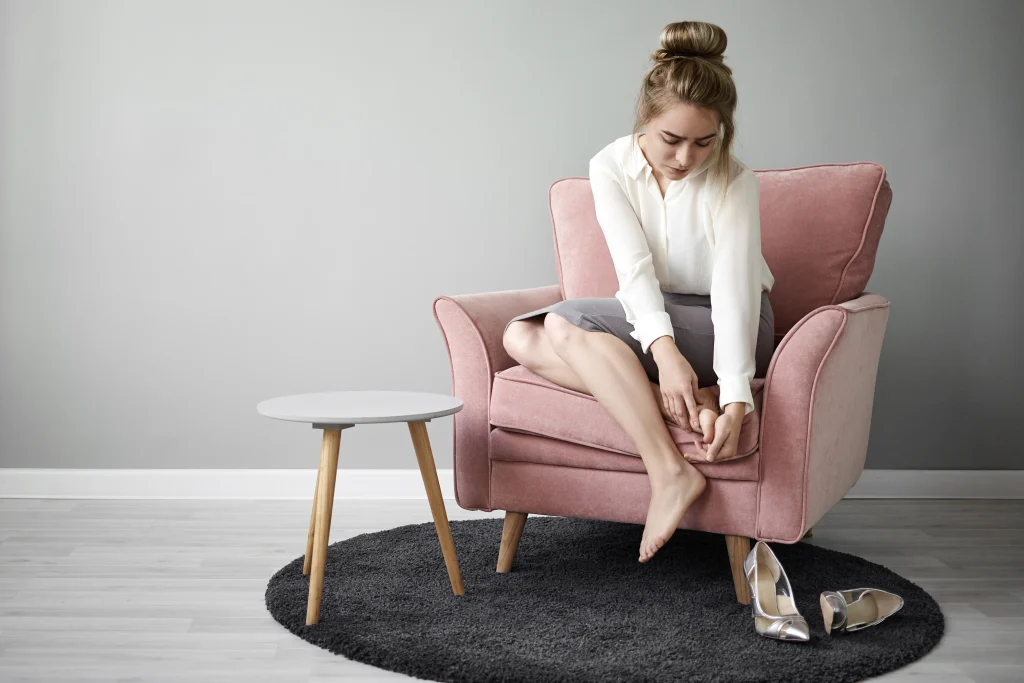
High heels do not affect everyone in exactly the same way.
You may be more likely to develop symptoms if you:
- Wear high heels for several hours at a time
- Frequently use very high or narrow heels
- Have previously sprained an ankle
- Have weak calf or ankle muscles
- Have reduced ankle mobility
- Experience frequent ankle rolling
- Have poor single-leg balance
- Spend long periods standing or walking in heels
- Suddenly increase the amount of time you spend wearing heels
Your previous injury history is particularly important.
Someone with good ankle strength and balance may tolerate a particular shoe differently from someone who has reduced calf strength, previous ligament injuries or poor proprioception.
What Will a Physiotherapist Assess?
Physiotherapy should not simply involve giving you a list of ankle exercises.
The first step is understanding what is actually contributing to your symptoms.
Ankle Range of Motion
A physiotherapist may assess dorsiflexion and other ankle movements to determine whether stiffness is affecting walking, squatting or other daily activities.
Both ankles may be compared because differences between sides can provide useful information.
Calf Strength and Endurance
The calf muscles help control the ankle during standing, walking and push-off.
Assessment may include repeated calf raises or other functional movements to determine whether weakness or fatigue is contributing to the problem.
Foot and Ankle Muscle Strength
The muscles surrounding the ankle contribute to stability and help control unwanted movement.
Resistance testing and functional exercises can help identify specific areas of weakness.
Single-Leg Balance
Single-leg standing is a simple but useful way to assess ankle control.
A physiotherapist may progress the task depending on the individual’s ability, symptoms and rehabilitation goals.
Walking and Functional Movement
The assessment may also include walking, stair climbing, squatting, stepping and changing direction.
This helps determine whether the problem occurs only while wearing heels or whether an underlying movement or strength issue is also present during everyday activities.
How Can Physiotherapy Help?
Treatment depends on the reason for the pain rather than the footwear alone.
If weakness is present, progressive strengthening may be appropriate.
If stiffness is contributing to symptoms, mobility exercises may be included.
If instability is the main concern, balance and proprioceptive training may become an important part of rehabilitation.
Recent evidence supports this approach for people with chronic ankle instability.
A 2026 systematic review and network meta-analysis of 24 randomized controlled trials involving 949 people found that several physical therapy approaches, including balance training, strength training and combined strength-and-balance program, improved ankle joint-position sense.
However, the researchers also noted that the certainty of evidence was very low, so treatment should still be individualized (Chen et al., 2026)
This is particularly relevant for people whose ankle pain is accompanied by repeated giving way or a history of recurrent sprains.
Exercises That May Help
The right exercises depend on the individual’s diagnosis and symptoms, but several types of exercises are commonly used in ankle rehabilitation.
Calf Raises
Calf raises strengthen the plantarflexor muscles and help improve their ability to tolerate repeated loading.
Begin with both feet and progress towards single-leg calf raises when adequate strength and control have developed.
Resistance-Band Ankle Exercises
Resistance bands can be used to strengthen different ankle movements, including dorsiflexion and eversion.
The resistance should be increased gradually rather than starting with a band that is too difficult to control.
Single-Leg Balance
Single-leg balance exercises challenge the ankle’s ability to maintain control.
Once basic balance becomes comfortable, a physiotherapist may introduce reaching movements or other controlled challenges.
Ankle Mobility Exercises
If stiffness is contributing to symptoms, controlled ankle mobility exercises may help restore comfortable movement.
These should be performed within an appropriate range and progressed according to the individual’s response.
Exercise should not be treated as a universal prescription.
An ankle affected by an acute injury requires a different approach from one affected by chronic instability or muscle weakness.
Should You Stop Wearing High Heels?
Not necessarily.
For many people, a more realistic approach is to reduce the amount of time spent in high heels and choose footwear that provides greater stability when possible.
Heel height, heel-base width and shoe design can all influence stability and comfort.
A systematic review examining ways to reduce the negative effects of high heels found some evidence supporting moderate heel heights, wider heel bases and supportive inserts.
The authors suggested that a heel height of approximately 3.76 to 4.47 cm may be more appropriate than higher heels, although the evidence was largely based on short-term studies and should not be interpreted as a universally “safe” heel height (Wang et al., 2021)
Therefore, there is no single heel height that can be guaranteed to prevent ankle pain.
Your tolerance depends on factors such as ankle strength, previous injuries, activity level, shoe design and how long you wear the footwear.
Myth vs Fact: High Heels and Ankle Health
How to Reduce Ankle Strain While Wearing Heels
Small changes can make high-heel use more manageable.
Choose a Wider Heel
A broader heel generally provides a more stable base than a very narrow heel.
Reduce Continuous Wear
If heels are required for work or an event, consider wearing comfortable footwear while travelling and changing into heels when necessary.
This reduces the total amount of time your ankles remain in an altered position.
Give Your Calves Recovery Time
If your calves feel tight or fatigued after wearing heels, avoid immediately repeating prolonged exposure.
Gentle movement and an individualized mobility programme may help restore comfortable movement.
Be Careful on Uneven Surfaces
Grass, gravel, stairs and uneven pavements require greater ankle control.
More stable footwear is usually a better choice for these situations.
Do Not Ignore Repeated Ankle Rolling
Repeated ankle rolling is not something you simply have to live with.
It may indicate reduced strength, impaired proprioception or chronic ankle instability that could benefit from rehabilitation.
What About Switching From Heels to Flats?
Some people notice discomfort when they suddenly switch from heels to completely flat footwear.
One possible explanation is that the calf and ankle have adapted to spending time in a more plantarflexed position.
Moving immediately into a different ankle position may therefore feel unusual or uncomfortable.
Instead of assuming that completely flat footwear is automatically the solution, consider how your ankle responds to the transition.
If you regularly wear high heels and experience calf tightness or ankle stiffness, a gradual transition combined with appropriate strengthening and mobility work may be more comfortable.
A physiotherapist can assess whether the discomfort is related to an actual mobility restriction or simply a temporary adaptation.
When Should You See a Physiotherapist?
Occasional mild discomfort that disappears after removing your shoes does not necessarily indicate an injury.
However, professional assessment is worthwhile if:
- Ankle pain keeps returning
- Your ankle repeatedly gives way
- You frequently roll the same ankle
- Swelling develops after wearing heels
- Pain continues after removing the shoes
- You have difficulty walking normally
- You notice significant ankle stiffness
- You recently suffered an ankle sprain
- You feel unstable on stairs or uneven surfaces
After an acute injury, significant swelling, inability to bear weight, severe pain or visible deformity should be assessed promptly rather than treated as ordinary footwear-related discomfort.
A Physiotherapist’s View: Treat the Person, Not Just the Shoe
It is easy to blame high heels when ankle pain appears after wearing them.
Physiotherapy looks at the bigger picture.
Two people can wear the same pair of shoes for the same amount of time and have completely different responses.
One person may have strong, well-controlled ankles, while another may have reduced calf strength, previous ligament injuries and poor balance.
The shoe is therefore only one part of the equation.
A rehabilitation programme should aim to improve the ankle’s capacity to handle everyday demands.
Depending on the assessment, this may include restoring mobility, strengthening the calf and foot muscles, improving balance, developing proprioception and gradually returning to activities the person wants to perform.
Final Thoughts
High heels can alter ankle position, muscle activity, balance and the way forces are distributed through the lower limb. These effects become more relevant when heels are very high, worn for prolonged periods or combined with existing ankle weakness or previous injuries.
You do not necessarily have to give up high heels to look after your ankles. Choosing more stable footwear, limiting prolonged wear and maintaining ankle and calf strength can help reduce unnecessary strain.
If ankle discomfort repeatedly appears after wearing heels, a physiotherapy assessment can help identify whether mobility, strength, balance, proprioception or a previous injury is contributing to the problem.
Final Thoughts
High heels can alter ankle position, muscle activity, balance and the way forces are distributed through the lower limb.
These effects become more relevant when heels are very high, worn for prolonged periods or combined with existing ankle weakness or previous injuries.
You do not necessarily have to give up high heels to look after your ankles.
Instead, pay attention to how your body responds.
Choose more stable footwear when possible, limit prolonged wear, maintain ankle and calf strength, and do not ignore recurring pain or instability.
If ankle discomfort repeatedly appears after wearing heels, physiotherapy can help determine whether the underlying issue is mobility, strength, balance, proprioception, tendon loading or a previous injury.
The goal is not simply to make you tolerate your shoes better.
It is to help your ankle become stronger, more mobile and better equipped to handle the activities you enjoy.
Frequently Asked Questions
1. Can wearing high heels cause ankle pain?
Yes. High heels can change ankle position, balance and lower-limb mechanics. Prolonged wear may contribute to ankle or calf discomfort, particularly in people with reduced strength, stiffness or previous ankle injuries.
2. Are higher heels more likely to cause ankle problems?
Higher heels generally create greater changes in ankle position and balance demands. However, individual tolerance varies depending on strength, footwear design, previous injuries and duration of use.
3. Can physiotherapy help ankle pain caused by high heels?
Yes. A physiotherapist can assess ankle mobility, calf and ankle strength, balance, proprioception and movement control, then develop an individualized rehabilitation programme.
4. What exercises can strengthen the ankle?
Depending on the underlying problem, exercises may include calf raises, resistance-band ankle exercises, single-leg balance and ankle mobility exercises.
5. Should I stop wearing high heels if my ankle hurts?
Not necessarily. Reducing prolonged wear and choosing more stable footwear may help, but recurring pain should be assessed to determine whether an underlying mobility, strength or stability problem is present.
6. When should I see a physiotherapist for ankle pain?
Consider an assessment if pain keeps returning, your ankle repeatedly gives way, you frequently roll the same ankle, swelling persists or you have difficulty walking or using stairs normally.
Stay tuned with us for more health related topics.
Follow us on LinkedIn and Instagram for more.
More Read


Medical Disclaimer
This article is intended for general educational and informational purposes only. It does not replace an individual assessment, diagnosis or treatment plan from a qualified physiotherapist, doctor or other healthcare professional. Ankle pain can have several causes, and the appropriate treatment depends on the individual’s symptoms, medical history and physical examination. If you have severe pain, significant swelling, difficulty bearing weight, visible deformity or symptoms following an acute injury, seek appropriate medical assessment promptly.


