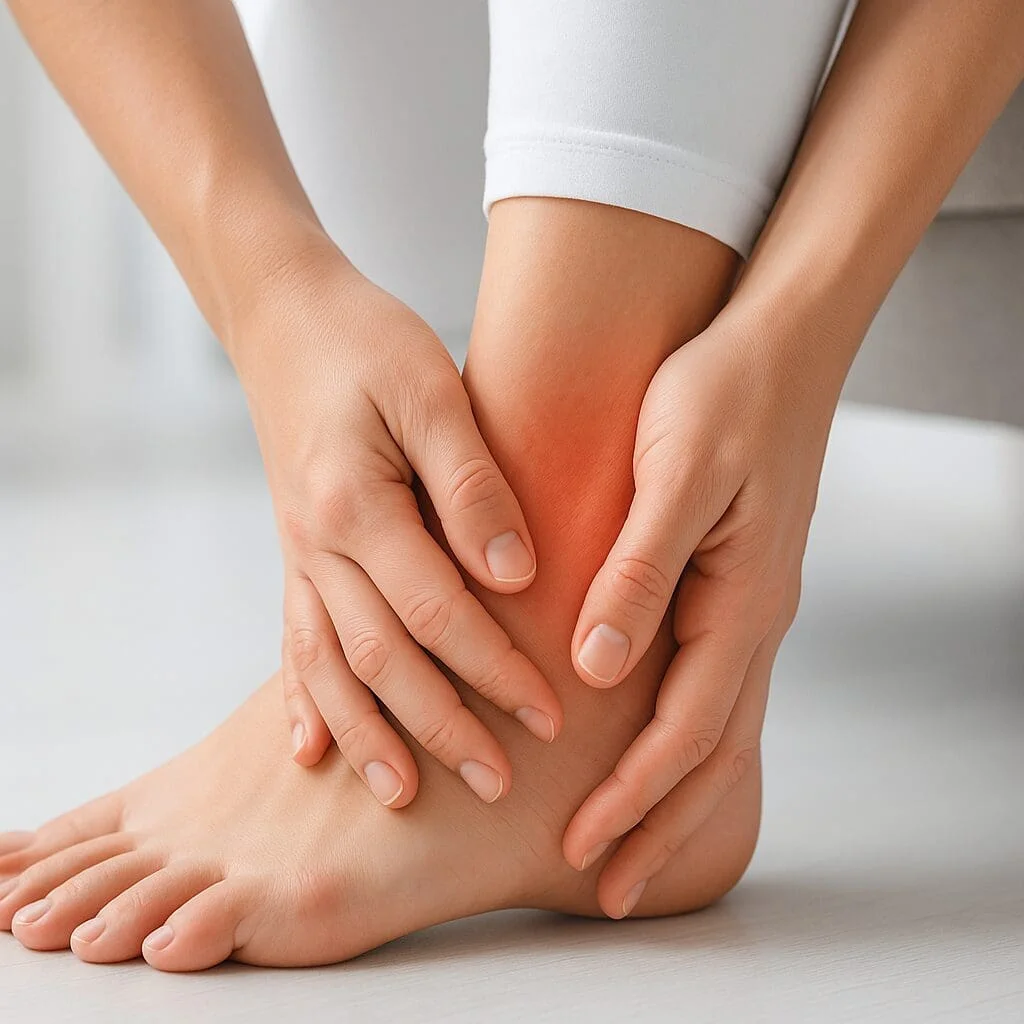

Ankle bursitis treatment focuses on reducing irritation and pressure around the affected bursa, controlling pain and swelling, and gradually restoring normal movement and activity once symptoms settle.
Ankle swelling is easy to blame on a sprain, arthritis, tendon problem or simply “water retention.”
But sometimes the structure responsible is much smaller and easier to overlook: a bursa.
A bursa is a tiny fluid-filled sac designed to reduce friction between tissues.
Around the ankle and heel, bursae help tendons and skin glide over bone.
When one becomes irritated, inflamed or filled with excess fluid, it can produce very noticeable swelling, tenderness and ankle pain.
This is called bursitis.
Quick Answer: Can a Bursa Cause Ankle Swelling?
Yes. An inflamed ankle or heel bursa can fill with excess fluid, become thickened and cause local swelling, tenderness and pain. The retrocalcaneal bursa lies between the Achilles tendon and heel bone, while the superficial calcaneal bursa is closer to the skin and can be irritated by footwear. However, swelling around the ankle can have many causes, so persistent, hot, rapidly worsening or unexplained swelling should be professionally assessed.
The important part is that ankle bursitis is not one single condition.
The location of the swelling matters.
A painful lump behind the heel may involve the superficial calcaneal bursa, while deeper pain between the Achilles tendon and heel bone can involve the retrocalcaneal bursa.
These problems can also occur alongside Achilles tendinopathy, Haglund’s deformity, inflammatory arthritis or footwear-related irritation.
As a physiotherapist, I would not advise treating every swollen ankle in exactly the same way.
The first question should be: what structure is actually producing the swelling?
Research shows that ultrasound can identify a thickened, fluid-filled or hyperaemic retrocalcaneal bursa and can also reveal accompanying Achilles tendon abnormalities. AJUM
Key Takeaways
- A bursa can become inflamed and produce visible swelling around the ankle or heel.
- Retrocalcaneal bursitis occurs deep between the Achilles tendon and calcaneus.
- Superficial calcaneal bursitis is more directly affected by shoe pressure.
- Haglund’s deformity, Achilles overload, footwear and inflammatory diseases can contribute.
- Ultrasound can help identify bursal fluid, wall thickening and increased vascularity.
- Do not assume every bursal fluid finding on imaging is clinically important.
- Reducing compression and modifying activity are often important early treatment steps.
- Aggressive stretching may aggravate some posterior heel conditions.
- Heel lifts may be useful in selected cases, but they are not a universal treatment.
- Corticosteroid injections around the retrocalcaneal bursa require particular caution because of the Achilles tendon.
- Hot, rapidly swollen or systemically symptomatic swelling requires medical assessment.
What Exactly Is Ankle Bursitis?
A bursa is a small, slippery sac containing a small amount of fluid.
Think of it as a biological cushion that helps two structures move against each other with less friction.
There are numerous bursae throughout the body, including around the foot and ankle.
Most are so small that you never notice them.
Problems begin when repeated pressure, friction, trauma or inflammation causes the bursa to become irritated.
It may produce additional fluid, become thickened and develop increased blood flow.
That can make the area painful and visibly swollen.
The retrocalcaneal bursa has a particularly interesting job.
It sits between the Achilles tendon and the upper back portion of the calcaneus, helping the tendon move relative to the bone.
A small amount of fluid in this bursa can be normal.
It is not correct to assume that seeing any fluid automatically means bursitis.
Ultrasound findings have to be interpreted alongside symptoms and examination. (Bone & Joint Research)
That distinction is important because many people undergo scans and become worried when a report mentions “bursal fluid.”
The clinical question is whether that finding actually explains the person’s pain.
Can a Bursa Really Cause Ankle Swelling?
Yes.
An inflamed bursa can accumulate excess fluid and become thickened.
Around the heel, this may create a visible or palpable swelling, particularly when the irritation is superficial.
However, swelling from bursitis does not always look like the classic “puffy ankle” people associate with a sprain.
The swelling may instead appear as:
- A small lump at the back of the heel
- Puffiness immediately above the heel bone
- Tenderness on either side of the Achilles insertion
- A soft or firm prominence irritated by footwear
- Local swelling that becomes worse after walking or running
- Thickening around the Achilles insertion
- Pain when the ankle moves into deeper dorsiflexion
This is one reason ankle bursitis can be mistaken for an Achilles tendon problem.
In fact, ultrasound descriptions of retrocalcaneal bursitis commonly include a thickened bursal wall, fluid and increased vascularity, often together with Achilles tendinopathy.
The Two Heel Bursae You Should Know About
Retrocalcaneal bursitis
This is the deeper problem.
The retrocalcaneal bursa sits between the Achilles tendon and the posterosuperior calcaneus.
Irritation here usually produces deep posterior heel pain, rather than a superficial skin-level lump.
Pain can increase when the ankle is dorsiflexed because the tissues around the Achilles insertion become compressed.
It can occur with:
- Achilles insertional tendinopathy
- Haglund’s deformity
- Running-related overload
- Sudden increases in activity
- Repetitive uphill running
- Footwear pressure
- Inflammatory diseases
A useful anatomical detail is that the retrocalcaneal bursa and Achilles tendon are not completely isolated structures.
Anatomical research has demonstrated that fluid introduced into the bursa can diffuse into the anterior portion of the Achilles tendon. (PMC)
This helps explain why a patient can have what feels like “Achilles pain” even when the bursa is an important contributor.
Superficial calcaneal bursitis
This bursa lies between the skin and the Achilles region.
It is much more vulnerable to external pressure, particularly from footwear.
You may notice:
- A visible bump
- Skin irritation
- Redness
- Tenderness when shoes touch the area
- Pain from a rigid heel counter
- Swelling that improves when shoes are removed
This distinction can change the treatment completely.
If the problem is predominantly superficial and shoe-related, changing footwear may be more important than aggressively stretching the calf.
Why Does Ankle Bursitis Happen?
There is rarely one universal cause.
1. Repetitive friction
Repeated rubbing is one of the simplest mechanisms.
A stiff shoe repeatedly presses against the back of the heel.
At first, the tissues tolerate it. But if exposure continues, the bursa may become irritated.
This is particularly relevant with:
- New running shoes
- Hard heel counters
- Formal shoes
- High-heeled footwear
- Tight athletic shoes
- Boots
- Shoes with a poorly shaped heel cup
Haglund-related problems are particularly associated with mechanical irritation involving the calcaneal prominence, Achilles tendon and surrounding bursae. (Polish journal Of Radiology)
2. Sudden training changes
Your tissues respond to load, not simply exercise.
Someone who suddenly doubles their running distance, introduces hill running or starts sprint training may expose the Achilles-bursa region to a load it has not recently experienced.
This does not mean exercise is bad.
It means that sudden changes in volume, intensity, surface or footwear can matter.
3. Haglund’s deformity
Haglund’s deformity is a bony prominence at the posterosuperior calcaneus.
Importantly, the bone itself is not necessarily painful.
The problem can arise when the prominence changes the mechanical environment around the Achilles tendon and bursa.
A systematic review describes retrocalcaneal bursitis as an important consequence of repetitive impingement between the bursa, Achilles region and calcaneal prominence. (Cureus)
This is why I would not automatically recommend surgery simply because an X-ray says “Haglund deformity.”
A bony shape can exist without symptoms.
4. Achilles insertional overload
The bursa and Achilles tendon live next to each other.
If the Achilles insertion is overloaded, the adjacent bursa may also become irritated.
Conversely, bursal inflammation can make Achilles loading uncomfortable.
This is one reason treatment should not focus exclusively on the tendon or exclusively on the bursa.
5. Foot and running mechanics
Running studies have found associations between calcaneal shape, Achilles tendon thickness and retrocalcaneal bursitis.
One study involving runners reported that the shape of the calcaneal tuberosity and the size of the bursal surface were associated with bursitis. (MDPI)
This is an interesting reminder that anatomy and loading interact.
However, I would avoid telling a patient that their foot “alignment caused the bursitis” based on one observation.
Human movement is more complicated than that.
What Does Ankle Bursitis Feel Like?
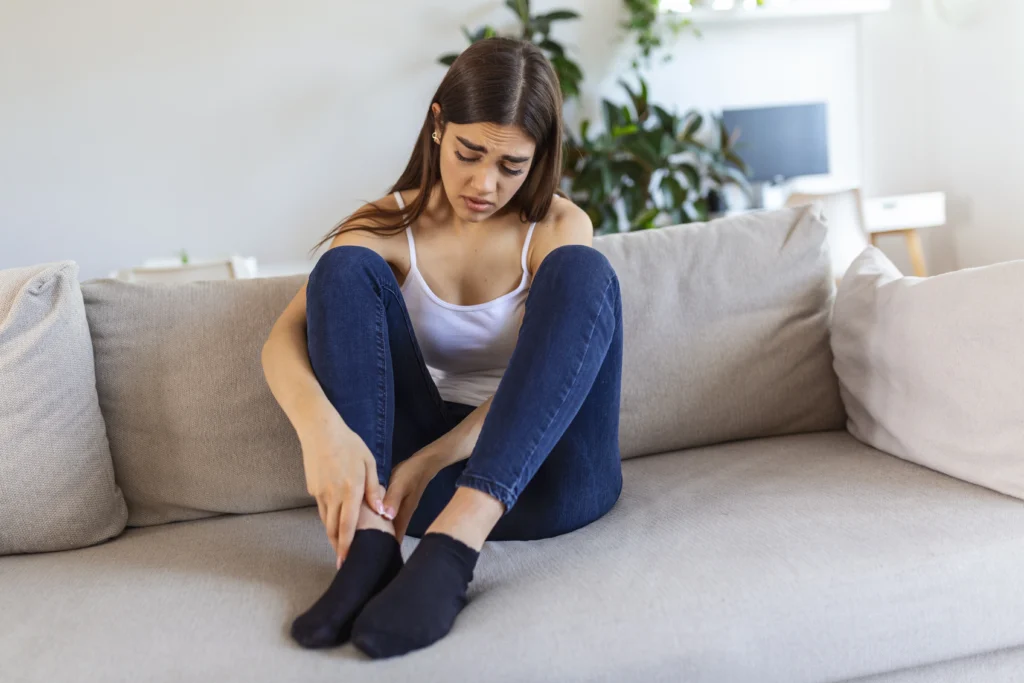
Symptoms depend on which bursa is involved.
Typical symptoms include:
- Localised posterior heel pain
- Swelling
- Tenderness
- Pain when shoes press on the area
- Pain during walking
- Discomfort while running
- Pain when climbing stairs
- Pain during deep ankle dorsiflexion
- Stiffness after inactivity
- Sensitivity around the Achilles insertion
A useful clue is where the pain is located.
Deep pain immediately in front of the Achilles tendon near its attachment may suggest retrocalcaneal involvement.
Pain directly underneath the skin at the back of the heel, particularly from shoe contact, raises suspicion of superficial calcaneal bursitis.
But these are clues, not a diagnosis.
Can Ankle Bursitis Occur Without an Injury?
Yes.
This surprises many people.
You do not need to twist your ankle for bursitis to develop.
Repeated low-level irritation can be enough.
For example, imagine someone who starts wearing a new pair of shoes every day.
The shoes are not painful initially, but their rigid heel counter repeatedly compresses the same region.
After several days, the person notices tenderness.
After two weeks, there is swelling.
There may have been no dramatic injury at all.
This is one reason the question “Did you injure your ankle?” is not sufficient when assessing posterior heel swelling.
When Inflammatory Disease Is Behind the Bursa
Sometimes the bursa is not simply reacting to footwear or exercise.
Inflammatory diseases such as rheumatoid arthritis can involve the Achilles insertion and retrocalcaneal bursa.
This is particularly important when swelling is:
- Bilateral
- Recurrent
- Associated with prolonged morning stiffness
- Accompanied by multiple painful joints
- Associated with unexplained fatigue or systemic symptoms
Ultrasound research in people with rheumatoid arthritis has identified retrocalcaneal bursitis and Achilles-region abnormalities among symptomatic ankles. (PubMed)
Another study found that retrocalcaneal bursitis can precede or accompany Achilles enthesitis during early rheumatoid arthritis, which means the bursa may sometimes provide an early clue to an underlying inflammatory process. (Sage Journals)
That is a very different situation from simple shoe irritation.
Could Gout or Infection Cause Ankle Bursitis?
They can.
Bursitis may result from inflammatory crystal disease such as gout, while infection can produce septic bursitis.
Infection is uncommon in the deep retrocalcaneal bursa but should never be ignored when the clinical picture is concerning.
Seek prompt medical assessment if swelling is accompanied by:
- Increasing redness
- Significant warmth
- Severe or rapidly worsening pain
- Fever
- Chills
- Feeling unwell
- Drainage or an open wound
- Rapidly increasing swelling
Septic bursitis can be difficult to distinguish clinically from non-infectious inflammation, and analysis of aspirated bursal fluid may be necessary in appropriate cases. (Elsevier)
Do not massage, aggressively stretch or attempt to drain a suspicious swollen area yourself.
How Is Ankle Bursitis Diagnosed?
A good diagnosis starts with history and physical examination.
I would want to know:
- When the swelling appeared
- Whether it followed a change in footwear
- Whether running or walking volume changed
- Whether the pain is superficial or deep
- Whether both ankles are involved
- Whether there is morning stiffness
- Whether there was trauma
- Whether the area is hot or red
- Whether symptoms change with ankle movement
Ultrasound can be particularly useful
Musculoskeletal ultrasound can show:
- Bursal fluid
- Bursal wall thickening
- Increased blood flow
- Achilles tendon thickening
- Tendon tears
- Adjacent soft-tissue abnormalities
It also has the advantage of allowing the clinician to assess the tissues dynamically.
MRI may be useful when the diagnosis is uncertain, symptoms are persistent, or a deeper tendon, bone or soft-tissue problem needs investigation. MRI can demonstrate retrocalcaneal bursitis alongside Achilles tendinopathy and bone changes. (NCBI)
An Important Point About Imaging
Please do not panic when a report says “bursal fluid.”
A bursa normally contains fluid.
The more important questions are:
Is it enlarged? Is the wall thickened? Is there increased vascularity? Does the location match the patient’s symptoms? Are there other abnormalities?
Imaging should support clinical reasoning, not replace it.
This is particularly important because Achilles tendinopathy, retrocalcaneal bursitis, Haglund-related irritation and other posterior heel disorders frequently overlap.
Physiotherapy Treatment for Ankle Bursitis
The treatment I use conceptually is not “remove inflammation at all costs.”
It is:
identify the irritant → reduce unnecessary compression → restore comfortable movement → gradually rebuild capacity.
Step 1: Remove the obvious mechanical trigger
If the heel counter is constantly pressing on the bursa, continuing to wear that shoe while taking anti-inflammatory medication is not solving the underlying problem.
For a few weeks, consider footwear with:
- A softer heel counter
- More space around the heel
- Less direct pressure
- A comfortable heel-to-toe transition
Some people benefit from temporarily using footwear that reduces compression rather than trying to “push through” the pain.
Step 2: Temporarily modify aggravating activity
This does not necessarily mean complete rest.
If running produces significant pain and swelling, reduce running volume temporarily.
You might substitute:
- Cycling
- Swimming
- Upper-body conditioning
- Shorter flat walks
- Other activities that do not reproduce the symptoms
The goal is to keep you active without continually provoking the bursa.
Step 3: Restore ankle movement carefully
Aggressive calf stretching can sometimes aggravate posterior heel symptoms because deep dorsiflexion increases compression around the Achilles insertion.
Therefore, I would not automatically prescribe repeated end-range calf stretching to someone with suspected retrocalcaneal bursitis.
Gentle, comfortable ankle mobility is usually more sensible initially.
Step 4: Gradually rebuild calf capacity
Once irritability settles, the calf-Achilles complex needs to become stronger and more load tolerant.
Depending on the diagnosis, this may include:
- Isometric calf loading
- Seated calf raises
- Standing calf raises
- Progressive resisted plantarflexion
- Functional heel raises
- Gradual return to running
The exact exercise selection should be adjusted to symptoms and whether insertional Achilles pathology is present.
Step 5: Consider a temporary heel lift when appropriate
A heel lift may reduce ankle dorsiflexion and alter Achilles loading.
Evidence on heel lifts is evolving. A 2024 systematic review found evidence across several lower-limb conditions, although the certainty and effects differed between conditions. (WILEY)
A 2024 feasibility randomised trial also investigated heel lifts specifically for insertional Achilles tendinopathy, suggesting that this is an area worth following rather than treating heel lifts as a universal solution. (NIH)
I would therefore consider them a temporary load-management tool, not a permanent correction for everyone.
What Should You Avoid?
Do not repeatedly press on the swelling
Constantly checking a painful bursa by poking it can become another source of irritation.
Do not aggressively stretch into pain
More stretching is not automatically better.
If deep dorsiflexion clearly reproduces posterior heel pain, repeatedly forcing that position may be counterproductive during the irritable stage.
Do not run through increasing swelling
A little exercise discomfort is not automatically dangerous, but progressive swelling after every session is a sign that the current load may be excessive.
Do not self-inject steroids
This deserves special attention.
The retrocalcaneal bursa has an anatomical relationship with the Achilles tendon.
A cadaveric study demonstrated diffusion of injected material from the bursa toward the anterior Achilles tendon. (BJR)
Clinical reports have also described Achilles ruptures following corticosteroid treatment for retrocalcaneal bursitis. (Springer Link)
More recent research involving 218 image-guided injections reported good or excellent short-term responses in approximately 63% of cases, but four Achilles ruptures were identified, representing 1.8%. (PMC)
This does not mean every injection causes rupture.
It means the risk-benefit decision deserves proper medical assessment, particularly when Achilles tendon pathology is also present.
Can Ankle Bursitis Go Away on Its Own?
Mild mechanical bursitis may improve when the irritant is removed.
For example, changing footwear and reducing aggravating activity may be enough for an uncomplicated case.
But persistent symptoms deserve assessment, particularly if:
- Swelling continues for several weeks
- Pain is getting worse
- You cannot exercise normally
- The Achilles tendon is also painful
- There is a hard bony prominence
- Symptoms are bilateral
- There is significant morning stiffness
- The area is hot or red
- You have systemic symptoms
Chronic retrocalcaneal bursitis sometimes occurs together with structural abnormalities and insertional Achilles disease.
In selected persistent cases, surgery may eventually be considered after appropriate conservative management. (NLM)
When Is Surgery Considered?
Surgery is not the first step for most cases.
It may be considered when a clearly identified structural problem continues to cause significant symptoms despite an adequate period of conservative treatment.
Depending on the underlying problem, surgery may involve:
- Bursectomy
- Removal of a prominent portion of bone
- Achilles tendon debridement
- Correction of Haglund-related impingement
Systematic-review evidence supports conservative management involving activity modification, physiotherapy and footwear modification before surgery for symptomatic Haglund-related conditions. (PubMed)
A Lesser-Known Clue: Your Shoes May Tell the Story
One of the most useful things you can do is examine the inside and back of your footwear.
Look for:
- A stiff heel counter
- Asymmetric wear
- A narrow heel cup
- A seam pressing against the painful area
- A recently introduced shoe
- A sudden change from soft to rigid footwear
Then ask yourself:
Does the pain reduce significantly when I walk barefoot or wear a different shoe?
If yes, footwear pressure may be contributing substantially.
That does not prove bursitis, but it provides an important clinical clue.
Another Lesser-Known Clue: The Bursa May Not Be the Main Problem
This is where I want readers to be careful.
A swollen bursa may be the victim rather than the original cause.
For example:
Haglund prominence → mechanical compression → bursal irritation → Achilles overload
Or:
Sudden running increase → Achilles overload → local tissue irritation → secondary bursal inflammation
Or:
Inflammatory arthritis → enthesitis → retrocalcaneal bursitis
In each situation, simply treating the bursa without addressing the underlying driver may lead to recurrence.
That is why “How do I get rid of ankle bursitis?” is sometimes the wrong first question.
A better question is:
“Why is this bursa being irritated?”
My Physiotherapist’s Takeaway
If you have swelling behind the ankle or heel, don’t automatically assume you have another ankle sprain.
A bursa can absolutely become swollen and painful.
But ankle bursitis is a mechanical and clinical diagnosis, not simply an imaging finding.
Look at the whole picture: footwear, training load, Achilles tendon health, calcaneal shape, ankle movement, inflammatory symptoms and the exact location of swelling.
For many mechanically driven cases, the most useful treatment is surprisingly simple:
remove the repeated irritation, modify activity temporarily, choose footwear carefully and progressively rebuild the capacity of the calf-Achilles complex.
And remember one particularly important point: the retrocalcaneal bursa is anatomically close to the Achilles tendon.
That relationship is one reason corticosteroid injections in this area require considerably more caution than many people realise.
If your swelling is hot, rapidly increasing, associated with fever, or accompanied by severe pain, do not manage it as ordinary bursitis at home. Get it medically assessed.
Your ankle does not need more treatment just because it hurts.
It needs the right diagnosis first.
Frequently Asked Questions
Can ankle bursitis cause swelling?
Yes. An inflamed bursa can produce excess fluid and local tissue thickening, causing swelling around the heel or ankle.
Where does retrocalcaneal bursitis hurt?
It usually causes pain deep at the back of the heel near the Achilles tendon insertion and may become more painful with ankle dorsiflexion.
Can shoes cause ankle bursitis?
Yes. Repeated pressure and friction from a rigid or poorly fitting heel counter can irritate the superficial or retrocalcaneal region.
Can Haglund’s deformity cause bursitis?
Yes. A prominent posterosuperior calcaneus can increase mechanical compression around the Achilles tendon and retrocalcaneal bursa.
Can you treat ankle bursitis with physiotherapy?
Many mechanically driven cases can be managed conservatively with activity modification, footwear changes, appropriate mobility work and progressive strengthening.
Should I stretch my calf if I have ankle bursitis?
Not necessarily aggressively. Deep ankle dorsiflexion can increase compression around the posterior heel, so stretching should be selected according to the individual’s diagnosis and irritability.
Can ankle bursitis happen without an injury?
Yes. Repeated pressure, footwear friction, increased running load and inflammatory conditions can cause bursitis without one obvious injury.
When should ankle swelling be checked by a doctor?
Seek medical assessment if swelling is rapidly increasing, hot, very painful, associated with fever or redness, follows significant trauma, or does not improve with appropriate activity and footwear modification.
Can steroid injections treat retrocalcaneal bursitis?
Image-guided injections may provide short-term pain relief in selected patients, but injections near the retrocalcaneal bursa require caution because of the close anatomical relationship with the Achilles tendon.
Can ankle bursitis come back?
Yes. Recurrence is more likely if the underlying mechanical trigger, footwear pressure, training-load problem or inflammatory condition is not addressed.
Stay tuned with us for more health related topics.
Follow us on LinkedIn and Instagram for more.
More Read

Medical Disclaimer!
This article has been reviewed and written under the guidance of our Head Physiotherapist, Dr. Kruti Raj (PT, MUHS,CPT,CMPT). The information shared is intended for educational purposes only and should not be considered a substitute for personalized medical advice, diagnosis, or treatment.
Please consult us or any other qualified healthcare professional before beginning any exercise program, especially if you are experiencing pain, recovering from injury, or managing a medical condition.