


A clicking, catching, or locking sensation in the hip can be uncomfortable and confusing, particularly when it happens during walking, squatting, exercising, or getting out of a chair.
Quick Answer: Why Does Your Hip Click or Lock?
A hip labral tear can cause deep groin pain, clicking, catching, or a sensation that the hip briefly locks, particularly during movements involving hip flexion and rotation. However, painless clicking may also come from tendons around the hip and does not automatically mean the labrum is damaged.
What can help? Depending on the cause, physiotherapy may include activity modification, progressive hip strengthening, movement-control training, and a gradual return to exercise. Persistent painful catching or restricted movement should be assessed by a healthcare professional.
One possible cause is a hip labral tear, an injury to the ring of cartilage surrounding the hip socket.
However, hip clicking is common and does not automatically indicate joint damage.
From a physiotherapy perspective, the important questions are whether the movement causes pain, whether the hip becomes restricted, and how symptoms affect daily activities.
A careful assessment can help identify the likely cause and determine whether rehabilitation, further investigation, or specialist treatment is appropriate.
Key Takeaways
- A hip labral tear affects the cartilage ring surrounding the hip socket.
- Symptoms may include deep groin pain, painful clicking, catching, or restricted movement.
- Painless clicking can occur because of tendon movement and does not automatically indicate a labral tear.
- Clinical assessment and appropriate imaging help determine whether a labral tear is relevant to the symptoms.
- Physiotherapy may improve strength, movement control, and daily function.
- Surgery is not necessary for every labral tear; treatment depends on symptoms, associated conditions, and response to rehabilitation.
- Sudden severe pain, inability to bear weight after an injury, or a hot, swollen hip with fever requires urgent medical assessment.
What Is a Hip Labral Tear?
The hip labrum is a ring of fibrocartilage attached to the rim of the acetabulum, the socket of the hip joint.
It helps deepen the socket, distribute pressure, support stability, and maintain a seal around the femoral head, the ball at the top of the thigh bone.
A hip labral tear occurs when this tissue becomes damaged or separates from its attachment.
It may develop following an injury, repetitive loading, or structural changes in the hip.
Some tears occur gradually without one obvious incident.
The labrum is particularly important during movements involving hip flexion and rotation, such as deep squats, pivoting, and bringing the knee towards the chest.
Labral tears can occur alongside femoroacetabular impingement (FAI), a condition in which the shape of the hip bones contributes to abnormal contact during certain movements.
However, not every labral tear is caused by FAI, and not everyone with FAI-related bone shapes experiences symptoms. (Su et al., 2019)
Why Does Your Hip Click, Catch or Lock?
Mechanical symptoms can originate inside the hip joint or from tendons and other soft tissues around it.
The type of sensation, its location, and whether it causes pain can help guide assessment.
1. Clicking During Hip Movement
You might notice a click when lifting your knee, rotating your leg, standing up, or moving from sitting to standing.
A deep click accompanied by groin pain may warrant an assessment for an intra-articular hip problem, including a labral tear.
However, painless clicking can also occur when a tendon moves over a bony prominence.
This is sometimes called snapping hip syndrome.
It can involve the iliopsoas tendon at the front of the hip or the iliotibial band near the outside of the hip.
If clicking is painless and does not restrict movement, it may not require treatment.
If it becomes painful, persistent, or associated with catching, an assessment can help establish the cause.
2. Catching During Rotation
Catching describes a sensation that the hip briefly catches or hesitates during movement.
It may occur when turning, pivoting, getting out of a car, or moving out of a deep squat.
A labral tear can contribute to catching, particularly when the hip is flexed and rotated.
The symptom may become more noticeable during sports or activities that repeatedly load the joint.
Catching is not specific to a labral tear.
The clinical examination should consider other joint conditions and surrounding soft-tissue problems before reaching a conclusion.
3. A Locking Sensation
Some people describe their hip as locking when movement suddenly feels restricted or difficult to continue.
The sensation may pass quickly, or the person may struggle to move the hip normally.
A painful locking sensation deserves more attention than an occasional painless click.
It may be associated with an intra-articular problem, but a labral tear is not the only possible explanation.
If the hip becomes genuinely stuck, movement is severely restricted, or you cannot bear weight, seek prompt medical assessment rather than repeatedly forcing the joint to move.
4. Deep Groin Pain Alongside Clicking
Pain deep in the groin or at the front of the hip is commonly reported with symptomatic labral tears.
It may worsen during prolonged sitting, deep hip flexion, squatting, or activities involving repeated rotation.
Some people also experience pain in the buttock or thigh.
Pain location alone cannot identify the damaged structure because hip tendon disorders, femoroacetabular impingement, and referred pain from the lower back can produce similar symptoms.
A combination of anterior groin pain, pain in deep hip flexion, and sharp catching pain with rotation can make a labral tear more likely, but it does not confirm the diagnosis. (Matache et al., 2025)
What Causes a Hip Labral Tear?
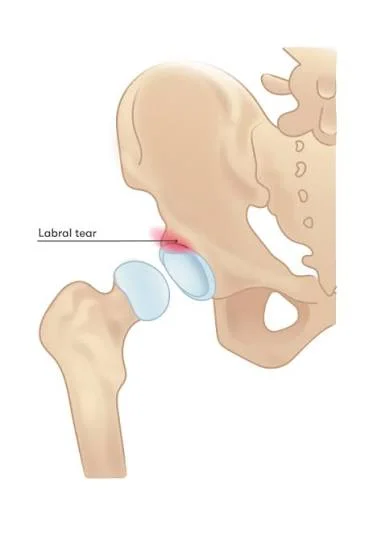
Hip labral tears may develop because of a single injury, repeated loading, or changes in joint structure.
Femoroacetabular Impingement
FAI involves the shape of the femoral head, acetabulum, or both contributing to abnormal contact during certain hip movements.
Repeated contact may irritate or damage the labrum, particularly during deep flexion and rotation.
Bone shapes associated with FAI can also be present in people who have no symptoms.
A diagnosis of FAI syndrome therefore requires consideration of symptoms, clinical signs, and imaging findings rather than bone shape alone.
Sports and Repetitive Loading
Football, hockey, martial arts, and other activities involving pivoting, rapid direction changes, or repeated deep squatting place considerable demands on the hip.
A sudden twist may trigger symptoms, while repetitive loading may contribute to symptoms developing over time.
These activities do not inevitably cause a tear.
Training volume, recovery, individual anatomy, and movement demands all influence the overall picture.
Previous Injury
A fall, collision, forced hip rotation, or other traumatic event may damage the labrum.
Symptoms can begin immediately or become noticeable when a person returns to normal activity.
Sudden severe pain after significant trauma, especially with difficulty bearing weight, requires prompt assessment to rule out a fracture or another serious injury.
Hip Dysplasia and Joint Instability
Hip dysplasia occurs when the socket does not adequately cover the femoral head.
This changes how force is distributed through the joint and may increase stress on the labrum.
People with hip instability or joint hypermobility may also experience pain and movement-related symptoms.
Their assessment should consider the overall stability and structure of the hip rather than focusing only on a suspected tear.
Age-Related Changes
Labral tissue can undergo degenerative changes over time.
A tear may develop gradually without a clear injury, particularly when other joint changes are present.
Importantly, a tear seen on an MRI is not necessarily the cause of pain.
Research has found labral abnormalities in people without hip symptoms, which is why imaging results must be interpreted alongside the clinical assessment. (Heerey et al., 2018)
Is It a Labral Tear or Another Hip Problem?
Several conditions can cause clicking, catching, or pain around the hip.
Understanding the differences helps explain why a click alone cannot establish the diagnosis.
| Possible cause | Common features |
|---|---|
| Hip labral tear | Deep groin pain, painful catching, or symptoms during hip flexion and rotation |
| Snapping hip syndrome | A noticeable tendon snap, often at the front or outside of the hip; it may be painless |
| Femoroacetabular impingement syndrome | Position-related hip or groin pain, restricted movement, and relevant clinical and imaging findings |
| Hip osteoarthritis | Pain and stiffness, often with progressively reduced hip movement |
| Lower-back-related pain | Hip or thigh symptoms that may vary with spinal movement or be accompanied by back symptoms |
These patterns can overlap.
For example, a labral tear and FAI may occur together, while a person with hip osteoarthritis may also have imaging evidence of labral damage. (Griffin et al., 2016)
How Is a Hip Labral Tear Diagnosed?
Diagnosis generally involves a detailed medical history, physical examination, and imaging when appropriate.
Clinical Assessment
A healthcare professional may ask when symptoms began, whether there was an injury, which movements trigger pain or catching, and whether symptoms interfere with walking, work, exercise, or sleep.
The physical assessment may include:
- Hip range of motion, particularly flexion and rotation.
- Muscle strength around the hip and pelvis.
- Walking pattern, balance, and single-leg control.
- Responses to selected clinical tests.
- Assessment of the lower back and surrounding tendons for other possible causes.
Clinical tests can reproduce familiar symptoms, but no single test should be treated as definitive proof of a labral tear.
Imaging Tests
X-rays can help assess bone shape, joint alignment, osteoarthritis, and other structural factors.
They do not directly show the labrum well.
MRI may help identify labral and other soft-tissue abnormalities.
In selected cases, magnetic resonance arthrography, which uses contrast within the joint, may provide additional information.
The choice of investigation depends on the clinical question and specialist assessment.
An imaging abnormality does not automatically explain a person’s symptoms.
The decision to treat should consider pain, function, examination findings, and the overall condition of the hip.
How Physiotherapy Can Help a Hip Labral Tear
Physiotherapy may help selected people with symptomatic labral tears improve strength, movement control, and tolerance to daily activities.
Treatment should be individualized according to the symptoms, associated hip conditions, functional limitations, and personal goals.
1. Activity Modification
The initial aim is often to reduce repeated irritation without unnecessarily stopping all movement.
Temporarily modifying deep squats, repeated pivoting, high-impact exercise, or positions that consistently provoke sharp groin pain may help.
The specific activities to adjust depend on the person’s symptoms and assessment.
Activity modification does not mean prolonged bed rest.
Comfortable movement and suitable exercise can often continue while the rehabilitation plan is adjusted.
2. Hip and Gluteal Strengthening
The gluteal muscles and other hip muscles help control the pelvis and thigh during walking, stair climbing, and single-leg activities.
Depending on the assessment, a physiotherapist may introduce bridges, supported standing hip exercises, sit-to-stand practice, or resistance-based strengthening.
Exercises should begin at a manageable level and progress according to the person’s response.
Strengthening does not directly repair every labral tear, but it may improve movement capacity and help manage symptoms.
3. Movement Control and Functional Training
Some people experience symptoms during squatting, stepping, turning, or getting out of a chair.
Rehabilitation can focus on improving control during these tasks and gradually increasing the range or load the hip can tolerate.
Exercises may include controlled step-ups, balance work, and task-specific movement practice.
Deep or repeated hip flexion should not be forced when it consistently provokes sharp pain or catching.
4. Gradual Return to Exercise
People who want to return to running, gym training, or sport may need a staged programme.
This can involve rebuilding strength and endurance, progressing functional movements, and gradually reintroducing higher-demand activities.
Progress should be guided by symptoms, movement quality, strength, and functional ability rather than a fixed timeline alone.
Research on non-operative management of non-arthritic hip-related pain suggests that many people report satisfactory improvement, although the evidence varies and the most effective combination of rehabilitation components remains uncertain. (Probst et al., 2023)
Hip Labral Tear: Myth vs Fact
MYTH: Every hip click means a labral tear.
FACT: Tendons moving around the hip can cause clicking. Pain, catching, movement restriction, and clinical findings help guide further assessment.
MYTH: A labral tear always requires surgery.
FACT: Some people improve with activity modification and physiotherapy. Surgery may be considered when symptoms remain limiting despite appropriate non-surgical care.
MYTH: An MRI finding always explains hip pain.
FACT: Labral abnormalities can occur in people without symptoms. Imaging should be interpreted alongside the person’s history and physical examination.
MYTH: All painful hip movements should be avoided permanently.
FACT: Temporarily modifying aggravating movements may help. Depending on the assessment and recovery, some activities can be reintroduced gradually through a suitable rehabilitation plan.
Which Exercises Should You Avoid During a Flare-Up?
There is no single exercise list that applies to every person with a labral tear.
The aim is to identify movements that repeatedly reproduce sharp pain or catching and temporarily adjust them while maintaining appropriate activity.
Depending on the person’s symptoms, it may be necessary to modify:
- Deep squats or lunges that cause sharp groin pain.
- Repeated pivoting or sudden changes of direction.
- High-impact activity that increases symptoms.
- Forced hip stretches that reproduce catching.
- Heavy resistance exercises performed through a painful range.
These activities do not need to be permanently avoided by everyone with a labral tear.
Some may be reintroduced gradually when symptoms, strength, and movement control improve.
A useful rule is to reduce the range, resistance, speed, or duration of an aggravating movement rather than pushing through sharp pain.
If symptoms remain worse after activity, adjust the programme and seek professional guidance.
Does a Hip Labral Tear Always Need Surgery?
No.
A labral tear does not automatically require surgery.
Management depends on symptom severity, functional limitations, associated hip structure, response to non-operative treatment, and personal goals.
A clinician may recommend an initial trial of activity modification and physiotherapy when appropriate.
If symptoms continue to limit daily activities or sport despite a suitable rehabilitation programme, an orthopaedic specialist may discuss options such as hip arthroscopy.
Surgical procedures may involve repairing the labrum, treating damaged tissue, or addressing an associated structural problem.
The most appropriate option depends on the clinical findings and the condition of the joint.
Surgery also requires rehabilitation.
Recovery varies according to the procedure, associated conditions, and the demands of work or sport.
Decisions should be made collaboratively with the treating specialist, with realistic expectations about benefits and limitations. (Theige and David, 2018)
When Should You Seek Medical Advice?
Arrange an assessment if clicking or catching is repeatedly painful, groin pain persists, hip movement becomes restricted, or symptoms interfere with walking, work, exercise, or sleep.
Seek urgent medical care if you experience:
- Sudden, severe hip pain.
- Inability to bear weight after an injury.
- A hot or swollen hip accompanied by fever or feeling unwell.
- A hip that becomes genuinely locked or develops a sudden major loss of movement.
Do not repeatedly force a locked or severely painful hip to move.
Prompt assessment can help determine whether urgent investigation is needed.
Final Thoughts
Clicking, catching, or locking in the hip can have several causes, and a labral tear is only one possibility. Persistent pain or restricted movement deserves assessment rather than self-diagnosis.
An individualised physiotherapy programme may help improve strength, movement control, and daily function. The right approach depends on the cause of symptoms and how the hip responds to treatment.
Conclusion
A hip labral tear is one possible cause of clicking, catching, locking, and deep groin pain, particularly during movements involving hip flexion and rotation.
However, painless clicking can arise from tendons, and similar symptoms may occur with other hip conditions.
Neither symptoms nor imaging findings should be interpreted in isolation.
Physiotherapy can help selected people manage symptoms through activity modification, progressive strengthening, movement-control training, and a gradual return to exercise.
If symptoms persist or significantly limit daily function, a healthcare professional can assess the cause and determine whether further imaging or specialist treatment is appropriate.
The goal is not simply to eliminate every hip click.
It is to understand what is causing the symptoms, protect function, and help you move comfortably and confidently.
Frequently Asked Questions
1. Does a hip labral tear always cause clicking?
No. Some labral tears cause pain or catching without an audible click, while some people have labral abnormalities on imaging without symptoms. Clicking alone cannot confirm a tear.
2. Can a hip labral tear heal without surgery?
Some people improve with non-surgical management, including activity modification and physiotherapy. Symptom improvement does not necessarily mean the torn tissue has structurally healed. Treatment depends on the cause and severity of symptoms.
3. Can physiotherapy help a hip labral tear?
Yes, physiotherapy may help improve hip strength, movement control, and tolerance for daily activities. Treatment can include progressive strengthening, activity modification, and a gradual return to exercise.
4. Which movements can aggravate a hip labral tear?
Deep squats, repeated pivoting, and movements combining deep hip flexion with rotation may aggravate symptoms in some people. The response varies, so activities should be modified according to symptoms and professional advice.
5. When should I see a doctor for hip clicking or locking?
Arrange an assessment for persistent painful clicking, repeated catching, restricted movement, or symptoms that interfere with daily activities. Seek urgent care for sudden severe pain, inability to bear weight after an injury, or a hot, swollen hip with fever.
Stay tuned with us for more health related topics.
Follow us on LinkedIn and Instagram for more.
More Read


Medical Disclaimer
This article is intended for general educational purposes only and does not replace professional medical advice, diagnosis, or treatment. Hip clicking, catching, and locking can have multiple causes, and symptoms alone cannot confirm a labral tear. Consult a qualified healthcare professional for an individual assessment and treatment advice. Seek urgent medical care for sudden severe hip pain, inability to bear weight after an injury, or a hot, swollen hip accompanied by fever or feeling unwell.


