


Watching a baby crawl for the first time is an exciting milestone.
But what if your baby is approaching their first birthday and still is not crawling?
Should you be concerned about their development?
Quick Answer: Why Is My Baby Not Crawling Yet?
A baby who is not crawling yet may simply be developing at their own pace. Some babies start crawling later, use alternative movement patterns such as bottom shuffling or rolling, or skip hands-and-knees crawling altogether.
What matters more is overall motor development, including independent sitting, head and trunk control, reaching, balance and using both sides of the body.
Not necessarily.
Babies develop at different rates, and some never crawl on their hands and knees.
However, the way a baby sits, rolls, reaches, shifts weight and uses both sides of the body can provide important clues about their motor development.
Understanding these signs can help parents recognize normal variation, encourage movement through play and identify when a pediatrician or pediatric physiotherapist should assess their baby.
When Do Babies Usually Start Crawling?
Many babies begin crawling between approximately 7 and 10 months.
However, this is a general guide, not a deadline.
A World Health Organization (WHO) study involving 816 children from five countries, including India, examined the ages at which babies achieved six major gross motor milestones.
For hands-and-knees crawling, the observed age window extended from approximately 5.2 to 13.5 months. Interestingly, 4.3% of the children did not demonstrate this particular crawling pattern.
These findings show that crawling does not happen at exactly the same age for every baby.
Some children use alternative ways of moving, while others skip traditional crawling altogether. (WHO Multicentre Growth Reference Study Group, 2006)
Why Is My Baby Not Crawling Yet?
Several factors can explain why a baby has not started crawling. Some reflect normal developmental variation, while others may need assessment.
1. Normal differences in motor development
Babies develop movement skills at different rates. One baby may begin crawling early, while another spends more time practicing rolling, sitting and reaching.
A baby who is developing new movement skills and using both sides of the body comfortably may simply need more time.
2. Your baby prefers another way of moving
Not every baby crawls on their hands and knees.
Some use alternative movement patterns, including:
- Belly crawling: Moving forward while keeping the stomach close to the floor.
- Bottom shuffling: Moving around while sitting.
- Rolling: Rolling repeatedly to reach toys or move across the floor.
- Scooting: Pushing backwards or forwards using the arms and legs.
- Combination movements: Using rolling, pivoting and sitting to explore.
Alternative movement patterns are not automatically signs of developmental problems.
However, persistent asymmetry or difficulty progressing through other motor skills deserves attention.
3. Limited opportunities for floor play
Babies develop movement skills by exploring their surroundings.
Spending excessive time in restrictive equipment, such as swings, bouncers and car seats when not travelling, may reduce opportunities for free movement.
Supervised floor play gives babies opportunities to practice rolling, reaching, pushing up and changing positions.
4. Strength and coordination are still developing
Crawling requires several abilities to work together, including:
- Head and trunk control.
- Shoulder and upper-body stability.
- Hip and leg strength.
- Balance and weight shifting.
- Coordination between the arms and legs.
Some babies need more practice developing these skills before they become mobile.
5. Premature birth
Babies born prematurely may achieve developmental milestones later than babies born at full term.
Healthcare professionals may use corrected age when assessing their development.
Corrected age accounts for how early the baby was born and is particularly important during the first two years.
For example, a baby born eight weeks early at 10 months of chronological age has a corrected age of approximately 8 months.
Discuss developmental expectations with your pediatrician rather than comparing a premature baby directly with a full-term baby of the same chronological age.
6. An underlying developmental or medical concern
Some babies experience difficulties related to muscle tone, strength, movement control, joint function or neurological development.
Conditions affecting the brain, nerves or muscles can influence how a baby develops movement skills.
Not crawling alone does not establish a diagnosis.
However, when it occurs alongside other developmental concerns, a professional assessment is important.
What Developmental Milestones Matter More Than Crawling?
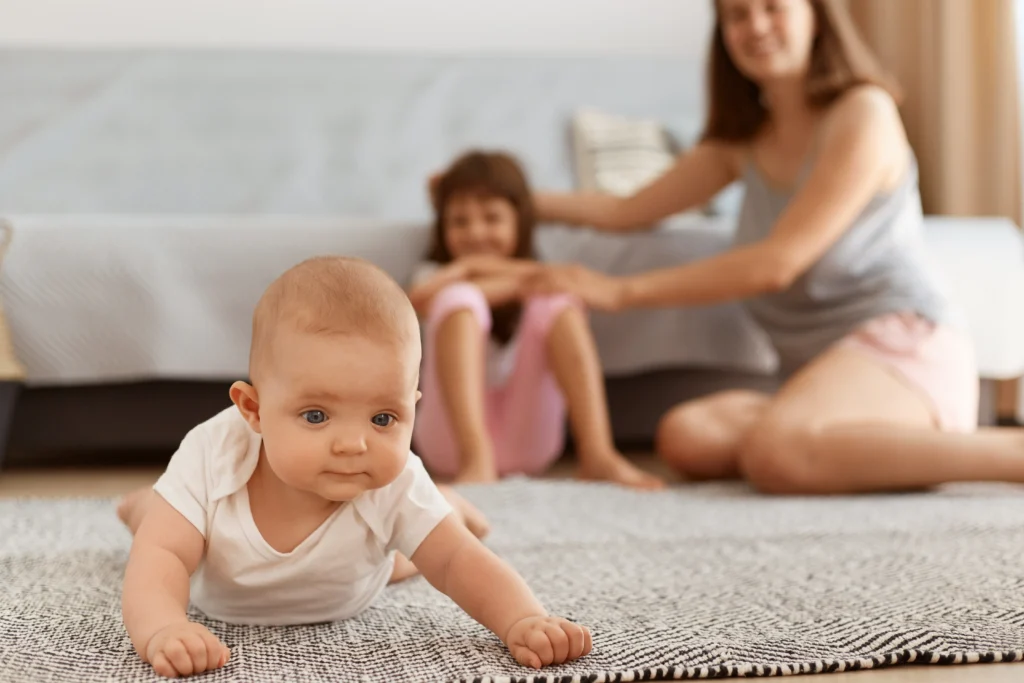
Crawling is only one part of gross motor development.
Other movements can help parents and healthcare professionals understand how a baby’s motor skills are progressing.
Sitting without support
By the end of 9 months, sitting without support is a milestone achieved by most babies according to the CDC.
Independent sitting requires trunk stability, balance and postural control. It also allows babies to use their hands for reaching, playing and exploring.
If your baby cannot sit independently around this age, discuss their development with a pediatrician.
Rolling and changing positions
Rolling helps babies develop body awareness, trunk control and coordination.
Observe whether your baby can move between positions and use their body comfortably.
Consistently struggling to move or showing a strong preference for one side may warrant assessment.
Reaching and shifting weight
When babies reach for toys, they learn to shift their weight while maintaining balance.
These movements help develop the control needed for more advanced activities, including moving from sitting to hands-and-knees positions.
Pushing up during tummy time
During supervised tummy time, babies gradually learn to lift their heads, support themselves on their forearms and push through their hands.
These activities help develop upper-body strength and postural control.
Using both sides of the body
Observe whether your baby moves both arms and legs comfortably.
Consistently favoring one side, dragging one leg, keeping one hand tightly fisted or avoiding movement with one arm should be discussed with a healthcare professional. (Centers for Disease Control and Prevention, 2025)
Signs That Your Baby May Need a Developmental Assessment
Not crawling by itself is not necessarily a warning sign. However, certain patterns deserve closer attention.
Consider arranging a developmental assessment if your baby:
- Cannot sit without support by around 9 months.
- Has difficulty controlling their head or trunk.
- Shows unusually stiff or floppy muscle tone.
- Consistently favors one arm or leg.
- Has difficulty rolling, reaching or changing positions.
- Shows little progress in acquiring new movement skills.
- Has difficulty using both sides of the body together.
Loss of previously acquired skills requires prompt medical assessment.
If your baby previously rolled, sat or moved in a particular way but has stopped doing so, do not wait for another milestone.
Parents should also seek advice if they have concerns about communication, interaction, feeding or other areas of development.
Developmental milestone checklists are useful for monitoring progress, but they are not diagnostic tools.
The CDC recommends discussing concerns with a healthcare professional and asking about developmental screening when appropriate. (Lipkin and Macias, 2020)
How Can Parents Encourage Their Baby to Crawl?
Parents do not need to force crawling. Instead, they can create safe opportunities for their babies to explore movement through everyday play.
1. Include supervised tummy time
When your baby is awake and alert, offer tummy time on a firm, safe surface under continuous supervision.
Start with short sessions and gradually increase the duration as your baby becomes comfortable.
Always place your baby on their back for sleep. Tummy time is only for awake, supervised periods.
2. Place toys slightly out of reach
Place an interesting toy just beyond your baby’s comfortable reach.
This encourages reaching, turning, pivoting and shifting weight. Keep the toy close enough to prevent frustration.
3. Encourage reaching in different directions
Place toys to the left, right and slightly in front of your baby.
This encourages movement in different directions and provides opportunities to practice coordination on both sides of the body.
4. Allow plenty of safe floor play
Give your baby opportunities to roll, sit, reach and explore on a clean, non-slip surface.
Reduce unnecessary time in restrictive seating equipment when your baby could safely be playing on the floor.
5. Get down and play with your baby
Sit or lie on the floor at your baby’s level. Use toys, sounds and facial expressions to encourage them to turn, reach and move towards you.
Make movement enjoyable rather than treating crawling as a task your baby must complete.
Never force your baby’s arms or legs into crawling positions or pull them into movements they cannot comfortably perform. (American Academy of Pediatrics, 2026)
Key Takeaways for Parents
- Many babies start crawling between approximately 7 and 10 months, but there is considerable individual variation.
- Some babies crawl on their stomachs, bottom-shuffle, roll or skip traditional hands-and-knees crawling.
- Independent sitting, head control, balance and movement symmetry are important developmental signs.
- Premature babies may need developmental milestones assessed using corrected age.
- Supervised tummy time and safe floor play provide opportunities to practise movement.
- Paediatric physiotherapy can support strength, balance, coordination and functional movement when needed.
- Loss of previously acquired skills requires prompt medical assessment.
How Can Pediatric Physiotherapy Help?
Pediatric physiotherapy can support babies who have difficulty developing age-appropriate movement skills.
The assessment focuses on the baby’s overall movement abilities rather than simply checking whether they can crawl.
A pediatric physiotherapist may assess:
- Head and trunk control.
- Muscle tone and strength.
- Rolling and independent sitting.
- Balance and weight shifting.
- Movement symmetry.
- Coordination between the arms and legs.
- Transitions between different positions.
Based on these findings, the physiotherapist may recommend individualized, age-appropriate activities.
Improving trunk and core control
Supported sitting, reaching and controlled changes in position can help babies develop trunk stability.
These skills provide a foundation for maintaining balance during movement.
Developing upper-body strength
Supervised tummy time and play-based activities encourage babies to use their shoulders, arms and hands to support their body.
These movements help prepare babies for pushing up and moving across the floor.
Encouraging weight shifting
Reaching for toys from different positions helps babies practice transferring their weight while maintaining balance.
This is an important component of developing coordinated movement.
Supporting movement transitions
A physiotherapist may use play-based activities to help babies practice moving between lying, sitting and hands-and-knees positions.
The activities should match the baby’s developmental abilities.
Physiotherapy is not about forcing a particular milestone; it is about improving functional movement and addressing identified difficulties.
If the assessment suggests a broader developmental or medical concern, the physiotherapist can coordinate referral to a pediatrician or other appropriate specialist.
Does Skipping Crawling Affect Walking or Learning?
Not necessarily.
Some babies move directly from rolling or sitting to standing and walking without ever crawling on their hands and knees.
The American Academy of Pediatrics explains that there is no established scientific evidence that skipping crawling automatically causes reading or learning difficulties later in childhood.
Crawling provides opportunities to practice coordination, balance and movement, but it is not a mandatory developmental stage.
What matters is the child’s overall development, including gross motor skills, fine motor abilities, communication, social interaction and learning. (American Academy of Pediatrics)
Baby Crawling: Myth vs Fact
MYTH: Every baby must crawl before learning to walk.
FACT: Some babies skip traditional hands-and-knees crawling and progress to standing and walking through other movement patterns.
MYTH: A baby who is not crawling by 9 months definitely has a developmental delay.
FACT: Crawling is not a CDC 9-month milestone. Independent sitting and other developmental skills provide important information about motor progress.
MYTH: Babies need to be placed in a crawling position to learn how to crawl.
FACT: Safe floor play, reaching, tummy time and natural movement opportunities can help babies develop motor skills without forcing positions.
MYTH: Skipping crawling automatically causes learning or reading difficulties.
FACT: There is no established scientific evidence that skipping this particular movement pattern automatically causes later learning problems.
When Should You Consult a Pediatric Physiotherapist?
Consider consulting a pediatric physiotherapist if your baby has persistent difficulty with rolling, sitting, reaching, changing positions or using both sides of the body.
An assessment can help determine whether your baby needs additional support or whether their movement pattern is within expected developmental variation.
You do not need to wait until your baby reaches their first birthday if you are concerned about their motor development.
If your baby has lost previously acquired skills, has marked weakness or has other concerning symptoms, seek medical assessment promptly rather than arranging physiotherapy alone.
Final Thoughts: Every Baby Has Their Own Journey
Not every baby follows the same movement timeline. Some crawl early, some take their time, and others skip traditional crawling altogether. The absence of crawling alone does not tell you whether your baby is developing normally.
Focus on your baby’s overall progress, provide safe opportunities for floor play and enjoy exploring movement together. If you notice persistent difficulties, unusual muscle tone or one-sided movement, seek professional guidance.
Conclusion
If your baby is not crawling yet, it does not automatically mean something is wrong.
Babies develop at different rates, and some use alternative movement patterns or skip traditional hands-and-knees crawling altogether.
However, independent sitting, head and trunk control, movement symmetry and steady progress are important signs to observe.
Provide plenty of safe floor play, encourage movement through interaction and avoid comparing your baby’s development with other children.
If you notice persistent movement difficulties, unusual stiffness or floppiness, asymmetry or loss of previously acquired skills, seek a professional assessment.
Early guidance from a pediatrician and pediatric physiotherapist can help identify developmental concerns and support your baby’s movement journey.
Frequently Asked Questions
1. Is it normal for a 10-month-old baby not to crawl?
Yes. Some 10-month-old babies may not crawl yet. Babies develop at different rates, and some use alternative movement patterns or skip traditional crawling. Look at overall motor development, including sitting, reaching and movement control.
2. Should I worry if my baby is not crawling at 12 months?
Not necessarily. Crawling is not a mandatory milestone. However, if your baby also struggles with sitting, changing positions, reaching or other movements, arrange a developmental assessment.
3. Can a baby walk without crawling?
Yes. Some babies move from sitting or other movement patterns to standing and walking without crawling on their hands and knees. Skipping this particular movement pattern does not automatically indicate a developmental problem.
4. What activities can encourage my baby to crawl?
Supervised tummy time, safe floor play, reaching for toys and playing at your baby’s level can encourage movement. Allow your baby to explore naturally rather than forcing them into a crawling position.
5. Can paediatric physiotherapy help a baby who is not crawling?
Yes. A paediatric physiotherapist can assess muscle tone, strength, balance, trunk control, movement symmetry and motor skills. Individualised play-based activities may help address identified movement difficulties.
6. Does premature birth affect crawling age?
Yes. Babies born prematurely may reach some milestones later. Healthcare professionals may use corrected age when assessing development, particularly during the first two years.
7. What are the warning signs of delayed motor development?
Difficulty sitting independently around 9 months, unusual stiffness or floppiness, persistent one-sided movement, limited progress or loss of previously acquired skills should be discussed with a healthcare professional. Loss of skills needs prompt assessment.
Stay tuned with us for more health related topics.
Follow us on LinkedIn and Instagram for more.
More Read


Medical Disclaimer
This article is intended for general educational purposes only and does not replace professional medical advice, diagnosis or treatment. Every baby develops differently, and developmental milestones should be interpreted in the context of the child’s age, medical history and overall development.
Consult a qualified pediatrician or pediatric physiotherapist if you have concerns about your baby’s movement or development. Loss of previously acquired skills, marked weakness or other concerning symptoms requires prompt medical assessment. Never force a baby into a movement or exercise position.


