


Prenatal pilates exercises can help improve posture, core stability, flexibility, and pelvic support during pregnancy
Pregnancy changes the body faster than most women expect.
One month you are moving normally, sleeping comfortably, walking without effort.
A few weeks later, your lower back starts aching while brushing your teeth, turning in bed becomes awkward, and suddenly your posture feels completely unfamiliar.
A lot of pregnant women think this discomfort is something they simply have to tolerate.
That is not always true.
As a physiotherapist, one thing I’ve consistently noticed is that women who stay active with the right kind of movement usually cope better physically and mentally during pregnancy.
Not intense workouts. Not exhausting routines.
Just smart, controlled movement that supports the body while it adapts.
That is where prenatal Pilates stands out.
And honestly, it is very different from the trendy social media version people imagine.
Quick Answer
Prenatal Pilates is a safe, low-impact form of exercise designed specifically for pregnancy. It helps improve posture, strengthen deep core muscles, reduce lower back pain, support the pelvic floor, improve breathing control, and prepare the body for labor and postpartum recovery.
Unlike intense workouts, prenatal Pilates focuses on controlled movement, stability, mobility, and body awareness. Many physiotherapists recommend it because it supports the changing pregnant body without placing excessive stress on joints or abdominal muscles.
When practiced under professional guidance, prenatal Pilates may help women feel more comfortable, balanced, and physically confident throughout pregnancy.
Real prenatal Pilates is not about flat abs, difficult poses, or aesthetic fitness routines.
It is about breathing properly, improving spinal support, teaching the pelvic floor how to function correctly, reducing unnecessary tension, and helping the body carry pregnancy more comfortably.
In clinic, I often recommend prenatal Pilates to women struggling with:
- lower back pain,
- pelvic heaviness,
- poor posture,
- rib tightness,
- sleep discomfort,
- neck tension,
- and even fear around labor movement.
The biggest surprise for many women is this:
Prenatal Pilates usually feels gentle while quietly training some of the most important muscles involved in pregnancy and recovery.
Key Takeaways
- Prenatal Pilates helps strengthen deep core and pelvic floor muscles safely during pregnancy.
- It may reduce lower back pain, pelvic discomfort, and posture-related strain.
- Controlled breathing exercises in Pilates can improve relaxation and breathing efficiency.
- Prenatal Pilates focuses on stability and mobility rather than intense workouts.
- It may support labor preparation through better endurance, movement awareness, and pelvic mobility.
- Regular prenatal Pilates can improve balance, flexibility, circulation, and daily movement comfort.
- Physiotherapists often recommend prenatal Pilates because it is gentle, functional, and adaptable for all trimesters.
- Proper supervision and pregnancy-specific modifications are important for safety.
What Exactly Is Prenatal Pilates?
Prenatal Pilates is a pregnancy-modified form of Pilates designed to safely support the changing body throughout all three trimesters.
The focus is not calorie burning.
It mainly works on:
- deep core stability,
- breathing mechanics,
- pelvic floor coordination,
- posture,
- spinal mobility,
- balance,
- and body awareness.
Most sessions include slow, controlled movements instead of fast repetitions.
That matters because pregnancy already places a huge physical load on joints, ligaments, muscles, and connective tissue.
One important thing many women do not realize is that pregnancy hormones, especially relaxin, make the joints more mobile and less stable.
This is one reason women suddenly develop:
- hip pain,
- knee discomfort,
- or sacroiliac joint irritation,
- pelvic girdle pain
Pilates helps improve muscular support around these joints. (NIH)
Why Prenatal Pilates Feels Different From Normal Exercise
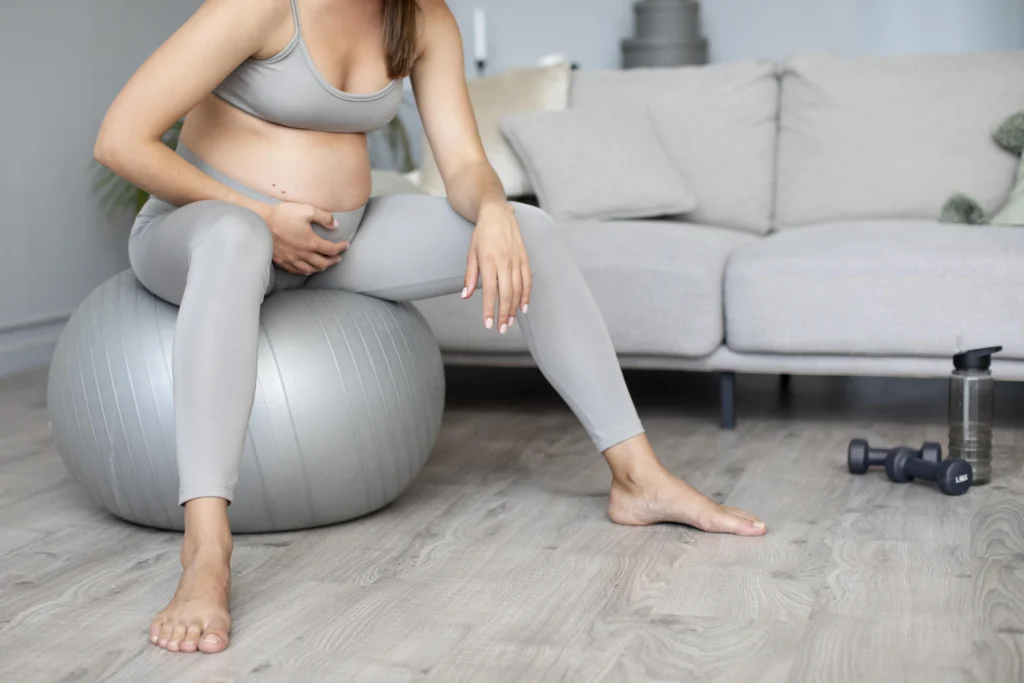
A lot of traditional workouts focus on intensity.
Prenatal Pilates focuses on efficiency.
That difference matters during pregnancy.
For example, many pregnant women unknowingly overuse their neck, lower back, or hip flexors because their deep stabilizing muscles are no longer working well.
Pilates retrains these deeper support systems.
In physiotherapy, we often pay close attention to:
- diaphragm function,
- pelvic floor coordination,
- rib cage mobility,
- and pressure management.
Prenatal Pilates naturally integrates all of these.
And honestly, this is one reason many women tell me:
“I finally feel lighter after exercising instead of more tired.”
One of the Biggest Benefits: Reduced Back Pain
Lower back pain is incredibly common during pregnancy.
Usually, it is not just because of weight gain.
It happens because:
- the center of gravity shifts forward,
- abdominal muscles stretch,
- posture changes,
- and spinal loading increases.
Many women start leaning backward without realizing it. That constant compensation overloads the lumbar spine.
Prenatal Pilates helps correct these movement patterns.
I’ve seen women improve significantly just by learning:
- better breathing,
- pelvic positioning,
- and deep core activation.
Research also supports this.
Research found that Pilates-based exercise programs during pregnancy may improve pain levels, physical conditioning, and overall quality of life. (PubMed)
The Pelvic Floor Part Nobody Explains Properly
Most pregnant women hear:
“Do Kegels.”
But very few are taught how the pelvic floor actually works.
The pelvic floor is not supposed to stay constantly tight.
It needs:
- strength,
- relaxation,
- coordination,
- and timing.
This becomes extremely important during labor.
One thing I often notice clinically is that women with excessive pelvic tension sometimes struggle more with pressure management and relaxation during delivery preparation.
Prenatal Pilates teaches women how to coordinate breathing with pelvic floor movement.
That is much more functional than random squeezing exercises.
(Siv Mørkved and her team et. al 2003) showed that pelvic floor muscle training during pregnancy may help reduce urinary incontinence both during and after pregnancy.
Prenatal Pilates Can Improve Breathing More Than Most Women Expect
This is one of the most underrated benefits.
As the uterus grows upward, the diaphragm loses space to move efficiently.
Many women unconsciously shift into shallow chest breathing.
That creates:
- neck tightness,
- rib stiffness,
- fatigue,
- and sometimes anxiety-like sensations.
Good prenatal Pilates sessions spend a surprising amount of time on breathing mechanics.
Not meditation-style breathing.
Functional breathing.
Learning how the ribs expand, how the diaphragm works with the pelvic floor, and how to avoid excessive pressure inside the abdomen.
And yes, breathing mechanics matter during labor too.
It Helps With Posture Without Constantly “Trying to Sit Straight”
Pregnancy posture advice online is often unrealistic.
You cannot force perfect posture all day.
The goal is not stiffness.
The goal is muscular balance.
Prenatal Pilates strengthens:
- upper back muscles,
- deep abdominal stabilizers,
- glutes,
- and postural support muscles.
That is why many women notice:
- less shoulder tension,
- reduced neck stiffness,
- and better sitting tolerance.
One interesting thing I’ve noticed in practice is that women working desk jobs often benefit enormously from gentle thoracic mobility exercises during pregnancy.
Sometimes the rib cage becomes more restricted than the lower back itself.
Prenatal Pilates and Diastasis Recti
This topic creates a lot of fear online.
Diastasis recti is the separation of abdominal muscles as the abdomen expands.
Some separation is normal during pregnancy.
The problem happens when pressure management becomes poor.
Aggressive workouts, improper core training, breath-holding, or forceful crunching may increase abdominal strain unnecessarily.
Prenatal Pilates focuses on controlled deep core activation rather than aggressive abdominal exercises.
That makes it far more pregnancy-friendly than many traditional fitness routines.
Still, honesty matters here:
No exercise guarantees prevention of diastasis recti.
Genetics, tissue quality, pregnancy size, and multiple pregnancies also play major roles.
Better Movement During Daily Life
This is something research papers do not always highlight enough.
Many women struggle more with:
- getting out of bed,
- rolling,
- standing from chairs,
- climbing stairs,
- or lifting objects
than actual exercise itself.
Prenatal Pilates improves movement efficiency.
That means everyday activities start feeling easier.
One patient once told me:
“I still feel pregnant, but I don’t feel stuck inside my body anymore.”
That sentence honestly describes the benefit perfectly.
Sleep Often Improves Too
Poor sleep becomes very common during pregnancy.
Especially during the second and third trimesters.
Physical discomfort plays a huge role.
Gentle mobility work, breathing exercises, reduced muscular tension, and improved circulation may all contribute to better sleep quality.
Recent reviews have shown prenatal exercise programs may positively affect maternal sleep and overall well-being.
Calculate your ideal sleep timings here: “Sleep Calculator“
Prenatal Pilates and Mental Health
Pregnancy is physical, but it is also emotionally demanding.
Many women feel disconnected from their bodies during pregnancy because everything changes so quickly.
Prenatal Pilates slows movement down enough for women to actually reconnect with how their body feels.
That matters psychologically.
Movement combined with breathing can help regulate stress responses and improve body confidence.
Some women even tell me prenatal Pilates becomes their “quiet hour” during pregnancy.
Not because it is easy.
Because it feels grounding.
Lesser-Known Benefits I’ve Seen Clinically
Rib Cage Mobility Improves
A lot of pregnant women develop tightness around the ribs, especially later in pregnancy.
Gentle rotational breathing exercises can help significantly.
Women Become More Aware of Tension Patterns
Many patients discover they constantly clench:
- shoulders,
- jaw,
- glutes,
- or pelvic muscles.
Awareness alone changes movement quality.
Swelling Sometimes Feels Better
Gentle circulation-focused movement may help reduce feelings of heaviness in the legs.
Especially for women sitting long hours.
Balance Improves
As body weight distribution changes, many women feel surprisingly unstable.
Controlled movement training improves coordination and body awareness.
What Makes Prenatal Pilates Safer Than Random Online Pregnancy Workouts
Honestly, not all “pregnancy workouts” online are truly pregnancy-safe.
Some routines:
- overload the abdominal wall,
- create excessive pressure,
- encourage unstable positions,
- or ignore pelvic floor mechanics completely.
Good prenatal Pilates respects pregnancy physiology.
Movements are usually modified according to trimester, symptoms, and comfort level.
That individualization matters.
ACOG continues to support regular moderate exercise during uncomplicated pregnancies because of its physical and psychological benefits. (ACOG Committee Opinion No. 804 (2020)
Important Things Pregnant Women Should Avoid During Pilates
A few common mistakes I regularly see:
Holding the breath
This increases pressure unnecessarily.
Over-tightening the core
Pregnancy core training should feel supportive, not rigid.
Stretching aggressively
Pregnancy hormones already increase flexibility.
Overstretching can irritate joints.
Ignoring pelvic pain
Pain is information.
Persistent pelvic pain should never be pushed through.
Following advanced online workouts blindly
Pregnancy modifications matter more than intensity.
Can Prenatal Pilates Exercises Help During Labor?
It cannot guarantee an easy labor.
No exercise can promise that.
But it can help women prepare physically.
Prenatal Pilates may improve:
- breathing control,
- endurance,
- pelvic mobility,
- body awareness,
- and movement confidence.
Some newer studies even suggest Pilates-based exercise programs may positively influence labor pain perception and maternal comfort. (Sadeghi et al. 2025)
What I Usually Tell First-Time Moms
You do not need to exercise perfectly during pregnancy.
You do not need intense workouts.
And you definitely do not need to “bounce back.”
Your body is already doing one of the hardest physiological jobs possible.
The goal of prenatal Pilates is not aesthetic fitness.
It is support.
Support for:
- your spine,
- breathing,
- pelvic floor,
- movement,
- recovery,
- and overall comfort.
That is why so many physiotherapists recommend it.
Not because it looks trendy online.
Because when done correctly, prenatal pilates exercises genuinely helps women move through pregnancy with less strain and more confidence.
Frequently Asked Questions
Is prenatal Pilates safe during pregnancy?
Yes, prenatal Pilates is generally safe for healthy pregnancies when exercises are modified correctly and supervised by a trained professional.
Can prenatal Pilates help with lower back pain?
Yes, prenatal Pilates may help reduce lower back pain by improving posture, core stability, pelvic support, and movement control.
How often should pregnant women do prenatal Pilates?
Most physiotherapists recommend practicing prenatal Pilates around 2 to 4 times per week depending on fitness level and pregnancy condition.
Can beginners start prenatal Pilates?
Yes, beginners can safely start prenatal Pilates under professional guidance with pregnancy-safe exercise modifications.
Does prenatal Pilates help during labor?
Prenatal Pilates may improve breathing control, endurance, pelvic mobility, and body awareness which can help women feel more prepared for labor.
Can prenatal Pilates prevent diastasis recti?
Prenatal Pilates may help improve pressure management and deep core support, but no exercise can completely prevent diastasis recti.
Is prenatal Pilates better than yoga during pregnancy?
Both are beneficial. Prenatal Pilates focuses more on core stability and posture, while prenatal yoga often emphasizes flexibility and relaxation.
Stay tuned with us for more health related topics.
Follow us on LinkedIn and Instagram for more.
More Read


Medical Disclaimer!
This article has been reviewed and written under the guidance of our Head Physiotherapist, Dr. Kruti Raj (PT, MUHS,CPT,CMPT). The information shared is intended for educational purposes only and should not be considered a substitute for personalized medical advice, diagnosis, or treatment.
Please consult us or any other qualified healthcare professional before beginning any exercise program, especially if you are experiencing pain, recovering from injury, or managing a medical condition.


