


Osgood-Schlatter disease is a common cause of knee pain in physically active children and teenagers, particularly during periods of rapid growth.
Quick Answer: Why Does Your Child Have a Painful Knee Bump?
Osgood-Schlatter disease is a common growth-related condition that causes pain, tenderness and sometimes a noticeable bump just below the kneecap. It occurs when repeated pulling from the patellar tendon irritates the developing tibial tubercle.
It commonly affects active children and teenagers who participate in running, jumping and other high-impact sports.
What usually helps?
- Temporary modification of painful activities.
- Progressive knee and hip strengthening.
- Appropriate flexibility and movement-control exercises.
- Gradual return to sports based on symptoms and function.
Remember: The knee bump may remain even after the pain improves. Most children recover without surgery.
It causes tenderness and sometimes a noticeable bony bump just below the kneecap.
The pain often becomes worse during running, jumping, squatting, kneeling or playing sports.
Although it can temporarily affect a child’s physical activity, most cases improve with appropriate activity modification, progressive strengthening and time for the growing knee to mature.
Key Takeaways for Parents
Repeated traction on the developing tibial tubercle causes local irritation and pain below the kneecap.
Running, jumping, kicking and repeated squatting may increase discomfort.
The visible bony prominence can remain after the pain settles and growth is complete.
Individualized strengthening, activity modification and movement training can help restore comfortable function.
Persistent pain, limping, significant swelling or difficulty bearing weight warrants medical assessment.
What Is Osgood-Schlatter Disease in Children?
Osgood-Schlatter disease, also known as tibial tubercle apophysitis, is an overuse condition affecting the developing area of bone at the upper part of the shinbone (tibia) in children.
To understand the condition, it helps to know how the knee straightens.
The quadriceps muscles at the front of the thigh contract to straighten the knee.
Their force travels through the quadriceps tendon, kneecap and patellar tendon before reaching the tibial tubercle, a small bony prominence just below the kneecap.
During childhood and adolescence, the tibial tubercle is still developing.
Repeated pulling from activities such as sprinting, jumping and kicking can irritate this growth-related attachment site.
This irritation causes localized pain and tenderness.
In some children, the tibial tubercle becomes more prominent, creating the visible bump that parents notice.
Osgood-Schlatter disease is not an infection or a tumor.
It is a growth-related musculoskeletal condition that commonly affects active adolescents. (Smith & Varacallo, 2023)
Why Does the Knee Bump Develop?
The bump develops at the tibial tubercle, where the patellar tendon attaches to the shinbone.
During growth, this attachment area is not yet fully mature.
Repeated loading of the quadriceps mechanism during sports can place traction forces on the developing bone.
Activities involving repeated knee bending and forceful straightening can aggravate this area, particularly when training intensity increases quickly or recovery time is insufficient.
The condition is commonly associated with:
- Repeated jumping and landing.
- Sprinting and rapid acceleration.
- Frequent kicking movements.
- Deep squatting and lunging.
- Sudden increases in sports training.
The visible prominence may remain even after the pain has settled.
Therefore, the aim of treatment is to manage pain and restore comfortable function, not necessarily to make the bump disappear.
What Are the Signs and Symptoms?
Symptoms usually develop gradually rather than following one specific injury.
Common signs include:
- Pain below the kneecap: Discomfort is usually localized over the tibial tubercle.
- A noticeable knee bump: The area may look enlarged or become more prominent.
- Tenderness to touch: Pressing directly over the bump can cause discomfort.
- Pain during sports: Running, jumping, sprinting and kicking may aggravate symptoms.
- Pain after exercise: Discomfort can increase during or after training.
- Difficulty kneeling: Direct pressure over the tibial tubercle may be uncomfortable.
- Pain during squats and stairs: Repeated knee bending may increase symptoms.
Some children experience symptoms in both knees, although one side may be more painful.
A child may walk comfortably but experience pain during football practice, basketball or repeated jumping.
This difference between everyday activity and sports participation is an important part of the assessment. (Kuwabara et al., 2021)
Which Children Are More Likely to Develop It?
Osgood-Schlatter disease most commonly affects growing children and adolescents, often during puberty.
It is particularly associated with sports that involve repeated running, jumping and forceful knee extension.
Factors that may contribute include:
1. Growth spurts
The tibial tubercle is still developing during adolescence. Repetitive traction on this area can contribute to irritation.
2. High sports participation
Children who regularly participate in football, basketball, volleyball, gymnastics, athletics and similar activities may experience repeated loading of the knee.
3. Sudden increases in training
Increasing the number of training sessions, practice duration or exercise intensity without sufficient recovery may aggravate symptoms.
4. Muscle flexibility and strength
Quadriceps and hamstring flexibility, hip strength and lower-limb movement control may influence how a child manages physical loads.
However, no single flexibility or strength problem explains every case.
Being physically active does not mean a child will necessarily develop Osgood-Schlatter disease.
How Is Osgood-Schlatter Disease in Children Diagnosed?
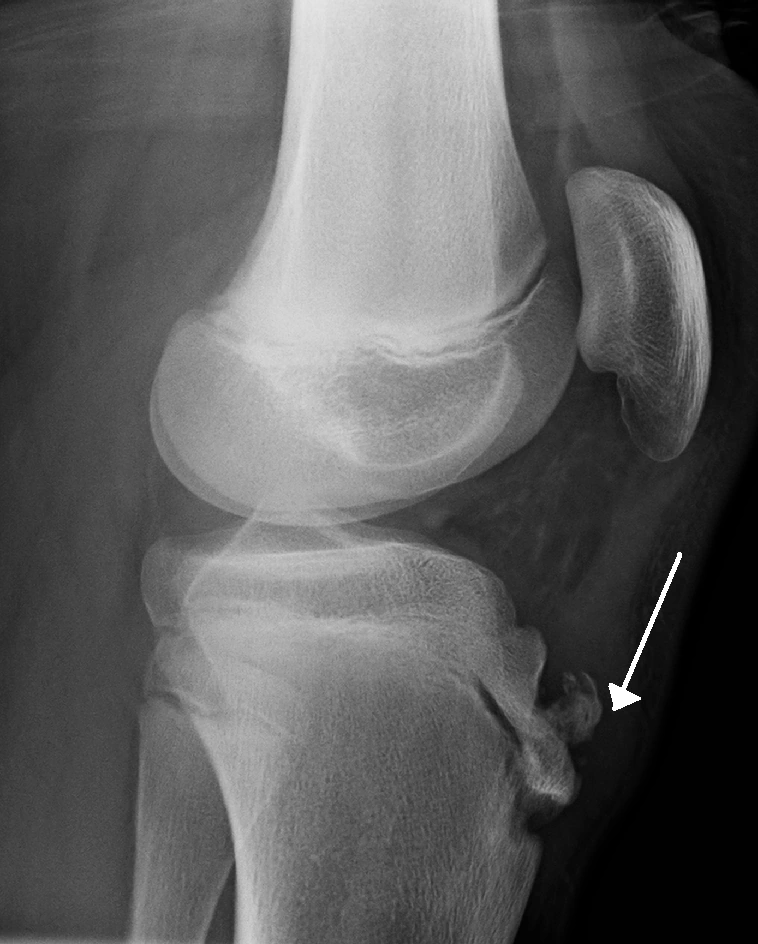
Diagnosis usually involves a clinical assessment by a pediatrician, sports medicine doctor or orthopedic specialist.
The assessment may include:
- Understanding when the pain started and which activities aggravate it.
- Checking the location of tenderness and swelling.
- Examining the tibial tubercle and patellar tendon.
- Assessing knee movement and pain during resisted knee extension.
- Checking quadriceps and hamstring flexibility.
- Observing walking, squatting and other functional movements.
Are X-rays or MRI Scans Necessary?
X-rays are not routinely required when the symptoms and physical examination are typical of Osgood-Schlatter disease.
However, a doctor may recommend imaging when symptoms are severe, persistent, follow an injury or suggest another condition.
Possible alternative diagnoses include:
- Patellar tendinopathy.
- Sinding-Larsen-Johansson syndrome, which affects the lower part of the kneecap.
- Tibial tubercle fracture.
- Patellofemoral pain.
- Bone or joint infection.
- Other bone or growth-related conditions.
Imaging helps investigate these possibilities when clinically indicated. (Royal Children’s Hospital Melbourne)
How Can Pediatric Physiotherapy Help?
Pediatric physiotherapy plays an important role in managing Osgood-Schlatter disease.
The main goals are to reduce activity-related pain, improve lower-limb strength, restore movement control and help the child return to sports safely.
Treatment should be individualized according to the child’s symptoms, growth stage, physical abilities and sporting requirements.
1. Activity Modification and Pain Management
Complete inactivity is not necessary for every child.
However, activities that repeatedly aggravate the knee may need temporary modification.
A physiotherapist may recommend:
- Reducing painful jumping and sprinting drills.
- Temporarily limiting deep squats or lunges if they provoke symptoms.
- Adjusting training duration and intensity.
- Including recovery days between demanding sessions.
- Maintaining comfortable activities that do not significantly increase pain.
A gradual approach helps children remain active without repeatedly overloading the painful area.
2. Quadriceps and Hamstring Flexibility
The quadriceps and hamstrings influence knee movement and the forces acting around the knee.
A physiotherapist may assess these muscle groups and recommend gentle flexibility exercises if restricted movement is identified.
Examples include:
- Gentle quadriceps stretching.
- Hamstring stretching.
- Comfortable hip flexor mobility exercises.
Stretching should not produce sharp pain or excessive pressure over the knee bump.
3. Progressive Knee Strengthening
Strengthening helps improve the child’s ability to control the knee during everyday activities and sports.
Depending on pain levels and movement ability, exercises may include:
- Straight-leg raises.
- Controlled sit-to-stand movements.
- Bridges.
- Supported squats within a comfortable range.
- Progressive knee extension exercises.
The physiotherapist adjusts resistance, repetitions and movement range according to the child’s response.
The aim is to gradually improve muscle capacity rather than push through pain.
4. Hip and Lower-Limb Strengthening
The hip muscles, particularly the gluteal muscles, help control lower-limb movement during running, jumping and landing.
If an assessment identifies reduced hip strength or poor movement control, a program may include:
- Side-lying hip abduction.
- Resistance-band side steps.
- Glute bridges.
- Supported single-leg balance.
- Controlled step-ups and step-downs.
These exercises help develop lower-limb control and should be progressed according to the child’s functional needs.
5. Balance and Movement Control
Children involved in sports need more than strong muscles.
They also need to coordinate movements while accelerating, landing, changing direction and maintaining balance.
Physiotherapy may include:
- Single-leg balance activities.
- Controlled landing practice.
- Step-down training.
- Squat movement control.
- Gradual running and jumping drills.
The physiotherapist observes how the child controls the knee, hip and ankle during these activities and addresses any relevant movement difficulties.
6. Gradual Return to Sports
Returning to sports too quickly can cause symptoms to flare up.
A physiotherapist may gradually progress the child through:
- Comfortable everyday activities.
- Basic strengthening exercises.
- Controlled functional movements.
- Light jogging and running.
- Jumping and landing practice.
- Sport-specific drills.
- Full training and competition.
Progression should depend on symptoms, strength, movement control and the child’s ability to tolerate increasingly demanding activities.
A prospective cohort study involving 51 adolescents with Osgood-Schlatter disease evaluated a 12-week program involving activity modification, pain monitoring, knee strengthening and gradual return to sport.
Around 80% reported improvement at 12 weeks, increasing to 90% at 12 months.
This supports an active rehabilitation approach, although the study did not establish that the program works equally well for every child. (Rathleff et al., 2020)
Can Your Child Continue Playing Sports?
Not every child needs to stop all sports.
The decision depends on pain severity, movement quality and the demands of the activity.
If symptoms are mild and the child can participate without limping or significantly worsening pain, modified activity may be possible.
However, temporarily reducing or stopping painful activities may be necessary when:
- Pain increases during training.
- The child starts limping.
- Jumping or sprinting becomes difficult.
- Pain continues to interfere with everyday activities.
- Symptoms remain worse after training.
Parents should avoid encouraging children to push through significant pain to complete practice or competitions.
The goal is to maintain suitable physical activity while allowing the irritated area to recover.
Osgood-Schlatter Disease: Myth vs Fact
Myth: The knee bump means the bone is permanently damaged.
Fact: The bump develops because of changes around the developing tibial tubercle. It may remain after symptoms resolve and does not automatically indicate ongoing damage.
Myth: Every child with Osgood-Schlatter disease must stop sports completely.
Fact: Some children can continue modified activities. Painful movements and training loads may need adjustment depending on symptoms.
Myth: Physiotherapy only involves stretching.
Fact: Treatment may include progressive strengthening, movement control, balance, activity modification and gradual sports-specific training.
Myth: The knee bump must disappear for recovery to be complete.
Fact: The bony prominence may remain even after pain and activity limitations have resolved.
Myth: Knee pain during adolescence is always Osgood-Schlatter disease.
Fact: Other conditions can cause knee pain. A proper clinical assessment is important, particularly after an injury or when symptoms are unusual.
How Long Does Osgood-Schlatter Disease in Children Last?
Recovery varies between children.
Symptoms may settle over several weeks or continue to fluctuate for months, particularly during periods of rapid growth and ongoing sports participation.
In many cases, symptoms gradually improve as the tibial tubercle matures and its growth-related attachment site closes.
The visible bump may remain even after the pain disappears.
This is usually harmless unless it continues to cause discomfort, particularly when kneeling.
A small proportion of people experience persistent symptoms into adulthood, sometimes associated with a residual bone fragment near the tibial tubercle.
Does the Knee Bump Disappear Completely?
Not necessarily.
The pain and irritation usually improve as the child finishes growing, but the bony prominence may remain.
This happens because the tibial tubercle can undergo changes during the healing and maturation process.
A remaining bump does not automatically mean that the condition is still active or that treatment has failed.
If the prominence remains painful after growth has finished, an orthopedic specialist can assess whether a residual bone fragment or another problem is contributing to the symptoms.
When Should Parents Seek Medical Attention?
Although Osgood-Schlatter disease is generally manageable, not every painful knee bump is caused by this condition.
Arrange a medical assessment if your child experiences:
- Persistent or worsening pain despite activity modification.
- A noticeable limp or difficulty walking.
- Significant swelling around the knee.
- Pain that occurs at rest or regularly wakes the child at night.
- Symptoms that do not improve as expected.
- Pain following a fall, collision or sudden injury.
Seek urgent medical attention if your child develops a hot, red and swollen knee with fever, becomes unable to bear weight, or experiences sudden severe pain after an injury.
These symptoms may indicate infection, fracture or another condition requiring prompt assessment.
What Can Parents Do at Home?
Parents can support recovery by making practical changes to their child’s daily activities.
- Encourage comfortable movement instead of complete inactivity.
- Reduce activities that consistently trigger knee pain.
- Apply a cold pack wrapped in a towel after activity if it helps relieve discomfort.
- Avoid direct pressure on the painful bump when kneeling.
- Allow adequate recovery time between demanding sports sessions.
- Follow the physiotherapist’s exercise programme.
- Monitor changes in pain, walking ability and sports participation.
Do not force painful stretches or strengthening exercises.
Medication, if needed, should be discussed with the child’s healthcare professional.
Final Thoughts
Seeing a painful bump below your child’s kneecap can be worrying, especially when it begins affecting sports and everyday activities. However, Osgood-Schlatter disease is generally a manageable growth-related condition.
With appropriate activity adjustments, progressive strengthening and guidance from a pediatric physiotherapist, most children can gradually return to their preferred activities.
One thing to remember: Recovery is about comfortable movement, strength and confidence, not necessarily making the knee bump disappear.
Pay attention to persistent pain, limping or unusual swelling, and seek medical advice when symptoms need further assessment.
Conclusion
Osgood-Schlatter disease is a common cause of knee pain in growing children and adolescents.
It develops when repeated pulling from the patellar tendon irritates the developing tibial tubercle, producing tenderness and sometimes a visible bump below the kneecap.
Although the condition can interfere with sports and physical activity, most children improve with appropriate activity modification, progressive strengthening and time for growth-related changes to settle.
Pediatric physiotherapy can help manage symptoms, improve lower-limb strength and movement control, and guide a gradual return to sports.
The goal is not simply to remove the knee bump, but to help the child remain active without repeatedly aggravating the painful area.
Frequently Asked Questions About Osgood-Schlatter Disease
1. What causes Osgood-Schlatter disease in children?
Osgood-Schlatter disease develops when repeated pulling from the patellar tendon irritates the developing tibial tubercle. It commonly affects growing children who participate in running, jumping and other high-impact sports.
2. At what age does Osgood-Schlatter disease usually occur?
It commonly occurs during puberty and periods of rapid growth. The exact age varies depending on the child’s growth and physical development.
3. Can Osgood-Schlatter disease affect both knees?
Yes. It can affect one or both knees. When both knees are involved, the pain may still be worse on one side.
4. Does the knee bump disappear after recovery?
Not always. The pain usually improves as the growth-related attachment site matures, but the bony prominence may remain even after symptoms resolve.
5. Can a child continue playing sports with Osgood-Schlatter disease?
Some children can continue modified sports activities if symptoms remain manageable. Activities that cause significant pain or limping should be reduced or temporarily stopped.
6. Can physiotherapy help Osgood-Schlatter disease?
Yes. Individualised physiotherapy can help manage pain, improve knee and hip strength, develop movement control and guide a gradual return to sports.
7. How long does Osgood-Schlatter disease take to heal?
Recovery varies. Symptoms may improve over several weeks or fluctuate for months, particularly during growth spurts and periods of sports participation.
8. When should parents worry about a painful knee bump?
Parents should seek medical assessment for persistent or worsening pain, limping, significant swelling or difficulty walking. A hot, red and swollen knee with fever or inability to bear weight needs urgent assessment.
Stay tuned with us for more health related topics.
Follow us on LinkedIn and Instagram for more.
More Read


Medical Disclaimer
The information provided in this article is intended for general educational purposes only. It should not be considered a substitute for professional medical advice, diagnosis or treatment.
Every child has different physical development, symptoms and healthcare needs. A painful knee bump should be assessed by a qualified healthcare professional to confirm the cause and determine the appropriate treatment.
Do not delay seeking medical advice or disregard professional recommendations based on information in this article. Consult a qualified pediatrician, orthopedic specialist or physiotherapist for individualized guidance.


