COLLEGE STATION, TEXAS. Researchers at Texas A&M University are investigating whether a nasal spray containing experimental drug-carrying nanocarriers could help slow Alzheimer’s disease.
The approach aims to deliver medicine directly to the brain while reducing exposure to other organs.
The research combines an experimental compound called DDL-357 with metal-organic framework (MOF) nanocarriers.
Early studies in mice have shown promising results for the individual technologies, but the combined nasal treatment has not yet demonstrated benefits in humans.
How Nanotechnology Could Change Alzheimer’s Treatment
Alzheimer’s disease is a progressive brain disorder that affects memory, thinking and behavior. It gradually damages nerve cells and the connections between them, making everyday activities increasingly difficult.
Most Alzheimer’s research has focused on reducing amyloid-beta plaques, which accumulate between nerve cells. However, the disease involves several biological processes, including inflammation, abnormal tau proteins, impaired communication between neurons and progressive cell damage.
Researchers at Texas A&M University are exploring a different strategy. Instead of targeting amyloid accumulation alone, the project aims to address several processes that contribute to cognitive decline.
The project is led by neuroscientist Ashok K. Shetty and mechanical engineer Ya Wang. It was one of 11 projects selected from 112 pre-proposals to receive an inaugural seed grant from the Texas A&M Health Dementia and Alzheimer’s Research Initiative.
A report published by the Waco Tribune-Herald on November 6, 2026, highlighted the research and its long-term ambition. The scientists hope that treatments capable of significantly delaying disease progression could allow people to live much longer without experiencing severe effects from Alzheimer’s.
The researchers describe this ambition as a possible functional cure. It would involve slowing the disease rather than eliminating it. However, this remains a long-term research vision, not a demonstrated outcome.
Why Is Treating Alzheimer’s So Difficult?
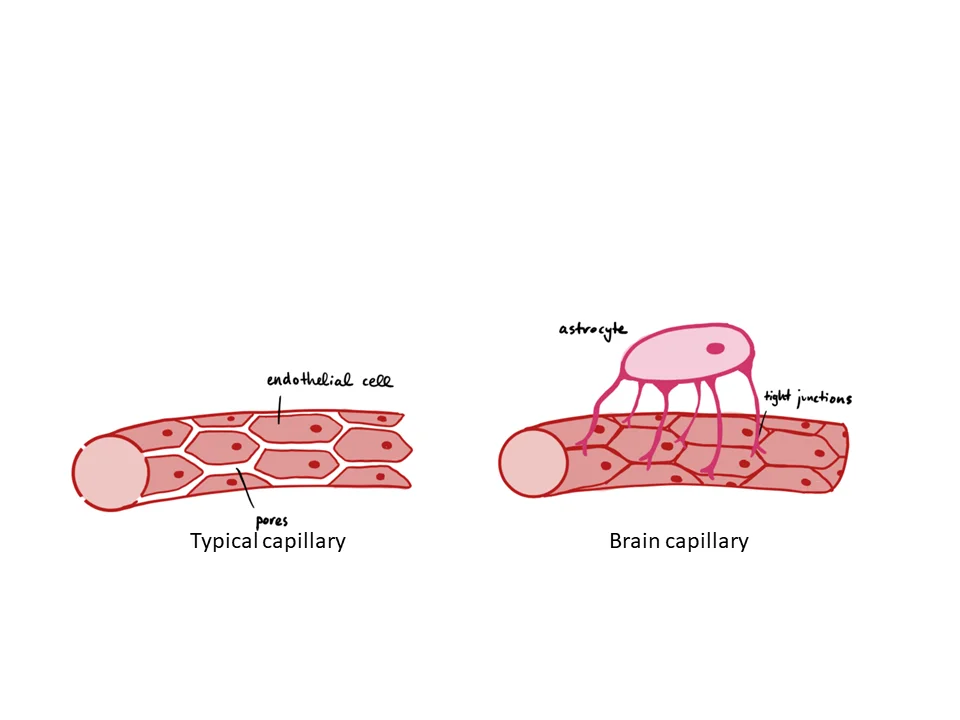
One of the biggest challenges in developing Alzheimer’s treatments is the blood-brain barrier (BBB).
The blood-brain barrier is a protective system formed by specialized cells lining the blood vessels in the brain. It controls which substances can move from the bloodstream into brain tissue.
This barrier protects the brain from harmful chemicals, toxins and infectious agents. However, it also prevents many medicines from reaching their intended targets.
Some drugs circulate through the bloodstream but cannot enter the brain in sufficient quantities to produce therapeutic effects. This can limit their effectiveness and increase exposure to other organs.
Researchers have estimated that the blood-brain barrier restricts approximately 98% of small-molecule drugs from reaching the brain at effective levels. This commonly cited estimate illustrates the challenge of developing treatments for neurological conditions.
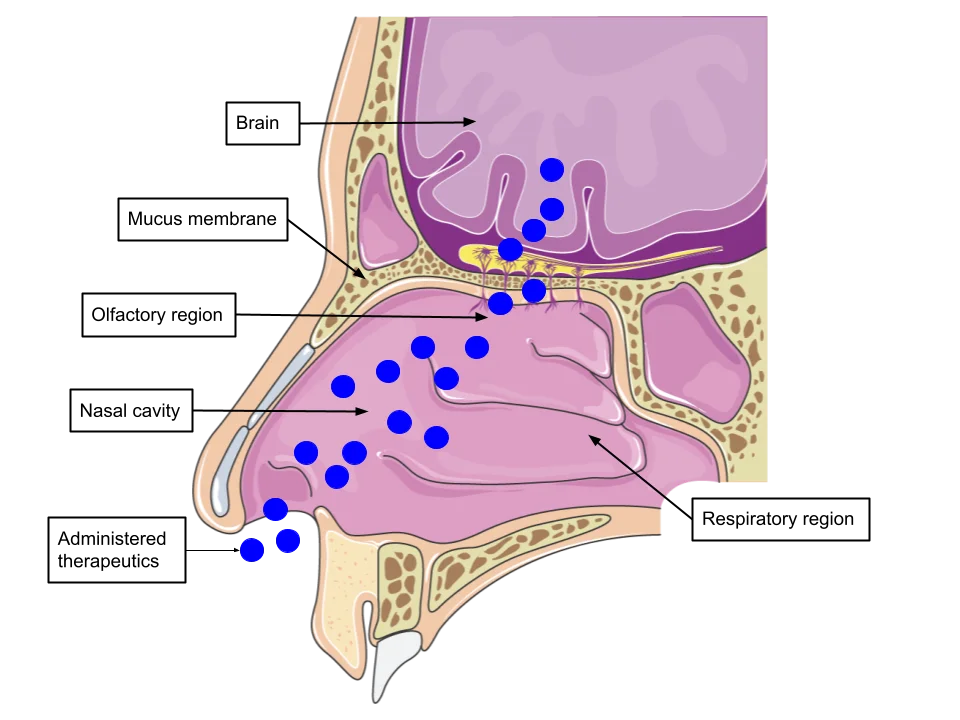
Nasal drug delivery offers another possible route. It aims to transport certain medicines from the nasal cavity towards the brain without relying entirely on bloodstream circulation. (Drath et al., 2025)
How Can a Nasal Spray Reach the Brain?
The nose has specialised nerve pathways that connect with the central nervous system. Researchers are investigating whether these pathways can transport medicines directly towards brain tissue.
Two pathways are particularly important.
1. Olfactory pathway
The olfactory system controls the sense of smell. Specialized nerve cells in the upper nasal cavity connect with the olfactory bulb, a structure located near the front of the brain.
Certain substances administered through the nasal cavity may travel along this pathway towards the brain.
2. Trigeminal pathway
The trigeminal nerve carries sensory information from the face to the brain. Its branches extend into the nasal region and connect with structures in the brainstem.
This pathway may also contribute to the movement of certain drugs from the nose towards the central nervous system.
Together, these pathways form the basis of nose-to-brain drug delivery. However, not every nasal formulation reaches the brain efficiently. Delivery depends on particle size, drug properties, formulation and administration technique. (Drath et al., 2025)
What Are the Nanorobots Used in the Research?
Despite the term nanorobots used in the original report, the drug delivery technology is more accurately described as metal-organic framework nanocarriers.
Metal-organic frameworks, or MOFs, are highly porous materials made from metal ions connected by organic molecules. Their structure contains tiny spaces that can hold drug molecules and help control their release.
Their design works similarly to a microscopic sponge.
These nanocarriers offer several potential advantages:
- Drug loading: Their porous structure can hold experimental medicines.
- Controlled release: Their composition can influence how quickly the medicine is released.
- Targeted delivery: Their formulation may improve drug accumulation in selected brain regions.
- Biodegradability: The proposed carriers are designed to break down after releasing their drug payload.
The research team is investigating MOFs made using metals naturally present in the human body. However, the final formulation must undergo further testing to establish its breakdown process and long-term safety.
These particles are not autonomous robots that independently navigate through the brain. They function as microscopic drug carriers.
DDL-357: The Experimental Drug Behind the Research
An important component of the project is DDL-357, an experimental small-molecule compound that increases levels of a protective protein called secreted clusterin (sCLU).
Clusterin plays several roles in maintaining brain health. It can influence the aggregation and clearance of amyloid-beta and tau proteins. It is also associated with processes involved in protecting nerve cells from cellular stress and damage.
Researchers believe increasing secreted clusterin could help address several mechanisms associated with Alzheimer’s disease.
The Texas A&M research team is particularly interested in three potential effects:
Reducing brain inflammation: Chronic inflammation can contribute to neuronal damage. Researchers are investigating whether increasing clusterin levels can help regulate inflammatory activity.
Supporting the formation of new neurons: Neurogenesis refers to the development of new nerve cells. The team wants to investigate whether DDL-357 can support this process.
Protecting synapses: Synapses are connections through which nerve cells communicate. Preserving these connections is important for learning and memory.
These are research objectives rather than established effects of the proposed nasal treatment.
What Did Previous DDL-357 Studies Show?
A 2025 study published in npj Drug Discovery investigated DDL-357 in two different Alzheimer’s mouse models.
The researchers administered the compound orally and observed several promising findings.
In the first model, called ApoE4TR-5xFAD, two weeks of treatment significantly increased secreted clusterin levels in the hippocampus, a brain region important for memory.
In a separate experiment using 3xTg-AD mice, six weeks of treatment reduced phosphorylated tau at the Ser396 site. The treated mice also performed better in the Barnes maze, a behavioral test used to assess spatial learning and memory.
However, not every result was statistically significant. For example, the reduction in amyloid-beta levels did not reach statistical significance in the reported experiments.
Most importantly, these findings came from oral DDL-357 administration in mice. They do not demonstrate that nasal delivery of DDL-357 will produce the same effects. (Cohn et al., 2025)
What Did Earlier Nanocarrier Experiments Reveal?
The current Texas A&M project also builds on an earlier study published in 2025. This experiment examined whether MOF-based nanocarriers could deliver metformin into the brain through the nasal route.
Metformin is a medicine commonly prescribed to manage type 2 diabetes. Researchers investigated its potential as a drug that could be delivered to the brain using nanotechnology.
The study used MOF-74-Mg nanocarriers loaded with metformin in mice.
The researchers reported several findings:
- Approximately 9% of the administered dose accumulated in collected mouse brain tissue eight hours after nasal administration.
- The nanocarriers achieved approximately 10% drug loading by weight.
- Laboratory testing showed that around 90% of the metformin was released over 16 hours.
- Brain imaging showed high uptake of the particles by neurons and microglia in several regions, including the hippocampus and striatum.
The researchers reported neuronal uptake of approximately 79% to 85% and microglial uptake of 93% to 97% in their measurements.
However, an important experimental detail must be considered. The mice received hyaluronidase before nasal administration to increase the permeability of the nasal mucous membrane. The brain accumulation measurements also involved small animal groups.
The reported 82-fold difference compared brain accumulation with previously published oral metformin data. It should not be interpreted as the result of a direct, matched comparison proving that nasal administration is 82 times more effective in humans.
Furthermore, this experiment tested metformin delivery, not DDL-357 treatment. It demonstrated the potential of the delivery technology, not a cure or improvement in Alzheimer’s symptoms. (Yuan et al., 2025)
What Challenges Must Researchers Overcome?
Although nose-to-brain delivery offers potential advantages, several issues must be addressed before the technology can become a treatment.
Nasal absorption: The nasal cavity contains mucus and protective cilia that remove foreign particles. This can reduce the time medicines remain in the nose and limit absorption.
Drug distribution: Researchers must establish whether enough DDL-357 reaches important brain regions and enters the intended cell types.
Safety: Repeated exposure to nanocarriers must not damage nasal tissues, affect the sense of smell or cause harmful effects in the brain.
Dosage: Scientists must determine the appropriate drug concentration and administration frequency.
Long-term effectiveness: Even if the medicine reaches the brain, researchers must establish whether it produces meaningful improvements in brain function and slows disease-related changes.
These challenges are common in the development of intranasal drug delivery systems and require extensive preclinical investigation. (Drath et al., 2025)
When Could the Nasal Spray Become Available?
The proposed DDL-357 nasal treatment remains at the preclinical research stage.
The Texas A&M team is currently investigating whether the nanocarriers can reach different brain regions, deliver sufficient quantities of the drug and enter the intended cell types.
The researchers must also determine whether the combined formulation can safely slow Alzheimer’s-related changes in the brain.
If the preliminary findings are successful, the team hopes to pursue additional research funding, potentially through the National Institutes of Health.
Human clinical trials would require further testing of safety, dosage, drug distribution and treatment effectiveness. There is currently no established timeline for the treatment to reach patients.
It is also important to understand that this research does not replace existing medical care. People experiencing memory loss or changes in cognitive function should seek an appropriate medical assessment.
Conclusion
The development of a nanotechnology-based nasal spray represents an interesting direction in Alzheimer’s research. It combines DDL-357, an experimental compound that increases protective clusterin levels, with metal-organic framework nanocarriers designed to improve drug delivery to the brain.
Earlier mouse experiments have demonstrated the potential of MOF-based carriers to transport medicines into brain tissue. Separate research has also reported encouraging effects of DDL-357 on certain Alzheimer’s-related changes and memory performance in mice.
However, the combined nasal formulation still needs to demonstrate its safety and effectiveness. Researchers must establish whether it can deliver sufficient quantities of DDL-357 to the brain and produce meaningful benefits.
The technology is not an approved Alzheimer’s treatment, and human benefits have not been established. Further research will determine whether this experimental approach can become a useful part of future Alzheimer’s care.