
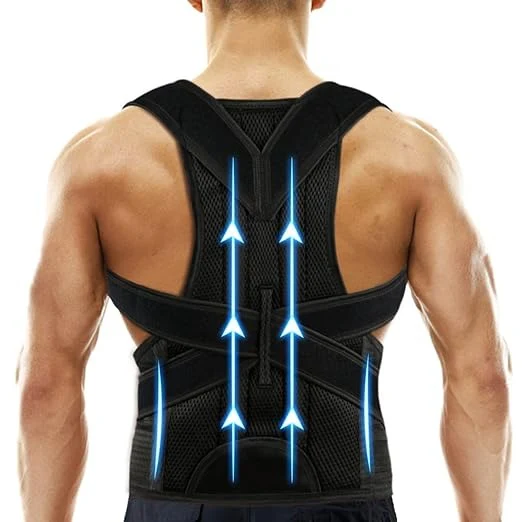

Why So Many People Are Turning to Neck Posture Devices
If you sit at a desk for long hours or spend a lot of time on your phone, you’ve probably noticed how easy it is to fall into a slouched position.
Many people start feeling neck stiffness, upper back tightness, or even headaches without realizing that posture plays a major role.
That is where wearable posture devices enter the picture.
They promise quick correction, less pain, and better alignment. For someone dealing with daily discomfort, that sounds reassuring.
In my clinical practice, I often meet people who have already tried these devices. Some feel temporary relief. Others say the effect fades once they stop using it.
A few even feel more dependent on the device over time.
So instead of asking whether these devices work, a better question is how they interact with your body.
Read about our Complete Neck Pain Guide : Causes, Symptoms, Exercises and Treatment
They can be useful for improving posture awareness and reducing slouching in the short term. However, if used for long hours or without exercises, they may reduce muscle engagement and create dependency.
Quick Insight:
Smart posture devices are generally safer because they encourage active correction, while rigid braces may weaken muscles if overused.
Bottom Line:
Use posture devices as a reminder, not a replacement. Long-term posture improvement depends on strengthening your neck and back muscles.
Read about: Early Signs of Cervical Spine Damage You Should Never Ignore
Key Takeaways
- Posture devices improve awareness but do not strengthen muscles
- Overuse of braces can reduce muscle activity and lead to dependency
- Smart posture trainers are better as they promote active correction
- Long-term posture improvement comes from exercise and muscle endurance
- Short duration use is safe, but all-day use is not recommended
- Deep neck muscles need training, not external support
- Posture is about endurance, not just sitting straight
- Combining devices with physiotherapy exercises gives the best results
Read about : 15 Common Causes of Neck Pain You Should Know
What Exactly Are Wearable Neck Posture Devices?

Understanding the Two Common Types
Most posture devices fall into two broad categories.
Passive posture correctors
These are braces or straps that physically pull your shoulders back and restrict slouching.
They create an immediate upright position without much effort from your muscles.
Smart posture trainers
These are small electronic devices placed on your upper back or neck.
They do not hold your body in position. Instead, they vibrate or send feedback when you start slouching.
At first glance, both seem helpful. But from a physiotherapy perspective, they influence your body very differently.
Read: Simple Posture Correction Exercises for Forward Head Posture
Why Posture Matters More Than Just Appearance
Your neck is designed to support your head in a balanced position. When you repeatedly bend forward, especially while using phones or laptops, the load on your cervical spine increases significantly.
Research has shown that as the head moves forward, the effective force on the neck rises sharply. (Hansraj, K. K. 2014)
At extreme angles, the load can reach levels that your muscles are not designed to handle for long durations. Over time, this leads to fatigue, strain, and discomfort.
But posture is not only about alignment. It is about how well your muscles can sustain that alignment throughout the day.
Read in detail about: How to Fix Upper Crossed Syndrome Naturally
The Real Issue: External Support Versus Internal Strength
One of the most important principles in rehabilitation is this.
If your body is supported externally for too long, your internal support system becomes less active.
When you wear a passive posture corrector:
- Your muscles are not doing the work
- Your brain reduces muscle engagement
- Your body adapts to the external support
Over time, this can reduce muscle endurance.
This does not mean the device is harmful in every situation. It means the way it is used matters more than the device itself.
Read: What is Torticollis? How to treat neck tilt condition
Do These Devices Actually Work?
What Research and Practice Both Show
Recent research suggests that posture devices can improve posture, but the improvement is often small. (de Vries et al. 2025)
The changes in posture angle are sometimes only a few degrees.
In clinical terms, that may not always translate into meaningful long term benefits.
Another important limitation is duration.
Most studies observe short-term effects. Long-term outcomes are still not well established.
This is something many people are not told when they purchase these devices.
Read about: What Is Military Neck Or Cervical Kyphosis And How To Treat It
The Muscle Substitution Effect
This is something I explain to patients very often.
When you rely on a posture device, your body may start shifting work away from deep stabilizing muscles.
Instead of strong internal support, your system begins to depend on:
- Passive structures like ligaments
- External correction from the device
- Superficial muscles instead of deep stabilizers
Over time, this can create a situation where:
You look upright with the device, but feel weaker without it.
This is not just a theory. It is something we observe clinically in long-term brace users.
Read: What Is Cervicovertebral Angle? Why It’s Important for Neck Posture
Can Posture Devices Make Your Neck Muscles Weak?
The short answer is yes, if used incorrectly.
Deep neck flexor muscles are essential for maintaining proper posture.
When these muscles are underactive, neck pain and dysfunction become more likely. (Jull, G. et al. 2008)
If a device replaces their function instead of training them, the muscles are not given a chance to improve.
That is where the risk lies.
Also read: How to Relieve Neck Tightness Without Equipment
Smart Devices Versus Braces
Why Smart Feedback Devices Are a Better Option
In recent years, I’ve noticed a shift in the type of devices patients bring to the clinic. Earlier, it was mostly rigid posture braces.
Now, more people are using small wearable sensors that sit quietly on the upper back and only respond when posture starts slipping.
What makes these devices different is how they interact with your body.
Instead of holding you in place, they wait. You sit, work, move naturally, and the moment you begin to slouch, you feel a gentle vibration.
It is not forceful. It is more like a tap on the shoulder that says, “Hey, you’re drifting.”
That small moment of awareness is powerful.
Because now, the correction comes from you. Your muscles engage. Your brain registers the movement.
Over time, this builds a pattern. You start catching yourself even before the device reacts.
Some of the newer versions go a step further. They use flexible, skin-like sensors that track posture throughout the day without feeling bulky or restrictive.
These are designed to blend into daily life rather than interrupt it. (Wang, C. et al. 2023)
But even with all this technology, the real benefit is not in the device itself. It is in how it changes your behavior.
People who use these devices well tend to do one thing differently. They respond.
Every vibration becomes a cue to reset, breathe, and realign. Over a few weeks, this starts becoming automatic.
From a physiotherapy point of view, that is exactly what we want. Not forced correction, but learned control.
Read about: Which Is The Best Sitting Posture To Avoid Neck Pain And How To Achieve It
When Braces Can Be Useful
Now, this does not mean braces are useless. In fact, there are situations where they can be quite helpful, provided they are used thoughtfully.
For example, someone dealing with sudden neck pain may struggle to maintain an upright posture at all.
In such cases, a brace can offer temporary support and reduce strain on irritated tissues.
After certain injuries, especially when movement needs to be limited for a short period, braces can act as a protective tool.
They give the body some time to settle before active rehabilitation begins.
I also sometimes suggest short-term use for people who have completely lost awareness of their posture.
In these cases, wearing a brace for brief periods can help them understand what an upright position feels like.
But this is where the line needs to be clear.
A brace is a support tool, not a training tool.
If someone starts wearing it for hours every day, the body quickly adapts in the wrong way. The muscles begin to rely on the brace.
The natural stabilizing system becomes less active. And when the brace comes off, the posture often collapses back to where it started, sometimes even worse.
I have had patients tell me, “I feel straight only when I wear it.” That statement itself is a warning sign.
Because the goal is not to feel correct with support. The goal is to be able to maintain that posture without needing anything external.
Read in detail: Neck Pain from Phone Use? Here’s How to Treat Text Neck Syndrome
So if a brace is used, it should be:
- For short durations
- For specific situations
- Alongside strengthening exercises
Used this way, it can be helpful. Used passively and continuously, it can delay real progress.
That distinction is what most people miss.
Read in detail: Best Desk Setup to Reduce Neck and Back Pain
The Behavioral Side of Posture Correction
One of the most overlooked aspects is behavior.
Devices do not fix posture. They only bring your attention to it.
A recent system showed high accuracy in detecting poor posture and providing feedback, but correction still depended on the user’s response. (Arunachalam et al. 2024)
This explains why two people can use the same device and get completely different results.
The difference lies in whether they actively engage with the correction.
Read About: Best Sleeping Position for Neck Pain: A Physiotherapist’s Complete Guide
Posture Is an Endurance Issue, Not Just Alignment
This is a shift in understanding that many people find surprising.
Good posture is not about holding a straight position for a few seconds.
It is about sustaining proper alignment throughout the day without fatigue.
Devices can improve position temporarily. But only exercises improve endurance.
That is why relying only on devices often leads to short-lived results.
Read About: How to Choose the Right and Best Pillow for Neck Pain
What Physiotherapy Focuses On Instead
In clinical practice, we rarely rely on external devices alone.
The focus is on:
- Activating deep neck flexors
- Strengthening upper back muscles
- Improving thoracic mobility
- Retraining movement patterns
Exercise-based approaches have shown better long-term outcomes for neck pain compared to passive methods. (Mahmoud, N. F. et al. 2019)
This is where lasting change comes from.
Read about: Effective Neck Pain Exercises At Home: A Complete Guide to Relief and Improved Mobility
Simple Exercises That Make a Real Difference
Chin tucks
Gently draw your chin backward while keeping your eyes level. Hold for a few seconds. This activates deep stabilizing muscles.
Scapular retraction
Pull your shoulder blades back and down. This improves upper back support.
Thoracic extension
Extend your upper back over a chair to reduce stiffness and improve posture alignment.
These exercises train your body instead of replacing its function.
Read: How to Fix Neck Hump Naturally
When You Should Use Neck Posture Devices
You can use a posture device safely if:
- You limit usage to short durations
- You combine it with exercises
- You use it as a reminder, not a solution
Think of it like training wheels. Helpful in the beginning, but not meant to stay forever.
Read: Spasm In Neck: What Causes It & How to Fix It Fast
Signs You Are Overusing It
Be cautious if you notice:
- Discomfort when not wearing the device
- Increased stiffness after removing it
- Reduced awareness without it
- Dependence for daily posture
These are early indicators that your body is not adapting independently.
Read about: What is Turkey Neck And How To Fix It Naturally
When You Should Avoid Using It
Avoid or limit use if:
- You already have muscle weakness
- You rely on it for long hours
- You are not doing strengthening exercises
- You have underlying cervical issues without guidance
In such cases, unsupervised use can do more harm than good.
Read about: Yoga for Neck Pain: Poses That Actually Work
Final Thoughts
Wearable neck posture devices are not inherently harmful. They can be helpful tools when used correctly and for the right duration.
But they are not a replacement for muscle strength, coordination, and endurance.
Your body is designed to support itself. The goal should always be to improve that ability, not replace it.
If you choose to use neck posture devices, use it wisely.
Let it guide you, not control you.
Read: How to Fix Sagging,Ozempic Neck After Rapid Weight Loss
Frequently Asked Question
Q1. Do posture correctors weaken muscles? Yes, prolonged use can reduce muscle engagement and lead to weakness.
Q2. How long should I use a posture device? It is best to limit usage to short periods and combine it with exercises.
Q3. Are smart posture devices better than braces? Yes, they encourage active correction rather than passive support.
Q4. Can posture devices fix neck pain permanently? No, they only help temporarily. Exercise is essential for long-term relief.
Q5. Is it safe to wear posture correctors daily? Short duration use is safe, but long hours may create dependency.
Q6. What is the best way to improve posture? Strengthening muscles and improving awareness through physiotherapy.
Q7. Can I rely only on posture devices? No, they should be used alongside exercises, not as a replacement.
Q8. Do they help with tech neck? They may help temporarily, but long-term improvement requires active correction.
Stay tuned with us for more health related topics.
Follow us on LinkedIn and Instagram for more.
More Read


Medical Disclaimer!
This article has been reviewed and written under the guidance of our Head Physiotherapist, Dr. Kruti Raj (PT, MUHS,CPT,CMPT). The information shared is intended for educational purposes only and should not be considered a substitute for personalized medical advice, diagnosis, or treatment.
Please consult us or any other qualified healthcare professional before beginning any exercise program, especially if you are experiencing pain, recovering from injury, or managing a medical condition.


