


If your knee hurts when you climb stairs, squat, get up after sitting, or run, you may have been told that the problem is “chondromalacia patella.”
The word itself can sound frightening because it refers to changes in the cartilage underneath the kneecap.
But here is the first thing I want you to know as a physiotherapist:
an MRI showing cartilage changes does not automatically mean that you need surgery, and cartilage findings do not always explain the amount of knee pain you feel.
In fact, modern management of patellofemoral problems has moved considerably beyond simply asking, “How damaged is the cartilage?”
Quick Answer
Can chondromalacia patella recover without surgery? In many cases, yes. Treatment usually begins with education, activity-load modification and progressive physiotherapy focused on improving quadriceps and, when appropriate, hip strength. Taping, foot orthoses and movement retraining may be added when they help. An MRI finding alone does not mean surgery is necessary.
We now look at the whole knee, including muscle capacity, hip strength, movement patterns, training load, foot mechanics, previous injuries, pain sensitivity and how well the knee tolerates everyday activities.
The latest best-practice guidance places exercise therapy and education at the centre of treatment, with taping, foot orthoses, manual therapy or movement retraining used selectively when they help an individual patient. (BMJ Journals, 2024)
So if you have been diagnosed with chondromalacia patella and are worried that your active life is over, take a breath.
There is a great deal that can be done before surgery is considered.
Key Takeaways
- Chondromalacia describes cartilage changes beneath the kneecap, but cartilage findings do not always explain pain.
- Physiotherapy and progressive strengthening are central to non-surgical recovery.
- Quadriceps and hip strengthening should be selected according to your individual assessment.
- Sudden increases in running, squatting, stairs or workout volume can aggravate symptoms.
- Complete rest is usually not the long-term solution.
- Taping and foot orthoses can help selected patients as supportive treatments.
- Surgery is not automatically necessary because an MRI shows cartilage damage.
- Recovery should be measured by strength, function and activity tolerance.
What Is Chondromalacia Patella?
Chondromalacia patella refers to softening, irregularity or damage involving the articular cartilage on the underside of the patella, or kneecap.
Your patella sits in a groove at the front of the thigh bone called the trochlea.
As you bend and straighten your knee, the kneecap moves within this groove.
The cartilage covering these surfaces helps the joint move smoothly and distribute forces.
However, there is an important distinction that is often missed online:
Chondromalacia patella and patellofemoral pain are not necessarily interchangeable diagnoses.
Patellofemoral pain is primarily a clinical pain condition involving the area around or behind the kneecap.
Chondromalacia describes a cartilage finding.
The two can coexist, but one does not automatically prove the other is causing your symptoms.
This distinction matters because articular cartilage itself does not contain nerves capable of directly producing pain.
Pain may instead arise from structures around the joint, including synovial tissues, fat pad, subchondral bone and other pain-sensitive tissues. (American Academy of Orthopaedic Surgeons)
That is one of the lesser-known facts I wish more patients were told after seeing an MRI report.
Why Can Chondromalacia Patella Happen?
There usually isn’t one single culprit.
I often explain patellofemoral pain as a capacity-versus-load problem.
Your knee may be perfectly capable of handling a certain amount of stress, but problems can arise when the load suddenly exceeds what the tissues and muscles are currently prepared to tolerate.
A sudden increase in exercise
You don’t necessarily need to be an elite runner to develop kneecap pain.
A person who normally walks 3,000 steps a day and suddenly starts doing 10,000 steps, stair workouts and squats every day has dramatically changed their knee workload.
The same applies to:
- Suddenly increasing running distance
- Starting HIIT workouts
- Adding frequent stair climbing
- Returning to sport after months away
- Increasing squat or lunge volume
- Adding hills to running
- Increasing gym frequency
- Changing training surfaces
The knee may tolerate the first few sessions and then become increasingly irritated.
This is why I don’t tell patients simply to “rest the knee.”
I want to know what changed immediately before the pain started.
Patellofemoral pain is common in physically active people, adolescents and adults.
A systematic review found substantial prevalence in the general population and particularly high rates among adolescents and athletic populations.
Quadriceps weakness or reduced knee capacity
Your quadriceps aren’t simply muscles that straighten your knee.
They help control how your knee handles load.
When the quadriceps are poorly conditioned, activities such as descending stairs, squatting, running and jumping can become more demanding.
But I would caution against the old idea that every case is caused by a weak “VMO.”
The current evidence supports strengthening the knee as a whole rather than obsessively trying to isolate one tiny part of the quadriceps.
A 2023 randomized controlled trial found that 12 weeks of quadriceps-focused and hip-focused exercise produced equivalent improvements in people with patellofemoral pain. (BMJ)
That means your rehabilitation should be based on your examination rather than a one-size-fits-all “VMO exercise.”
Hip muscle weakness and movement control
Your hip influences what happens below it.
During walking, running, landing or squatting, the hip muscles help control the position of your thigh.
Some people with patellofemoral pain demonstrate altered hip mechanics, although the relationship is more complicated than simply saying “weak glutes cause chondromalacia.”
A systematic review and meta-analysis found associations between patellofemoral pain and several aspects of hip biomechanics, supporting the importance of evaluating the hip as part of a broader assessment. (MDPI)
This is why I often assess a patient’s single-leg squat, step-down, walking and running pattern rather than examining only the knee.
Foot and ankle mechanics
Your foot is another piece of the chain.
Foot and ankle alignment can influence lower-limb movement, but it would be inaccurate to tell everyone with chondromalacia that they need orthotics.
Research suggests that foot and ankle characteristics may be associated with patellofemoral pain, but individual assessment is still important. (NCBI)
A useful clinical trick is to see whether a person’s symptoms improve during a functional task when temporary foot support is introduced.
If there is a meaningful change, an orthosis may be worth considering.
The newest best-practice guidance specifically recommends using prefabricated foot orthoses selectively rather than automatically prescribing them to everyone.
Previous kneecap injury
A previous patellar dislocation, fracture or direct blow can alter how the patellofemoral joint behaves.
In these situations, rehabilitation may need to address stability, strength, confidence and movement control in addition to pain.
Prolonged sitting
One surprisingly characteristic symptom is pain after sitting with the knee bent for a long time.
This is sometimes called the “movie theatre sign.”
You may feel perfectly comfortable walking around but become uncomfortable after sitting through a film, long meeting or car journey.
The symptom is recognised in patellofemoral pain presentations. (Mayo Clinic)
The solution isn’t necessarily to avoid sitting forever.
Often, improving movement tolerance and gradually restoring knee capacity is more useful.
What Does Chondromalacia Patella Feel Like?
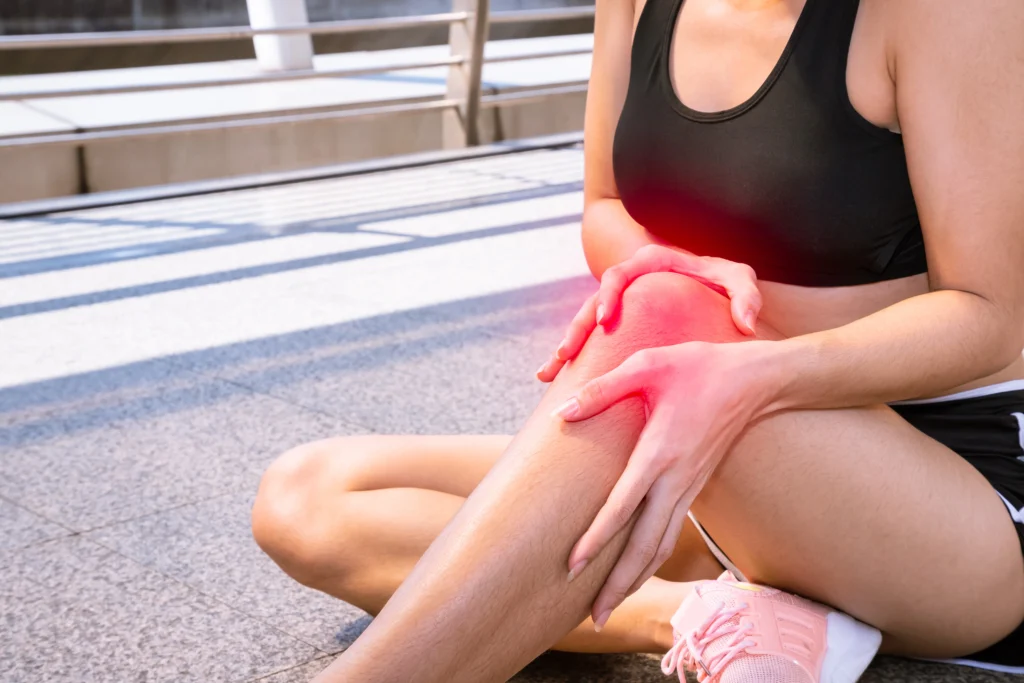
Symptoms can vary considerably.
Common complaints include:
- Aching pain around or behind the kneecap
- Pain while climbing or descending stairs
- Discomfort during squats
- Pain after prolonged sitting
- Pain during running or jumping
- Discomfort when getting up from a chair
- Grinding or clicking sensations
- Mild swelling or irritation
- Reduced tolerance for kneeling
- Pain after increasing exercise
Descending stairs can be particularly uncomfortable because the quadriceps must work eccentrically to control your body weight.
But clicking deserves special attention.
A noisy knee is not automatically a damaged knee.
Crepitus can occur in people without significant pain or functional limitation.
I am much more interested in whether the noise is accompanied by persistent pain, swelling, locking, giving way or loss of function.
Does an MRI Mean Your Knee Is Getting Worse?
Not necessarily.
This is one of the most important concepts in modern musculoskeletal physiotherapy.
Imaging can identify structural changes, but structural findings and symptoms do not always match perfectly.
Some cartilage changes may exist without severe pain.
Conversely, a person can experience considerable pain without dramatic structural abnormalities.
That is why your physiotherapist should not prescribe treatment for chondromalacia patella based solely on the MRI report.
The examination should consider:
- Pain behaviour
- Functional limitations
- Knee strength
- Hip strength
- Movement patterns
- Range of motion
- Training history
- Foot mechanics
- Previous injuries
- Symptom irritability
- Your goals
This approach is consistent with the 2024 British Journal of Sports Medicine best-practice guide, which recommends beginning with the person’s history, symptoms and physical impairments before choosing interventions.
How Is Chondromalacia Patella Diagnosed?
Diagnosis begins with history and physical examination.
Your clinician may observe your knee during:
- Walking
- Squatting
- Step-downs
- Stair movement
- Single-leg tasks
- Running
- Knee flexion and extension
They may assess tenderness, strength, mobility and patellar movement.
MRI can be useful when there is uncertainty, suspected structural injury, persistent symptoms or another condition needs to be ruled out.
But an MRI should not become the entire diagnosis.
One particularly interesting historical paper examining patellar cartilage found that cartilage changes could exist without persistent symptoms,
highlighting why the term “chondromalacia” should not automatically be treated as a complete explanation for ongoing anterior knee pain. (Abernethy et al., )
Can Chondromalacia Patella Recover Without Surgery?
Yes, many people can significantly improve without surgery.
The goal is not to magically “regrow” every area of cartilage.
Instead, conservative rehabilitation aims to reduce symptoms, restore strength, improve movement capacity, manage loading and help you return to normal activity.
The strongest modern evidence supports exercise therapy combined with education.
The 2024 best-practice guide recommends knee-targeted exercise, with or without hip-targeted exercise, as the foundation of chondromalacia patella treatment.
Supporting treatments such as taping, orthoses, manual therapy and movement retraining can be added according to individual needs.
Earlier consensus recommendations similarly concluded that exercise reduces pain and improves function, while combined hip and knee exercise can be particularly useful. (International Patellofemoral Pain Research)
The Physiotherapy Approach I Prefer
Step 1: Calm the irritated knee without completely stopping movement
If your knee is highly irritable, temporarily reduce activities that repeatedly provoke symptoms.
That could mean:
- Shortening running distance
- Reducing squat depth
- Limiting repeated stairs
- Temporarily reducing jumping
- Switching some sessions to cycling or swimming
- Reducing workout frequency
This is load modification, not complete rest.
A common mistake is going from exercising every day to doing absolutely nothing for six weeks.
The knee becomes less conditioned, and returning to activity can then trigger the same symptoms again.
Step 2: Begin with tolerable strengthening
Depending on your symptoms, early rehabilitation may include:
- Quadriceps isometrics
- Straight-leg raises
- Controlled mini-squats
- Step-ups
- Hip abductor strengthening
- Hip extension exercises
- Calf strengthening
- Controlled leg press
- Progressive knee extension exercises
The exact exercise is less important than the principle:
The knee needs progressive exposure to load.
Research has consistently supported exercise therapy for patellofemoral pain.
A randomized controlled trial found supervised exercise improved pain and function compared with usual care. (BMJ)
Step 3: Progress rather than staying with “easy exercises”
This is where many rehabilitation programmes fail.
A person may perform clamshells and straight-leg raises for months but never progress to meaningful functional loading.
Your knee eventually needs to become stronger for the activities you actually want to perform.
That might mean progressing toward:
isometrics → controlled strengthening → squats → step-downs → lunges → hopping → running → sport-specific movements
The exact progression depends on your symptoms and goals.
Step 4: Train the hip when it is relevant
Hip strengthening can be particularly valuable when your examination shows poor hip capacity or movement control.
But you don’t need to perform endless glute exercises simply because you have anterior knee pain.
A 2023 randomized equivalence trial found hip-focused and quadriceps-focused programmes produced similar improvements over 12 weeks.
So the better question is not:
“Should I strengthen my hips or my knees?”
It is:
“What does my assessment show I need to improve?”
A Lesser-Known Recovery Tool: Exercise Volume
More exercise isn’t automatically better.
A fascinating 2026 randomized clinical trial compared one-set versus three-set resistance training in women with patellofemoral pain.
Both groups completed a nine-week programme, providing emerging evidence that rehabilitation volume can be individualised rather than assuming that more sets always produce better outcomes. (Elsevier)
This matters if your knee becomes sore after high-volume workouts.
You may not need to stop strengthening.
You may simply need to reduce the dose and build it back gradually.
What About Taping?
Patellar taping can sometimes provide short-term symptom relief.
I use it as an adjunct, not as the main treatment for chondromalacia patella.
If taping makes stairs or squats more comfortable, that information can be clinically useful.
It may allow you to exercise with less discomfort while your strength and capacity improve.
Current guidance supports taping selectively, especially when pain irritability is interfering with rehabilitation.
If the tape is the only thing making your knee feel better after months of treatment, however, I would reassess the rehabilitation strategy.
Are Knee Braces and Orthotics Necessary?
Not for everyone.
A prefabricated foot orthosis may help some people in the short term, particularly when symptoms respond to a clinical trial of support.
Similarly, a brace may occasionally improve confidence or comfort.
But neither should become a substitute for rebuilding strength and load tolerance.
Think of these tools as bridges, not permanent solutions.
What Should You Avoid During Recovery?
You don’t necessarily need to permanently ban squats, stairs, running or gym training.
Instead, I recommend avoiding the combination of:
too much + too soon + too often.
For example, if you suddenly begin five days of running, three days of leg training and weekend hiking, your knee may struggle even if every individual activity is technically “safe.”
Also avoid:
- Training through progressively increasing pain
- Increasing several training variables simultaneously
- Returning to full sport immediately after a pain-free week
- Performing exercises simply because they are trending online
- Believing every click means cartilage destruction
- Relying exclusively on machines or passive treatments
- Staying inactive for prolonged periods without a rehabilitation plan
A Useful Pain Rule During Exercise
Pain during rehabilitation needs context.
A mild, tolerable increase in symptoms during an exercise does not automatically mean you are damaging your cartilage.
What matters is the overall response.
If a particular exercise causes severe pain, significant swelling or a prolonged flare that repeatedly lasts into the following days, the exercise dose may be too high.
I usually look at:
Pain during exercise → symptoms later that day → next-morning response → ability to perform normal activities.
This gives much more information than judging an exercise solely by whether you felt one twinge during the movement.
The latest best-practice guide specifically recommends adjusting exercise according to symptom severity and irritability and revisiting the plan when favourable progress is not occurring.
How Long Does Chondromalacia Recovery Take?
There is no universal recovery clock.
Some people improve considerably within several weeks.
Others with longstanding pain require several months of progressive rehabilitation.
The important point is that improvement should be measured by function, not simply by whether the MRI looks different.
Ask yourself:
- Can I climb more stairs?
- Can I sit longer?
- Can I walk farther?
- Can I squat deeper?
- Can I train more frequently?
- Is my pain less intense?
- Do flare-ups settle faster?
- Is my strength improving?
These are meaningful recovery markers.
Research also suggests that earlier physiotherapy may be associated with lower subsequent healthcare use and recurrence compared with delayed physiotherapy in people with patellofemoral pain. (BMC)
When Should Surgery Be Considered?
The phrase “chondromalacia” does not automatically mean surgery.
In many people with patellofemoral pain, conservative treatment is the appropriate starting point.
A particularly important randomized trial compared arthroscopy plus exercise with exercise alone in people with chronic patellofemoral pain.
Both groups improved, but adding arthroscopy did not provide a meaningful additional benefit and increased healthcare costs. (Kettunen et al., )
That does not mean surgery is never appropriate.
A specialist assessment becomes particularly important when there is:
- Recurrent patellar dislocation
- True mechanical locking
- Significant structural injury
- Large symptomatic cartilage defects
- Persistent swelling
- Major instability
- Failure of an appropriately designed and adequately progressed rehabilitation programme
- Another structural condition requiring surgical management
The decision should be based on the complete clinical picture, not simply an MRI grade.
When Knee Pain Is Not “Just Chondromalacia”
Please don’t assume every anterior knee symptom is chondromalacia.
Other conditions can produce similar pain, including:
- Patellar tendinopathy
- Fat-pad irritation
- Meniscal pathology
- Osteoarthritis
- Bursitis
- Referred pain
- Ligament injury
- Patellar instability
- Inflammatory joint conditions
Urgent medical evaluation is appropriate after major trauma, sudden inability to bear weight, a locked knee, significant swelling, fever or a hot/red joint.
A physiotherapist should also refer when the presentation doesn’t fit a straightforward musculoskeletal pattern.
Three Things I Wish Every Patient With Chondromalacia Knew
Your MRI grade is not your destiny
A higher-grade cartilage finding does not mean that your future function is automatically poor.
Your rehabilitation potential depends on far more than the appearance of cartilage.
Pain-free does not mean “fully conditioned”
This is one of the biggest traps.
You may feel wonderful after two weeks of rest and immediately return to running 5 km.
The knee may not be ready.
The goal is not just to remove pain.
It is to restore capacity so that your knee can tolerate your lifestyle.
Recovery is often about tolerance, not perfection
Your knee doesn’t need to move perfectly at every millisecond.
Human movement is variable.
What matters is whether your body can repeatedly tolerate the activities you ask it to perform.
My Practical Chondromalacia Recovery Checklist
If I were guiding a patient through rehabilitation, I would focus on these principles:
- Identify what changed before the pain began.
- Reduce excessive load without becoming completely inactive.
- Strengthen the quadriceps progressively.
- Assess and train the hip when indicated.
- Improve single-leg control where necessary.
- Consider foot mechanics rather than automatically prescribing orthotics.
- Use taping selectively when it improves exercise tolerance.
- Increase exercise volume gradually.
- Monitor the response over the following 24 hours.
- Progress toward the activities you actually want to return to.
- Reassess the diagnosis if rehabilitation is not working.
- Don’t let an MRI report determine your entire treatment plan.
Final Word From a Physiotherapist
If you’ve been told that you have chondromalacia patella, I understand why the word “cartilage damage” can make you immediately think about surgery.
But your knee is more than a picture on an MRI.
Your muscles, nervous system, movement habits, training load, confidence, activity level and the tissues surrounding the kneecap all influence how your knee behaves.
The evidence increasingly supports a rehabilitation-first approach centred around education, progressive exercise and individualised load management, with additional tools used when they actually help you move forward.
And perhaps the most reassuring message is this:
You do not have to wait for your knee to become completely pain-free before beginning to rebuild it.
You need the right starting point, the right exercise dose and enough progression to make your knee more capable than it was before.
If your pain is persistent, worsening or interfering substantially with everyday activities, get an individual assessment rather than trying to diagnose the exact cartilage problem from an MRI report alone.
Your goal should not simply be “protect the cartilage.”
Your goal should be to build a knee that is strong, confident and capable of handling the life you want to live.
Frequently Asked Questions
Can chondromalacia patella heal without surgery?
Many people can improve significantly without surgery through progressive physiotherapy, strengthening, education and appropriate activity modification.
Can I exercise with chondromalacia patella?
Yes. Exercise is one of the main treatments, but the intensity, range, volume and frequency should match your current tolerance.
Is walking good for chondromalacia patella?
Walking is often appropriate when symptoms are manageable. If walking causes increasing pain or swelling, your activity dose may need temporary adjustment.
Does chondromalacia patella always require surgery?
No. Surgery is not automatically required because cartilage changes are visible on an MRI. Conservative rehabilitation is usually an important first step.
How long does chondromalacia patella take to recover?
Recovery varies. Some people improve within weeks, while longstanding symptoms can require several months of progressive rehabilitation.
Can I run with chondromalacia patella?
Running does not necessarily have to be permanently stopped. Distance, speed, hills and frequency can be modified and gradually rebuilt as tolerance improves.
Does clicking mean my kneecap cartilage is getting worse?
No. Clicking or grinding can occur without serious progression. Persistent pain, swelling, locking or instability are more clinically important symptoms.
What exercises help chondromalacia patella?
Depending on the individual, rehabilitation may include quadriceps, hip, calf and functional strengthening exercises with gradual progression.
Should I use a knee brace or orthotic?
Some people benefit from supportive interventions, but they should be selected according to symptoms and examination findings rather than used automatically.
When should I see a doctor for chondromalacia?
Seek professional assessment for persistent or worsening pain, significant swelling, instability, locking, inability to bear weight, fever, redness or major trauma.
Stay tuned with us for more health related topics.
Follow us on LinkedIn and Instagram for more.
More Read


Medical Disclaimer!
This article has been reviewed and written under the guidance of our Head Physiotherapist, Dr. Kruti Raj (PT, MUHS,CPT,CMPT). The information shared is intended for educational purposes only and should not be considered a substitute for personalized medical advice, diagnosis, or treatment.
Please consult us or any other qualified healthcare professional before beginning any exercise program, especially if you are experiencing pain, recovering from injury, or managing a medical condition.


