


Lower back pain affects millions of people worldwide and remains one of the most common reasons for missed work, reduced activity, and medical consultation. Research consistently shows that movement-based interventions, including specific core activation exercises like pelvic tilt exercise for lower back pain, are among the most effective ways to reduce chronic and subacute lower back pain.
Unlike passive treatments, which offer only short-term relief, active movement retrains muscles and nervous systems, leading to lasting functional improvements.
One of the simplest yet most powerful tools in this category is the pelvic tilt, a foundational movement that targets deep core stabilizers, reduces lumbar stiffness, and retrains proper spinal alignment.
In this article, you will learn what it is, why it matters, how to do it safely, how often to perform it, common mistakes to avoid, and what the latest research says about its effectiveness.
Also Read: Top 5 Posture Mistakes Causing Back Pain and How to Fix Them
What Is a Pelvic Tilt?
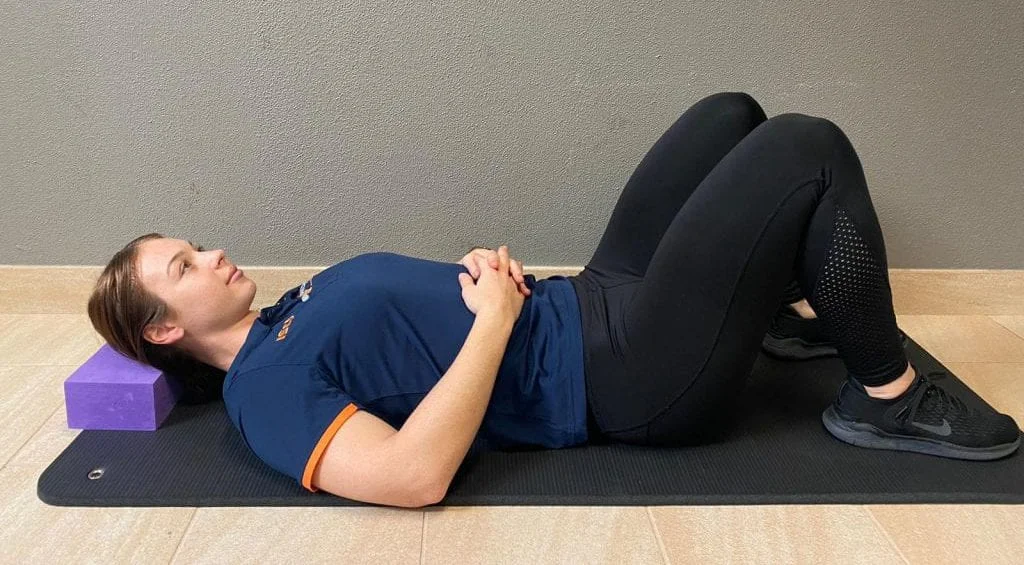
A pelvic tilt is a controlled movement that gently rocks the pelvis forward and backward to flatten and arch the lower back.
It targets the transversus abdominis, multifidus, and deep spinal stabilizers, muscles crucial for supporting the spine and reducing undue stress on vertebral joints.
Most people carry habitual postural patterns, such as anterior pelvic tilt, that increase lumbar strain and contribute to pain.
Pelvic tilts train these muscles to work together, improving motor control, reducing muscle guarding, and enhancing lumbar stability.
Also Read: Ultimate Guide to Home Physiotherapy for Back Pain
Why Pelvic Tilts Are Important for Back Pain Relief
Scientific evidence supports the pelvic tilt as part of core stabilization programs for low back pain management:
- Systematic reviews show that core stabilization exercises reduce pain and disability more reliably than passive modalities like ultrasound or massage alone. (ATPMJ, Springer)
- Patients with chronic low back pain often display reduced activation of deep core muscles; retraining these muscles correlates with improved outcomes. (Journal of Orthopaedic & Sports Physical Therapy)
- Pelvic tilts improve lumbopelvic rhythm, the coordinated response between the pelvis, hips, and spine, which is a critical component of safe movement.
How to Do a Pelvic Tilt Correctly- Step by Step
Before performing this exercise, find a comfortable flat surface and wear non-restrictive clothing.
Step-by-Step Instructions
- Start Position
Lie on your back with your knees bent and feet flat on the floor about hip-width apart. - Neutral Spine Awareness
Slightly arch your lower back so there is a small space between your spine and the floor. This is your relaxed neutral position. - Initiate the Tilt
Take a slow breath in through your nose.
On the exhale, gently flatten your lower back to the floor by tightening your abdominal muscles and tilting your pelvis upward. - Hold and Feel Activation
Hold this flattened position for 3–5 seconds while breathing normally. - Release Slowly
Inhale and allow your pelvis to return to the neutral position gradually. - Repetition
Perform 10–15 repetitions. Rest and repeat 2–3 sets as tolerated.
Alternative Versions for Progression
As movement improves, you can progress pelvic tilts:
Bridge-Assisted Pelvic Tilt
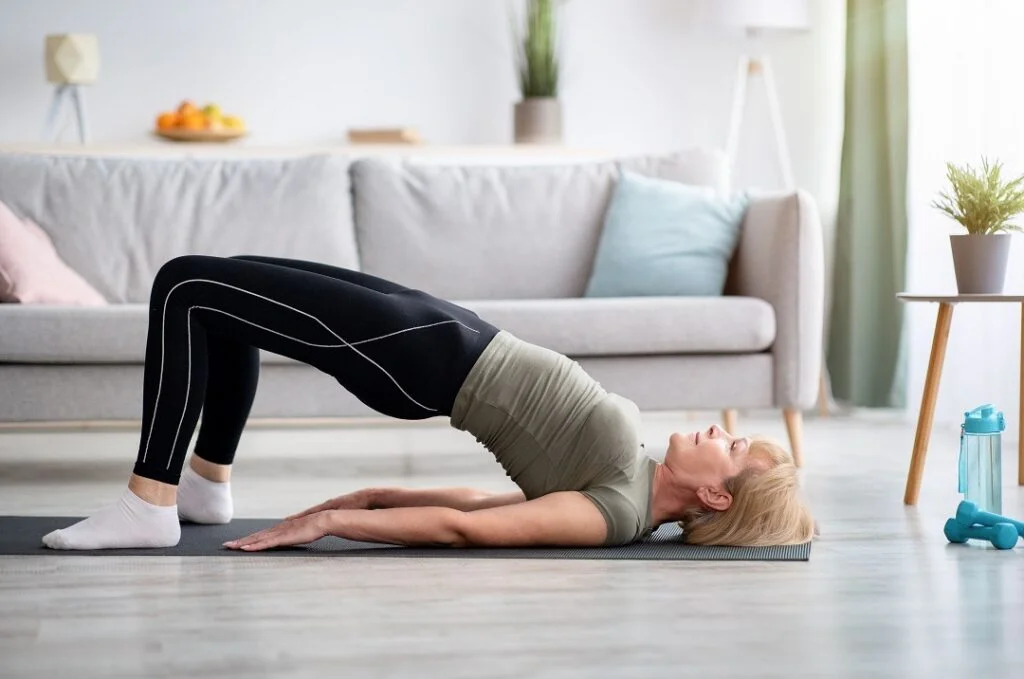
- Perform pelvic tilts while lifting the hips into a bridge position (without over-arching).
- This engages glutes while maintaining core activation.
Seated Pelvic Tilt

- Sit tall on a firm chair with neutral spine.
- Perform the same rocking motion of pelvis forward and backward.
- Helpful for office workers and those who sit most of the day.
Standing Pelvic Tilt

- Stand with light support (chair back or wall).
- Control pelvic shifts gently while maintaining upright alignment.
How Often Should You Do Pelvic Tilts?
Consistency is key:
- Beginner: 1–2 sets daily
- Intermediate: 2–3 sets twice daily
- Maintenance: Incorporate into daily morning or evening routines
Do not rush repetitions. Quality is more important than quantity.
Also Read : Best Knee Strengthening Exercises for Beginners to Reduce Knee Pain
Common Mistakes When Doing Pelvic Tilts
Incorrect Breath Patterns
Holding your breath increases muscle tension and reduces relaxation. Breathe normally while performing the tilt.
Arching Rather Than Flattening
Some people over-exaggerate and arch the low back outward instead of flattening gently. Focus on small, controlled movements.
Using Neck or Upper Body Tension
Keep your shoulders and neck relaxed; do not pull with upper body muscles.
Rushing Through Reps
Perform all repetitions slowly with focus on engagement.
Why Pelvic Tilts Work- Science Explained
Motor Control Over Strength
Modern rehabilitation emphasizes motor control retraining, teaching muscles to work in coordinated patterns before building brute strength. Pelvic tilts activate deep stabilizers that are often suppressed in chronic pain.
Reduced Fear-Avoidance
Pain can change how the nervous system interprets movement. Gentle pelvic tilts encourage safe mobility without pain spikes, which in turn reduces fear-avoidance behavior, a key inhibitor of recovery.
Improved Lumbopelvic Coordination
If the pelvis and lower back move poorly together, the spine can become overloaded during routine tasks like bending and lifting.
Research shows that pelvic coordination improvements correlate with better functional movement and less pain.
Also Read: 15 Common Causes of Neck Pain You Should Know
What the Latest Research Says
Recent studies (2023–2025) support the inclusion of pelvic tilts and core stabilization in treatment plans:
Adherence Matters
A 2024 study found that patients who adhered closely to daily exercise programs, including pelvic tilts, had significantly better outcomes than those who did not. (Springer)
Home Programs Can Match Supervised Therapy
Digital rehabilitation research indicates that structured home exercise programs can be as effective as in-clinic sessions when delivered with feedback tools and consistent protocols. (MDPI)
Neuroscience-Based Approaches
Contemporary frameworks emphasize pain education combined with movement practice, recognizing that pain perception is influenced by both physical and neural factors.
This strengthens the role of safe, repetitive movements like pelvic tilts.
Who Should Be Cautious With Pelvic Tilts
Pelvic tilts are generally safe, but consult a clinician if you have:
- Recent lumbar spine fracture
- Severe spinal stenosis symptoms
- Pain that radiates below the knee with numbness or weakness
- Pregnant women beyond the first trimester should modify movements guided by a professional
Incorporating Pelvic Tilts Into Daily Life
Pelvic tilts are not just an exercise, they can inform how you move in daily tasks:
- Before bending to pick up an object, perform 3–5 gentle tilts.
- After sitting long periods, complete a quick set to reset lumbar posture.
- During breaks at work, use seated pelvic tilts to reduce stiffness.
What I See in My Clinic
When I teach pelvic tilts in clinic, most patients are surprised by how challenging such a small movement can feel.
Many initially use their hip flexors or hold their breath instead of gently activating the deep abdominal muscles. Once they learn to isolate and control the pelvis properly, their confidence improves quickly.
I often see better posture awareness, smoother transitions from sitting to standing, and reduced stiffness within a couple of weeks, not because the movement is dramatic, but because it restores coordination where it was missing.
Also read: Knee-to-Chest Stretch for Bach Pain Relief and Spinal Flexibility- A Complete Guide
What I Would Advise You to Do This Week
- Perform pelvic tilts once in the morning and once in the evening
- Combine with light walking (20–30 minutes)
- Break sitting every 40–50 minutes
- Hydrate and maintain a balanced diet
- Reassess pain and mobility
When to go for a Medical Evaluation
Seek professional evaluation if you experience:
- Progressive leg weakness
- Loss of bladder or bowel control
- Unexplained weight loss with pain
- Severe night pain
- Pain following major trauma
These symptoms may indicate underlying conditions that require medical attention.
Also read: Also read: Spinal Twists for Lower Back Pain Relief- A Complete Guide
A Common Belief I Regularly Correct
Many people think the pelvic tilt is just a “basic warm-up” or too simple to make a real difference. In reality, the pelvic tilt is not about intensity, it’s about precision.
When performed correctly, it retrains deep stabilizing muscles like the transversus abdominis and multifidus, which are often underactive in people with lower back pain.
Skipping foundational control exercises and jumping straight into advanced workouts is one of the most common reasons recovery stalls.
My Final Advice to You
Treat the pelvic tilt as a skill, not just an exercise. Focus on slow, controlled movement and proper breathing rather than rushing repetitions.
Mastering this small, subtle motion builds the foundation for stronger bridges, squats, lifting mechanics, and daily movement.
When done consistently and correctly, the pelvic tilt becomes a powerful reset tool for your spine, one that supports long-term stability, not just short-term relief.
Also Read: 10 Best Daily Stretches for Back Pain Relief at Home
Frequently Asked Questions (FAQ)
1. Can pelvic tilts cure back pain completely?
Pelvic tilts are a foundational movement that improves spinal control and reduces pain, but they work best as part of a broader mobility and strengthening program.
2. How soon will I feel results?
Some people feel reduced stiffness after the first session. Lasting change typically takes 1–4 weeks of consistent practice.
3. Should I do pelvic tilts if my back pain is sharp?
If pain is sharp or radiates down the leg, pause and consult a clinician. Gentle movement is beneficial, but severe symptoms require evaluation.
4. How many repetitions should I do?
Start with 10–15 repetitions per set, 1–2 sets daily, and increase gradually as tolerated.
5. Is it normal to feel discomfort?
A mild pulling sensation is normal; sharp or worsening pain is not. Adjust depth or frequency.
6. Can pelvic tilts help with posture?
Yes. Pelvic tilts teach proper positioning of the pelvis, which promotes better posture and reduces compensatory strain on the spine.
7. Are pelvic tilts good for seniors?
Yes. They are low impact and can be modified seated or standing.
8. Do I need equipment?
No. Pelvic tilts require only a flat surface and controlled movement.
9. Can I combine pelvic tilts with walking?
Yes. Combining stretching, core activation, and walking maximizes circulation and flexibility.
10. Should I use a back belt with pelvic tilts?
Use belts temporarily during heavy lifting or acute pain, but do not rely on them instead of active engagement.
Stay tuned with us. Follow us on Social media for the latest updates
Join us on Instagram for the Latest Health-related updates


