


If you have been told that you have “cartilage wear” in your knee, you may immediately imagine bone grinding against bone and assume that your knee is permanently damaged.
As a physiotherapist, I want you to pause before making that conclusion.
Knee cartilage wear is real, but the phrase is often used far too loosely.
Cartilage changes can occur gradually with ageing, previous injury, altered joint mechanics, excess loading, or osteoarthritis.
More importantly, the amount of cartilage seen on an X-ray or MRI does not always match the amount of pain a person feels.
This is one of the most important facts about knee cartilage problems.
Quick Answer
Knee cartilage wear refers to changes or deterioration of the smooth cartilage covering the knee joint surfaces. It can occur with ageing, previous knee injuries, meniscus damage, excess joint loading, obesity, muscle weakness and osteoarthritis. Treatment usually focuses on reducing excessive loading, improving strength and movement control, maintaining physical activity and managing symptoms. Physiotherapy can significantly improve knee pain, strength and function, although it cannot guarantee that severely damaged cartilage will grow back.
Your knee is not simply a hinge covered with cartilage.
It is a living system involving articular cartilage, menisci, muscles, ligaments, synovium, bone, nerves and the brain’s pain-processing system.
When one component changes, the others may adapt.
Research increasingly supports this broader view of knee osteoarthritis rather than treating cartilage loss as an isolated problem.
A 2025 systematic review and network meta-analysis involving 217 randomized trials and 15,684 people found meaningful benefits from different forms of exercise for pain, function, gait and quality of life. (BMJ, 2025 )
So, if your scan says “cartilage thinning,” the next question should not simply be, “How do I grow the cartilage back?”
The better question is:
How can we reduce unnecessary joint stress, improve the way the knee handles load, control symptoms and preserve function for as long as possible?
That is where physiotherapy becomes extremely valuable.
Key Takeaways
- Cartilage wear is not the same as pain. Imaging findings and symptoms do not always match.
- Previous knee injury matters. ACL, meniscus and other injuries can increase long-term osteoarthritis risk.
- Exercise does not automatically destroy cartilage. Appropriate therapeutic loading is an important part of treatment.
- Strong muscles matter. Quadriceps, hip and calf conditioning can improve the knee’s ability to handle everyday loads.
- Weight management can help. When appropriate, reducing excess body weight can decrease the overall burden on the knee.
- MRI is not always necessary. A clinical examination and appropriate X-ray may be sufficient in many cases.
- Do not completely rest a worn knee. Progressive activity is generally more useful than prolonged inactivity.
- Exercise should be individualized. The right dose depends on symptoms, strength, mobility and current activity level.
- Cartilage damage does not automatically mean knee replacement. Many people manage symptoms successfully with conservative treatment.
What Is Knee Cartilage Wear?
Articular cartilage is the smooth, resilient tissue covering the ends of the bones inside your knee.
It allows the femur, tibia and patella to move against one another with very low friction while helping distribute forces across the joint.
Unlike muscle, cartilage does not have a rich direct blood supply.
Its nutrition and metabolic environment are influenced by movement and loading within the joint.
Cartilage contains cells called chondrocytes embedded within an extracellular matrix containing collagen, proteoglycans and water.
One lesser-known fact is that cartilage degeneration is not simply a matter of the tissue being “rubbed away.”
Changes can involve altered cartilage composition, collagen organization, water content, the underlying bone, synovial inflammation and mechanical loading.
Early degeneration may therefore occur before dramatic cartilage loss is visible on an X-ray.
A systematic review of exercise and cartilage health found that therapeutic joint-loading exercise did not appear to harm articular cartilage in people with or at risk of knee osteoarthritis, although the authors emphasized that the quality of evidence was limited. (British Journal of Sports Medicine)
This challenges one of the most common fears I hear in physiotherapy clinics:
“If my cartilage is wearing out, won’t exercise wear it out faster?”
Usually, avoiding all movement is not the solution.
The goal is to find the right amount and type of loading for your knee.
Is Cartilage Wear the Same as Knee Osteoarthritis?
Not necessarily.
“Cartilage wear” is a descriptive phrase.
Osteoarthritis is a broader joint disorder involving multiple tissues.
Knee osteoarthritis can involve:
- Articular cartilage changes
- Meniscal degeneration
- Subchondral bone changes
- Synovial inflammation
- Osteophyte formation
- Ligament changes
- Muscle weakness
- Altered movement patterns
This distinction matters because treating the cartilage image alone can lead to poor treatment decisions.
For example, two people can have similar X-rays but completely different pain levels and functional abilities.
Conversely, someone may have substantial knee pain with relatively modest radiographic changes.
This is why a good assessment should connect your imaging findings with your symptoms, movement, strength, function and medical history.
What Causes Knee Cartilage Wear?
There is rarely one single cause.
Age-related joint changes
Cartilage composition and the ability of joint tissues to tolerate mechanical stress change with age.
However, ageing alone does not mean that painful knee degeneration is inevitable.
Some older adults have considerable radiographic changes and remain highly active, while others develop symptoms with less obvious structural change.
The important distinction is between structural ageing and symptomatic disease.
Previous knee injury
A previous ACL injury, meniscal injury, fracture or significant knee trauma can change how forces travel through the joint.
A meta-analysis of 24 observational studies involving more than 20,000 participants found that a history of knee injury was strongly associated with later knee osteoarthritis, with a pooled odds ratio of approximately 4.2. (Elsevier)
This is one reason rehabilitation after a knee injury should not stop simply because swelling and pain have disappeared.
Restoring strength, balance, movement control and confidence may be important long after the initial injury.
Meniscus damage or removal
The meniscus is not merely a cushion.
It contributes to load distribution, joint stability and contact mechanics.
When part or all of a meniscus is removed, forces may become concentrated over smaller areas.
Long-term research has associated previous meniscectomy and obesity with increased risk of radiographic knee osteoarthritis. (Wiley)
This is one reason modern knee rehabilitation increasingly considers meniscal preservation and restoring movement capacity rather than treating the cartilage in isolation.
Higher body weight
Body weight matters, but the explanation is more complicated than “every extra kilogram destroys cartilage.”
Higher body mass increases the mechanical demands placed on the knee during activities such as walking, stairs and rising from a chair.
Metabolic factors associated with excess adiposity may also influence joint health.
A large systematic review and meta-analysis published in 2025 identified overweight or obesity and previous knee injury among important modifiable risk factors for incident knee osteoarthritis. (PubMed)
Importantly, weight management should not be presented as blame.
For a patient with painful knee osteoarthritis, even modest improvements in physical activity, strength and body composition can be clinically useful.
Weak quadriceps and poor muscle capacity
Your quadriceps are not just “leg muscles.”
They help your knee tolerate everyday loading.
An updated systematic review involving 46,819 participants found an association between knee extensor weakness and development of symptomatic and radiographic knee osteoarthritis in both women and men, although the evidence quality was rated low. (BMJ)
This does not mean weak quadriceps directly cause every case of cartilage wear.
It means muscle capacity is an important part of the overall knee environment.
Repetitive occupational loading
Interestingly, being active is not automatically harmful.
The problem may arise when the knee is exposed to high repetitive loads without adequate recovery, strength or movement variability.
Long-term observational research has linked physically demanding work, obesity and traumatic knee injury with increased knee osteoarthritis risk. (Oxford Academic)
This is especially relevant to people who spend years repeatedly squatting, kneeling, climbing, lifting or working on hard surfaces.
What Does Knee Cartilage Wear Feel Like?
Symptoms vary considerably.
Common symptoms include:
- Knee pain during walking
- Pain while climbing or descending stairs
- Discomfort after prolonged sitting
- Stiffness after inactivity
- Reduced knee bending
- Difficulty squatting
- Swelling after activity
- Grinding or creaking sensations
- Reduced confidence while walking
- Difficulty getting up from a chair
Some people notice pain mainly during weight-bearing activities.
Others feel discomfort after exercise rather than during it.
Some have little pain despite significant structural changes.
This is why the phrase “bone-on-bone” should not be used casually.
Why Does Knee Cartilage Wear Hurt If Cartilage Has Limited Nerve Supply?
This is a fascinating and frequently misunderstood aspect of knee pain.
Pain does not necessarily come directly from the damaged cartilage itself.
Other structures around the knee can contribute to symptoms, including the synovium, subchondral bone, capsule, ligaments, periosteal tissues and surrounding soft tissues.
Changes in the nervous system can also influence how strongly the brain interprets incoming signals.
This explains why simply looking at an MRI cannot tell us exactly how much pain someone should have.
A scan is useful information.
It is not a pain meter.
How Is Knee Cartilage Wear Diagnosed?
Diagnosis should begin with a detailed history.
As a physiotherapist, I would want to know:
- When the symptoms started
- Whether there was an old injury
- Which activities provoke symptoms
- Whether the knee swells
- Whether you experience locking
- Whether you can fully straighten the knee
- How stairs affect you
- Whether sitting for long periods causes stiffness
- Whether walking distance has changed
- Whether symptoms are present at night
- Whether another joint is also painful
Then comes the physical examination.
Movement assessment
I may examine:
- Knee flexion and extension
- Squatting
- Sit-to-stand movement
- Step-down control
- Walking pattern
- Single-leg balance
- Hip strength
- Quadriceps strength
- Calf strength
- Foot and ankle mechanics
The aim is not simply to find a “bad knee.”
It is to understand how your entire lower limb manages load.
X-ray
Weight-bearing X-rays can help assess joint-space narrowing, osteophytes and other bony changes.
However, an X-ray does not directly show cartilage.
Joint-space narrowing is used as an indirect marker of cartilage loss.
MRI
MRI can visualize cartilage, menisci, ligaments, bone marrow and other soft tissues more directly.
But MRI is not automatically necessary for every person with knee pain.
The American College of Radiology notes that MRI is generally not routinely required when radiographs already explain the symptoms and osteoarthritis is apparent.
MRI becomes more useful when symptoms are unexplained, an alternative diagnosis is suspected, or additional structural information could change management. (American College of Radiology)
This is an important cost-saving and anxiety-reducing point.
More imaging is not always better care.
Can Physiotherapy Stop Knee Cartilage From Wearing Out?
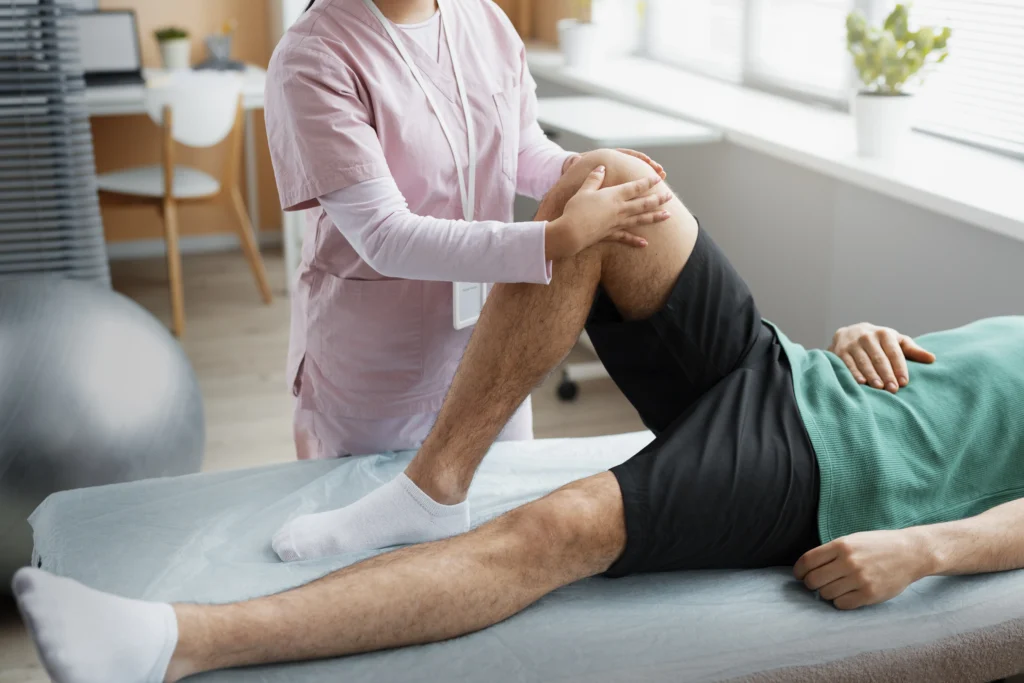
I would phrase this carefully.
Physiotherapy cannot promise to rebuild severely damaged articular cartilage.
However, physiotherapy can address many factors that influence pain, function and joint loading.
The objectives are usually to:
- Reduce excessive symptom-provoking load.
- Improve quadriceps and hip strength.
- Improve movement coordination.
- Increase physical capacity gradually.
- Improve walking and stair tolerance.
- Reduce fear of movement.
- Improve confidence in using the knee.
- Help maintain independence and activity.
Exercise is strongly recommended as a core treatment for knee osteoarthritis in major clinical guidelines.
The ACR/Arthritis Foundation guideline strongly recommends exercise and weight loss for appropriate patients with knee or hip osteoarthritis,
while OARSI identifies arthritis education and structured land-based exercise, with or without dietary weight management, as core treatments.
Physiotherapy Treatment for Knee Cartilage Wear
Strength training
A properly designed strengthening programme is usually more useful than randomly performing dozens of knee exercises.
Depending on your presentation, exercises may include:
- Sit-to-stand
- Wall-supported squats
- Step-ups
- Leg press
- Quadriceps strengthening
- Hamstring strengthening
- Calf raises
- Hip abductor strengthening
- Glute strengthening
The exercise should be progressed gradually.
A person who has been sedentary for months should not suddenly begin deep squats with heavy resistance simply because someone online said they are good for arthritis.
Aerobic exercise
Walking, cycling, swimming and water-based exercise can help improve cardiovascular fitness and overall activity.
A particularly interesting finding comes from the 2025 BMJ network meta-analysis.
Across 217 randomized trials, aerobic exercise had the highest probability of being the most beneficial modality overall for pain, function, gait performance and quality of life.
This does not mean everyone should abandon strength training.
It means that aerobic capacity deserves much more attention in knee rehabilitation than it sometimes receives.
Neuromuscular training
Your muscles need more than strength.
They need coordination.
Exercises involving balance, controlled step-downs, directional changes and functional movement can help you regain confidence and control.
This can be particularly useful when knee symptoms have caused you to move cautiously or avoid using one leg.
Mobility work
If your knee cannot comfortably straighten or bend, mobility work may be included.
However, aggressive stretching is not automatically better.
The correct approach depends on why the range of motion is limited.
Manual therapy
Hands-on treatment may sometimes help short-term pain or movement restrictions, particularly when combined with active rehabilitation.
I would not use manual therapy as the entire treatment plan.
The goal is to help you move better and become more capable, not to make you dependent on repeated passive treatment.
The “Good Pain” Rule Is More Complicated Than You Think
One of the most useful things I teach patients is how to interpret symptoms after exercise.
A mild increase in discomfort does not automatically mean you have damaged your cartilage.
But severe pain, substantial swelling, prolonged worsening or loss of function should not simply be ignored.
Instead of asking only:
“Did it hurt?”
ask:
“How did my knee respond over the next 24 hours?”
If your knee returns to its usual level after activity, the exercise may be within a tolerable range.
If each session produces increasing swelling, significant pain and reduced function the next day, the dose may need to be modified.
This concept of monitoring the response to load is often more useful than following rigid internet rules about which exercise is universally “safe.”
Weight Loss Can Help, But It Is Not the Whole Treatment
If you are overweight and have knee osteoarthritis, weight management can be helpful.
But I never want patients to believe that their knee pain is simply a consequence of their body weight.
Exercise, muscle strength, sleep, physical activity, nutrition, stress and joint mechanics can all interact.
The ACR/Arthritis Foundation guideline strongly recommends weight loss for people with knee or hip osteoarthritis who are overweight or obese.
A clinically sensible strategy is to combine sustainable weight management with progressive physical activity rather than waiting to lose weight before beginning rehabilitation.
Lesser-Known Things That Can Make a Difference
Do not completely rest a degenerative knee
Complete inactivity can reduce muscle capacity and physical tolerance.
The evidence does not support the idea that therapeutic exercise automatically “grinds down” arthritic cartilage.
Train the hip, not just the knee
The muscles around your hip influence lower-limb control during walking, stairs and single-leg activities.
Weakness or poor coordination higher up the chain may change how you control the knee.
Do not chase the crackling sound
Crepitus can sound alarming.
But noise alone does not tell us how much cartilage has been lost.
If your knee makes noise but remains functional and relatively comfortable, the sound itself is not necessarily an indication that you are damaging it.
Avoid sudden changes in activity
A knee may tolerate walking three kilometres but react badly if you suddenly increase that to ten kilometres.
The problem may be the abrupt change in load rather than the activity itself.
Increase activity progressively.
Do not use MRI findings as your treatment plan
Your scan should inform your rehabilitation, not dictate it.
A “moderate cartilage defect” does not automatically mean you need to stop exercising.
What Should You Avoid With Knee Cartilage Wear?
Avoid:
- Sudden increases in exercise volume
- Training through significant swelling
- Repeated high-impact activity when the knee is acutely irritated
- Long periods of complete inactivity
- Assuming every knee sound means cartilage destruction
- Copying advanced rehabilitation exercises from social media
- Repeatedly testing a painful movement to “see if it is better”
- Ignoring persistent locking or instability
- Assuming surgery is inevitable because an MRI looks abnormal
The right exercise depends on your current capacity.
A 20-year-old athlete with a cartilage injury and a 65-year-old person with osteoarthritis may both have “cartilage damage,” but their rehabilitation requirements can be completely different.
When Should You See a Physiotherapist or Doctor?
Seek professional assessment if your knee pain is persistent, progressively worsening or interfering with daily activities.
Medical assessment becomes particularly important if you have:
- Significant unexplained swelling
- A hot, red knee
- Fever with knee pain
- Inability to bear weight
- A major traumatic injury
- Repeated giving way
- True locking of the knee
- Rapidly increasing deformity
- Severe night pain
- Unexplained weight loss
- Significant calf swelling or pain
These symptoms should not simply be attributed to “cartilage wear.”
Does Cartilage Wear Always Lead to Knee Replacement?
Absolutely not.
Many people with knee osteoarthritis manage their symptoms successfully for years with exercise, physical activity, weight management, education, medication when appropriate and other conservative treatments.
At the same time, physiotherapy should not be presented as a magical way to avoid surgery in every patient.
For people with moderate-to-severe symptomatic osteoarthritis whose non-operative treatment is no longer effective, joint replacement may eventually become appropriate.
A 2023 ACR/AAHKS guideline specifically addressed this situation and found that additional non-operative treatment should not automatically be used to delay indicated arthroplasty. (2023 ACR/AAHKS arthroplasty guideline)
The important point is that surgery should be based on symptoms, disability, clinical assessment and shared decision-making, not simply the age of an MRI report.
My Physiotherapy Takeaway
When someone tells me, “My knee cartilage is wearing out,” I do not immediately think, “This person needs to protect the knee from movement.”
I think:
What is causing this knee to struggle with its current workload?
Is the quadriceps weak?
Is the hip under-conditioned?
Has activity suddenly increased?
Is there a previous ACL or meniscus injury?
Is the knee swollen?
Is the person avoiding movement because of fear?
Is body weight adding to the overall mechanical and metabolic burden?
Is there reduced ankle or hip mobility?
Is the person doing too much too soon?
Those questions are often much more clinically useful than staring at a scan.
The evidence increasingly supports active management.
Exercise can improve pain and function, and current evidence does not support the simplistic idea that appropriately prescribed loading inevitably accelerates cartilage destruction.
Your cartilage may not be perfectly preserved.
But your knee is more than its cartilage.
The goal of physiotherapy is not merely to make an X-ray look better.
It is to help you walk farther, climb stairs more confidently, become stronger, reduce pain and keep your knee useful for as long as possible.
That is a much more realistic and empowering definition of knee rehabilitation.
Frequently Asked Questions
1. Can knee cartilage wear be reversed?
Severely damaged articular cartilage does not reliably regenerate on its own. However, physiotherapy, strengthening, activity modification and weight management can improve pain and function and help you manage the condition.
2. Is walking bad for worn knee cartilage?
Walking is not automatically harmful. In many people with knee osteoarthritis, appropriately dosed walking is a useful form of physical activity. The amount should be adjusted according to symptoms and recovery.
3. What is the best exercise for worn knee cartilage?
There is no single best exercise for everyone. Strength training, aerobic exercise, neuromuscular training and mobility work may all be useful depending on your symptoms and physical capacity.
4. Does knee cartilage wear always cause pain?
No. Structural cartilage and osteoarthritis changes do not always correspond directly with pain intensity. Pain can also involve the synovium, bone, capsule, surrounding tissues and nervous system.
5. Can physiotherapy help knee cartilage damage?
Yes. Physiotherapy can improve muscle strength, physical capacity, movement control, walking ability and pain management. It cannot promise to regenerate severely damaged cartilage.
6. Is an MRI necessary for knee cartilage wear?
Not always. Clinical assessment and X-rays can be sufficient in many cases. MRI is generally considered when symptoms are unexplained, another problem is suspected or additional structural information could change treatment.
7. Should I avoid squats if I have knee cartilage wear?
Not necessarily. Squatting can often be modified according to your pain, strength, range of motion and current tolerance. A physiotherapist can help determine the appropriate depth, resistance and progression.
8. Does losing weight help worn knee cartilage?
For people who are overweight or obese, weight management can reduce the overall mechanical and metabolic burden associated with knee osteoarthritis and is recommended as part of comprehensive management.
9. Does cartilage wear mean I will eventually need knee replacement?
No. Many people manage knee osteoarthritis without replacement for many years. Surgery is considered when symptoms and disability remain substantial despite appropriate non-operative management.
10. When should I see a physiotherapist for knee cartilage wear?
Consider an assessment if knee pain, stiffness, weakness or reduced mobility is affecting walking, stairs, exercise, work or daily activities, particularly if symptoms are persistent or worsening.
Stay tuned with us for more health related topics.
Follow us on LinkedIn and Instagram for more.
More Read


Medical Disclaimer!
This article has been reviewed and written under the guidance of our Head Physiotherapist, Dr. Kruti Raj (PT, MUHS,CPT,CMPT). The information shared is intended for educational purposes only and should not be considered a substitute for personalized medical advice, diagnosis, or treatment.
Please consult us or any other qualified healthcare professional before beginning any exercise program, especially if you are experiencing pain, recovering from injury, or managing a medical condition.


