


You take your bra off after a long day and notice two deep lines across your shoulders.
Sometimes they disappear quickly.
Other times, the skin feels sore and your shoulders feel heavy or achy.
Quick Answer
Shoulder grooves from bra straps are common and usually result from prolonged pressure on the skin and soft tissues. The groove itself does not usually mean that the shoulder has been damaged. However, tight straps, poor bra fit, inadequate support, or excessive pressure can contribute to shoulder, neck, or upper-back discomfort. If pain, numbness, tingling, weakness, or persistent tenderness continues after removing the bra, the symptoms should be assessed rather than automatically blamed on the straps.
These marks are commonly called shoulder grooves.
They are especially noticeable when bra straps are narrow, tight, or carrying more of the breast weight than they should.
But can those grooves actually cause shoulder pain?
The answer depends on what is creating the pressure and what else is happening around your neck, shoulders, and upper back.
Key Takeaways
- Temporary shoulder grooves from bra straps are common and usually are not a sign of damage.
- Tight straps or poor bra fit can concentrate pressure over the shoulders and contribute to discomfort.
- Breast weight, posture, muscle fatigue, and shoulder-blade mechanics can also influence symptoms.
- Changing the bra may help when fit or support is contributing, but persistent pain should not automatically be blamed on the bra.
- A physiotherapist can assess the neck, shoulder, upper back, shoulder blade, posture, and movement patterns to identify contributing factors.
What Are Shoulder Grooves From Bra Straps?
Shoulder grooves are temporary indentations in the soft tissue where bra straps sit.
They occur when pressure is applied to the same area of the shoulder for several hours.
A visible mark does not automatically mean that the shoulder has been damaged.
Clothing can leave temporary impressions on the skin simply because it has been pressing against the body.
The concern is greater when the grooves are accompanied by persistent tenderness, aching, burning, tingling, or discomfort that continues after the bra has been removed.
Why Do Bra Straps Leave Deep Marks?
A properly fitting bra should distribute support across the band, cups, and straps rather than making the shoulders do most of the work.
If the band is too loose or the bra does not provide adequate support, the straps may be tightened to compensate.
This can increase pressure over a relatively small area of the shoulder.
Breast size and weight can also influence the mechanical load experienced by the body.
Research has reported associations between breast size, breast-related symptoms, and musculoskeletal pain in some women (Coltman et al., 2019).
That does not mean larger breasts automatically cause shoulder pain.
It simply means breast-related loading can be one factor worth considering when someone experiences persistent neck, shoulder, or upper-back discomfort.
Can Shoulder Grooves Cause Pain?
The groove itself is usually not the main cause of shoulder pain.
More often, the groove is a visible sign that pressure has been concentrated over the shoulder for a prolonged period.
If the straps are consistently tight, the surrounding tissues may become uncomfortable.
You may notice tenderness exactly where the strap sits, an aching sensation around the top of the shoulder, or a feeling of heaviness toward the end of the day.
Some women may also notice discomfort extending toward the neck or upper back.
This is why it is important not to blame every shoulder problem on the bra.
Posture, muscle fatigue, work habits, breast support, exercise, and existing neck or shoulder problems can all contribute.
What Happens When Bra Straps Are Too Tight?
Imagine having a narrow strap pressing against the same part of your shoulder for eight or ten hours.
The pressure remains relatively constant while you may also be sitting at a desk, driving, carrying a bag, using a computer, or repeatedly moving your arms.
By the end of the day, the shoulder can feel increasingly tired.
Some people may also respond to discomfort by unconsciously stiffening or elevating their shoulders.
This can increase muscular tension and make the area feel even more uncomfortable.
The change may be subtle. You may not notice that you are doing it until the bra is removed and your shoulders finally relax.
Could the Trapezius Muscle Be Involved?
The trapezius is a large muscle that extends from the neck across the upper back and toward the shoulder.
It helps control the shoulder blade and contributes to several movements of the neck and shoulder.
When someone repeatedly experiences pressure over the top of the shoulder, it makes sense to assess how the surrounding muscles are functioning rather than looking only at the skin mark.
A physiotherapist may assess whether the upper trapezius is becoming overactive, whether other shoulder-blade muscles are contributing effectively, and whether the neck and upper back are moving normally.
Neck and shoulder symptoms can involve several interacting physical factors rather than one isolated structure (Blanpied et al., 2017).
It can.
If the breasts are heavier or the bra does not provide enough support through the band and cups, the straps may end up carrying more of the load.
This can make the straps feel as though they are digging into the shoulders.
Breast biomechanics research has shown that breast movement and support are influenced by factors such as breast size, tissue characteristics, and external support (McGhee & Steele, 2020).
This is one reason why simply loosening the straps is not always the complete solution.
If the straps are already doing too much work, loosening them without improving the overall fit may make the bra feel less supportive.
Could Your Bra Band Be the Problem?
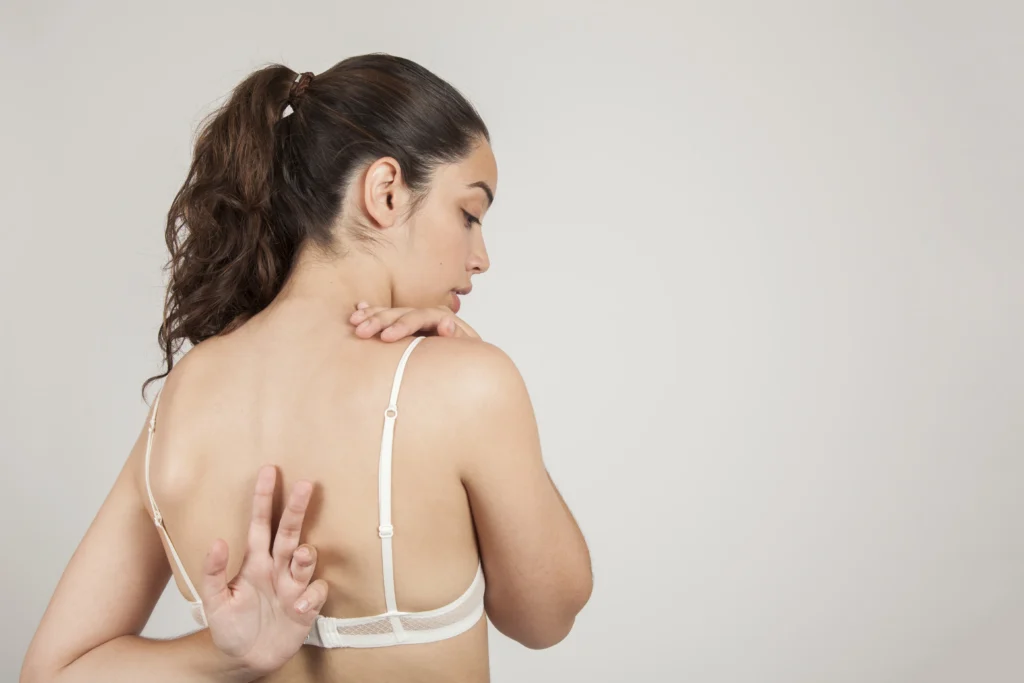
The band is an often-overlooked part of bra fit.
When the band is too loose, it may move around instead of providing a stable base.
The straps may then need to be tightened to keep the bra in position.
That can increase pressure on the shoulders.
A band that is excessively tight can create discomfort around the ribs and torso as well.
The goal is not to make one part of the bra extremely tight.
The support should feel reasonably distributed across the bra rather than concentrated in one place.
Do Wider Bra Straps Help?
Wider straps can sometimes feel more comfortable because they distribute pressure over a larger surface area.
Think about the difference between pressing a narrow edge into the skin and spreading the same force over a wider area.
However, wider straps do not automatically solve shoulder pain.
If the overall fit is poor, a wider strap may simply make an uncomfortable bra slightly more tolerable.
The band, cups, straps, breast support, and individual body mechanics still matter.
Can Shoulder Grooves Affect Posture?
Not directly in every person, but discomfort can influence how someone holds their body.
If your bra straps repeatedly feel uncomfortable, you may unconsciously tense your shoulders or change your position to avoid the pressure.
Over several hours, that can contribute to muscle fatigue.
This becomes particularly relevant for people who already spend long periods at a desk or perform repetitive upper-limb activities.
Neck and shoulder pain can be influenced by several physical and occupational factors, including sustained postures and repetitive loading (Côté et al., 2008).
So if shoulder grooves appear alongside neck stiffness or upper-back aching, it is worth looking beyond the bra itself.
Why Does One Shoulder Hurt More?
You may notice that one shoulder has a deeper groove or feels more painful than the other.
That does not automatically mean the bra is uneven.
People rarely use both sides of their body in exactly the same way.
You might carry a handbag on one shoulder, use a computer mouse with one hand, sleep mostly on one side, or have differences in shoulder movement.
These everyday habits can change how pressure is experienced.
A physiotherapist can assess these movement patterns and determine whether the shoulder symptoms are related to the bra, surrounding muscles, or another musculoskeletal factor.
Can Exercise Make Strap Pressure Worse?
It can, particularly when a bra does not provide enough support for the activity.
During running and other higher-impact exercises, breast movement increases and the body has to manage additional motion.
Research examining breast support during running has shown that support can influence breast movement and upper-body biomechanics (Scurr et al., 2010).
This is why the bra that feels comfortable while sitting at work may not be appropriate for running, gym workouts, or other high-impact activities.
If you consistently finish exercise with deep strap marks, shoulder soreness, or discomfort, the issue may be related to support and fit rather than exercise itself.
Are Temporary Shoulder Grooves Normal?
A temporary indentation that disappears soon after removing your bra is generally less concerning than a mark that remains painful or is associated with other symptoms.
Many people experience some degree of strap marking simply because clothing applies pressure to the skin.
The important question is what happens alongside the groove.
If there is no pain, numbness, persistent tenderness, weakness, or unusual swelling, a temporary mark is usually more of a comfort and fit issue.
However, if the area repeatedly becomes painful or remains uncomfortable long after the bra has been removed, it is worth investigating.
When Could a Groove Be a Warning Sign?
A groove becomes more concerning when it is not simply a temporary skin indentation.
Pay attention if you regularly experience:
- Persistent pain after removing the bra
- Burning or unusual sensitivity around the strap area
- Numbness or tingling in the shoulder, arm, or hand
- Weakness or difficulty using the arm
- Significant swelling
- Pain that continues even when you are not wearing a bra
These symptoms do not necessarily mean that the bra has caused an injury.
They simply suggest that another factor may need to be considered.
Persistent shoulder symptoms can arise from the neck, nerves, muscles, tendons, joints, or other structures, so continuing to tighten or loosen the bra may not address the underlying problem.
When Should You Get Shoulder Pain Assessed?
Shoulder pain should not automatically be attributed to bra straps.
Consider professional assessment if the pain continues despite changing or removing the bra, keeps returning, interferes with sleep, or affects normal arm movement.
You should also seek assessment if you develop weakness, significant numbness or tingling, substantial swelling, or pain following an injury.
The purpose of an assessment is not simply to determine whether you need a different bra.
It is to understand what is actually contributing to the symptoms.
How Can a Physiotherapist Help?
A physiotherapist can look at the problem from a movement perspective.
Instead of only asking whether the straps are tight, they may assess your neck, shoulder movement, upper-back mobility, shoulder-blade control, muscle strength, posture, and everyday activities.
The shoulder blade is particularly important because it provides a moving base for the arm.
Problems with scapular movement can influence shoulder mechanics and may be associated with shoulder symptoms (Kibler et al., 2013).
Treatment depends on what the assessment finds.
For some people, simple changes to bra fit and daily habits may be enough.
Others may benefit from mobility exercises, strengthening, posture-related advice, or treatment directed at an underlying neck or shoulder problem.
How Can You Tell If Your Bra Is Contributing?
There is a simple observation you can make.
Notice how your shoulders feel after several hours in your usual bra.
Then compare that with how they feel on a day when you wear a different, comfortable, well-fitting bra.
Pay attention to whether the grooves are unusually deep, whether the straps constantly need adjustment, and whether the band rides upward.
If your symptoms consistently increase with one bra and decrease with another, the bra may be contributing.
That still does not prove the bra is the only cause.
It simply gives you useful information about one possible trigger.
What Should Comfortable Bra Straps Feel Like?
Bra straps should feel secure without feeling as though they are cutting into the shoulders.
They should not constantly slip off, dig into the skin, or require repeated tightening throughout the day.
The bra should also feel reasonably supportive when you move your arms rather than only when you are standing still.
If you need to tighten the straps excessively to keep the bra in place, it may be worth reassessing the overall fit instead of continuing to tighten them.
Myth vs Fact
Myth: Deep shoulder grooves always mean that the bra is damaging your shoulders.
Fact: Temporary strap marks are common and do not automatically indicate tissue damage. Persistent pain or other symptoms are more important than the appearance of the groove alone.
Myth: Tightening the straps provides better support.
Fact: Excessively tight straps can concentrate pressure on the shoulders. A well-fitting bra should distribute support across the band, cups, and straps.
Myth: If changing the bra does not fix the pain, the pain is unrelated to the bra.
Fact: Bra fit may be only one contributing factor. Posture, muscle fatigue, shoulder-blade mechanics, neck problems, work habits, and exercise can also influence shoulder pain.
Lesser-Known Fact: The Shoulder Blade May Matter More Than the Groove
A visible shoulder groove naturally attracts attention because it is easy to see.
But the more important issue may be what is happening around the shoulder blade.
The shoulder blade moves continuously as you raise, lower, and rotate your arm.
It works together with the neck, upper back, ribs, and shoulder joint.
If these areas are already working inefficiently, additional pressure or discomfort from bra straps may make symptoms more noticeable.
So when a woman says, “My bra straps hurt my shoulders,” a physiotherapist may look beyond the strap itself.
The more useful question becomes: Why does this amount of pressure bother your shoulder?
That shift in perspective can help identify the actual contributing factors.
Can You Prevent Shoulder Grooves?
You do not necessarily need to stop wearing bras simply because they leave temporary marks.
Instead, pay attention to fit, comfort, support, and how your body responds throughout the day.
Avoid repeatedly tightening the straps to compensate for a loose or poorly fitting bra.
Consider whether the band and cups are providing enough support.
For exercise, choose support appropriate for the activity rather than using the same bra for every situation.
And if shoulder discomfort continues despite changing the bra, do not keep changing bras indefinitely without considering other causes.
Your neck, shoulder blade, upper back, work setup, sleeping position, exercise routine, and general movement habits may all be relevant.
Final Thoughts
Shoulder grooves from bra straps are usually a sign of prolonged pressure rather than an injury by themselves. If your bra feels uncomfortable, start by looking at the overall fit rather than simply tightening or loosening the straps. If shoulder, neck, or upper-back pain continues despite changing the bra, remember that posture, muscle function, shoulder-blade movement, and other musculoskeletal factors may also be involved. Persistent or unusual symptoms deserve a proper assessment so the underlying cause can be addressed.
Conclusion
Shoulder grooves from bra straps are common, and the groove itself is usually not a sign of damage.
However, deep or uncomfortable strap marks can sometimes indicate that pressure is being concentrated over the shoulders, particularly when the straps are too tight or the bra is not distributing support effectively.
If the grooves are accompanied by persistent shoulder, neck, or upper-back pain, the bra may be one contributing factor rather than the entire explanation.
A physiotherapy assessment can help determine whether the problem is related to bra fit, muscle fatigue, shoulder-blade mechanics, posture, or another musculoskeletal issue.
The goal is not simply to make the groove disappear. It is to understand why your shoulders are uncomfortable in the first place.
Frequently Asked Questions
Can bra straps cause shoulder pain?
Tight or poorly positioned bra straps can contribute to shoulder discomfort by concentrating pressure over a small area. However, shoulder pain can have many other causes as well.
Are shoulder grooves from bra straps normal?
Temporary strap marks are common and usually are not concerning. Persistent pain, tenderness, numbness, tingling, or weakness alongside the groove should be assessed.
Can tight bra straps cause neck and shoulder pain?
They may contribute to discomfort by placing prolonged pressure on the shoulder area. Posture, muscle fatigue, breast support, and existing neck or shoulder problems can also play a role.
Should I loosen my bra straps if they leave grooves?
If the straps are excessively tight, adjusting them may improve comfort. However, repeatedly loosening or tightening the straps may not solve the problem if the overall bra fit or support is inadequate.
Can breast weight contribute to shoulder pain?
Breast size and weight can influence mechanical loading, but they are not the only factors associated with shoulder or upper-back discomfort.
When should shoulder pain from bra straps be assessed?
Consider an assessment if pain persists after removing the bra, keeps returning, interferes with sleep or arm movement, or occurs with numbness, tingling, weakness, significant swelling, or an injury.
Stay tuned with us for more health related topics.
Follow us on LinkedIn and Instagram for more.
More Read


Medical Disclaimer
This article is intended for general educational purposes and should not be considered a substitute for individual medical or physiotherapy advice. Shoulder pain can have different causes, and symptoms that are persistent, severe, worsening, or associated with weakness, numbness, tingling, swelling, or injury should be evaluated by an appropriately qualified healthcare professional.


