


Ankle pain 2 weeks after a sprain does not necessarily mean something is wrong, as ligament healing can take time, but persistent pain, swelling or difficulty bearing weight deserves attention.
Quick Answer
Yes, an ankle sprain can still hurt after 2 weeks. Mild pain, stiffness, swelling or weakness may persist while the ligament continues to heal. The key is whether your symptoms are gradually improving. If pain is getting worse, you cannot bear weight, swelling is increasing, or there has been little meaningful improvement, the ankle should be reassessed by a qualified healthcare professional.
The important question is whether the ankle is gradually improving.
Ankle pain, stiffness, swelling and weakness can persist during recovery, but worsening symptoms, difficulty bearing weight or a lack of meaningful progress may need reassessment.
Key Takeaways
- An ankle sprain can still cause pain after 2 weeks, especially after a more significant injury.
- The most important sign is whether pain, swelling and movement are gradually improving.
- Stiffness, weakness and balance problems can remain even when walking becomes easier.
- Returning to running or sport should be based on function rather than the number of days since injury.
- Physiotherapy can help restore ankle mobility, strength, balance and load tolerance.
- Worsening pain, inability to bear weight, marked swelling, bony tenderness or stalled recovery should be assessed.
Is It Normal for an Ankle Sprain to Still Hurt After 2 Weeks?
Yes, it can be normal for an ankle sprain to still hurt after two weeks.
Ankle sprains vary in severity, and recovery does not follow exactly the same timeline for everyone.
Research shows that pain often decreases substantially during the first two weeks, but some people continue to experience pain, instability or functional limitations for much longer (van Rijn et al., 2008).
Therefore, being not completely pain-free at two weeks is not necessarily a problem.
What matters more is the direction of recovery.
If you can walk farther, move the ankle more easily and put more weight through the foot than you could during the first few days, that is generally more reassuring than symptoms that are staying the same or becoming worse.
What Should an Ankle Sprain Feel Like After 2 Weeks?
By two weeks, many people should notice some improvement in everyday function, although complete recovery may take longer.
You may notice:
- Less pain than during the first few days
- Reduced swelling
- Less bruising
- Improved ankle movement
- Easier walking
- Better tolerance for standing
- Less tenderness
- Gradual improvement in confidence using the injured ankle
You may still have some discomfort with stairs, uneven surfaces, faster walking or certain ankle movements.
You also may not yet be ready for running, jumping or sport.
That does not necessarily mean the ankle has failed to heal.
When Is Ankle Pain After 2 Weeks Concerning?
Persistent pain becomes more concerning when the recovery has stalled or moved backwards.
Pay particular attention if:
- Pain is getting worse
- You still cannot bear weight properly
- You have a significant limp
- Swelling is increasing
- Pain remains severe
- There is marked tenderness directly over a bone
- The ankle repeatedly gives way
- You have new numbness or significant weakness
- You have severe pain at rest
- There has been little meaningful improvement since the injury
These symptoms do not automatically indicate a serious injury, but they make a reassessment more appropriate.
Why Does My Ankle Still Hurt After 2 Weeks?
Several factors can explain ongoing pain.
The Ligament Is Still Healing
An ankle sprain involves injury to one or more ligaments.
Even when walking becomes easier, the injured tissue may not yet have regained its full capacity to tolerate higher loads.
A person may therefore feel comfortable during ordinary activities but develop pain when attempting running, jumping or rapid changes of direction.
Swelling Is Still Limiting Movement
Residual swelling can make the ankle feel stiff and can restrict normal movement.
This can alter the way you walk and place additional demands on other parts of the lower limb.
The Ankle Has Become Stiff
After an injury, people often move the ankle less because movement hurts.
Reduced movement can contribute to stiffness, particularly around ankle dorsiflexion.
The Muscles Have Become Weaker
Pain and reduced activity can temporarily reduce calf and ankle muscle performance.
This may become obvious when trying to stand on one leg, climb stairs or perform a single-leg heel raise.
The Ankle Has Not Regained Load Tolerance
This is an important distinction.
You might be able to walk around the house without much discomfort but develop pain after a 30-minute walk.
That does not necessarily mean you have injured the ligament again.
It may simply mean that the ankle currently tolerates a lower level of load than it did before the injury.
Why Does My Ankle Still Hurt When I Walk After 2 Weeks?
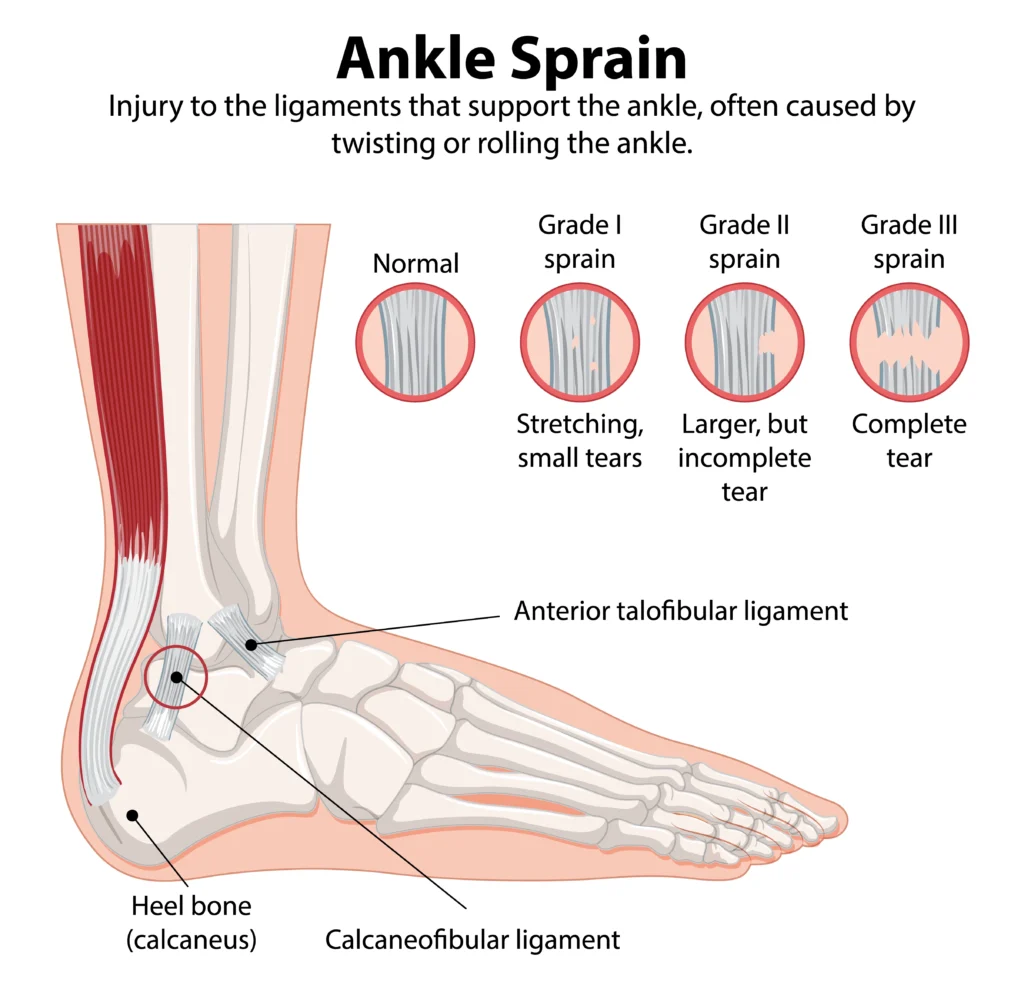
Walking places repeated load through the ankle.
If walking is becoming easier each day, gradual recovery may still be occurring.
If you are still walking with a substantial limp, avoiding the injured leg or developing increasing pain during ordinary walking, however, it is reasonable to have the ankle assessed.
A physiotherapist can examine walking mechanics, ankle movement, strength, balance and the way the ankle responds to loading.
Why Is My Ankle Still Swollen After 2 Weeks?
Some residual swelling can remain after an ankle sprain.
The important factor is whether the swelling is gradually reducing.
A small amount of swelling that appears after increased activity can occur during recovery.
Increasing swelling, particularly when combined with worsening pain, inability to bear weight or other new symptoms, deserves reassessment.
Why Is My Ankle Still Stiff After 2 Weeks?
Stiffness is common after an ankle injury.
Swelling, pain and reduced movement can all contribute to loss of ankle mobility.
A physiotherapist may assess movements such as dorsiflexion and plantarflexion and determine whether stiffness is affecting walking, squatting, stairs or other activities.
Treatment may then include progressive mobility exercises rather than simply waiting for the stiffness to disappear.
Why Is My Ankle Still Weak After 2 Weeks?
Weakness can persist because the injured leg has not been used normally.
The problem is not always simply muscle strength.
An ankle sprain can also affect balance, proprioception and the ability to coordinate the ankle during single-leg activities.
Clinical practice guidelines recommend addressing mobility, strength and movement-coordination impairments following lateral ankle sprains (Martin et al., 2021).
Why Does My Ankle Still Hurt But I Can Walk?
Being able to walk is a positive functional sign, but it does not mean the ankle is completely recovered.
You may still experience pain because of:
- Residual ligament sensitivity
- Stiffness
- Reduced strength
- Balance deficits
- Increased activity
- An irritated tendon
- Another injured structure
This is why recovery should not be judged by walking alone.
The ankle may need to tolerate progressively more demanding activities before it is ready for running or sport.
Why Am I Still Limping After 2 Weeks?
A persistent limp can occur when pain, stiffness or weakness prevents the injured ankle from moving normally through the walking cycle.
A limp that is gradually improving may simply reflect ongoing recovery.
A substantial limp that has not improved, or one accompanied by significant pain or inability to bear weight, is a reason to seek assessment.
Rather than deliberately forcing a normal walking pattern, rehabilitation should progressively restore the movement and strength needed for comfortable walking.
Can an Ankle Sprain Still Be Injured After 2 Weeks?
Yes.
Feeling better does not necessarily mean the ankle is ready for every activity.
Returning suddenly to running, jumping, court sports or uneven-surface activities can expose the recovering ankle to much greater loads than normal walking.
This is why rehabilitation should progress according to function rather than a calendar date.
Can You Run After an Ankle Sprain at 2 Weeks?
Two weeks is not a universal return-to-running point.
Some people with a mild sprain may begin a gradual return to jogging relatively early.
Others may require considerably longer.
Before returning to running, it is useful to consider:
- Pain during daily activities
- Ankle range of motion
- Calf and ankle strength
- Single-leg balance
- Confidence in the injured ankle
- Ability to perform running-related movements
- Response to progressively increased loading
For sports participation, the PAASS framework recommends considering pain, ankle impairments, athlete perception, sensorimotor control and sport or functional performance rather than relying only on elapsed time (Smith et al., 2021).
Can You Exercise With an Ankle Sprain After 2 Weeks?
In many cases, appropriate exercise is part of recovery.
The exercises should match the person’s current symptoms and functional ability.
Ankle Mobility Exercises
Controlled ankle movements can help restore comfortable range of motion.
Resistance Exercises
Resistance-band exercises can progressively strengthen the muscles controlling the ankle.
Calf Strengthening
Calf raises can be progressed as weight-bearing becomes more comfortable.
Balance Training
Single-leg balance and other sensorimotor exercises can be introduced when appropriate.
Functional Exercises
Later rehabilitation may include step-downs, hopping, changes of direction or other movements relevant to the person’s goals.
Exercise-based rehabilitation has been shown to reduce recurrent ankle sprain risk compared with usual care, although the optimal exercise program can vary between individuals (Wagemans et al., 2022).
Should You Still Rest an Ankle Sprain After 2 Weeks?
Complete rest is not usually the goal once the ankle can tolerate movement and loading.
For many uncomplicated ankle sprains, rehabilitation involves progressively increasing activity rather than keeping the ankle completely inactive.
Early mobilization and exercise have evidence supporting their role in recovery, while rehabilitation should be adjusted according to pain, function and injury severity (Doherty et al., 2017).
That does not mean pushing through significant pain.
The aim is progressive loading, not simply more activity.
What Can a Physiotherapist Do for an Ankle Sprain That Still Hurts?
Physiotherapy is particularly relevant when the ankle has persistent functional problems after the acute phase.
A physiotherapist may assess:
- Pain location
- Swelling
- Ankle range of motion
- Calf strength
- Ankle muscle strength
- Walking pattern
- Single-leg balance
- Proprioception
- Functional movement
- Confidence using the ankle
- Previous ankle injuries
Treatment may include:
- Progressive mobility exercises
- Strength training
- Balance and proprioception exercises
- Gait rehabilitation
- Functional strengthening
- Activity modification
- Gradual return to running
- Sport-specific progression where appropriate
The purpose is not simply to reduce pain.
The aim is to restore the physical capacity needed for the person’s normal activities.
Can Physiotherapy Diagnose Why the Ankle Still Hurts?
A physiotherapist can perform a clinical musculoskeletal assessment and identify many common movement, strength and functional impairments.
However, persistent pain can sometimes indicate a fracture, osteochondral injury, syndesmotic injury or another condition requiring medical investigation.
A physiotherapist should therefore refer for further medical assessment when the presentation falls outside routine rehabilitation or when imaging may be necessary.
Could It Be a Fracture Instead of a Sprain?
Yes.
An injury initially thought to be a sprain can sometimes involve an associated fracture.
Clinicians may use the Ottawa Ankle Rules as part of the assessment to determine whether radiographs are indicated.
An updated 2026 systematic review found that the rules remain highly sensitive for ankle fractures, although specificity is relatively low (Sharifi Razavi et al., 2026).
The Ottawa Ankle Rules are clinical decision tools, not something that should be used as a substitute for a professional examination.
Marked bony tenderness or an inability to bear weight should therefore not simply be treated as a normal part of recovery.
Could It Be a High Ankle Sprain?
Not every ankle sprain involves the same ligaments.
A syndesmotic, or “high ankle,” sprain affects the ligaments connecting the lower leg bones above the ankle joint.
Pain may be felt higher above the ankle rather than only around the outer ankle.
These injuries can behave differently from typical lateral ankle sprains and may require a different rehabilitation progression.
If the pain pattern does not fit a typical lateral sprain or recovery is unexpectedly slow, assessment can help determine whether another structure is involved.
Could Persistent Pain Come From Another Injury?
Yes.
Persistent symptoms after an ankle injury can occasionally be related to structures other than the originally suspected ligament.
Examples include:
- Tendon injury
- Syndesmotic injury
- Medial ligament injury
- Bone injury
- Osteochondral injury
- Persistent ankle instability
A systematic review has also found that persistent symptoms can occur after an apparently uncomplicated first lateral ankle sprain, reinforcing the importance of monitoring recovery rather than assuming that every ankle follows the same course. (Matricali et al., 2022).
When Might an MRI Be Considered?
An MRI is not routinely required for every ankle sprain.
Imaging decisions depend on the clinical findings and the suspected problem.
Further imaging may be considered when symptoms persist unexpectedly, when there is concern about another structure, or when the clinical examination suggests an injury that cannot be adequately evaluated with plain radiographs.
For example, persistent deep ankle pain, mechanical symptoms or symptoms that fail to follow the expected recovery pattern may require further investigation.
The decision should be made by an appropriately qualified clinician rather than based on the number of days since the injury alone.
What Should You Do If Your Ankle Still Hurts at 2 Weeks?
Start by looking at the trend.
Ask yourself:
- Is the pain lower than it was during the first week?
- Can I walk farther?
- Is swelling decreasing?
- Is my ankle moving better?
- Can I put more weight through the leg?
- Is my balance improving?
- Can I perform daily activities more comfortably?
If several answers are yes, the ankle may simply still be progressing through recovery.
If the answers are mostly no, or symptoms are getting worse, arrange an assessment.
When Should You See a Physiotherapist?
A physiotherapy assessment may be useful if:
- Pain has plateaued after two weeks
- Walking is still uncomfortable
- You are still limping
- The ankle feels weak
- Balance remains poor
- The ankle feels unstable
- Stiffness is limiting movement
- You are unsure how to progress exercises
- You want to return to running
- You want to return to sport
- You have previously sprained the same ankle
Early rehabilitation can help address functional deficits before they become persistent problems.
When Should You See a Doctor?
Seek medical assessment when:
- You cannot bear weight
- Pain is severe or worsening
- There is marked bony tenderness
- Swelling is increasing significantly
- The ankle appears deformed
- You develop numbness
- There is significant weakness
- You have severe pain at rest
- You develop unusual redness, warmth or systemic symptoms
- Recovery has substantially stalled
- You suspect a fracture or another significant injury
These situations may require further examination, radiographs or other investigations.
Myth vs Fact
Myth: An ankle sprain should be completely pain-free after 2 weeks.
Fact: Recovery varies between individuals. Some pain, stiffness or weakness can remain after 2 weeks, particularly after a more significant sprain. The direction of recovery is more important than an exact deadline.
Myth: If I can walk, my ankle is fully healed.
Fact: Walking is only one part of recovery. Strength, balance, movement control and the ability to tolerate higher loads may still be reduced.
Myth: More rest is always better when pain persists.
Fact: Once the ankle can tolerate movement and loading, progressive rehabilitation is generally more useful than prolonged complete rest.
Lesser-Known Fact: Feeling Better Does Not Mean the Ankle Is Fully Recovered
One of the easiest mistakes after an ankle sprain is to use pain reduction as the only measure of recovery.
You may feel comfortable walking but still have deficits in balance, strength or movement control.
That can become important when you return to running, jumping or sport.
Recovery should therefore progress from symptom control to normal movement, strength, balance and activity tolerance, rather than stopping rehabilitation as soon as everyday pain decreases.
Final Thoughts
An ankle sprain can still hurt after 2 weeks, and that does not automatically mean that recovery is abnormal. What matters most is whether pain, swelling, movement and everyday function are gradually improving.
If recovery has stalled, a physiotherapy assessment can help identify problems with mobility, strength, balance or load tolerance and guide the next stage of rehabilitation.
However, severe or worsening pain, inability to bear weight, significant swelling, bony tenderness or other concerning symptoms should be medically assessed rather than simply treated as a normal part of recovery.
Conclusion
An ankle sprain that still hurts after two weeks can be part of a normal recovery, especially when symptoms are gradually improving.
There is no single day when every ankle sprain should become pain-free.
What matters is the overall trajectory.
Improving walking, decreasing swelling, better ankle movement and increasing tolerance for activity are encouraging signs.
In contrast, worsening pain, persistent difficulty bearing weight, significant swelling, marked bony tenderness or a lack of meaningful improvement should prompt reassessment.
Physiotherapy can play an important role when persistent symptoms are related to stiffness, weakness, balance, movement control or reduced load tolerance.
It can also help guide a safe progression back to walking, running and sport.
If recovery has stalled at two weeks, the answer is not necessarily to rest longer or push through the pain.
A proper assessment can help determine what the ankle still needs and whether further medical investigation is appropriate.
Frequently Asked Questions
Is it normal for an ankle sprain to still hurt after 2 weeks?
Yes. Some pain, stiffness, swelling or weakness can remain after two weeks. The important sign is whether symptoms are gradually improving rather than worsening.
Why is my ankle still swollen after 2 weeks?
Residual swelling can persist while an ankle sprain heals. However, increasing swelling or swelling accompanied by worsening pain should be assessed.
Why does my ankle still hurt but I can walk?
Walking may become comfortable before the ankle has fully regained strength, balance, movement control and load tolerance.
Can I run 2 weeks after an ankle sprain?
Not everyone is ready to run at two weeks. Running should be introduced gradually when pain, mobility, strength, balance and functional control are adequate.
Should I see a physiotherapist if my ankle still hurts after 2 weeks?
A physiotherapy assessment can be useful if pain has plateaued, walking remains difficult, the ankle feels weak or unstable, or you need guidance returning to running or sport.
When should I see a doctor for an ankle sprain?
Seek medical assessment for severe or worsening pain, inability to bear weight, significant swelling, marked bony tenderness, deformity, numbness, significant weakness or recovery that is not progressing.
Stay tuned with us for more health related topics.
Follow us on LinkedIn and Instagram for more.
More Read


Medical Disclaimer
This article is intended for general educational purposes only and does not replace an individual medical or physiotherapy assessment. Ankle pain after a sprain can have different causes, and treatment should be based on the individual’s injury, symptoms, medical history and physical examination. Seek medical attention for severe or worsening pain, inability to bear weight, significant swelling, deformity, suspected fracture, numbness, significant weakness or symptoms that are not improving.


