


A fracture in a child is not always the same as a fracture in an adult.
Children’s bones are still developing, and they contain specialised areas called growth plates that allow bones to increase in length.
Quick Answer: What Are Growth Plate Injuries?
Growth plate injuries are fractures or damage involving the developing areas of cartilage near the ends of children’s bones. Unlike adult fractures, these injuries can sometimes affect future bone growth, potentially causing limb length differences or changes in bone alignment.
Treatment depends on the injury type and severity. It may involve immobilisation, fracture realignment or surgery, followed by medical monitoring. Once healing permits, physiotherapy helps restore joint movement, muscle strength, balance and functional mobility.
Important for parents
Persistent pain, swelling or difficulty using a limb after an injury should be medically assessed, even if the child can still move the affected joint.
These areas have different structural properties from mature bone and can be injured during falls, accidents and sports activities.
A growth plate injury deserves particular attention because damage to this area can sometimes affect how a child’s bone develops.
Although many children recover well, some injuries require careful orthopedic treatment and follow-up to identify potential growth problems.
Understanding the differences between childhood and adult fractures, recognizing warning signs and knowing how physiotherapy supports recovery can help parents make informed decisions about their child’s care.
Key Takeaways: Growth Plate Injuries in Children
Growth plates support bone development. They are areas of cartilage near the ends of growing bones.
Children’s fractures need special attention. Damage to a growth plate can sometimes affect future bone growth.
Salter-Harris classification matters. It helps doctors understand the fracture pattern and plan treatment.
Early assessment is important. Some growth plate injuries may not be obvious on the first X-ray.
Follow-up protects future bone health. Some injuries require monitoring for growth arrest or limb alignment changes.
Physiotherapy supports recovery. It helps restore movement, strength, balance and safe return to activities after medical clearance.
What Are Growth Plates?
Growth plates, medically known as physes, are areas of cartilage located near the ends of certain bones.
They are responsible for the longitudinal growth of bones during childhood and adolescence.
As a child grows, cartilage cells within the growth plate gradually develop into bone.
This process allows long bones, such as the thigh bone, shin bone and upper arm bone, to increase in length.
Growth plates are found in several areas, including:
- Wrist: Near the ends of the radius and ulna.
- Knee: Near the lower end of the femur and upper end of the tibia.
- Ankle: Near the lower ends of the tibia and fibula.
- Shoulder: Near the upper end of the humerus.
Growth plates gradually close and become solid bone as children reach skeletal maturity.
The timing varies according to the individual, the bone involved and biological development.
Why Are Growth Plate Injuries Different From Adult Fractures?
The main difference is that children’s bones contain active growth plates, whereas most adults have growth plates that have already closed.
In adults, fractures usually involve mature bone. In children, a fracture may pass through the growth plate, potentially affecting the area responsible for future bone development.
Here are the key differences.
1. Growth plates have different structural properties
Growth plates are made of cartilage rather than fully mineralized bone.
Certain areas within the growth plate are relatively vulnerable to shearing forces.
Consequently, an injury that might cause a ligament sprain in an adult can sometimes result in a growth plate fracture in a child.
2. Injuries can affect future bone growth
Many growth plate injuries heal without affecting normal development. However, damage to the growth plate can occasionally cause partial or complete growth arrest.
Possible consequences include:
- One limb becoming shorter than the other.
- Angular deformity as the bone grows unevenly.
- Changes in joint alignment.
- Reduced function in more significant cases.
The risk depends on the injury location, fracture pattern, displacement and the amount of growth remaining.
3. Children’s bones have a greater capacity for remodeling
Children’s bones generally have a stronger ability to remodel than adult bones. This means some residual deformities can gradually improve as the child grows.
However, remodeling has limits. It cannot reliably correct every fracture displacement, particularly when the injury affects the joint surface or growth plate.
4. Symptoms may resemble an ordinary sprain
Growth plate injuries can cause pain, swelling and difficulty moving a joint. These symptoms may resemble a ligament injury or a less complicated fracture.
A child may also be able to move the injured joint despite having a growth plate fracture. Therefore, movement alone cannot rule out an injury.
What Causes Growth Plate Injuries in Children?
Growth plate injuries can happen during everyday activities, sports or accidents.
They may result from a sudden force or, less commonly, repeated stress.
Common causes include:
- Falls: Landing on an outstretched hand or falling directly onto a knee or ankle.
- Sports injuries: Sudden twisting, collisions and awkward landings during football, basketball, gymnastics or running.
- Direct impact: A ball striking a finger or a collision during physical activity.
- Road and cycling accidents: A direct blow or high-energy impact can damage developing bone.
- Repetitive loading: Certain sports movements can place repeated stress on developing bone structures.
Growth plate fractures are particularly relevant during adolescence, when children may participate in higher-intensity sports while their bones are still developing.
Common Types of Growth Plate Injuries
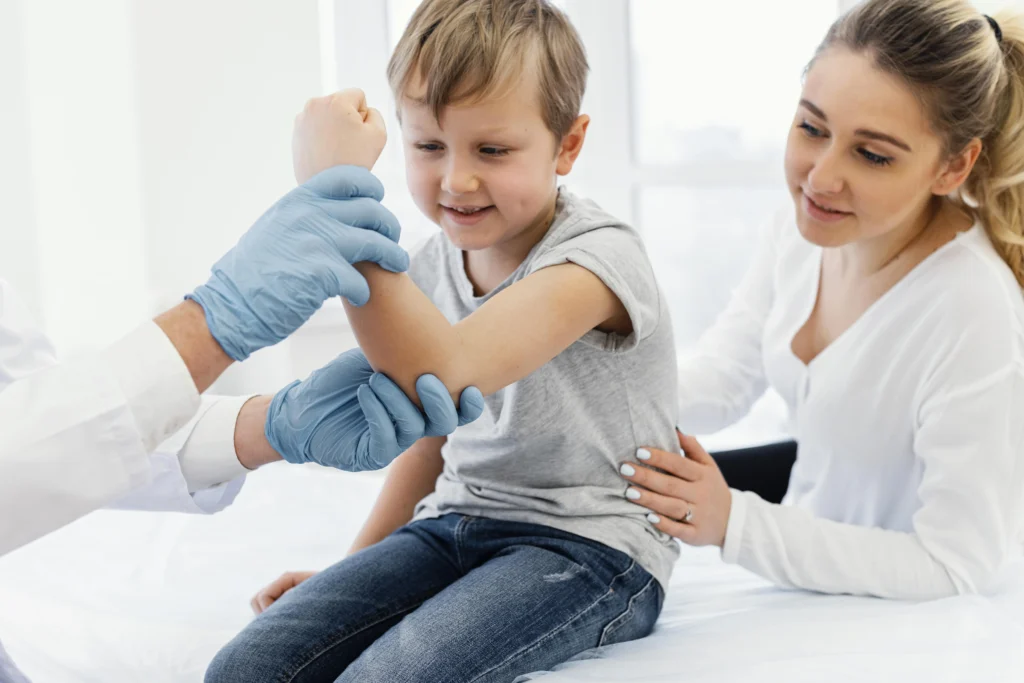
Growth plate fractures can occur in different bones, but certain locations are affected more frequently.
1. Wrist Growth Plate Fractures
The distal radius, located near the wrist, is one of the common sites of growth plate injury.
These fractures often happen when a child falls onto an outstretched hand.
Symptoms may include wrist pain, swelling, tenderness and difficulty gripping or moving the wrist.
2. Ankle Growth Plate Fractures
The lower ends of the tibia and fibula contain growth plates that can be injured during twisting movements, falls or sports collisions.
Children may experience pain around the ankle, swelling, bruising and difficulty bearing weight.
3. Knee Growth Plate Fractures
Growth plate injuries can affect the lower end of the femur or upper end of the tibia.
They may occur following a direct impact, fall or high-force sports injury. Pain, swelling and difficulty straightening the knee or walking require medical assessment.
4. Finger Growth Plate Fractures
Finger growth plates may be injured when a ball strikes the fingertip, during falls or through direct impact.
Swelling, tenderness, bruising and difficulty bending or straightening the finger are common symptoms.
5. Shoulder and Elbow Growth Plate Injuries
These injuries can occur in young athletes involved in throwing sports, gymnastics and other activities that place repeated stress on the upper limb.
Pain may develop around the shoulder or elbow, particularly during throwing, lifting or overhead movements.
Understanding the Salter-Harris Classification
Doctors commonly use the Salter-Harris classification to describe fractures involving the growth plate.
It identifies how the fracture passes through the growth plate and surrounding bone.
There are five main types:
- Type I: The fracture passes directly through the growth plate, separating the epiphysis from the metaphysis.
- Type II: The fracture passes through the growth plate and extends into the metaphysis. This is the most common type.
- Type III: The fracture passes through the growth plate and extends into the epiphysis, potentially involving the joint surface.
- Type IV: The fracture crosses the metaphysis, growth plate and epiphysis.
- Type V: The growth plate is compressed or crushed.
Types III and IV are particularly concerning because they can involve the joint surface and multiple areas of the growth plate.
Type V injuries are also serious because compression damage may be difficult to identify initially.
The classification helps doctors plan treatment, but it does not predict every child’s outcome.
The location of the injury, displacement and remaining growth are also important. (Waseem et al., 2024)
Growth Plate Injury vs Ordinary Fracture: What Is the Difference?
A growth plate fracture is still a fracture, but its involvement of a developing area of bone changes the assessment and follow-up requirements.
| Feature | Growth plate fracture | Adult fracture |
|---|---|---|
| Bone structure | Involves an active growth plate | Involves mature bone |
| Main concern | Healing and possible growth disturbance | Healing, alignment and joint function |
| Long-term effects | Possible growth arrest or limb deformity | Possible stiffness, deformity or joint problems |
| Remodeling | Greater potential in growing children | More limited |
| Follow-up | May include monitoring of future bone growth | Usually focuses on fracture healing and function |
The important distinction is not that every childhood fracture is more serious than an adult fracture.
It is that an injury involving an active growth plate introduces an additional concern: the child’s future bone development.
Signs and Symptoms Parents Should Recognize
Symptoms depend on the location and severity of the injury.
Some children experience immediate pain, while others develop symptoms gradually.
Look out for:
- Pain near the end of a bone or around a joint.
- Swelling or bruising after a fall or sports injury.
- Tenderness when the affected area is touched.
- Difficulty moving the nearby joint.
- Limping or refusing to put weight on the injured leg.
- Reduced grip or difficulty using the affected hand.
- Pain that increases during physical activity.
A child with significant pain, visible deformity, severe swelling, numbness, a cold or pale limb, or an open wound needs urgent medical assessment.
Can a Growth Plate Injury Be Missed on an X-ray?
Yes. Some growth plate injuries are difficult to identify on an initial X-ray.
Growth plates are made of cartilage, which does not appear in the same way as solid bone on standard radiographs.
A subtle fracture may therefore be difficult to see, particularly if there is no obvious displacement.
If the examination suggests a growth plate injury despite normal X-rays, the doctor may recommend further assessment.
Depending on the injury, this may include:
- MRI: Helps assess cartilage, bone marrow and surrounding soft tissues.
- CT scan: Provides detailed information about complex fracture patterns and joint involvement.
- Ultrasound: May help assess selected injuries, particularly in younger children.
A normal X-ray does not always exclude a growth plate injury. Persistent localized pain and tenderness should be reassessed.(Singh et al., 2021)
How Are Growth Plate Injuries Treated?
Treatment depends on the injured bone, fracture type, displacement, the child’s age and how much growth remains.
The main goals are to restore appropriate alignment, protect the growth plate and allow the bone to heal.
1. Immobilization
Many uncomplicated growth plate fractures can be treated with a splint or cast.
Immobilization protects the injured area and prevents unnecessary movement while healing takes place.
2. Fracture Reduction
If the bone fragments have moved out of their normal position, a doctor may need to realign them. This procedure is called fracture reduction.
It may be performed without surgery or through an operation, depending on the fracture pattern and severity.
3. Surgery
Some displaced or unstable fractures, particularly those involving the joint surface, may require surgery.
The aim is to restore alignment while minimizing additional damage to the growth plate.
4. Follow-up Monitoring
Follow-up appointments are important because some growth disturbances become apparent only as the child continues to grow.
Doctors may recommend repeat examinations or imaging to check bone alignment, healing and growth. Some children require longer-term monitoring, particularly after higher-risk injuries.
Treatment and follow-up should be guided by a pediatric orthopedic specialist. (National Institute of Arthritis and Musculoskeletal and Skin Diseases, 2023)
How Does Physiotherapy Help After a Growth Plate Injury?
Physiotherapy supports recovery after the treating doctor confirms that rehabilitation can safely begin.
It does not replace fracture reduction, immobilization or orthopedic treatment.
The rehabilitation program depends on the injured bone, healing progress, movement restrictions and the child’s functional needs.
1. Restoring Joint Movement
After a period in a cast or splint, children may experience stiffness and reduced joint mobility.
A physiotherapist may introduce gentle, age-appropriate range-of-motion exercises once permitted.
The aim is to restore comfortable movement without placing excessive stress on the healing area.
2. Improving Muscle Strength
Immobilization and reduced activity can lead to muscle weakness.
Progressive strengthening may target the muscles around the injured joint and the surrounding limb.
Exercises are introduced gradually according to the child’s healing stage and medical advice.
3. Improving Balance and Coordination
An ankle or lower-limb injury can affect balance, walking and coordination.
Physiotherapy may include controlled balance activities, weight-shifting exercises and movement training to help children regain confidence during everyday activities.
4. Correcting Walking and Movement Patterns
Children recovering from leg injuries may develop a limp or avoid loading the affected limb.
A physiotherapist can assess walking mechanics and introduce appropriate gait training when weight-bearing is permitted.
5. Building Functional Fitness
As recovery progresses, rehabilitation may include age-appropriate activities that improve endurance, coordination and control.
The program should be adjusted to the child’s injury and should not involve impact or high-load movements until they are medically permitted.
6. Preparing for a Safe Return to Sports
Returning to sport too early can increase the risk of further injury.
Before sports participation, rehabilitation may progress to include:
- Functional strengthening.
- Controlled jumping and landing.
- Running and direction changes.
- Sport-specific movement drills.
- Gradual increases in training intensity.
The child should return to sport only after medical clearance and when strength, movement and functional ability are appropriate for the activity.
The National Institute of Arthritis and Musculoskeletal and Skin Diseases also highlights the role of physical therapy in restoring joint movement and strengthening supporting muscles after growth plate injuries. (NIAMS, 2023)
What Is Growth Arrest and Why Does Follow-up Matter?
Growth arrest occurs when part or all of a growth plate stops functioning before the bone has completed its normal development.
In some cases, a small bridge of bone forms across the injured growth plate. This is known as a physeal bar.
Depending on its location and size, it may cause:
- Partial or complete interruption of bone growth.
- Unequal growth between the two limbs.
- Gradual bending or angular deformity.
- Changes in joint alignment.
Growth arrest is not inevitable. However, it is an important reason why certain growth plate fractures need follow-up beyond the initial healing period.
Parents should attend recommended appointments and report new limping, visible changes in limb alignment, persistent pain or differences in limb length.
The Royal Children’s Hospital Melbourne provides guidance on assessment, fracture classification and management of pediatric growth plate injuries. (Royal Children’s Hospital Melbourne)
How Long Does a Growth Plate Injury Take to Heal?
Recovery time varies according to the fracture type, location, severity and treatment.
Many uncomplicated growth plate fractures heal over several weeks. More complex injuries may require longer immobilisation, rehabilitation and medical monitoring.
It is important to understand that bone healing and complete functional recovery are not always the same thing.
A child may need additional time to regain joint movement, muscle strength, balance and confidence before returning to sports.
The treating doctor should guide the timeline for weight-bearing and activity progression.
Can Children Continue Playing Sports With a Growth Plate Injury?
Children should not continue playing sports when a growth plate fracture is suspected or diagnosed until they have been assessed and given appropriate medical advice.
Continuing to participate may increase pain or worsen the injury, particularly when the fracture is unstable or displaced.
During recovery, the doctor may recommend avoiding:
- Running and jumping.
- Contact sports.
- Heavy lifting involving the injured limb.
- Repetitive throwing or overhead activities.
- Movements that cause pain or place stress on the injured area.
The return-to-sport decision should consider fracture healing, medical clearance, joint movement, strength and the demands of the child’s sport.
Myth vs Fact: Growth Plate Injuries in Children
MYTH: Children recover from all fractures without complications.
FACT: Many children heal well, but some growth plate injuries can affect bone growth and require follow-up.
MYTH: A normal X-ray means there is no growth plate injury.
FACT: Some injuries are difficult to identify initially. Persistent pain and tenderness may require reassessment.
MYTH: A child can continue playing if they can move the injured joint.
FACT: Joint movement does not rule out a fracture. Suspected growth plate injuries need medical assessment before sports participation.
MYTH: Physiotherapy should start immediately after every fracture.
FACT: Rehabilitation must follow medical advice and the stage of fracture healing. Exercise should not compromise fracture stability.
MYTH: Once the bone heals, no further monitoring is necessary.
FACT: Some growth disturbances appear later. Follow-up may be necessary to assess bone growth and alignment.
Can Growth Plate Injuries Be Prevented?
Not every injury can be prevented, especially those caused by unexpected falls or accidents. However, sensible activity habits can reduce avoidable risks.
Parents and coaches can encourage children to:
- Warm up before training and sports.
- Learn appropriate jumping, landing and movement techniques.
- Increase training intensity gradually.
- Avoid excessive repetitive activity without adequate recovery.
- Wear suitable protective equipment.
- Follow age-appropriate training programs.
- Report pain rather than continuing to play through it.
Children involved in competitive sports should have adequate rest and a balanced activity schedule, particularly during periods of rapid growth.
When Should Parents Seek Medical Advice?
Seek prompt medical assessment if a child develops pain around a joint or the end of a bone after a fall, collision or sports injury, particularly when there is swelling, tenderness or difficulty moving the limb.
Urgent assessment is important if the child:
- Cannot bear weight or use the affected limb.
- Has severe pain or an obvious deformity.
- Develops significant swelling.
- Experiences numbness, tingling or unusual color changes.
- Has an open wound near the injured area.
Do not assume that the injury is only a sprain because the child can still move the joint. Some growth plate injuries allow limited movement despite a fracture.
Final Thoughts
Childhood is an important period for bone development, and growth plate injuries deserve careful attention. Although most children recover well, some injuries can affect normal bone growth if the growth plate is damaged.
Parents should not overlook persistent pain, swelling or difficulty moving a limb after an injury. Timely medical assessment and appropriate follow-up can help identify complications early.
Supporting a healthy recovery
With appropriate orthopedic care and a medically guided physiotherapy program, children can work towards restoring movement, strength, confidence and a safe return to everyday activities and sports.
Conclusion
Growth plate injuries are different from adult fractures because they involve the developing areas of bone responsible for future growth.
Although many children recover successfully, some injuries can affect bone length, alignment or joint function if the growth plate is damaged.
Early assessment, appropriate orthopedic treatment and follow-up are essential.
Once healing allows, physiotherapy can help children restore movement, strength, balance and confidence before gradually returning to sports.
For parents, the most important message is simple: persistent pain near a child’s joint after an injury should never be ignored.
Timely medical care and appropriate rehabilitation can make a meaningful difference to recovery and long-term bone health.
Frequently Asked Questions About Growth Plate Injuries
1. Are growth plate injuries more serious than adult fractures?
Not necessarily. However, growth plate injuries require special attention because damage can sometimes affect future bone growth, limb length or alignment.
2. At what age do growth plate injuries occur?
They can occur throughout childhood and adolescence while the growth plates remain open. The timing of growth plate closure varies between individuals and bones.
3. Can a growth plate injury be missed on an X-ray?
Yes. Some injuries are difficult to identify on initial X-rays. If symptoms and clinical findings suggest an injury, further assessment or imaging may be required.
4. How long does a growth plate fracture take to heal?
Many uncomplicated fractures heal over several weeks, but recovery varies according to the injury, location and treatment. Functional recovery may take longer.
5. Can growth plate injuries affect a child’s height?
Some severe injuries can cause partial or complete growth arrest, potentially resulting in a limb length difference. Many growth plate fractures, however, heal without affecting normal growth.
6. Does physiotherapy help after a growth plate injury?
Yes. Once medically permitted, physiotherapy can help restore joint movement, muscle strength, balance, coordination and functional mobility.
7. Can a child return to sports after a growth plate fracture?
Most children can return to sports after appropriate healing and rehabilitation. The timing should be guided by the treating doctor and based on functional recovery.
8. When should parents take their child to a doctor?
Seek medical assessment after an injury that causes pain near a joint, swelling, tenderness or difficulty using the affected limb. Severe pain, deformity, numbness or an open wound requires urgent assessment.
Stay tuned with us for more health related topics.
Follow us on LinkedIn and Instagram for more.
More Read


Medical Disclaimer
This article is intended for general educational and informational purposes only. It does not replace professional medical advice, diagnosis or treatment. Growth plate injuries require individual assessment by a qualified healthcare professional. Treatment and rehabilitation recommendations depend on the child’s age, injury type, fracture severity and healing progress. Always consult a qualified doctor or pediatric orthopedic specialist before starting exercises or returning to sports. Seek urgent medical attention for severe pain, visible deformity, numbness, circulation changes or an open injury.


