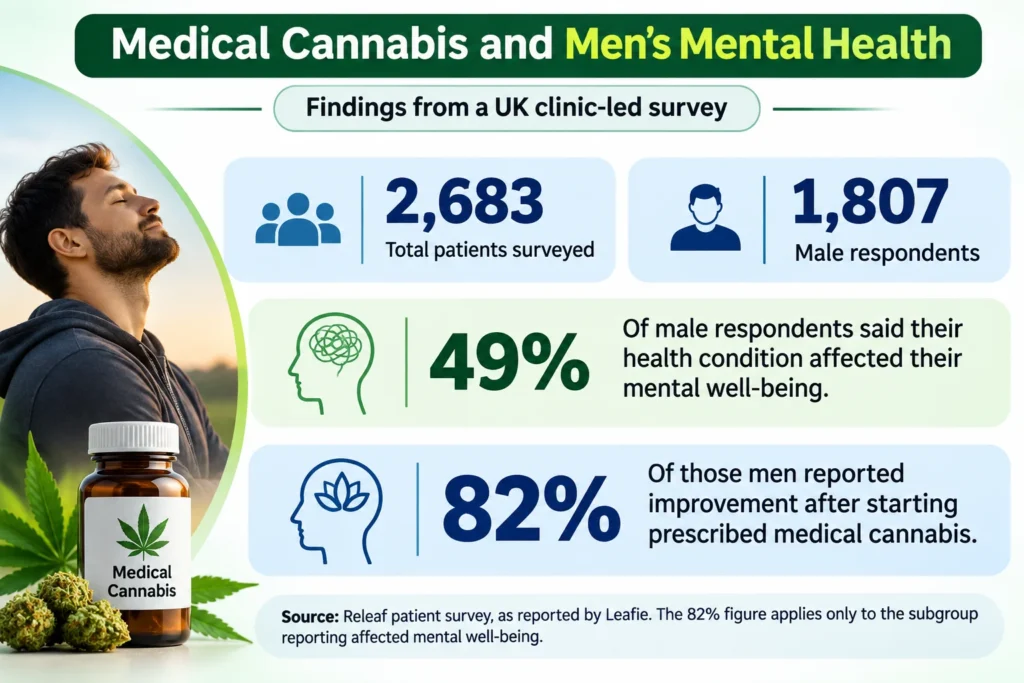
LONDON, UK: A UK clinic-led survey has found that 82% of men whose health conditions affected their mental well-being reported improvement after starting prescribed medical cannabis.
The findings highlight the connection between long-term physical health problems and mental health in men. However, clinical research has not yet established medical cannabis as an effective treatment for anxiety or depression.
What the Survey Reveals About Medical Cannabis and Men’s Mental Health
A survey conducted by UK medical cannabis clinic Releaf collected responses from 2,683 active patients, including 1,807 men.
Almost half of the male respondents (49%) said their health condition had affected their mental well-being before starting treatment. Among these men, 82% reported an improvement after beginning prescribed medical cannabis.
Across all male respondents, 61% said their treatment had helped their anxiety or depression symptoms.
The findings were reported by Liam O’Dowd in Leafie’s November 12, 2026 article, highlighting the experiences of men who had struggled with long-term health conditions.
Many participants had experienced symptoms for years before seeking medical cannabis treatment. Around 44% of male respondents had lived with symptoms for more than 10 years. Another 58% had already tried four or more treatments.
These findings suggest that many patients had explored several treatment options before receiving medical cannabis.
Long-Term Health Conditions Affect Work and Relationships
The survey also examined how ongoing health problems affected men’s daily lives.
Before treatment, 71% of male respondents said their condition had affected their ability to work. Half reported difficulties in their relationships with friends, family members or partners.
Among men whose work had been affected, 70% reported an improvement after starting treatment.
One respondent described feeling “less stressed about letting people down” and being able to go places without repeatedly cancelling plans.
Graham Woodward, Releaf’s Chief Medical Officer, said many patients had struggled for more than a decade and tried several treatments before seeking medical cannabis. He noted that their mental health, relationships and working lives had suffered during this period.
The survey also highlighted the stigma associated with prescribed cannabis. Nearly one-third of male respondents (31%) said they tried to hide their medical cannabis use from other people. Among men whose conditions had affected their mental well-being, this figure increased to 33%.
What NHS England Data Says About Men’s Mental Health
The connection between physical illness and mental well-being is also reflected in official UK health data.
The NHS England Adult Psychiatric Morbidity Survey 2023/24 found that approximately one in six men in England met the criteria for a common mental health condition. These conditions include depression and anxiety disorders.
The survey also found that 32.9% of adults with a physical health condition that limited their daily activities had a common mental health condition. This compared with 12.6% of adults without a limiting physical health condition.
The association between physical and mental health problems was stronger among men than women.
The findings highlight the importance of considering mental well-being when treating long-term physical health conditions.
The NHS England Adult Psychiatric Morbidity Survey (2025) provides further details.
Men’s mental health is also an important public health concern when considering suicide rates.
According to the Office for National Statistics, the age-standardized suicide rate for deaths registered in England and Wales in 2025 was 17.5 per 100,000 males, compared with 5.5 per 100,000 females.
These figures highlight a substantial difference between male and female suicide rates. They provide wider context for men’s mental health but do not establish any connection between medical cannabis treatment and suicide prevention.
Source: Office for National Statistics, Suicides in England and Wales (2026).
Another UK Survey Reports Improvements Among Medical Cannabis Patients
The findings are consistent with patient-reported improvements identified in a separate UK survey published in May 2026.
The survey collected responses from 6,282 patients across four medical cannabis clinics: Mamedica, Alternaleaf, CB1 Medical and Curaleaf.
Among the 5,128 patients prescribed treatment for anxiety, depression or post-traumatic stress disorder (PTSD), 97.6% reported an improvement in their symptoms. Additionally, 92.3% reported better sleep, while 93.5% said their ability to manage daily activities had improved.
Around 88.3% considered medical cannabis the most effective treatment they had tried for their condition.
The findings were reported by Leafie in its May 27, 2026 coverage of the multi-clinic survey.
However, these figures also come from patient-reported survey data. The voluntary, cross-sectional survey did not establish that medical cannabis caused the improvements or that the findings apply to all people with mental health conditions.
Does Clinical Research Support Medical Cannabis for Anxiety and Depression?
Although patient surveys report positive experiences, clinical research presents a more cautious picture.
Cannabis contains several active compounds called cannabinoids. The two most widely studied are tetrahydrocannabinol (THC) and cannabidiol (CBD).
These compounds interact with the body’s endocannabinoid system, which is involved in several biological processes. Researchers are studying how this system may relate to mood, sleep, pain and stress responses.
However, evidence of a biological effect does not automatically establish that a medicine can successfully treat a mental health disorder.
A systematic review published in Psychiatry Research in November 2026 examined 82 experimental studies and 118 observational studies involving cannabinoids and mental health or substance use disorders.
The review found some evidence of reduced anxiety symptoms in randomised controlled trials. However, the results varied considerably between studies, and the certainty of evidence was very low.
Evidence for PTSD was limited to a small trial involving 20 participants. The review found little to no meaningful effect on depression symptoms.
Observational studies also reported improvements in anxiety, depression and PTSD symptoms. However, the researchers considered these studies to have a high risk of bias.
The authors concluded that current evidence is insufficient to support cannabinoids as first-line treatments for mental health or substance use disorders.
The review was published in Psychiatry Research by Bharat and colleagues (2026).
What Are the Potential Risks of Medical Cannabis?
Medical cannabis is not suitable for everyone. Its effects depend on the cannabinoid composition, dosage, treatment duration and individual medical history.
THC-containing products can cause dizziness, tiredness, mood changes and impaired concentration. Regular exposure to THC can also increase the risk of dependence and psychosis in some people.
CBD can interact with other medicines and may affect liver function. Patients using CBD-based medicines may require medical monitoring.
The NHS advises that cannabis-based medicines should only be used under appropriate medical supervision. In England, NHS prescriptions are generally limited to a small number of conditions, including certain severe forms of epilepsy, chemotherapy-related nausea and vomiting, and muscle stiffness associated with multiple sclerosis when other treatments have not helped.
The NHS does not list anxiety or depression among the routine indications for NHS medical cannabis prescriptions.
Patients should also avoid assuming that CBD oils or cannabis products purchased online offer the same quality, safety or effects as prescribed medicines.

What the Findings Mean for Men’s Mental Health
The survey provides useful insight into the experiences of men receiving prescribed medical cannabis, particularly those living with long-term health conditions.
The reported improvements in mental well-being, work and relationships highlight the importance of addressing the wider impact of chronic illness.
However, patient experiences should not be confused with proof of clinical effectiveness. The survey was clinic-led and did not include a control group to establish whether cannabis treatment caused the improvements.
Larger, independent randomised controlled trials are needed to determine which patients may benefit, which cannabis-based products are suitable and what risks treatment may involve.
Medical cannabis should not replace established treatments for depression or anxiety without appropriate clinical advice.
For now, the findings add to the growing discussion around medical cannabis and men’s mental health, while highlighting the need for stronger scientific evidence.