If you’re exploring headache diagnosis methods, the first step is understanding that most headaches aren’t random, they follow patterns your body is trying to show you.
If you came into my clinic with a chronic headache, I would not start by asking where it hurts.
I would start by asking what changed in your life.
Because most long-standing headaches are not random.
They follow patterns.
And if you miss that pattern, you end up treating symptoms again and again.
Chronic headache usually means pain on 15 or more days per month for at least three months.
But that definition does not help me treat you.
What helps is understanding why your system keeps producing pain.
Quick Answer
Physiotherapists do not diagnose chronic headaches based on symptoms alone. They assess movement, posture, muscle function, lifestyle habits, and nervous system response before identifying the cause.
Most chronic headaches are linked to a combination of neck dysfunction, weak stabilizing muscles, poor posture, sleep issues, and daily habits rather than a single problem.
The goal is not just to label the headache, but to understand the pattern behind it so treatment becomes targeted and long-lasting.
Key Takeaways
- Physios first check if your headache changes with movement or posture.
- Upper neck (C1–C3) dysfunction is a common but overlooked cause.
- Weak deep neck flexor muscles are often more important than tightness.
- Poor posture alone is not the issue, long duration without breaks is.
- Sleep quality, breathing pattern, and stress response all influence headaches.
- Jaw clenching and upper back stiffness are hidden contributors.
- Diagnosis is based on patterns, not a single test or scan.
First question I answer quietly
Is this headache mechanical or not
Before thinking about diagnosis, I check if your pain changes with movement or posture.
I might ask you to:
- Turn your neck
- Sit upright
- Slouch
- Hold a position
If your headache increases or reduces with these changes, it tells me your neck and surrounding structures are involved.
This step is important because cervicogenic headaches behave differently from migraines or other neurological headaches.
They are usually linked to movement and joint dysfunction (Bogduk N 2014)
What patients usually get wrong about headaches

Most people walk in with fixed beliefs.
And honestly, some of them slow down recovery.
Common things I hear:
- “It’s just stress”
- “My MRI is normal so nothing is wrong”
- “I need stronger medicines”
But in clinic, I often see this instead:
- Pain is coming from movement patterns
- Muscles are not coordinating well
- Lifestyle is feeding the cycle
A normal scan does not mean normal function.
And headaches are more about function than structure.
Then I observe you without telling you
Most people expect machines or scans.
But observation gives more useful information in the first few minutes.
I look at:
- How your head sits over your shoulders
- Whether your shoulders round forward
- How your upper back moves
Forward head posture increases load on cervical structures and can contribute to persistent headache patterns (Khan et al. 2021)
But here is the part many miss. It is not just the neck.
The upper back and shoulder position play a major role in how load is distributed.
What your first physio session actually looks like
Most people expect machines or exercises straight away.
That is not how it works.
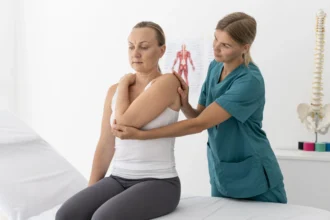
Your first session is mostly assessment using correct headache diagnosis methods.
Typically:
- 10 to 15 minutes talking
- 10 minutes observing posture and movement
- 10 to 15 minutes hands-on testing
Sometimes I treat in the first session. Sometimes I don’t.
Because getting the diagnosis right matters more than rushing treatment.
Upper cervical spine is always on my radar
This is where things get specific.
The upper cervical segments C1 to C3 have a direct connection with the trigeminal nerve system.
This means dysfunction here can refer pain into the head and face (Jull G et al. 2002)
So I check small movements, not big ones.
Rotation, slight nodding, segment stiffness.
If I reproduce your headache during these tests, that gives me a strong direction.
I do not just check tightness
I look for what is not working
A lot of people come in saying their muscles are tight.
But clinically, I am more interested in weakness and control.
Deep neck flexors
These are small stabilizing muscles at the front of your neck.
They do not create big movement, but they keep your neck stable.
In many chronic headache patients, these muscles are:
- Weak
- Delayed
- Poorly coordinated
So larger muscles like upper trapezius take over and get overloaded. (Falla D et al. 2004)
Newer clinical trials also show that training these muscles improves pain and function in cervicogenic headache patients Mishra et al. (2024)
Range of motion tells me patterns quickly
I check how your neck moves.
Not just whether it moves, but how it moves.
Things I notice:
- Rotation restriction on one side
- Pain at end range
- Subtle compensations
Very often, the side that does not move well matches the side of your headache.
That correlation is rarely accidental.
Quick self check you can try right now
Try this before you overthink your headache.
- Sit tall and gently tuck your chin
- Hold for 10 seconds
Then compare it with your usual posture.
If your headache reduces even slightly, your neck is involved.
Another one:
- Turn your head left and right slowly
If one side feels tighter and your headache sits on that side, that is a useful clue.
This is not a diagnosis.
But it tells you your body is giving signals.
I always ask about your daily routine
This is where the real answers usually come from.
I ask simple things:
- How long do you sit
- Do you use a laptop or phone more
- Do you take breaks
Because chronic load matters more than one bad posture.
Even a perfect posture held for hours can create strain.
Small daily habits that silently worsen headaches
These are things people rarely connect to headaches:
- Working on a laptop placed too low
- Looking down at phone for long periods
- Skipping meals
- Not drinking enough water
- Sitting without back support
Individually, they seem harmless.
But over weeks, they build load on your system.
And that load shows up as headache.
Sleep is a bigger factor than most people think
Many patients overlook this completely.
I ask:
- How many hours you sleep
- Whether you wake up with headache
- Your pillow height and position
Poor sleep quality is linked with higher headache frequency and increased pain sensitivity (Rains JC et al. 2015)
Morning headaches often point toward:
- Poor neck support
- Jaw clenching
- Disturbed sleep cycles
Calculate your ideal sleep timings here: “Sleep Calculator”
Breathing pattern gives away hidden tension
This is something patients do not expect.
If you breathe using your chest instead of your diaphragm, your neck muscles stay active all the time.
Over time, this creates fatigue and tension.
Recent rehabilitation research shows breathing patterns influence posture and musculoskeletal load (Bordoni B et al. 2023)
So I always observe how you breathe when you are not paying attention.
Shoulder and upper back are never ignored
Your neck does not work alone.
If your shoulder blade is not stable or your upper back is stiff, your neck compensates.
That compensation builds up over time.
Research has shown altered shoulder and thoracic posture in people with chronic headaches (Khan et al. 2021)
So I check:
- Scapular control
- Upper trapezius dominance
- Thoracic mobility
Stress is not just mental
It shows physically
Instead of asking if you are stressed, I observe how your body behaves.
Things I notice:
- Constant muscle tension
- Shallow breathing
- Low tolerance to pressure
Chronic headache patients often have a sensitized nervous system, where pain processing becomes amplified.
In such cases, treatment is not just physical correction. It includes calming the system.
Jaw involvement is often missed
Many chronic headaches are linked with jaw tension.
I check:
- Clenching habits
- Clicking sounds
- Pain near temples
Temporomandibular dysfunction can contribute to headache patterns, especially around the temples and sides of the head (Fernández-de-las-Peñas C et al. 2015)
I always rule out red flags first
Before confirming anything, safety comes first.
If I hear:
- Sudden severe headache
- Vision changes
- Numbness
- Loss of coordination
I refer immediately.
No trial and error here.
When physiotherapy alone is not enough
Not every headache should be treated only with physio.
Sometimes we co-manage.
You may need medical support if:
- Headaches are worsening suddenly
- You have strong migraine symptoms
- Pain is not responding at all to movement-based treatment
In those cases, combining:
- medical care
- physiotherapy
- lifestyle correction
works better than relying on one approach.
So what actually leads to diagnosis
It is never one factor in headache diagnosis methods that leads to diagnosis.
Most chronic headaches are a combination of:
- Upper cervical stiffness
- Weak deep neck flexors
- Postural load
- Poor sleep
- Stress and nervous system sensitivity
When these stack together, headaches persist.
How I connect all findings before giving a diagnosis
At this point, I am not guessing.
I am connecting patterns.
For example:
- Limited neck rotation on right
- Headache on right side
- Weak deep neck flexors
- Long sitting hours
That combination tells a story.
Diagnosis is not one test.
It is the pattern that repeats across tests.
Things patients are usually surprised to hear
From real clinic experience:
- Headaches often improve when we treat the upper back
- Pillow height alone can change symptoms
- Weakness can cause more issues than tightness
- Breathing retraining can reduce neck tension
- Jaw clenching at night is a hidden trigger
A quick note I usually tell my patients
Your headache is real.
But it is not random.
Your body is responding to something it has been dealing with for a while.
Once we identify that pattern, things start making sense.
And when things make sense, they become easier to fix.
Final thought on headache diagnosis methods by physios
If you only chase pain, it keeps coming back.
If you understand what is driving it, you can change it.
That is how physiotherapy approaches chronic headaches.
What improvement should actually feel like
Most people expect pain to disappear first.
But that is not always the first sign of progress.
Early improvements usually feel like:
- Neck feels lighter
- Movement becomes easier
- Less frequent headaches
- Faster recovery after a long day
Pain reduction follows.
So do not judge progress too early.
Once you understand the right headache diagnosis methods, you stop guessing and start fixing the real cause behind your pain.
Frequently Asked Questions
Can physiotherapy really help chronic headaches?
Yes, especially when headaches are linked to neck dysfunction, posture, or muscle imbalance. Many patients see long-term improvement with the right approach.
How do physios identify the cause of headache?
They assess movement, posture, muscle strength, breathing patterns, and daily habits instead of relying only on scans.
Are tight muscles the main reason for headaches?
Not always. Weak or poorly coordinated muscles often play a bigger role than simple tightness.
Can poor posture alone cause headaches?
It is usually the duration of poor posture over time that contributes to headaches, not posture alone.
Does sleep affect chronic headaches?
Yes, poor sleep can increase headache frequency and reduce pain tolerance.
Is breathing really connected to headaches?
Yes, shallow breathing increases neck muscle activity, which can lead to tension and headaches.
Do I need MRI or scans before seeing a physio?
Not in most cases. Physiotherapists can assess headaches clinically unless there are serious warning signs.
Stay tuned with us for more health related topics.
Follow us on LinkedIn and Instagram for more.
More Read





Medical Disclaimer!
This article has been reviewed and written under the guidance of our Head Physiotherapist, Dr. Kruti Raj (PT, MUHS,CPT,CMPT). The information shared is intended for educational purposes only and should not be considered a substitute for personalized medical advice, diagnosis, or treatment.
Please consult us or any other qualified healthcare professional before beginning any exercise program, especially if you are experiencing pain, recovering from injury, or managing a medical condition.