


Diastasis recti recovery without surgery often focuses on :
rebuilding deep core strength, breathing control, and abdominal support gradually.
Most women do not discover the term “diastasis recti” in a clinic.
They notice it while getting out of bed. Or while lifting their baby.
Or maybe during a workout when the stomach suddenly forms a strange ridge down the middle.
At first, many assume it is stubborn belly fat.
Others think they simply need to “tighten the core more.”
Some spend months doing intense ab workouts that quietly make things worse.
As a physiotherapist, I have seen women become frustrated because nobody explained what recovery really looks like.
The internet is full of dramatic before-and-after photos, quick-fix promises, and generic advice that treats every postpartum body the same.
But recovery is rarely that simple.
Some women improve within a few months.
Others continue noticing symptoms years later even after exercising consistently.
In many cases, the problem is not laziness or lack of effort.
It is that the body needs a different approach.
Quick Answer
Diastasis recti can often improve without surgery through physiotherapy-based rehabilitation, breathing retraining, posture correction, pelvic floor coordination, and gradual core strengthening. Recovery focuses more on restoring abdominal tension, pressure control, and daily function rather than simply “closing the gap.” Many women see meaningful improvement with consistent rehabilitation, especially when exercises are performed correctly and progressed gradually.
The most effective recovery plans usually include deep core activation, rib cage positioning, pressure management during lifting, and realistic postpartum healing expectations instead of aggressive ab workouts or quick-fix fitness programs.
The good news is that many women recover very well without surgery.
Not perfectly overnight.
Not through endless crunches.
But through gradual, intelligent rehabilitation that restores strength, pressure control, movement confidence, and core function.
And importantly, healing does not always mean achieving a completely flat stomach.
Sometimes the biggest victory is being able:
to lift your child, exercise, laugh, cough, and move through the day without heaviness, instability, back pain, or fear of making things worse.
Key Takeaways
- Diastasis recti recovery is possible without surgery in many mild to moderate cases.
- Healing is not only about reducing the abdominal gap. Core function and tissue tension matter more.
- Breathing mechanics and pressure management play a major role in recovery.
- Traditional crunches and aggressive ab workouts may worsen symptoms early on.
- Pelvic floor dysfunction and diastasis recti commonly occur together.
- Posture, rib flare, constipation, and lifting habits can influence healing significantly.
- Recovery timelines vary and may take several months depending on tissue condition and lifestyle factors.
- Evidence-based physiotherapy focuses on gradual strengthening instead of quick-fix approaches.
- Many women can safely return to strength training and exercise with proper progression.
- Functional improvement matters more than achieving a perfectly flat stomach.
What Is Diastasis Recti, Really?
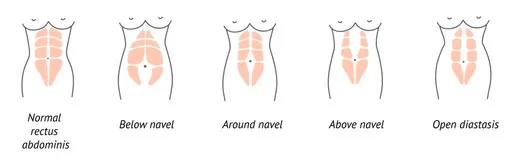
Diastasis recti happens when the connective tissue between the abdominal muscles stretches and widens.
During pregnancy, this tissue naturally expands to accommodate the growing uterus.
That part is completely normal.
The issue begins when the tissue struggles to regain tension afterward.
You may notice:
- A bulge or dome in the abdomen
- Weakness while lifting
- Lower back discomfort
- Poor pressure control
- Feeling disconnected from your core
- Persistent bloating appearance
- Pelvic floor symptoms
- Difficulty returning to exercise
One important thing many women are never told is this:
A visible gap alone does not automatically mean dysfunction.
Some women have a wider separation but excellent strength and minimal symptoms.
Others have a smaller gap but poor tension and significant instability.
Current research increasingly suggests that tissue tension and functional control matter more than the gap measurement itself. (Mota et al. 2024)
That changes the conversation entirely.
Recovery should not revolve around obsessively checking finger widths every week.
Why So Many Women Feel Confused About Recovery
Part of the confusion comes from outdated advice.
For years, postpartum women were often told one of two extremes:
- “Just do crunches.”
- “Never use your abs again.”
Neither is fully correct.
The abdominal wall needs movement to recover.
But it also needs proper pressure management.
This is where physiotherapy becomes different from random social media fitness advice.
Instead of asking:
“How do we flatten the stomach quickly?”
We ask:
“How does the body transfer pressure during movement?”
That small shift changes everything.
One of the Biggest Mistakes Women Make
Many women unknowingly hold tension in the wrong place all day.
They constantly suck the stomach inward.
Ironically, this can interfere with natural breathing mechanics and deep core coordination.
I often see women who are bracing their abdomen almost continuously without realizing it.
The ribs stay flared, the diaphragm moves poorly, and the pelvic floor becomes overactive or fatigued.
The body starts functioning from tension instead of coordination.
That is not real stability.
The Core Is More Than “Abs”
The deep core system includes:
- The diaphragm
- The pelvic floor
- The transverse abdominis
- Deep spinal stabilizers
- The rib cage
- Breathing mechanics
These systems work together constantly.
When one area becomes dysfunctional, the body compensates elsewhere.
This is why some women with diastasis recti also experience:
- Urinary leakage
- Pelvic heaviness
- Constipation
- Rib pain
- Lower back pain
- Hip tightness
The body rarely works in isolated pieces.
Why Crunches Sometimes Make Things Worse
This surprises many women because crunches are still marketed as “core strengthening.”
Traditional crunches can create excessive intra-abdominal pressure if the deep system is not coordinating properly.
Instead of distributing pressure efficiently, the abdomen pushes outward against weakened connective tissue.
That is when women notice:
- Coning
- Doming
- Midline bulging
- Pressure downward into the pelvic floor
This does not mean crunches are permanently forbidden forever.
It means timing matters.
Early-stage rehabilitation usually focuses first on restoring tension control and breathing mechanics before adding heavier abdominal loading.
The Breathing Connection Most Women Never Hear About
One of the most overlooked parts of recovery is breathing.
Not “deep breaths for relaxation.”
Actual pressure-regulating breathing.
Many postpartum women shift into shallow chest breathing without realizing it.
Sleep deprivation, stress, pain, posture changes, and feeding positions all contribute.
Over time, the diaphragm stops coordinating efficiently with the pelvic floor and abdominal wall.
This matters because the diaphragm directly influences abdominal pressure.
A physiotherapy assessment often reveals that improving breathing mechanics changes core activation almost immediately. (Cleveland Clinic)
A Simple Breathing Drill That Helps Many Women
This is one of the first exercises I teach clinically.
360-Degree Rib Breathing
- Lie comfortably with knees bent.
- Place your hands around the lower ribs.
- Inhale slowly through the nose.
- Feel the ribs expand sideways and backward slightly.
- Exhale gently through pursed lips.
- Allow the lower abdomen to softly recoil inward.
The goal is not aggressive squeezing.
The goal is coordination.
Done consistently, this often improves awareness of the deep core far more effectively than high-intensity ab exercises.
Recovery Is Not Always Linear
This is something women appreciate hearing because it reflects reality.
Some weeks feel strong.
Then suddenly symptoms flare after:
- poor sleep
- illness
- lifting more than usual
- returning to workouts too quickly
- constipation
- stress
That does not automatically mean damage occurred.
Connective tissue recovery is gradual and influenced by many variables.
A perfect recovery timeline does not exist.
Lesser-Known Fact: Constipation Can Delay Healing
This rarely gets discussed online, yet it matters enormously.
Repeated straining during bowel movements increases abdominal pressure significantly.
For some women, daily constipation places more stress on the linea alba than exercise does.
Improving bowel habits can genuinely support recovery.
Helpful strategies include:
- adequate hydration
- proper fiber intake
- relaxed toilet posture
- avoiding prolonged straining
- slow exhalation during bowel movements
Small daily habits often matter more than fancy rehab gadgets.
Why Some Women Plateau Despite Exercising
This is where rehab becomes nuanced.
Sometimes women are technically “doing the exercises” but still:
- breath-holding during effort
- gripping excessively
- arching the lower back
- flaring the ribs
- rushing movements
- training fatigue instead of control
I also see women progressing too aggressively because they feel pressure to “bounce back.”
The connective tissue may not tolerate high load yet even if the muscles feel stronger.
Recovery is not just muscle strengthening.
It is load management.
The Rib Flare Issue Nobody Talks About
Many postpartum women develop rib flare after pregnancy.
The rib cage remains lifted and externally rotated.
This changes how pressure moves through the trunk.
When the ribs stay elevated constantly:
- abdominal tension decreases
- the diaphragm struggles mechanically
- the pelvis compensates
- the lower back often overworks
In clinic, improving rib positioning alone sometimes reduces abdominal doming significantly.
This is why posture is not just cosmetic.
It directly influences core function.
Do Exercises Actually Work?
Research is still evolving, and this is important to say honestly.
Some systematic reviews show exercise improves function, strength, and quality of life even if the abdominal gap does not fully close. (ScienceDirect)
Other reviews point out that evidence quality remains inconsistent because studies use different exercise programs and measurement methods.
Clinically, though, many women absolutely improve with guided rehabilitation.
The key is understanding that improvement may mean:
- better tension
- less bulging
- reduced symptoms
- improved strength
- improved movement confidence
Not necessarily a perfectly flat stomach.
Exercises That Usually Help Early On
The best early exercises for diastasis recti recovery without surgery often look surprisingly simple.
That is because rehab focuses on coordination first.
Heel Slides
These help train abdominal control during limb movement.
Glute Bridges
Glute Bridges helps strengthening your glutes.
Strong glutes reduce compensatory stress on the trunk.
Bird Dog Variations
Bird Dog exercises improve rotational control and spinal stability.
Side-Lying Core Work
Often tolerated better early postpartum.
Functional Exhalation Training
Learning to exhale during effort matters more than many realize.
The exercises themselves are not magical.
The quality of movement matters more.
Exercises That Commonly Cause Problems Early
Not because they are “bad forever,” but because they often overload healing tissue too soon.
Examples include:
- aggressive sit-ups
- intense planks
- double leg lowering
- uncontrolled Pilates progressions
- heavy lifting with breath-holding
- advanced HIIT circuits
Some women tolerate these earlier than others.
That variability is normal.
Social Media Has Created Unrealistic Expectations
This deserves honest discussion.
Many women now believe recovery should happen in:
- 6 weeks
- 8 weeks
- 3 months
That pressure creates frustration and sometimes unsafe exercise behaviors.
Connective tissue healing is slower than muscle adaptation.
And postpartum recovery is influenced by:
- sleep deprivation
- hormonal changes
- stress
- breastfeeding demands
- multiple pregnancies
- genetics
- nutrition
- activity level
No two recoveries look identical.
Nutrition Matters More Than Most People Think
No food “fixes” diastasis recti.
But tissue healing absolutely depends on nutritional support.
Protein intake is especially important because collagen and connective tissue remodeling require amino acids.
Vitamin C also contributes to collagen synthesis. (Pullar et al. 2017)
Poor nutrition may slow healing capacity, especially in exhausted postpartum women who skip meals frequently.
The Sleep Factor Is Real
Sleep deprivation affects:
- recovery
- pain sensitivity
- hormonal regulation
- tissue repair
- exercise tolerance
Many postpartum women feel frustrated because they are doing “everything right” while sleeping in fragmented 2-hour blocks.
The nervous system cannot fully recover under constant exhaustion.
That matters more than many fitness programs acknowledge.
Calculate your ideal sleep timings here: “Sleep Calculator“
What About Belly Binders?
Binders can help temporarily.
Some women feel more supported wearing them early postpartum, especially during walking or prolonged standing.
But binders do not heal connective tissue independently.
Over-reliance may reduce natural muscle activation if used constantly.
Think of them as temporary support, not a cure.
Can You Lift Weights Again?
Usually yes.
Many women eventually return to:
- strength training
- running
- Pilates
- yoga
- CrossFit
- heavy lifting
But progression matters.
One of the biggest rehab goals is helping women trust movement again instead of fearing every exercise.
A well-progressed strength program often improves function substantially.
A Surprising Clinical Observation
Some women improve more after reducing exercise volume.
That sounds counterintuitive.
But when the body is constantly overloaded with:
- intense workouts
- poor sleep
- chronic stress
- under-fueling
The system sometimes cannot adapt efficiently.
More exercise is not always better rehab.
Smarter loading usually works better.
When Surgery May Be Necessary
Not every case resolves conservatively.
Surgery may be considered when:
- large hernias exist
- significant functional impairment persists
- severe tissue laxity remains
- chronic pain continues
- rehabilitation fails despite consistent effort
But many women improve substantially without needing surgical repair.
The Emotional Side of Diastasis Recti
This part deserves more attention.
For some women, the hardest part is not the physical separation itself.
It is feeling disconnected from their body afterward.
Many women tell me:
“I don’t feel stable anymore.”
“My core doesn’t feel like mine.”
“I’m scared to exercise.”
“I still look pregnant.”
Those experiences are real.
Recovery should never be reduced to aesthetics alone.
Function, confidence, comfort, and body trust matter deeply too.
What I Wish More Women Knew
You do not need to punish your body into healing.
Recovery usually responds better to:
- consistency
- patience
- gradual loading
- breathing coordination
- intelligent progression
Not aggressive “snap back” culture.
And importantly, improvement is still possible even years postpartum.
I have worked with women:
- 6 months postpartum
- 5 years postpartum
- after multiple pregnancies
- after failed online programs
- after being told surgery was their only option
The body often retains more healing potential than people realize.
Final Thoughts
Diastasis recti recovery without surgery is rarely about finding one magical exercise.
It is about rebuilding pressure control, movement confidence, tissue support, and whole-body coordination over time.
That process can feel frustrating at moments.
Especially when social media keeps promoting rapid transformations that ignore how recovery actually works.
But many women do improve significantly through evidence-based rehabilitation.
Not perfectly. Not instantly.
But meaningfully.
And for most women, that matters far more in daily life than chasing a perfectly flat abdomen ever will.
Consistent core rehabilitation and proper movement strategies can support long-term diastasis recti recovery without surgery.
Frequently Asked Questions About Diastasis Recti Recovery
Can diastasis recti heal naturally without surgery?
Yes, many women improve significantly through physiotherapy, breathing retraining, gradual strengthening, and proper pressure management without needing surgery.
How long does recovery usually take?
Recovery timelines vary. Some women notice improvement within a few months, while others may require longer rehabilitation depending on tissue quality, lifestyle, and consistency.
Are crunches bad for diastasis recti?
Traditional crunches may increase abdominal pressure and worsen doming in the early stages of recovery if the deep core is not functioning well.
Can I lift weights with diastasis recti?
Many women can return to weight training safely with proper breathing, pressure control, and gradual progression under professional guidance.
Can diastasis recti cause lower back pain?
Yes, reduced abdominal support and altered pressure mechanics can contribute to lower back discomfort and instability.
Does wearing a belly binder fix diastasis recti?
Belly binders may provide temporary support but they do not heal the connective tissue on their own.
Can I recover years after pregnancy?
Yes, many women continue improving years postpartum with structured rehabilitation and movement retraining.
Which physiotherapist should I consult for diastasis recti?
A pelvic health or women’s health physiotherapist is usually best trained to assess postpartum core and pelvic floor recovery.
Stay tuned with us for more health related topics.
Follow us on LinkedIn and Instagram for more.
More Read


Medical Disclaimer!
This article has been reviewed and written under the guidance of our Head Physiotherapist, Dr. Kruti Raj (PT, MUHS,CPT,CMPT). The information shared is intended for educational purposes only and should not be considered a substitute for personalized medical advice, diagnosis, or treatment.
Please consult us or any other qualified healthcare professional before beginning any exercise program, especially if you are experiencing pain, recovering from injury, or managing a medical condition.


