


Groin pain during pregnancy can make walking, turning in bed, and daily movement uncomfortable as the pelvis adapts to pregnancy changes.
One pregnant woman described her pain to me in a way that honestly made perfect sense the moment I heard it.
She said, “It feels like I pulled something deep inside my inner thigh, except I didn’t exercise or injure myself.”
Another woman called it:
“A bruised feeling between my legs.”
Someone else once said:
“It feels like my pelvis forgot how to work properly.”
Pregnancy groin pain gets described in dozens of different ways because it rarely feels exactly the same from one woman to another.
And that is part of what makes it confusing.
A lot of women expect lower back pain during pregnancy.
Some expect swelling or fatigue.
But groin pain catches people off guard because it can suddenly appear during completely normal movements.
Rolling in bed.
Getting out of a car.
Climbing stairs.
Putting on pants while balancing on one leg.
Even turning too quickly while carrying groceries sometimes triggers it.
Quick Answer
Pregnancy groin pain commonly happens because the pelvis, abdominal muscles, joints, and surrounding tissues are adapting to rapid physical changes. As pregnancy progresses, posture shifts, ligaments soften, muscles work differently, and pressure transfers through the pelvis change significantly.
Many women notice groin pain while walking, rolling in bed, climbing stairs, standing on one leg, or getting out of cars. Pelvic girdle pain, inner thigh muscle strain, pelvic floor tension, and altered movement mechanics are some of the most common contributors.
As a physiotherapist, I see pregnancy groin pain constantly.
But one thing I wish more women understood is this:
Groin pain during pregnancy is not always “just stretching.”
That explanation gets repeated online so often that many women start ignoring symptoms that are actually coming from much more complex changes in the :
pelvis, hips, muscles, posture, breathing patterns, and movement mechanics.
Some discomfort is very common during pregnancy.
But understanding why it happens usually helps women manage it far more effectively and fear it far less. (PubMed)
Pregnancy-related musculoskeletal discomfort commonly affects the pelvis, hips, lower back, and surrounding structures as the body adapts to rapid physical changes.
Key Takeaways
- Pregnancy groin pain is often related to pelvic girdle strain, posture changes, and altered force transfer through the pelvis.
- Rolling in bed, climbing stairs, walking, and standing on one leg commonly aggravate symptoms.
- Inner thigh muscles often work harder during pregnancy to help stabilize pelvic movement.
- Stress, fatigue, breath-holding, and muscular tension may quietly worsen pelvic discomfort.
- Groin pain during pregnancy is not always caused only by hormone changes or “stretching.”
- Very small movement modifications often reduce pelvic strain significantly.
- Gentle movement is usually more helpful than complete inactivity for many women.
- Severe or rapidly worsening pelvic pain should always be assessed professionally.
Pregnancy Changes the Way Force Moves Through the Pelvis
This is honestly one of the simplest ways to understand pregnancy groin pain.
The body is constantly redistributing pressure.
As the baby grows:
- the abdominal wall stretches,
- posture shifts,
- breathing mechanics change,
- the pelvis adapts,
- and walking patterns become slightly different.
The body compensates automatically.
Some women barely notice these changes.
Others feel them constantly.
One thing many pregnant women notice is that pain appears more during uneven movements than straight-line movements.
For example:
- rolling in bed hurts,
- but walking slowly feels okay,
- climbing stairs hurts,
- but standing still feels manageable,
- getting into the car hurts,
- but sitting afterward feels better.
That pattern matters because it often points toward pelvic load transfer issues rather than simple muscle soreness.
The Hormone Relaxin Gets Blamed for Almost Everything
Honestly, relaxin has become the internet’s favorite explanation for every pregnancy ache.
Yes, relaxin contributes to ligament softening during pregnancy.
But that explanation alone is incomplete.
Women often hear:
“Your joints are loose now.”
And while there is some truth to that, pregnancy pain is influenced by much more than hormones alone.
Research increasingly shows that pregnancy-related pelvic pain involves:
- biomechanics,
- muscular coordination,
- stress,
- fatigue,
- breathing patterns,
- previous injuries,
- movement habits,
- and nervous system sensitivity too.
Researchers discussed how pregnancy-related pelvic pain involves complex biomechanical and neuromuscular adaptations rather than hormone changes alone. (NIH)
That distinction matters because many women become scared of movement after hearing their body is “unstable.”
Usually the body responds better to confident, supported movement than constant guarding.
One of the Most Common Causes: Pelvic Girdle Pain
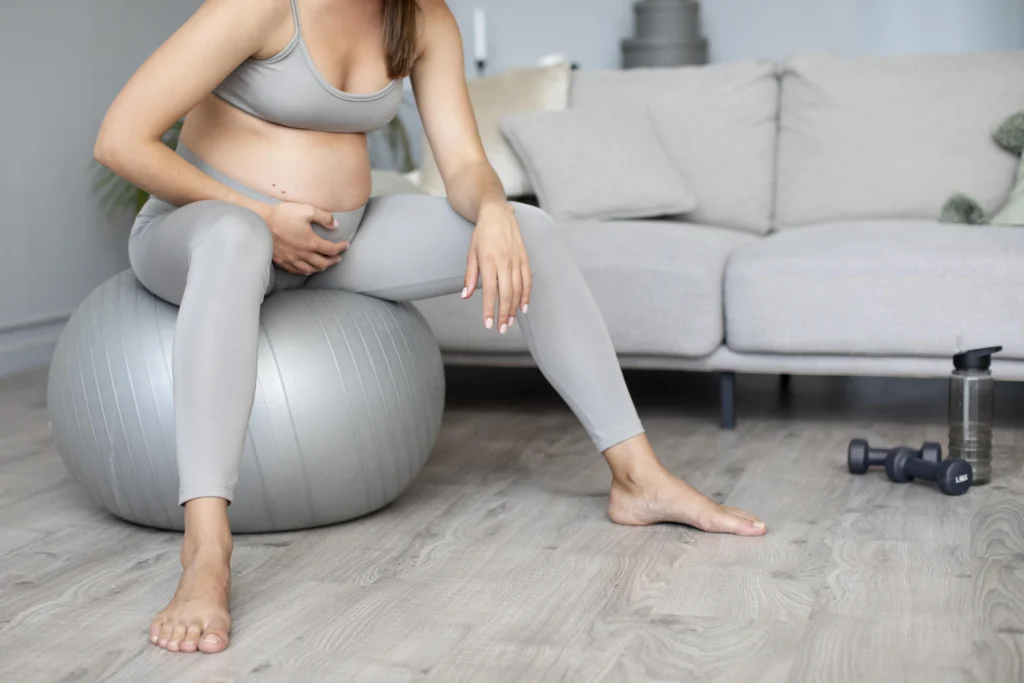
This is probably the biggest reason pregnant women develop groin discomfort.
Pelvic girdle pain happens when the joints and surrounding tissues around the pelvis become irritated or overloaded.
Pain may appear:
- near the pubic bone,
- through the groin,
- around the hips,
- or deep near the buttocks.
And honestly, many women struggle describing exactly where it hurts because the pelvis transfers force constantly during movement.
Pelvic girdle pain commonly worsens with stairs, rolling in bed, walking, and standing on one leg.
One thing I notice constantly in clinic is that women often say:
“Sitting is fine. Moving is what hurts.”
That is very common with pelvic load transfer problems.
Why Rolling in Bed Suddenly Feels Like a Workout
Women mention this constantly.
And honestly, it makes perfect biomechanical sense.
Rolling in bed requires:
- pelvic rotation,
- abdominal coordination,
- hip stability,
- and pressure transfer through the trunk.
During pregnancy, all of those systems are adapting simultaneously.
The abdominal wall stretches.
The pelvis handles force differently.
Muscles fatigue faster.
Then something as simple as turning in bed suddenly feels difficult.
A lot of women wake up multiple times at night not because they cannot sleep, but because changing position hurts.
One tiny change often helps surprisingly well:
keeping a pillow between the knees while turning.
Small mechanical adjustments matter much more than people realize.
Groin Pain Is Not Always Actually Coming From the Groin
This surprises women all the time.
Pain felt near the groin may actually originate from:
- the pelvic joints,
- hip muscles,
- adductors,
- pelvic floor,
- lower abdomen,
- or even the lower back.
The nervous system does not always localize pelvic pain neatly.
That is one reason pregnancy pain feels confusing.
A woman may point directly to the inner thigh while the actual irritation is happening closer to the pubic joint.
The Inner Thigh Muscles Often Work Overtime During Pregnancy
The adductor muscles attach near the pubic region.
When pelvic stability changes, these muscles frequently work harder trying to control movement.
Then women describe:
- pulling,
- aching,
- tightness,
- soreness after walking,
- or sharp discomfort stepping sideways.
Interestingly, many women immediately start stretching aggressively thinking the muscles are simply “tight.”
But sometimes the muscles are overworking because the pelvis feels irritated underneath.
Stretching harder does not always solve that problem.
Occasionally it worsens it.
Why Putting on Pants Hurts So Much
This sounds oddly specific until you understand the mechanics.
Standing on one leg increases force transfer through the pelvis significantly.
That is why many women feel pain while:
- wearing pants,
- stepping into bathtubs,
- climbing stairs,
- or getting into SUVs.
Single-leg loading tasks challenge pelvic stability much more than people realize.
That pattern is incredibly common clinically.
A Lesser-Known Cause: Over-Bracing
This gets missed constantly.
Some pregnant women are not weak at all.
They are gripping all day.
I often see women unconsciously tightening:
- inner thighs,
- glutes,
- upper abs,
- jaw,
- shoulders,
- and pelvic floor trying to create “stability.”
The body becomes rigid instead of coordinated.
Then walking feels exhausting.
Stress worsens this too.
Interestingly, jaw tension and pelvic floor tension are neurologically connected.
So yes, emotional stress can absolutely influence pelvic discomfort patterns.
Why Groin Pain Often Feels Worse by Evening
Fatigue changes movement more than most women realize.
By evening:
- postural muscles tire,
- breathing becomes shallower,
- movement becomes less efficient,
- and pelvic support decreases.
Women often say:
“I feel almost normal in the morning and terrible by night.”
That pattern is extremely common.
Especially in women:
- standing long hours,
- carrying toddlers,
- commuting,
- or working physically demanding jobs.
Pregnancy is physically demanding even before adding daily life on top of it.
Sitting Too Long Can Trigger Groin Pain Too
Most women expect movement to hurt.
But prolonged sitting creates its own problems.
Long sitting periods may:
- stiffen the hips,
- compress the pelvis,
- reduce circulation,
- and increase pressure through the pelvic floor.
Then standing up suddenly feels awful.
Soft couches usually make this worse because the pelvis sinks backward and the hips stiffen further.
One woman told me:
“I can sit comfortably for twenty minutes. Then suddenly I feel locked.”
That description is incredibly common.
Why Walking Helps Some Women but Makes Others Worse
This confuses women constantly.
Gentle walking often helps:
- circulation,
- stiffness,
- and muscular coordination initially.
But excessive walking when pelvic tissues are already irritated may worsen symptoms.
Some women feel better after moving.
Others feel much worse after grocery shopping for thirty minutes.
Pregnancy pain is not perfectly predictable.
That inconsistency actually makes it more frustrating emotionally.
What Research Says About Pregnancy Groin Pain
Research consistently shows pregnancy-related pelvic pain is multifactorial.
Meaning symptoms are influenced by:
- biomechanics,
- stress,
- posture,
- muscular coordination,
- sleep quality,
- fatigue,
- and daily movement patterns.
Researchers discussed how pregnancy-related pelvic girdle pain significantly affects mobility, sleep, mental wellbeing, and daily activities. (PMC)
Another review emphasized that individualized physiotherapy approaches often improve outcomes more effectively than generalized rest-based advice alone. (NLM)
That shift is important because older advice often focused too heavily on simply avoiding movement.
Modern physiotherapy tends to focus more on improving tolerable movement patterns instead.
Constipation
One Thing Most Women Never Connect to Groin Pain
Seriously.
Constipation changes pelvic pressure dramatically.
Repeated straining increases force through:
- the pelvic floor,
- pubic region,
- and surrounding tissues.
During pregnancy, those tissues are already adapting to increased load.
Hydration, breathing, walking, and bowel habits influence pelvic comfort much more than most women expect.
This almost never gets discussed online.
But clinically, it matters.
Why Pregnancy Groin Pain Feels Emotionally Exhausting
Pelvic pain changes confidence.
When:
- walking hurts,
- rolling hurts,
- standing hurts,
- or putting on shoes hurts,
women naturally become cautious.
Then movement patterns change further.
That guarding increases muscular tension.
Pain changes movement.
Movement changes pain.
The cycle becomes frustrating quickly.
A lot of women also feel guilty for slowing down because pregnancy discomfort is often minimized socially.
That emotional side matters more than people realize.
Why Support Belts Help Some Women
Pelvic support belts sometimes reduce force through irritated pelvic joints.
Some women feel immediate relief while walking.
Others feel compressed and uncomfortable.
Both responses are normal.
Support belts work best when combined with:
- posture awareness,
- breathing coordination,
- movement modification,
- and physiotherapy-based strategies.
Not as permanent solutions.
Tiny Daily Changes Often Help More Than Big Exercise Programs
Honestly, some of the smallest movement changes help the most.
Things like:
- keeping knees together while getting out of cars,
- avoiding sudden twisting,
- using pillows between the knees,
- taking smaller steps,
- reducing single-leg standing,
- and changing sitting positions more often.
These sound simple.
But they reduce pelvic strain significantly.
One Important Thing I Tell Women Often
The goal is not avoiding movement completely.
The body usually becomes stiffer and more sensitive when movement disappears entirely.
The goal is reducing overload while maintaining confidence in movement.
That is a huge difference psychologically and physically.
When Groin Pain Needs Medical Assessment
Some pregnancy discomfort is common.
But worsening or severe symptoms should never simply be ignored.
Seek professional assessment if you notice:
- severe difficulty walking,
- fever,
- numbness,
- sudden sharp pain,
- weakness,
- vaginal bleeding,
- inability to bear weight,
- or rapidly worsening symptoms.
Not every pelvic pain is automatically “normal pregnancy pain.”
Final Thoughts
Pregnancy groin pain is incredibly common.
But common does not mean imaginary or unimportant.
The pelvis works harder during pregnancy than most women ever realize.
Walking.
Turning.
Standing.
Balancing.
Rolling in bed.
Even getting dressed suddenly requires different coordination strategies.
That is why groin pain often feels unpredictable and emotionally draining.
The good news is that many women improve significantly once they understand:
- what movements aggravate symptoms,
- how pressure transfers through the pelvis,
- and how small adjustments reduce irritation.
Sometimes relief comes less from doing more and more from moving differently.
And honestly, understanding what is happening often reduces fear almost immediately.
Frequently Asked Questions
Why does pregnancy cause groin pain?
Pregnancy changes posture, pelvic mechanics, ligament support, and muscular coordination, which may increase pressure and irritation around the groin and pelvis.
Is groin pain during pregnancy normal?
Mild to moderate groin discomfort is common during pregnancy, especially during the second and third trimesters. However, severe or worsening pain should be assessed professionally.
Why does rolling in bed hurt during pregnancy?
Rolling in bed requires pelvic rotation and pressure transfer through the hips and abdomen, which may aggravate irritated pelvic joints or muscles.
Can walking make pregnancy groin pain worse?
Some women feel better with gentle walking, while others experience increased irritation if pelvic tissues are already overloaded.
What is pelvic girdle pain during pregnancy?
Pelvic girdle pain refers to discomfort around the pelvic joints and surrounding tissues that often worsens with movement or uneven loading.
Can pregnancy groin pain affect sleep?
Yes, many women experience worsening pain while turning in bed or changing positions during sleep.
When should I seek help for pregnancy groin pain?
Seek medical or physiotherapy advice if pain becomes severe, rapidly worsens, affects walking significantly, or occurs with numbness, fever, or bleeding.
Stay tuned with us for more health related topics.
Follow us on LinkedIn and Instagram for more.
More Read


Medical Disclaimer!
This article has been reviewed and written under the guidance of our Head Physiotherapist, Dr. Kruti Raj (PT, MUHS,CPT,CMPT). The information shared is intended for educational purposes only and should not be considered a substitute for personalized medical advice, diagnosis, or treatment.
Please consult us or any other qualified healthcare professional before beginning any exercise program, especially if you are experiencing pain, recovering from injury, or managing a medical condition.


