


Learning how to slow knee osteoarthritis can help you protect your knee function, manage pain, stay active, and maintain mobility for longer.
If your knee has started hurting while climbing stairs, getting out of a chair, walking for longer periods or standing after sitting, you may already be wondering:
“Is my knee wearing out?”
This is one of the most common fears I hear as a physiotherapist.
But there is something important I want you to know before you start avoiding movement, buying expensive supplements or searching for a miracle treatment.
Quick Answer
You cannot guarantee that knee osteoarthritis will completely stop progressing naturally, but you can improve your knee’s capacity and reduce its impact on daily life. The most evidence-supported strategies include progressive strengthening, regular aerobic activity, appropriate weight management, balance training, gradual activity progression, good sleep and personalised physiotherapy.
Think less about protecting your knee from every movement and more about making your knee stronger and better prepared to handle everyday loads.
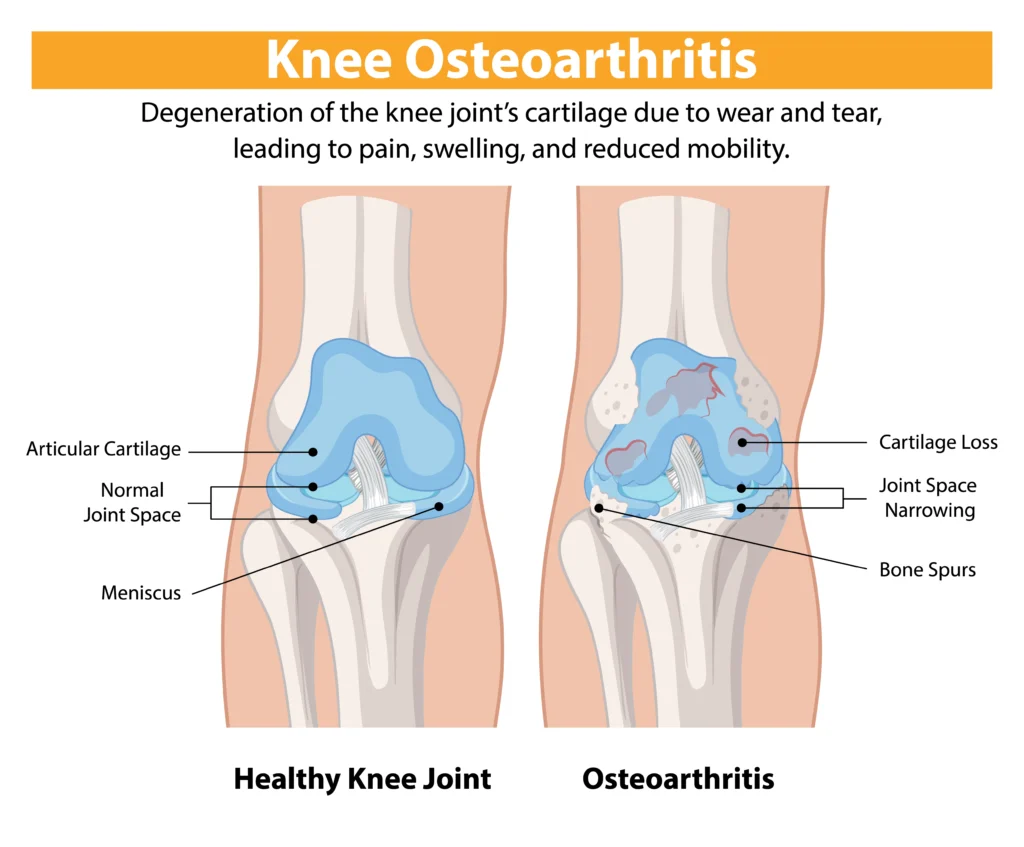
Knee osteoarthritis is not simply a story of cartilage gradually disappearing.
Your knee is a complete movement system involving cartilage, bone, synovium, menisci, ligaments, muscles, tendons, nerves and the way your brain responds to pain.
Your body weight, muscle strength, physical activity, previous injuries, sleep and even your confidence in using the knee can influence how well you function.
That changes the question.
Instead of asking, “How can I protect my knee from every load?”, ask:
“How can I make my knee better at handling the loads of everyday life?”
That is the approach I use in physiotherapy.
Current NICE guidance recommends tailored therapeutic exercise for everyone with osteoarthritis and advises weight management when overweight or obesity is present.
The 2023 EULAR recommendations similarly place individualised exercise, self-management, healthy weight, appropriate footwear and behaviour change at the centre of non-drug management. (NICE osteoarthritis guideline)
And the earlier you start improving your knee’s capacity, the more options you have.
Key Takeaways
- Knee osteoarthritis is more than cartilage loss. Bone, synovium, muscles, movement and pain sensitivity also matter.
- Regular physical activity does not automatically mean faster cartilage loss.
- Progressive strengthening can improve knee pain, function and physical capacity.
- The quadriceps are important, but hip, calf and whole-limb strength should also be assessed.
- Balance and proprioception are often overlooked parts of knee rehabilitation.
- Think about your total daily load rather than blaming one particular exercise.
- Temporary discomfort after starting exercise does not automatically mean that the knee has been damaged.
- Gradually increasing exercise is usually more sensible than repeatedly going from inactivity to excessive activity.
- If overweight or obesity is present, sustainable weight loss can improve pain and physical function.
- Do not rely on supplements, miracle foods, braces or gadgets as substitutes for active rehabilitation.
- Sleep and recovery deserve attention because persistent knee pain can interfere with sleep quality.
- The goal is not a completely load-free knee. The goal is a stronger, more capable knee.
Your knee has a load budget
One of the most useful ways to think about knee osteoarthritis is through load and capacity.
Every day, your knees handle hundreds or thousands of small loads.
Walking to the bathroom.
Standing from a chair.
Climbing stairs.
Squatting.
Carrying groceries.
Walking around the market.
Exercising.
Travelling.
Standing at work.
None of these activities automatically “wear out” a knee.
The problem occurs when the demands placed on the joint repeatedly exceed what the current system is prepared to tolerate.
Imagine two people walking for 45 minutes.
One has strong quadriceps, good hip control, adequate ankle mobility and regularly exercises.
The other has been inactive for six months, has significant muscle weakness and suddenly begins walking 45 minutes every day.
The activity is identical.
The capacity is not.
This is why I don’t like telling patients that an exercise is simply “good” or “bad” for arthritis.
The more useful question is:
Is this dose appropriate for your current capacity?
EULAR specifically recommends exercise with appropriate individual tailoring of dosage and progression rather than giving everyone an identical programme.
Don’t mistake movement for damage
One of the biggest mistakes after an osteoarthritis diagnosis is becoming afraid of movement.
Some people hear the word “arthritis” and immediately stop squatting, walking, exercising or using stairs.
That can create another problem.
Less movement often means less muscle strength and poorer physical capacity.
Eventually, an activity that was previously easy becomes difficult because the body has become less prepared for it.
Research from the Osteoarthritis Initiative is particularly interesting here.
In 689 people with radiographic knee osteoarthritis followed for four years, moderate physical activity was not associated with greater cartilage thickness loss after adjustment for baseline factors. (NCBI)
That does not mean unlimited exercise is harmless or that exercise can guarantee preservation of cartilage.
It means we should be careful about the simplistic idea that every additional step automatically accelerates osteoarthritis.
The goal is appropriate loading, not zero loading.
The cartilage story is more complicated than you think
I often tell patients:
“Your knee is not just cartilage.”
Osteoarthritis can involve changes in the cartilage, underlying bone, synovial tissues, menisci and surrounding structures.
Pain also does not always correspond neatly to the amount of structural change seen on an X-ray.
A systematic review examining the relationship between clinical symptoms and radiographic knee osteoarthritis found substantial discordance between imaging findings and symptoms. (PMC)
In simple terms, some people have impressive X-ray changes with relatively few symptoms, while others experience significant pain despite less dramatic radiographic findings.
This is why I don’t want you to look at an X-ray and think:
“My knee is finished.”
The image is information.
It is not your future.
NICE also recommends against routinely using imaging to guide non-surgical management or follow-up of osteoarthritis.
Your ability to walk, climb stairs, get up from a chair, exercise and participate in life matters enormously.
Build your knee’s capacity instead of constantly protecting it
If I had to choose one concept for this entire article, it would be capacity.
Capacity means how much work your body can comfortably handle.
When your quadriceps are weak, a staircase may represent a large challenge.
After months of progressive strengthening, the same staircase may represent a much smaller challenge.
The stairs did not change.
Your capacity changed.
This is why strengthening is such an important part of knee osteoarthritis management.
A 2025 systematized review specifically examining quadriceps strengthening in adults with knee osteoarthritis found evidence supporting improvements in pain and function with quadriceps-focused strengthening. (Wiley)
NICE recommends therapeutic exercise that can include local muscle strengthening and general aerobic fitness.
Your quadriceps are important, but your knee isn’t a one-muscle problem
The quadriceps deserve attention because they contribute to knee extension and functional activities such as standing, stair climbing and walking.
But don’t make the mistake of turning rehabilitation into endless knee extensions.
Your lower limb works as a chain.
The hip controls the pelvis and influences lower-limb movement.
The calf contributes to walking and propulsion.
The ankle influences how the lower limb moves over the foot.
Your trunk affects how your centre of mass is positioned.
That is why I often assess the whole lower limb, not just the painful knee.
A systematic review and meta-analysis found hip strength deficits in people with symptomatic knee osteoarthritis, supporting the idea that the hip deserves attention during assessment and rehabilitation. (JAPTA)
Depending on your assessment, your programme may therefore include:
Chair sit-to-stands
These train a movement you perform every day rather than an isolated gym movement.
Step-ups
A low step allows you to progressively develop strength and control.
Mini-squats
These can introduce controlled knee loading without immediately demanding a deep squat.
Calf raises
Useful for strengthening the lower leg and supporting walking capacity.
Hip strengthening
Bridges, hip abduction and other exercises may be appropriate when weakness is identified.
Balance exercises
These can help develop confidence and neuromuscular control.
The exercise itself is only half the prescription.
Progression is the other half.
Your exercise dose matters more than the exercise name
Suppose someone tells you:
“Squats are good for arthritis.”
That statement is incomplete.
How many?
How deep?
How often?
With what resistance?
What is the person’s current strength?
How does the knee respond afterwards?
A beginner performing three controlled sets of shallow chair squats is doing something completely different from an untrained person suddenly performing 100 deep weighted squats.
Both are called “squats.”
Their training dose is completely different.
This is why I prefer the phrase exercise prescription rather than simply “exercise.”
The prescription includes:
- intensity
- repetitions
- sets
- frequency
- range of movement
- speed
- resistance
- recovery
- progression
EULAR’s updated recommendations specifically emphasise tailoring exercise dosage and progression to the individual.
Learn the next-day rule
Here’s a simple clinical habit that can help you understand your own load tolerance.
Don’t judge an exercise only by how your knee feels during it.
Also observe what happens later.
Ask yourself:
How does my knee feel that evening?
And:
How does it feel the next morning?
A little temporary discomfort does not automatically mean that you have damaged the joint.
NICE specifically advises patients that pain may increase when therapeutic exercise is started, while regular and consistent exercise can provide longer-term benefits.
However, if a particular increase in activity repeatedly causes a prolonged flare, substantial swelling or a meaningful drop in function, that is useful information.
Don’t interpret it as:
“Exercise is bad for me.”
Instead ask:
“Was the dose too high for my current capacity?”
Then reduce, modify and gradually rebuild.
Don’t let a flare turn into weeks of complete rest
A flare-up can be frustrating.
You walk more than usual.
The knee becomes sore.
You stop everything.
Three weeks later, the pain has settled, but your muscles have become even weaker.
Then you restart at your previous activity level and the cycle repeats.
I prefer a different approach:
Reduce → modify → recover → rebuild.
You may temporarily reduce walking distance, resistance or repetitions while maintaining comfortable movement.
Then, once symptoms settle, gradually rebuild the workload.
This is very different from forcing through severe symptoms.
It is also very different from becoming afraid of every episode of discomfort.
The stairs are not necessarily your enemy
Many people with knee osteoarthritis tell me:
“I stopped using stairs because I was afraid they were damaging my knees.”
But stairs can also be useful information.
If stairs are difficult, I want to know why.
Is your quadriceps weak?
Is your hip control poor?
Is your ankle mobility restricted?
Are you afraid of loading the leg?
Is the step too high?
Are you rushing?
Is there significant pain?
A physiotherapist can break the task down.
You might start with a low step.
Then practise step-ups.
Then controlled step-downs.
Then gradually return to normal stairs.
The objective isn’t to keep you away from stairs forever.
It is to make you capable of using them again.
Your hip may be quietly contributing to your knee problem
The hip is one of the most overlooked areas in knee rehabilitation.
A person may have knee pain but also demonstrate weakness around the hip or poor control of the pelvis during single-leg activities.
That doesn’t mean weak hips “cause” every case of knee osteoarthritis.
It means that hip strength is one of the modifiable factors worth assessing.
The evidence confirms that hip strength deficits are present in people with symptomatic knee osteoarthritis, although the clinical picture varies between individuals. (JOSPT)
This is why a good physiotherapy assessment shouldn’t stop at:
“Where does it hurt?”
It should also ask:
“How does your entire lower limb perform?”
Don’t forget balance and proprioception
Another lesser-known aspect of knee rehabilitation is proprioception.
This is your body’s ability to sense joint position and movement.
You don’t consciously calculate the angle of your knee every time you walk.
Your nervous system does much of that work automatically.
Research has increasingly investigated proprioception and neuromuscular training in knee osteoarthritis.
A 2021 systematic review and meta-analysis of 24 randomized controlled trials involving 1,275 participants found that proprioceptive training improved:
pain, stiffness, physical function, joint-position sense, muscle strength, mobility and knee range of motion compared with no intervention.
A newer 2025 systematic review and meta-analysis has also examined how land-based exercise affects knee joint proprioception in people with osteoarthritis. (Science Direct)
This is why your rehabilitation may include simple balance work such as supported single-leg standing, controlled weight shifting or step-and-hold exercises.
You don’t need complicated equipment.
You need appropriate challenge.
Think about your total daily load, not just your workout
This is one of the most useful concepts for people who repeatedly experience knee flares.
Imagine you don’t exercise on weekdays.
Then on Saturday you:
- clean the entire house
- go shopping
- climb stairs repeatedly
- walk around a large shopping centre
- attend a family event
- stand for several hours
Then Sunday brings a long walk.
You might blame Sunday’s walk.
But the knee may actually be responding to the accumulated load of the previous 24–48 hours.
This is your daily load budget.
Your workout is only one part of it.
This concept is particularly useful for people who say:
“I don’t understand why my knee hurts. I barely exercised.”
Sometimes your exercise session isn’t the problem.
Your entire day’s activity is the relevant exposure.
Avoid the weekend-warrior pattern
Another common pattern is being inactive for most of the week and suddenly becoming extremely active on weekends.
The body may tolerate occasional activity, but if your current capacity is low, a sudden jump in activity can produce a flare.
Instead of:
very little → enormous activity → pain → complete rest
try:
small amount → recovery → slightly more → recovery → gradual progression.
Consistency beats occasional heroic effort.
Weight management can change the mechanical equation
If you are overweight or living with obesity, weight management deserves a place in your knee strategy.
But I want to say this carefully.
Knee osteoarthritis is not simply a weight problem.
Age, genetics, previous injury, joint structure, muscle strength, physical activity and other factors can contribute.
However, excess body weight increases the mechanical demands placed on weight-bearing joints and can make movement more challenging.
NICE recommends weight loss for people with osteoarthritis who are overweight or living with obesity, noting that any weight loss is likely to help and that 10% weight loss is likely to provide greater benefits than 5%.
The important part is that you do not have to reach your final weight before beginning rehabilitation.
Start moving and strengthening while working on sustainable nutrition.
Don’t wait until you’ve lost weight to start exercising
This is a mistake I see frequently.
Someone thinks:
“I’ll start exercising after I lose 10 kg because my knees hurt.”
But appropriate exercise can be part of the process of becoming fitter and managing weight.
The IDEA randomized clinical trial in adults with overweight or obesity and knee osteoarthritis found that intensive diet plus exercise produced greater improvements in pain, function, mobility and quality of life than either intervention alone. (BMC MSK Disorder)
This is one reason I prefer combining the two rather than treating them as competing strategies.
The goal is not simply to become lighter.
It is to become lighter and physically stronger.
Don’t fall for the “cartilage-rebuilding food” trap
The internet is full of claims about foods that supposedly rebuild cartilage.
Be sceptical.
No single food can reliably regenerate an established arthritic knee.
That doesn’t mean nutrition is irrelevant.
A dietary pattern rich in minimally processed foods, adequate protein, vegetables, fruits, whole grains, legumes, nuts and other nutrient-dense foods can support general health and help with sustainable weight management.
There is also emerging observational evidence worth watching.
A 2024 UK Biobank study involving 163,987 participants found that higher ultra-processed food consumption was associated with a 10% higher risk of knee osteoarthritis compared with the lowest consumption category. (Science Direct)
Replacing part of the ultra-processed food intake with minimally processed or unprocessed foods was associated with lower risk.
However, this was an observational study, so it cannot prove that ultra-processed foods directly cause osteoarthritis.
So my recommendation isn’t:
“Never eat processed food.”
It is:
Make minimally processed foods the foundation of your diet rather than searching for one magical arthritis food.
What about vitamin D?
Vitamin D is another area where online advice can become exaggerated.
If you are deficient, correcting that deficiency may be medically appropriate.
But vitamin D should not be sold as a guaranteed treatment for knee cartilage loss.
In a randomized clinical trial involving 413 people with symptomatic knee osteoarthritis and low vitamin D levels,
vitamin D supplementation did not significantly improve tibial cartilage volume or knee pain compared with placebo over two years.
An earlier randomized trial similarly found no significant reduction in pain or cartilage volume loss with vitamin D supplementation.
Interestingly, newer post-hoc research from the VIDEO trial suggests that baseline vitamin D levels may influence which patients respond to supplementation,
which is a reminder that the story may be more nuanced than “vitamin D works” or “vitamin D doesn’t work.” (Oxford Academic)
The sensible message is:
Test and correct deficiency when clinically appropriate, but don’t replace rehabilitation with supplements.
Sleep is part of your knee strategy
If your knee hurts at night, don’t dismiss sleep as unrelated.
Pain and sleep can influence each other.
A 2025 systematic review and meta-analysis found significantly poorer sleep quality among people with knee or hip osteoarthritis compared with healthy controls, with pain and psychological factors among important contributors. (Frontiers in Medicine)
Poor sleep can make the next day harder.
You may feel less energetic.
You may move less.
Exercise adherence can fall.
Your tolerance for pain may also change.
Therefore, knee management should include sleep rather than treating it as an optional extra.
If pain repeatedly wakes you, that deserves attention.
Don’t let fear become your rehabilitation programme
There is another load that rarely appears on an X-ray:
fear.
You feel pain.
You become afraid that the knee is being damaged.
You stop using it.
Your muscles weaken.
The knee feels less capable.
Every movement then feels more threatening.
This can create a vicious cycle.
The answer isn’t to ignore pain.
The answer is graded exposure.
If a deep squat is currently difficult, don’t force a deep squat.
Start with a chair.
If a full staircase is difficult, begin with a low step.
If a 30-minute walk is too much, start with a shorter duration.
Then gradually increase your capacity.
Confidence should be rebuilt alongside strength.
Don’t spend your money on every knee gadget
Braces, insoles, special shoes, compression products and walking aids may have a role in selected people.
But they aren’t universal cures.
EULAR includes footwear, walking aids and assistive devices within individualised osteoarthritis management.
NICE similarly recommends considering walking aids where appropriate and does not recommend routinely offering braces, supports or insoles to everyone.
So before buying a ₹5,000 or ₹10,000 knee product because an advertisement says it “protects cartilage,” ask:
What specific problem is this device supposed to solve?
If nobody can answer that question, don’t buy it simply because you have arthritis.
Manual therapy can help, but it should not become your whole treatment
Hands-on physiotherapy can sometimes help with pain, stiffness and movement.
But passive treatment should not be the foundation of long-term knee management.
NICE recommends considering manual therapy for knee osteoarthritis only alongside therapeutic exercise and notes that there isn’t enough evidence to support manual therapy alone.
That makes sense clinically.
If someone massages your knee today and you feel better, that’s useful.
But if you want to remain active six months from now, your body also needs capacity.
The long-term goal is to make you less dependent on passive treatment, not more.
Your “5-minute knee capacity check”
This isn’t a diagnostic test and shouldn’t replace professional assessment.
But it can help you notice where your current capacity may be limited.
Ask yourself:
Can I stand from a chair without pushing with my arms?
If not, lower-limb strength may need attention.
Can I climb stairs comfortably?
If not, assess strength, movement strategy and confidence rather than automatically avoiding stairs.
Can I briefly balance on one leg safely?
If not, balance and proprioception may deserve attention.
Can I walk for a reasonable period without a prolonged flare?
If not, your current walking dose may need modification.
Can I perform a controlled shallow squat?
If not, examine what is limiting you: pain, weakness, mobility or fear.
These questions are much more useful than simply asking:
“How bad does my X-ray look?”
What I would tell a patient with early knee osteoarthritis
If you came to my physiotherapy clinic with early knee osteoarthritis, I would not tell you to stop using your knee.
I would first assess your movement and capacity.
I would want to know:
- where exactly you feel pain
- when it occurs
- what activities aggravate it
- how long symptoms last afterward
- whether there is swelling
- your quadriceps strength
- hip strength
- calf strength
- balance
- knee mobility
- ankle mobility
- walking pattern
- stair performance
- activity levels
- previous injuries
- body-weight-related factors where relevant
- sleep and recovery
Then I would build a programme around your actual limitations.
Perhaps your biggest problem is strength.
Perhaps it is poor activity progression.
Perhaps you’re doing too much on weekends.
Perhaps you’re avoiding movement because of fear.
Perhaps weight management needs to be part of the plan.
Perhaps your knee symptoms aren’t actually coming from osteoarthritis alone.
That is why personalised assessment matters.
When you should not manage the knee yourself
Natural management does not mean avoiding healthcare.
Seek medical assessment if you develop a hot, markedly swollen knee, fever, sudden severe pain, inability to bear weight, significant locking, repeated giving way, rapidly worsening symptoms, significant injury or other unusual symptoms.
And if knee osteoarthritis is substantially affecting your quality of life despite appropriate non-surgical management, don’t feel that seeking further medical treatment means you have failed.
NICE recommends considering referral for joint replacement when symptoms substantially affect quality of life and non-surgical management has been ineffective or unsuitable.
Physiotherapy and surgery are not enemies.
The appropriate treatment depends on the individual.
So, can you actually slow knee osteoarthritis naturally?
Here is the honest answer I want you to remember:
We cannot promise that natural methods will completely stop or reverse established knee osteoarthritis.
Anyone promising to regrow all your lost cartilage with a supplement, special oil or one exercise is overselling the evidence.
But you can absolutely work on the things that determine how well your knee functions.
Build muscle.
Improve balance.
Maintain regular movement.
Manage activity spikes.
Reduce excess body weight when appropriate.
Eat a predominantly nutritious, minimally processed diet.
Sleep properly.
Progress exercise gradually.
Stop treating every movement as dangerous.
And get assessed when symptoms begin interfering with your life.
The objective is not to create a completely load-free knee.
It is to create a knee that is capable of handling life.
My physiotherapy prescription for slowing functional decline
If you remember nothing else from this article, remember these principles:
1. Build capacity, don’t simply reduce activity.
A stronger knee can handle everyday demands better.
2. Think about your total load.
Your workout is only one part of the stress your knee experiences.
3. Progress gradually.
Don’t jump from very little activity to enormous activity.
4. Strengthen the whole lower limb.
Quadriceps matter, but so do the hips, calves and movement-control system.
5. Train balance.
Proprioception and neuromuscular control are often forgotten.
6. Manage body weight without shame.
If weight loss is appropriate, even modest progress can be worthwhile.
7. Don’t chase miracle foods or supplements.
Build an overall healthy dietary pattern instead.
8. Treat sleep as part of rehabilitation.
Poor sleep and persistent pain can reinforce one another.
9. Use supports strategically.
A brace, walking aid or footwear change should solve a specific problem.
10. Don’t wait until your knee becomes severely limiting.
Early intervention gives you more opportunity to maintain strength, confidence and independence.
Final word
I don’t want you to leave this article thinking that you need to protect your knees from life.
I want you to think differently.
Your knee isn’t simply a piece of cartilage slowly being “used up.”
It is part of a living, adaptable movement system.
The question is not whether you can guarantee that osteoarthritis will never progress.
You can’t.
The better question is whether you can improve the capacity, strength, movement, confidence and health of the system around that knee.
In many cases, you can.
So if your knees have started giving you early warning signs, don’t wait until climbing stairs becomes a major struggle.
Don’t spend years avoiding movement.
Don’t let an X-ray determine how much you believe your body can do.
Start small.
Strengthen progressively.
Manage your load.
Recover properly.
And keep building capacity.
The goal isn’t simply to protect your knee from the future.
The goal is to make your knee better prepared for it.
Can knee osteoarthritis be slowed naturally?
There is no natural treatment that can guarantee complete prevention or reversal of knee osteoarthritis. However, progressive exercise, strength training, appropriate weight management, regular physical activity, balance training, sleep and self-management can improve symptoms, function and physical capacity.
Does exercise make knee osteoarthritis worse?
Appropriately prescribed exercise is a core treatment for knee osteoarthritis. Some people experience temporary discomfort when starting or progressing exercise, but regular therapeutic exercise can improve pain and function over time. The exercise dose should be tailored to individual capacity.
Can walking slow knee osteoarthritis?
Walking can be an effective form of aerobic activity for people with knee osteoarthritis. The key is choosing a duration and intensity that match current capacity and increasing the workload gradually rather than suddenly increasing walking volume.
What muscles should I strengthen with knee arthritis?
The quadriceps are particularly important, but rehabilitation may also include the hip muscles, calves and other lower-limb muscles. A physiotherapist can determine which areas are weak or poorly controlled and tailor the programme accordingly.
Should I avoid stairs if I have knee osteoarthritis?
Not necessarily. If stairs are painful or difficult, the underlying reason should be assessed. Strength, movement control, balance, ankle mobility and confidence can all contribute. Stairs can often be gradually retrained rather than permanently avoided.
Does losing weight help knee osteoarthritis?
For people with knee osteoarthritis who are overweight or living with obesity, weight loss can reduce pain and improve physical function. NICE states that any weight loss may be beneficial and that around 10% weight loss is likely to provide greater benefit than 5%.
Can vitamin D rebuild knee cartilage?
Current randomized trials do not support vitamin D supplementation as a reliable treatment for rebuilding knee cartilage or reducing knee osteoarthritis pain. Vitamin D deficiency should still be identified and treated when medically appropriate.
Why is hip strength important for knee osteoarthritis?
The hip is part of the lower-limb movement chain. Hip weakness may be present in people with symptomatic knee osteoarthritis and can affect movement control during functional activities. Rehabilitation should therefore be individualised rather than focusing exclusively on the knee.
Can knee osteoarthritis be reversed naturally?
Established knee osteoarthritis cannot currently be promised to completely reverse through natural treatment. A more realistic goal is to reduce symptoms, maintain strength and mobility, improve physical capacity and preserve independence and quality of life.
When should I see a physiotherapist for knee arthritis?
A physiotherapy assessment is worthwhile when pain, stiffness, weakness, reduced mobility or difficulty with walking, stairs or daily activities begins affecting your life. A physiotherapist can assess strength, movement, balance, mobility and activity tolerance and create a progressive programme.
Stay tuned with us for more health related topics.
Follow us on LinkedIn and Instagram for more.
More Read


Medical Disclaimer!
This article has been reviewed and written under the guidance of our Head Physiotherapist, Dr. Kruti Raj (PT, MUHS,CPT,CMPT). The information shared is intended for educational purposes only and should not be considered a substitute for personalized medical advice, diagnosis, or treatment.
Please consult us or any other qualified healthcare professional before beginning any exercise program, especially if you are experiencing pain, recovering from injury, or managing a medical condition.


