


Patellofemoral pain syndrome treatment usually focuses on reducing irritating loads.
If your knee hurts every time you climb stairs, squat, run, get up from a chair or sit for a long time, you may have wondered whether something is wrong with your kneecap.
Sometimes the pain feels directly behind the kneecap.
Sometimes it is difficult to point to one exact spot.
You may describe it as aching, pressure, burning, soreness or a vague pain at the front of the knee.
This pattern is commonly associated with patellofemoral pain (PFP), historically called patellofemoral pain syndrome (PFPS).
Patellofemoral pain syndrome causes pain around or behind the kneecap, commonly during squats, stairs, running, jumping or prolonged sitting. It is usually influenced by a combination of load, muscle capacity, hip and lower-limb function, activity changes and pain sensitivity. The main evidence-based treatment is individualized education, activity/load management and progressive knee and hip strengthening.
The important thing I want you to know as a physiotherapist is this: patellofemoral pain is not simply a problem of a “weak kneecap,” and it is rarely fixed by finding one muscle to blame.
It is usually influenced by a combination of how much load your knee is experiencing,
how quickly that load changed, muscle capacity, hip and lower-limb function, movement habits, training, recovery and sometimes psychological factors.
The latest best-practice guidance places education and appropriately prescribed exercise at the centre of treatment,
with interventions such as foot orthoses, taping or movement retraining added when an individual assessment suggests they are useful. (BJSM)
Let’s look at what is really happening and, more importantly, what you can do about it.
Key Takeaways
- Patellofemoral pain usually involves multiple factors rather than one damaged structure.
- Squatting, stairs, running and prolonged sitting are common symptom triggers.
- Progressive exercise targeting the knee, often combined with hip strengthening, is the foundation of treatment.
- Activity modification should reduce excessive irritation without causing prolonged complete rest.
- Foot orthoses, taping and movement retraining can help selected patients but should not replace rehabilitation.
- Persistent pain does not automatically mean cartilage damage or the need for surgery.
- A physiotherapist can individualize exercise dosage, movement assessment and return-to-sport progression.
What Exactly Is Patellofemoral Pain Syndrome?
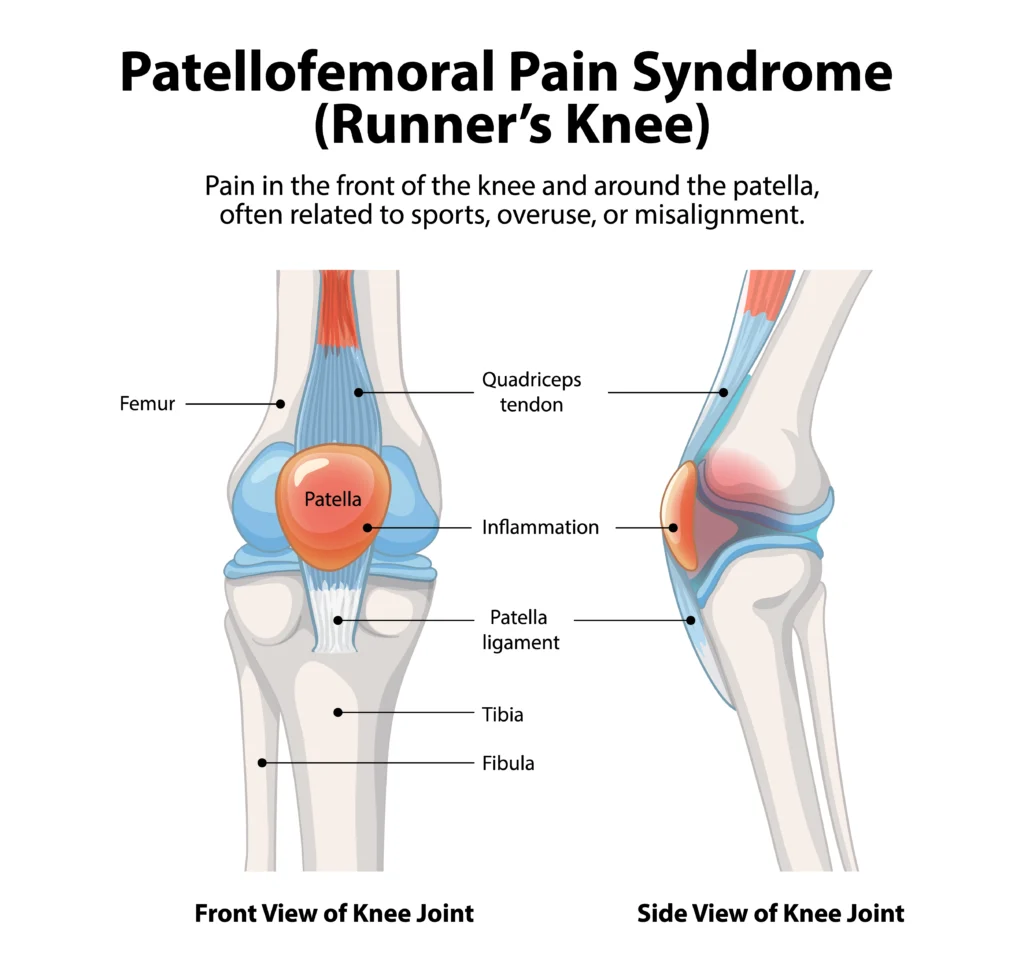
The word “patellofemoral” simply refers to the relationship between the patella, or kneecap, and the femur, or thigh bone.
Your kneecap sits within the quadriceps tendon and connects to the tibia through the patellar tendon.
As you bend and straighten your knee, the patella moves through the groove at the end of the femur called the trochlea.
This joint is exposed to substantial forces during everyday activities.
Walking is relatively easy for many people with PFP.
But squatting, climbing stairs, running, jumping and repeatedly bending the knee can substantially increase patellofemoral loading.
The 2019 physical therapy clinical practice guideline describes PFP as poorly defined pain around or behind the patella that commonly becomes worse with activities such as:
squatting, prolonged sitting, stairs, jumping and running. (2019 JOSPT)
One reason the condition can be frustrating is that there is rarely one single structural abnormality responsible for every person’s symptoms.
That is why two people can both have “patellofemoral pain” but require completely different rehabilitation programmes.
What Does Patellofemoral Pain Feel Like?
Typical symptoms include:
- Pain around or behind the kneecap
- Pain when climbing or descending stairs
- Discomfort during squats or lunges
- Pain after sitting with the knees bent for a long time
- Pain while running or jumping
- Aching after increasing exercise
- Pain when standing after prolonged sitting
- Occasional clicking or grinding
- A feeling that the knee is irritated after repetitive activity
One particularly characteristic feature is load-related pain rather than constant pain.
For example, you may feel perfectly comfortable lying in bed but develop pain after several flights of stairs.
That distinction is clinically useful.
A physiotherapist does not simply ask, “Where does it hurt?” I also want to know when it hurts, how quickly it appears, what makes it worse and what happens afterward.
That information helps determine how irritable the knee currently is.
Why Does the Kneecap Hurt?
This is where the old explanation of “your kneecap is rubbing incorrectly” becomes too simplistic.
PFP is now understood as a multifactorial problem involving mechanical, behavioral and psychological factors rather than one universal mechanical fault. (Springer Link)
Your knee may simply be receiving more load than it can currently tolerate
Imagine that you normally walk 5,000 steps a day.
Then you suddenly start walking 12,000 steps, add stair workouts and begin squatting at the gym.
Your tissues have not necessarily become “damaged.”
Instead, the demand placed on them may have increased faster than your capacity to tolerate it.
This is one of the most overlooked concepts in patellofemoral rehabilitation.
The problem is not always the activity itself.
It can be the sudden change in activity.
Your quadriceps may need more capacity
The quadriceps are essential for controlling the knee during functional movements.
If the knee extensor system lacks sufficient strength or endurance, activities involving repeated knee flexion may become more challenging.
However, I would not advise simply doing hundreds of straight-leg raises and assuming the problem is solved.
Recent research continues to support strengthening as a core component of rehabilitation, although the certainty and optimal dosage of specific programmes vary.
A 2025 systematic review found a positive effect of strengthening strategies for PFP, while also noting that certainty of evidence was low to very low. (BMC)
That nuance matters.
Exercise works, but the right exercise for the right person at the right dose is more useful than blindly following a generic list.
Your Hip Matters More Than You Think
One of the biggest changes in the way physiotherapists approach PFP is the recognition that the knee should not be examined in isolation.
Your hip controls the position and movement of your thigh.
During activities such as running, landing and single-leg squatting, the muscles around the hip influence how the entire lower limb behaves.
A 2025 meta-analysis comparing combined hip-and-knee strengthening with knee strengthening alone found improvements in pain and functional activity favouring combined strengthening, although the included studies had substantial heterogeneity. (Wiley)
Earlier evidence has similarly shown that combining hip and knee strengthening can reduce pain and improve activity. (JOSPT)
This is why I rarely prescribe a rehabilitation programme that focuses exclusively on the knee.
Your hip is part of the knee’s movement system.
The Surprising Role of Your Trunk
Here is a lesser-known consideration: your rehabilitation may sometimes need to extend above the hip.
Your trunk influences pelvic control, which influences the position of the femur and lower limb during dynamic tasks.
A 2024 systematic review and meta-analysis involving 19 studies and 1,138 participants found evidence that core training can improve short-term function in people with PFP, although the certainty for some pain outcomes was low. (Wolters Kluwer)
This does not mean that everyone with kneecap pain needs an intensive “core workout.”
It means your physiotherapist should look at the whole movement chain rather than treating the painful area in isolation.
Could Your Running Technique Be Contributing?
Possibly, but this is another area where oversimplification causes problems.
You may have heard:
“Your knees go inward, so that is causing your pain.”
Movement patterns can matter, but a movement observed in someone with pain is not automatically the original cause.
A large systematic review and meta-analysis found that people with PFP can demonstrate differences such as lower cadence, shorter stride length, greater contralateral pelvic drop and altered knee motion.
However, the researchers emphasized that it remains uncertain whether these features cause pain or develop as adaptations to pain. (PubMed)
This is a crucial physiotherapy principle:
Do not treat a movement simply because it looks different.
Treat it when changing that movement appears to improve the person’s symptoms, function or tolerance.
For some runners, increasing cadence may help.
A recent 2026 umbrella review found that gait retraining commonly uses gradual cadence increases of around 5 to 10%, impact-reduction strategies and feedback, but also emphasized the need for individualized application. (NCBI)
So I would not tell every runner with PFP to immediately change their running style.
First, we determine whether a particular movement strategy actually changes your symptoms.
Is Patellofemoral Pain Caused by Poor Kneecap Tracking?
Not necessarily.
This is one of the most persistent myths surrounding PFPS.
People are often told that their kneecap is “out of alignment” or “tracking incorrectly.”
There can certainly be biomechanical contributors, but modern research does not support one universal mechanical explanation for everyone with PFP.
A clinical diagnosis is generally made from the history and examination rather than from one isolated imaging finding. (Elsevier)
That is why a physiotherapist may assess:
- Squatting
- Step-down movement
- Single-leg control
- Quadriceps strength
- Hip strength
- Range of motion
- Running mechanics
- Foot posture
- Training load
- Previous injuries
- Pain behavior
- Functional limitations
The objective is not to find something abnormal simply for the sake of finding it.
The objective is to identify modifiable factors that are relevant to your symptoms.
Do You Need an MRI for Patellofemoral Pain?
Usually, not automatically.
PFP is predominantly a clinical diagnosis.
Imaging may be appropriate when symptoms are atypical, persistent despite appropriate management, associated with significant swelling or trauma, or when another condition needs to be excluded.
A review on diagnosis of patellofemoral disorders notes that MRI is not routinely necessary when a reasonable clinical diagnosis can be established, although imaging may become appropriate when the presentation is complex. (PMC)
This is important because an MRI can show structural findings that are not necessarily responsible for your pain.
More imaging does not automatically mean better treatment.
Does Patellofemoral Pain Mean Your Cartilage Is Damaged?
Not necessarily.
The term “pain behind the kneecap” often makes people immediately think:
“I must have worn away my cartilage.”
That conclusion is not justified from symptoms alone.
In fact, long-term follow-up research has found that people can experience persistent PFP without developing radiographic knee osteoarthritis.
In one study, 57% of respondents reported an unfavourable recovery at 5 to 8 years, yet 98% of those who underwent radiographs had no radiographic knee osteoarthritis. (BMJ)
At the same time, persistent anterior knee pain should not simply be ignored.
Research has found associations between frequent anterior knee pain and subsequent worsening of patellofemoral cartilage in some middle-aged populations. (NCBI)
The practical message is not to panic.
It is to take persistent knee pain seriously and rehabilitate it appropriately.
The Best Way to Fix Patellofemoral Pain
If you ask me what treatment has the strongest overall support, my answer is straightforward:
Progressive exercise plus education and individualized load management.
The 2024 best-practice guide recommends education combined with knee-targeted, with or without hip-targeted, exercise as the foundation of management.
Supporting interventions should be selected according to the individual’s presentation. (2024 BJSM)
International consensus recommendations have similarly supported exercise, particularly combined hip and knee strengthening, while recommending foot orthoses in selected patients for short-term pain relief. (BJSM, 2018)
Start with pain-tolerant strengthening
Depending on your irritability and strength, exercises may include:
Early stage
- Quadriceps isometric contractions
- Straight-leg raises
- Controlled bridges
- Side-lying hip abduction
- Gentle sit-to-stand exercises
Intermediate stage
- Squats to a tolerable depth
- Step-ups
- Split squats
- Resistance-band hip exercises
- Leg press
- Progressive knee-extension strengthening
Advanced stage
- Single-leg squats
- Step-downs
- Lunges
- Hopping
- Jump landing
- Running drills
- Sport-specific strengthening
The progression should be based on your response, not an arbitrary calendar.
Do not fear knee bending
This may surprise you.
Many people with PFP stop squatting completely because someone told them:
“Never bend your knee if it hurts.”
That is usually not a sustainable rehabilitation strategy.
Your knee eventually needs to regain tolerance to the very movements that you want to perform.
The question is not:
“Is knee bending bad?”
The better question is:
“How much knee bending can I tolerate right now, and how can we progressively increase that capacity?”
The 2024 best-practice guide specifically recommends adjusting exercise according to symptom severity and irritability, with greater emphasis on hip exercises when loaded knee flexion is poorly tolerated. (BJM)
A Simple Physiotherapy Progression
Your exact programme should be individualized, but the general rehabilitation logic can look like this.
Phase 1: Calm the irritation
Reduce activities that provoke substantial symptoms.
This does not mean complete rest.
You might temporarily reduce:
- Deep squats
- Repeated stair workouts
- High-volume running
- Jumping
- Long periods of painful knee flexion
Continue activities that your knee tolerates.
Phase 2: Build capacity
Begin progressive strengthening for the quadriceps, hip and lower limb.
The goal is not simply to make the muscles “strong.”
You are teaching your body to tolerate progressively greater loads.
Phase 3: Restore functional movement
Introduce:
- Step-downs
- Single-leg tasks
- Deeper squats
- Lunges
- Running drills
- Jumping
according to your goals.
Phase 4: Return to your normal life
A successful rehabilitation programme should eventually allow you to do what matters to you.
That might mean:
- Running 5 km
- Playing football
- Going to the gym
- Climbing stairs comfortably
- Hiking
- Sitting through a movie
- Performing your job without knee pain
Pain reduction is important, but restored function is the bigger target.
The Pain Monitoring Rule I Use With Patients
One of the most useful tools in rehabilitation is learning to distinguish between:
acceptable exercise discomfort and a genuine flare-up.
A mild increase in symptoms during an exercise does not automatically mean you are harming your knee.
However, if pain becomes substantially worse, changes your movement, persists strongly afterward or makes the next day’s activities significantly harder, the exercise dose may be too high.
This is where physiotherapy becomes more useful than a generic “10 best exercises” article.
We can modify:
- Range
- Resistance
- Repetitions
- Sets
- Frequency
- Exercise selection
- Recovery time
- Activity volume
without necessarily abandoning exercise altogether.
One of the Biggest Mistakes: Resting Until You Feel Perfect
Complete rest can make everyday activities feel better temporarily.
But if you completely remove load for weeks, your muscles and tissues can lose capacity.
Then, when you return to your normal activity, the knee may become irritated again.
This creates a frustrating cycle:
pain → rest → weakness/deconditioning → sudden return → pain
Instead, rehabilitation should gradually rebuild capacity.
Research in adolescents provides an excellent example.
A prospective intervention using activity modification, load management, exercises and return-to-sport guidance produced high rates of successful outcomes at 12 weeks and maintained substantial improvements at one year. (Sage Journals)
Why “More Exercise” Is Not Always Better
Here is another lesser-known point.
Exercise dosage matters, but there is no simple rule that says more sets = faster recovery.
A 2025 systematic review examining resistance-training volume found very low-certainty evidence that higher training volume produces better pain and disability outcomes than lower volume. (2025, JOSPT)
Your knee does not need to be destroyed by an enormous rehabilitation session.
It needs a consistent, progressive stimulus that it can recover from.
This is particularly important for people who become enthusiastic after learning that strengthening is evidence-based and suddenly perform 100 squats every day.
That is not evidence-based rehabilitation.
Why Exercise Technique and Dosage Matter
An interesting study of adolescents with PFP found that participants performed only a small fraction of their prescribed exercise dosage when actual time under tension was objectively measured, despite reporting considerably more exercise in diaries. (NLM)
That finding has an important clinical lesson:
Doing an exercise and doing the prescribed exercise are not necessarily the same thing.
If your physiotherapist prescribes slow, controlled repetitions, rushing through them changes the training stimulus.
If you are prescribed three sessions per week but perform one occasionally, the programme is different.
Consistency matters.
Can Foot Orthotics Help?
Sometimes.
Foot orthoses are not a universal treatment for patellofemoral pain syndrome.
But certain people may experience short-term improvement when foot orthoses alter symptoms during a functional task.
International consensus supports foot orthoses for short-term pain relief, while the 2024 best-practice guide recommends considering prefabricated orthoses when a person responds favourably during assessment. (BMJ Journals)
That means you do not necessarily need an expensive custom orthotic.
A simple clinical trial of an appropriate prefabricated option may be enough to determine whether this approach helps you.
What About Patellar Taping?
Taping can be useful for some patients, especially when pain is interfering with exercise.
Interestingly, newer evidence has strengthened the case for short-term benefits in some athletic populations.
A 2025 systematic review and meta-analysis reported improvements in pain and function with taping, particularly when combined with exercise, although the included evidence was limited. (PubMed)
A separate 2026 meta-analysis focusing on kinesiology tape examined randomized trials of pain reduction, adding to the evolving evidence base. (Degruyterbrill)
But I would never want a patient to think:
“The tape is fixing my knee.”
The tape is an adjunct.
The rehabilitation programme is what should ultimately improve your capacity.
Things I Would Ask You to Stop Doing
Stop repeatedly testing your painful knee
Some people squat ten times just to check whether the knee still hurts.
Then they climb stairs to check again.
Then they run.
This repeatedly irritates an already sensitive system.
Instead, test your function periodically while following your rehabilitation plan.
Stop chasing the perfect kneecap position
Your body does not need to achieve a mythical “perfect alignment” before you can become pain-free.
Stop changing exercises every three days
Muscles and movement capacity require repeated exposure.
Constantly switching programmes makes it difficult to know what is helping.
Stop increasing everything simultaneously
Do not increase:
- Running distance
- Running speed
- Gym weights
- Squat depth
- Training frequency
all in the same week.
Change one major variable at a time when possible.
When Should You See a Physiotherapist?
I recommend professional assessment if:
- Your knee pain keeps returning
- You cannot exercise normally
- Stairs are becoming increasingly difficult
- You have persistent pain despite modifying activity
- Your knee feels unstable
- You are avoiding activities because of fear of pain
- Symptoms have continued for several weeks
- You have tried exercises but are not progressing
Longer symptom duration has been associated with poorer long-term outcomes in PFP, making persistent symptoms a good reason to seek appropriate rehabilitation rather than simply waiting indefinitely. (BMJ)
Red Flags: When Kneecap Pain May Be Something Else
Not every anterior knee pain problem is PFP.
Seek medical assessment promptly if your knee pain follows significant trauma or is accompanied by:
- Major swelling
- Inability to bear weight
- A locked knee
- Significant instability
- Fever or systemic illness
- Redness and marked warmth
- Severe night pain without an obvious mechanical explanation
- A rapidly worsening condition
- A new significant deformity
These symptoms can point toward conditions requiring a different diagnostic pathway.
Patellar tendinopathy, meniscal pathology, osteoarthritis, inflammatory arthritis, bursitis, referred pain and other knee disorders can mimic aspects of anterior knee pain.
This is why self-diagnosis from one symptom is unreliable.
Can Patellofemoral Pain Become Chronic?
Yes.
And this is something I think patients deserve to hear honestly.
PFP is sometimes described as a minor condition that will simply disappear.
Unfortunately, that is not true for everyone.
Long-term research has found that a substantial proportion of people continue to report symptoms years later, particularly when symptoms have already been present for a long time. (NCBI)
But chronic does not mean untreatable.
It means that rehabilitation may need to address more than muscle strength.
Your Brain and Pain Experience Matter Too
This does not mean your pain is imaginary.
Pain is real.
But pain is influenced by more than tissue loading.
A systematic review found associations between PFP and psychological factors such as anxiety, catastrophising and fear of movement, although the quality and quantity of evidence varied. (PMC)
If you become frightened every time your knee makes a noise, you may gradually stop moving.
Less movement can reduce physical capacity.
Reduced capacity can make normal activities feel more demanding.
That can create another cycle:
pain → fear → avoidance → reduced capacity → increased sensitivity to activity
Good physiotherapy should help break that cycle through education and graded exposure.
The “Clicking Kneecap” Does Not Automatically Mean Damage
Another common concern is:
“My knee clicks, so something must be torn.”
Not necessarily.
Clicking, popping or grinding can occur in healthy knees and does not automatically establish the source of pain.
What matters more is the overall clinical picture.
If clicking is accompanied by locking, significant swelling, instability or traumatic onset, however, it deserves assessment.
What If Physiotherapy Has Not Worked?
Before concluding that physiotherapy “doesn’t work,” I would ask five questions:
Was the diagnosis correct?
Not every anterior knee problem is PFP.
Was the programme individualized?
A generic protocol may not address your particular limitations.
Was the exercise progressed?
Doing the same light exercises for six months may not provide sufficient stimulus.
Was your activity load managed?
Strengthening while continuing a sudden increase in running volume may keep symptoms irritated.
Was adherence realistic?
A perfect 12-exercise programme that you never perform is inferior to a simpler programme you can consistently follow.
The 2024 best-practice guideline recommends reassessing the original clinical reasoning if meaningful improvement is not occurring after a realistic period, rather than blindly continuing the same intervention. (2024 BJSM)
Does Patellofemoral Pain Require Surgery?
Most people with uncomplicated PFP begin with conservative management.
Exercise-based rehabilitation is the foundation.
In a randomized trial involving people with chronic PFPS, arthroscopy combined with an exercise programme did not provide better outcomes than exercise alone at nine months. (BMC)
Five-year follow-up likewise found no meaningful advantage from adding arthroscopy to home exercise. (BMJ)
That does not mean surgery is never appropriate for every possible patellofemoral disorder.
It means that ordinary patellofemoral pain syndrome should not automatically lead to surgery simply because conservative treatment requires patience.
How Long Does Patellofemoral Pain Take to Improve?
There is no honest single recovery number.
Some people improve within several weeks.
Others need several months.
Persistent symptoms may require a longer rehabilitation process.
Your timeline depends on:
- How long you have had symptoms
- Current pain irritability
- Strength deficits
- Training load
- Sleep and recovery
- Previous injuries
- Exercise adherence
- Work demands
- Sporting demands
- Fear of movement
- Other medical conditions
For adolescents, one randomized trial found that adding exercise therapy to education improved recovery compared with education alone, with benefits continuing through two years.
Importantly, greater weekly exercise adherence was associated with better odds of recovery. (BMJ)
The lesson is encouraging:
Recovery is not necessarily about finding a magic exercise.
It is about consistently rebuilding your capacity.
My Physiotherapist’s Practical Takeaway
If your kneecap hurts when you squat, climb stairs, run or sit for a long time, don’t immediately assume you have “worn-out cartilage” or a badly damaged kneecap.
First, understand the bigger picture.
PFP is usually a load-and-capacity problem influenced by multiple factors.
Your patellofemoral pain syndrome treatment should therefore look beyond the painful spot.
A good rehabilitation programme may involve:
- Education about your condition
- Temporary modification of aggravating activities
- Quadriceps strengthening
- Hip strengthening
- Progressive lower-limb loading
- Movement retraining when clinically appropriate
- Foot orthoses when they produce a useful response
- Taping when it helps you tolerate rehabilitation
- Gradual return to running, jumping or sport
- Reassessment when progress stalls
Most importantly, do not confuse pain relief with complete recovery.
You may feel better before your physical capacity has fully returned.
Likewise, mild exercise discomfort does not automatically mean that you are damaging your knee.
Your ultimate goal should be to make your knee stronger, more tolerant and more confident under the loads you actually want to perform.
That is a much more useful target than simply trying to make the kneecap “look perfectly aligned.”
Final Word
Patellofemoral pain syndrome can be incredibly frustrating because the pain often appears during ordinary activities that you cannot simply avoid forever.
But the modern approach is reassuring.
You do not necessarily need an MRI.
You do not automatically need surgery.
You do not need to stop bending your knee.
And you do not need to spend months searching for one “bad” muscle.
The strongest current evidence supports a more practical strategy:
understand the problem, manage your load, strengthen the knee and hip progressively, and use supportive treatment for patellofemoral pain syndrome,
selectively when they help you move and exercise.
If your kneecap hurts, don’t just ask, “What is wrong with my kneecap?”
Ask the more useful question:
“What is my knee currently unable to tolerate, and how can I progressively teach it to tolerate more?”
That shift in thinking is often where successful rehabilitation begins.
Frequently Asked Questions
What is patellofemoral pain syndrome?
Patellofemoral pain syndrome is pain around or behind the kneecap that commonly becomes worse during activities such as squatting, climbing stairs, running, jumping or prolonged sitting.
How do you fix patellofemoral pain syndrome?
Treatment usually involves education, load management and progressive strengthening of the knee and hip. Supporting treatments such as taping, foot orthoses or movement retraining may be useful for selected patients.
Is patellofemoral pain syndrome serious?
It is usually managed conservatively, but persistent symptoms should not be ignored. A proper assessment is important because several other knee conditions can cause similar symptoms.
Can patellofemoral pain syndrome go away?
Yes. Many people improve with appropriate rehabilitation, although recovery time varies depending on symptom duration, irritability, activity demands and adherence to treatment.
Are squats bad for patellofemoral pain?
Squats are not automatically harmful. Their depth, resistance, volume and frequency can be modified according to your current tolerance and progressively increased during rehabilitation.
Should I stop running with patellofemoral pain?
Not necessarily. Depending on symptom severity, running volume, pace, terrain and cadence may be modified temporarily while strength and load tolerance are rebuilt.
Does patellofemoral pain require surgery?
Most uncomplicated patellofemoral pain cases begin with conservative management, particularly education and progressive exercise. Surgery is not automatically required.
Can hip exercises help patellofemoral pain?
Yes. Research supports combining hip and knee strengthening for many people with patellofemoral pain, particularly when hip-related impairments are identified.
Do knee braces help patellofemoral pain?
Braces are not universally necessary. Their usefulness depends on the individual presentation and should not replace progressive rehabilitation.
When should I see a physiotherapist for kneecap pain?
Consider an assessment when pain persists, repeatedly returns, interferes with stairs or sport, limits exercise, or does not improve with sensible activity modification.
Stay tuned with us for more health related topics.
Follow us on LinkedIn and Instagram for more.
More Read


Medical Disclaimer!
This article has been reviewed and written under the guidance of our Head Physiotherapist, Dr. Kruti Raj (PT, MUHS,CPT,CMPT). The information shared is intended for educational purposes only and should not be considered a substitute for personalized medical advice, diagnosis, or treatment.
Please consult us or any other qualified healthcare professional before beginning any exercise program, especially if you are experiencing pain, recovering from injury, or managing a medical condition.


