


Benign prostatic hyperplasia, or BPH, is a non-cancerous enlargement of the prostate that can gradually interfere with urine flow and cause bothersome urinary symptoms as men age.
If you are waking up once or twice every night to urinate, waiting several seconds before your urine starts, noticing that your stream is weaker than it used to be, or returning to the bathroom shortly after you just went, you may simply blame age.
Many men do.
But these small changes can sometimes be among the earliest benign prostatic hyperplasia symptoms.
Quick Answer
Early benign prostatic hyperplasia symptoms often develop gradually and may include a weak urine stream, difficulty starting urination, interrupted flow, post-void dribbling, frequent urination, urgency, nighttime urination and a feeling that the bladder has not completely emptied.
These symptoms can have causes other than BPH, so persistent or worsening urinary changes should be assessed by a healthcare professional.
Benign prostatic hyperplasia, or BPH, is a non-cancerous enlargement of the prostate.
It becomes increasingly common with age, but an important point is often missed: having an enlarged prostate and having bothersome urinary symptoms are not exactly the same thing.
Modern urological guidelines increasingly discuss these problems under the broader term male lower urinary tract symptoms (LUTS) because the prostate, bladder, urethra, nervous system, fluid habits and pelvic floor can all contribute. (Uroweb)
As a physiotherapist, I find this distinction particularly useful.
A man’s urinary symptoms are not simply a “prostate problem.”
His bladder habits, pelvic-floor coordination, physical activity, sleep, constipation, fluid timing and medications can influence how severe those symptoms feel.
So let’s look beyond the obvious signs.
✅ What Men Should Remember
✔ A weak or interrupted urine stream can be an early warning sign.
✔ Nighttime urination is not always caused by an enlarged prostate.
✔ Prostate size does not perfectly predict symptom severity.
✔ Don’t automatically perform large numbers of Kegel exercises without understanding your pelvic-floor function.
✔ Regular physical activity and healthy lifestyle habits may support urinary health.
✔ Review potentially symptom-worsening medicines with your doctor or pharmacist.
✔ Blood in urine, fever with urinary symptoms or inability to urinate requires prompt medical attention.
The earliest benign prostatic hyperplasia symptoms may include:
- Taking longer than usual to start urinating
- A weaker or thinner urine stream
- A stream that starts and stops
- Dribbling after finishing
- Feeling that the bladder has not completely emptied
- Needing to urinate more frequently
- Sudden urinary urgency
- Waking during the night to urinate
- Needing to strain or push to begin urination
- Spending longer in the bathroom than previously
These symptoms do not automatically mean you have BPH.
Urinary tract infection, prostatitis, bladder disorders, medications, diabetes, neurological problems and prostate cancer can produce overlapping symptoms. (NIDDK)
Key Takeaways
- BPH symptoms often develop gradually, so men may normalize them as part of aging.
- A weak stream, hesitancy, dribbling and incomplete emptying are important early clues.
- Prostate size does not reliably predict symptom severity.
- Nocturia may involve bladder function, fluid timing, sleep and nighttime urine production, not just the prostate.
- Physical activity, healthy fluid habits and appropriate pelvic-floor training may support symptom management.
- Sudden inability to urinate, blood in the urine, fever with urinary symptoms or severe lower abdominal pain requires prompt medical assessment.
1. Your Urine Takes Longer to Start
One of the symptoms men often overlook is urinary hesitancy.
You reach the toilet, position yourself and expect the stream to begin immediately.
Instead, there is a pause.
Perhaps it lasts only a few seconds.
You may not think much of it.
But if that pause becomes a consistent part of your daily routine, it deserves attention.
As the prostate enlarges, it can increase resistance around the urethra.
The bladder then needs to generate greater pressure to push urine through the narrowed outlet.
However, hesitancy is not exclusive to BPH.
Pelvic-floor overactivity, neurological conditions, medications and other forms of bladder-outlet dysfunction can contribute as well.
Physiotherapy insight: I would particularly pay attention if you are consciously tightening your abdomen, buttocks or pelvic floor to “force” urine to start.
Repeated straining is not an ideal long-term urination strategy.
2. Your Urine Stream Is Becoming Noticeably Weaker
A gradual reduction in urine flow is another classic clue.
You may remember having a strong, continuous stream years ago.
Now it seems thinner, slower or less forceful.
Sometimes men compensate by standing closer to the toilet.
That sounds insignificant, but changes in urinary flow can provide useful information.
A weaker stream can occur when there is increased outlet resistance, but it can also occur when the bladder muscle is not contracting effectively.
This is one reason why simply assuming “my prostate must be enlarged” can be misleading.
The current EAU guidelines specifically recognize that male LUTS can arise from multiple interacting mechanisms, including bladder overactivity, obstruction and reduced bladder contractility. (EAU)
3. You Start Waiting Around in the Bathroom
Here is a surprisingly practical clue:
Has urinating become a longer task?
Perhaps you:
- wait for the stream to start,
- urinate slowly,
- pause halfway,
- wait again,
- then finish with a few drops.
Individually, none of these changes may seem dramatic.
Together, however, they can suggest that your lower urinary tract is working harder than it used to.
The International Prostate Symptom Score, commonly called IPSS, evaluates several of these symptoms rather than looking at prostate size alone.
That matters because research has repeatedly demonstrated that symptom severity does not map neatly onto prostate size. (PubMed)
4. You Still Feel Like You Have Urine Left
This is one of the symptoms I would not casually dismiss.
After urinating, you may zip up, leave the bathroom and then think:
“I don’t think I’m completely empty.”
You may even return a few minutes later.
Incomplete bladder emptying can occur with bladder outlet obstruction, but it can also reflect impaired bladder contraction or other urinary problems.
Persistent incomplete emptying deserves medical evaluation because significant residual urine can increase the risk of complications such as urinary infections and, in some circumstances, urinary retention.
A doctor can assess this objectively, often using a post-void residual measurement.
5. You Have Started Dribbling After Urination
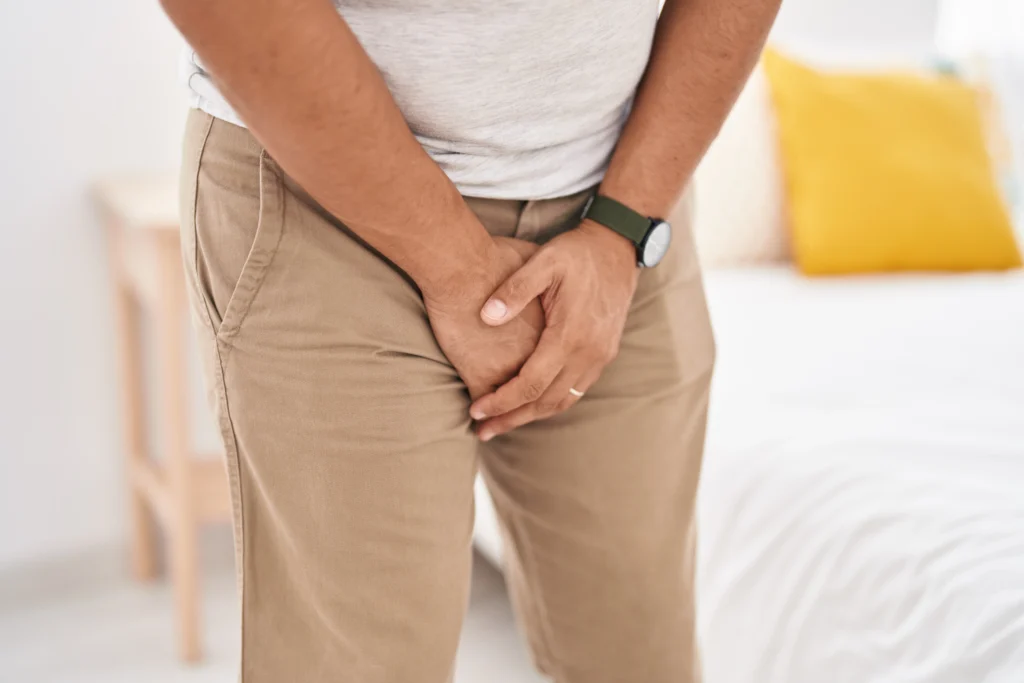
Post-void dribbling is another symptom men often quietly accept.
You finish urinating.
You shake, wait and leave.
Then a small amount of urine escapes into your underwear.
This can happen because urine remains within the urethra after the main stream has stopped.
Importantly, post-void dribbling is not synonymous with prostate enlargement.
Pelvic-floor coordination can influence how efficiently the urethra clears residual urine.
This is where a physiotherapist can sometimes add value, particularly when assessment identifies poor pelvic-floor coordination rather than simply weakness.
I don’t recommend blindly doing hundreds of Kegels.
The pelvic floor needs to contract when appropriate and relax when appropriate.
That distinction is frequently overlooked.
6. Nighttime Urination Is Becoming Your New Routine
Perhaps the most normalized symptom is nocturia.
You go to bed thinking:
“I’m getting older. Of course I wake up to pee.”
Not necessarily.
Occasional nighttime urination can be normal, but repeatedly waking to urinate can significantly affect sleep and daytime function.
And here’s an important lesser-known fact:
Nocturia is not automatically a prostate problem.
Nighttime urine production, evening fluid intake, caffeine, alcohol, sleep disorders, leg swelling, cardiovascular conditions and bladder dysfunction can all contribute.
The EAU describes male LUTS as multifactorial rather than simply a consequence of prostate enlargement.
That is why I would rather ask a patient why he wakes to urinate than automatically blame the prostate.
7. You Suddenly Have to Find a Bathroom
Urinary urgency is different from simple frequency.
Frequency means you are urinating more often.
Urgency means you feel you need to go now.
Some men start planning their day around bathroom locations.
They stop drinking water before meetings.
They avoid long drives.
They search for toilets immediately after arriving somewhere.
These behavioral adaptations can be an early indication that urinary symptoms are beginning to interfere with quality of life.
And this is where self-management can become surprisingly useful.
A recent systematic review and meta-analysis of randomized trials found that self-management interventions for male LUTS were associated with improvements in symptom scores and quality of life, although study quality and interventions varied. (NCBI)
8. You Are Going “Just in Case” All the Time
This is a habit I frequently want men to reconsider.
You are leaving home, so you urinate.
You reach the office, so you urinate.
Before a meeting, you urinate again.
Before driving, you urinate again.
Eventually, your day becomes structured around precautionary bathroom trips.
Sometimes this is understandable when urgency is significant.
But repeatedly emptying the bladder when it contains only a small amount may reinforce a frequent-voiding pattern in some individuals.
This does not mean you should hold urine for long periods or deliberately ignore a strong urge.
Instead, bladder habits should be individualized.
A urinary diary can be surprisingly informative because it records fluid intake, voiding times, urine volume and nighttime episodes.
9. You Strain to Urinate
This is one symptom I would not normalize.
If you routinely tighten your abdominal muscles or bear down to make urine come out, your urinary system may be working against increased resistance.
Men sometimes develop a habit of “pushing” because it appears to make the stream stronger.
But repeated straining is not a substitute for finding the underlying cause.
The EAU guidelines emphasize that voiding dysfunction may involve obstruction, detrusor underactivity or other mechanisms.
If straining has become necessary, it is worth discussing with a doctor rather than simply increasing the force.
The BPH Myth I Want Men to Stop Believing
“A bigger prostate always means worse symptoms.”
This is one of the most important facts in this entire article.
It isn’t that simple.
Older research has demonstrated weak or inconsistent relationships between prostate size and symptom severity, while more recent research continues to investigate anatomical factors such as intravesical prostatic protrusion and bladder-neck anatomy. (PMC)
Think of it this way:
Two men may have similarly sized prostates.
One may urinate comfortably.
The other may struggle with weak flow, urgency and incomplete emptying.
Why?
Because urinary function depends on more than prostate volume.
The bladder, urethra, nervous system, pelvic floor and behavioral factors all matter.
That is exactly why modern guidelines focus on male lower urinary tract symptoms rather than treating prostate size as the whole story.
What Actually Happens as BPH Develops?
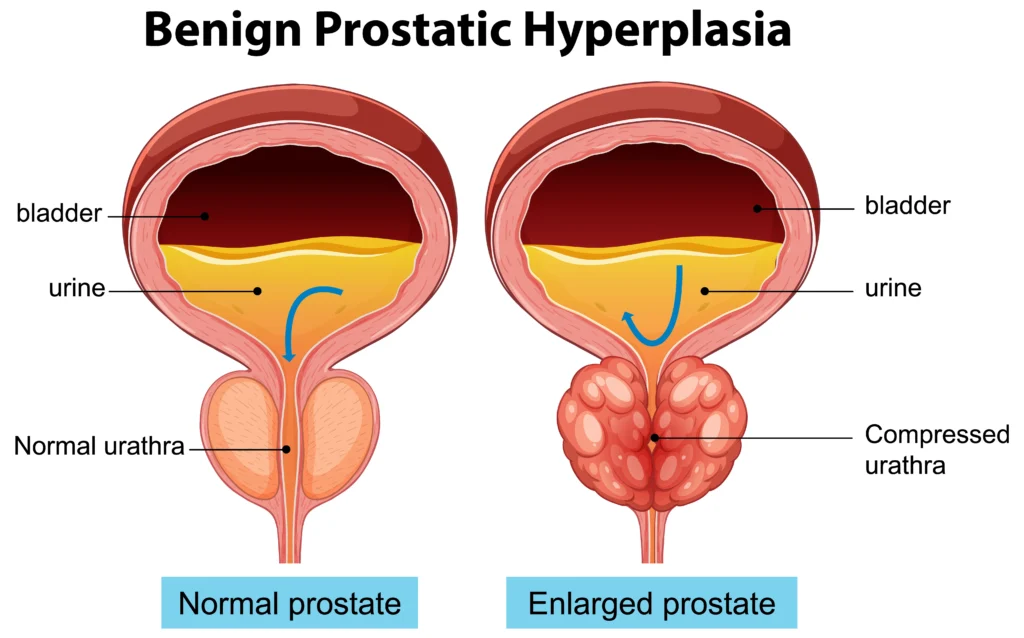
The prostate sits below the bladder and surrounds part of the urethra.
As benign prostatic tissue enlarges, it can contribute to narrowing of the urinary passage.
The bladder initially compensates by generating more pressure.
Over time, persistent obstruction can alter bladder function.
This produces an interesting sequence:
Increased resistance → harder bladder work → altered bladder behavior → urinary symptoms.
That is why early symptoms can involve both emptying and storage.
Emptying symptoms include:
- hesitancy,
- weak stream,
- intermittency,
- straining,
- incomplete emptying.
Storage symptoms include:
- frequency,
- urgency,
- nocturia.
BPH can therefore feel less like “a prostate problem” and more like a collection of changing bladder habits.
Why Your Physiotherapist May Ask About Your Legs
This may surprise you.
If you have swollen legs during the day, some of that fluid can return to circulation after you lie down.
Your kidneys may then produce more urine during the night.
That means nighttime urination may sometimes be influenced by fluid redistribution, not simply the prostate.
This is one reason a physiotherapy assessment should not focus exclusively on pelvic-floor muscles.
Your activity level, prolonged sitting, mobility, leg swelling, sleep quality and daily movement patterns may all be relevant.
A small randomized study in men with nocturia tested a multicomponent behavioral and exercise program incorporating pelvic-floor training, urge suppression, delayed voiding, fluid management, sleep hygiene and peripheral edema management. (Elsevier)
The lesson isn’t that exercise “cures BPH.”
It is that nighttime urination deserves a whole-person assessment.
Can Exercise Help With BPH Symptoms?
Exercise cannot physically remove an enlarged prostate.
But physical activity is relevant to the broader BPH/LUTS picture.
A systematic review and meta-analysis involving more than 43,000 men found that moderate and vigorous physical activity were associated with lower odds of BPH/LUTS compared with sedentary behavior. (PMC)
More recent research published in 2026 also suggests that moderate exercise and moderate-to-high physical activity may be protective, although the evidence remains inconsistent and more high-quality randomized research is needed. (SpringerLink)
From a physiotherapy perspective, I would rather see a man develop a sustainable movement routine than chase a “prostate exercise.”
Think:
- regular walking,
- resistance training,
- mobility work,
- breaking up prolonged sitting,
- maintaining cardiovascular fitness.
The goal is not to exercise the prostate.
The goal is to support the systems surrounding urinary health.
What About Pelvic-Floor Exercises?
This is where online advice often becomes too simplistic.
You may see:
“Do 100 Kegels a day to fix your enlarged prostate.”
I would be very cautious with that advice.
The pelvic floor helps regulate urinary continence, but urinary symptoms can involve both weakness and excessive muscle activity.
A systematic review of pelvic-floor muscle-training programs in men found substantial variation in exercise protocols and reporting, highlighting that there is no single universal program. (Wiley)
A small randomized trial also compared pelvic-floor muscle therapy with alpha-blocker therapy in men with LUTS, demonstrating why pelvic-floor rehabilitation deserves consideration as part of individualized care rather than as a one-size-fits-all replacement for medical management. (NCBI)
When pelvic-floor physiotherapy may be useful
Assessment may be particularly relevant when urinary symptoms coexist with:
- urgency,
- urinary leakage,
- post-void dribbling,
- difficulty relaxing during urination,
- pelvic discomfort,
- poor bladder control.
The important point is coordination, not simply strength.
Small Daily Changes That Can Make Urinary Symptoms Easier
Don’t dramatically restrict water
Some men become frightened by frequent urination and respond by barely drinking.
That can backfire.
Concentrated urine may irritate the bladder, while inadequate hydration can create other health problems.
Instead, pay attention to timing and quantity.
The EAU recommends that fluid advice should consider actual 24-hour fluid intake and urine output rather than automatically prescribing severe fluid restriction.
Reduce evening caffeine if nocturia bothers you
Coffee, tea, energy drinks and some other caffeinated beverages can aggravate frequency or urgency in susceptible individuals.
Try changing the timing rather than assuming you must eliminate caffeine forever.
Be sensible with alcohol
Alcohol can affect urinary patterns and sleep, making nighttime symptoms more noticeable.
If nocturia is disturbing your sleep, examine your evening alcohol intake honestly.
Don’t routinely hold urine for extremely long periods
Busy professionals sometimes ignore bladder signals for hours.
That is not an ideal strategy.
Likewise, constantly emptying the bladder “just in case” may reinforce frequent bathroom behavior.
A balanced pattern is preferable.
Review your medications
This is a particularly important lesser-known tip.
Some medicines can worsen urinary symptoms, including certain decongestants, antihistamines, diuretics and other drugs.
Never stop a prescribed medication yourself.
Instead, ask your doctor or pharmacist whether your medication could be influencing your urinary symptoms.
Constipation Is Worth Discussing Too
The bladder and bowel live next to each other in the pelvis.
Severe constipation can influence pelvic pressure and urinary symptoms.
If urinary changes appear alongside:
- hard stools,
- infrequent bowel movements,
- excessive straining,
- bloating,
tell your healthcare professional.
From a physiotherapy perspective, bowel and bladder habits should not always be treated as completely separate systems.
What Should Men Avoid?
Avoid self-prescribing prostate supplements
“Natural” does not automatically mean effective or safe.
If a supplement promises to shrink your prostate rapidly, reverse BPH overnight or replace medical treatment, be skeptical.
Discuss supplements with a healthcare professional, particularly if you take other medications.
Avoid repeatedly straining to urinate
If you need to push every time, investigate why.
Avoid ignoring progressively worsening symptoms
BPH can remain stable for years in some men, and not everyone needs immediate medication or surgery.
The EAU notes that watchful waiting can be appropriate for men with mild or moderate symptoms who are minimally bothered.
But “watchful waiting” should not mean never checking anything.
Avoid assuming every urinary symptom is BPH
Urinary infection, prostatitis, bladder dysfunction, neurological disorders and prostate cancer can overlap with BPH symptoms.
When Should You See a Doctor?
Please don’t wait for symptoms to become severe.
Arrange a medical assessment if urinary changes are persistent, worsening or interfering with sleep, work, travel or intimacy.
A clinician may consider:
- medical history,
- medication review,
- symptom scoring,
- physical examination,
- urinalysis,
- PSA testing when appropriate,
- prostate assessment,
- urinary flow testing,
- post-void residual measurement,
- ultrasound or other investigations when indicated.
The aim isn’t simply to prove that your prostate is enlarged.
It is to determine why you are experiencing the symptoms.
Red Flags You Should Never Blame on “Age”
Seek prompt medical attention if you:
- suddenly cannot urinate,
- develop severe lower abdominal discomfort,
- see blood in your urine,
- develop fever and chills alongside painful or urgent urination,
- experience significant worsening of urinary symptoms.
Acute urinary retention can require urgent treatment.
Blood in the urine should also be evaluated rather than automatically attributed to BPH.
Does BPH Always Get Worse?
No.
This is another misconception.
Some men experience gradually worsening symptoms, while others remain relatively stable for years.
The EAU guideline reports that many men with mild LUTS can remain stable under watchful waiting, with approximately 85% of men with mild LUTS remaining stable at one year in one cited study.
However, men with significant prostate enlargement and bothersome symptoms may have greater long-term risk of complications.
Long-term clinical trials have demonstrated that appropriately selected medical therapy can reduce risks such as acute urinary retention and BPH-related surgery. (NEJM)
That is why early assessment is more useful than either panic or neglect.
A Physiotherapist’s Practical Perspective
If you came to me describing early urinary symptoms, I would not begin by saying:
“Your pelvic floor is weak. Do Kegels.”
I would want to understand the entire pattern.
I’d ask:
When did the symptoms start?
Is the problem starting the stream, maintaining it or finishing?
How many times are you waking at night?
How much are you drinking and when?
Do you drink caffeine late in the day?
Are you constipated?
Do you sit for long periods?
Are your legs swollen by evening?
Do you strain to urinate?
Do you feel unable to relax your pelvic floor?
Are you taking medications that could affect urination?
And importantly:
Has a doctor evaluated the urinary symptoms?
Physiotherapy can be a useful part of conservative management for selected men, but it should complement, not replace, appropriate urological assessment.
Lesser-Known Point: Your Lifestyle Can Affect More Than Your Waistline
BPH and LUTS have been studied alongside metabolic health.
A 2026 systematic review and meta-analysis found an association between metabolic syndrome and larger prostate volume, although the relationship between metabolic syndrome and symptom severity is more complicated and varies between studies. (Sage Journals)
Earlier meta-analyses similarly found associations between metabolic factors and prostate volume, particularly in men with obesity and other metabolic abnormalities. (PMC)
This does not mean losing weight will automatically cure BPH.
It means that urinary health should be considered within the bigger picture of:
movement + cardiovascular health + metabolic health + sleep + bladder habits + pelvic-floor function.
That is a much more useful way of thinking about prevention.
Final Word
The earliest benign prostatic hyperplasia symptoms are rarely dramatic.
They may begin with a few extra seconds before the urine starts.
A slightly weaker stream.
A few drops after finishing.
One nighttime bathroom visit that gradually becomes two.
A growing habit of finding a toilet wherever you go.
Because these changes happen slowly, men often adapt to them instead of questioning them.
That is exactly why they deserve attention.
BPH is common, but not every urinary symptom is BPH, and prostate size alone does not tell the whole story.
Current evidence supports looking at the lower urinary tract as a functional system, while considering lifestyle, physical activity, bladder behavior, medications, pelvic-floor function and overall health.
My biggest advice is simple:
Don’t wait until you cannot urinate to take your urinary symptoms seriously.
Early evaluation gives you more opportunity to understand what’s actually happening and choose between observation, lifestyle changes, medication, physiotherapy-supported strategies or other treatments when appropriate.
And if you are waking up repeatedly at night, struggling to start your stream, straining to urinate or feeling that your bladder never completely empties, don’t simply tell yourself:
“I’m getting older.”
Sometimes your bladder is giving you useful information long before the problem becomes impossible to ignore.
Frequently Asked Questions
1. What are the early symptoms of benign prostatic hyperplasia?
Early BPH symptoms may include a weak urine stream, difficulty starting urination, interrupted flow, post-void dribbling, frequent urination, urgency, nighttime urination, and a feeling that the bladder has not completely emptied.
2. Is waking up at night to urinate always a sign of BPH?
No. Nocturia can occur with BPH, but nighttime urination may also be influenced by evening fluid intake, caffeine, alcohol, sleep problems, bladder dysfunction, medications, and other health conditions.
3. Does a larger prostate always cause worse urinary symptoms?
No. Prostate size does not always correspond to symptom severity. Some men with a significantly enlarged prostate have few symptoms, while others with less enlargement may experience considerable urinary difficulties.
4. Can a weak urine stream be an early sign of an enlarged prostate?
Yes. A progressively weaker or interrupted urine stream can be one of the symptoms associated with BPH. However, a weak stream can have other causes, so persistent changes should be medically evaluated.
5. Can exercise help with BPH symptoms?
Regular physical activity may support overall urinary and metabolic health and has been associated with lower risk of BPH and lower urinary tract symptoms. Exercise should be viewed as part of healthy management rather than a cure for prostate enlargement.
6. Can pelvic floor exercises help men with BPH symptoms?
Pelvic floor physiotherapy may help selected men with urinary symptoms, particularly when urinary control or pelvic floor coordination is involved. However, simply performing large numbers of Kegel exercises is not appropriate for everyone.
7. Can lifestyle changes improve BPH symptoms?
Lifestyle measures may help some men manage symptoms. Useful strategies can include reducing caffeine and alcohol, adjusting evening fluid intake, staying physically active, reviewing symptom-worsening medicines with a healthcare professional, and developing healthier bladder habits.
8. Can BPH be treated without surgery?
Yes. Depending on symptom severity and individual risk, treatment may include watchful waiting, lifestyle changes, self-management strategies, and medicines. Some men with persistent or complicated symptoms may eventually need a minimally invasive procedure or surgery.
9. When should a man see a doctor about possible BPH?
You should discuss persistent, worsening, or bothersome urinary symptoms with a healthcare professional, especially weak flow, difficulty starting urination, incomplete emptying, frequent nighttime urination, urgency, or repeated urinary problems.
10. Is suddenly being unable to urinate an emergency?
Yes. Sudden inability to urinate can indicate acute urinary retention and requires prompt medical attention. Blood in the urine, fever and chills with urinary symptoms, or severe lower abdominal pain also warrant urgent medical assessment.
This information is educational and does not replace an individual medical evaluation.
Stay tuned with us for more health related topics.
Follow us on LinkedIn and Instagram for more.
More Read


Medical Disclaimer!
This article has been reviewed and written under the guidance of our Head Physiotherapist, Dr. Kruti Raj (PT, MUHS,CPT,CMPT). The information shared is intended for educational purposes only and should not be considered a substitute for personalized medical advice, diagnosis, or treatment.
Please consult us or any other qualified healthcare professional before beginning any exercise program, especially if you are experiencing pain, recovering from injury, or managing a medical condition.


