


Exercises for men after prostate surgery can play an important role in recovery, but the right exercises and timing depend on the type of surgery, healing stage, symptoms and your surgeon’s or physiotherapist’s guidance.
Recovering from prostate surgery can feel surprisingly confusing.
You may be told to walk, but also told not to lift.
You may be encouraged to strengthen your pelvic floor, yet doing too many pelvic floor contractions can leave the muscles tired and poorly coordinated.
Quick Answer
Walking and correctly performed pelvic floor exercises are generally the foundation of recovery, provided your surgeon has cleared you for them. As healing progresses, men can usually move toward functional strengthening, resistance training and eventually higher-impact exercise. The exact timing depends on the type of prostate surgery, healing, urinary symptoms and medical clearance. Heavy lifting and strenuous exercise should not be restarted prematurely.
Then there is the question most men eventually ask:
“When can I exercise normally again?”
The answer is not simply “when the incision heals.”
Your abdominal wall, pelvic floor, bladder control, cardiovascular fitness and general strength all recover at different speeds.
After radical prostatectomy in particular, the urinary sphincter and surrounding pelvic tissues may need time to relearn how to manage pressure during coughing, walking, standing, lifting and exercise.
From a physiotherapy perspective, I prefer to think of recovery as a graded return to movement, not a race back to the gym.
Current evidence supports pelvic floor muscle training after radical prostatectomy, while broader exercise rehabilitation can help restore physical function and quality of life.
A 2024 randomized controlled trial found that supervised physiotherapist-led pelvic floor training improved urinary continence and pelvic floor function after robot-assisted radical prostatectomy. (Wiley)
But there is an important distinction: the exercises that are appropriate immediately after surgery are not necessarily the exercises that are appropriate six or twelve weeks later.
So let us look at what is genuinely useful, what should wait, and the lesser-known mistakes that can slow recovery.
Key Takeaways
- Walking is usually the best starting exercise once your surgical team allows activity.
- Pelvic floor muscle training is particularly important after radical prostatectomy for urinary continence recovery.
- Do not assume that more Kegels mean faster recovery. Pelvic floor muscles also need relaxation and recovery.
- Avoid heavy lifting, high-impact exercise and strenuous abdominal training until your surgeon clears you.
- Use the Knack manoeuvre before coughing, sneezing or movements that increase abdominal pressure.
- Prevent constipation and avoid excessive straining during bowel movements.
- Progress exercise gradually: walking → functional strengthening → resistance training → higher-impact activity.
- Persistent leakage deserves professional assessment rather than endless unsupervised Kegels.
First: Which Prostate Surgery Did You Have?
Not every prostate operation has the same rehabilitation requirements.
Radical prostatectomy
A radical prostatectomy removes the prostate, usually because of prostate cancer.
It can be performed through open, laparoscopic or robot-assisted surgery.
Urinary leakage is particularly relevant after this operation because the anatomy and urinary sphincter mechanism have been altered.
Pelvic floor muscle training is therefore an important component of rehabilitation.
The 2026 European Association of Urology guideline recommends offering pelvic floor muscle training, alone or with biofeedback or electrical stimulation, to men undergoing radical prostatectomy to speed recovery from urinary incontinence, although the recommendation strength is described as weak because the evidence is not completely uniform. (EAU)
TURP
Transurethral resection of the prostate is commonly performed for benign prostate enlargement.
The recovery pathway is different because there is no large abdominal incision.
Nevertheless, the urinary tract still needs time to recover.
The NHS advises avoiding heavy lifting and intense exercise for around six weeks after TURP, while normal activities may gradually resume earlier depending on recovery. (NHS TURP)
HoLEP and other procedures
Holmium laser enucleation and other minimally invasive procedures have their own postoperative instructions.
Therefore, your surgeon’s restrictions take priority over any generic exercise programme you read online.
This is especially important if you have experienced bleeding, infection, urinary retention, wound problems or another postoperative complication.
The Safest Exercise Immediately After Prostate Surgery: Walking
Walking is often underestimated.
It does not look like “rehabilitation,” but in the early postoperative period, it may be one of the most valuable forms of exercise.
Short, comfortable walks encourage circulation, reduce prolonged inactivity and help you gradually rebuild endurance without placing the same mechanical demands on the surgical area as heavy resistance exercise.
After radical prostatectomy, many men are already walking around shortly after surgery.
Memorial Sloan Kettering notes that people commonly walk in the hospital after surgery and that activity should be increased gradually according to recovery and medical instructions. (Memorial Sloan Kettering Cancer Center)
How I would progress walking
Think in terms of frequency before intensity.
Start with several short walks rather than attempting one long walk.
For example:
- 5 to 10 minutes of comfortable walking
- several times throughout the day
- increase duration gradually
- maintain a pace at which you can speak comfortably
- rest before exhaustion rather than after it
If 10 minutes feels easy for several days, you can gradually add a few minutes.
You do not need to achieve a particular step count immediately.
A lesser-known tip: watch your urinary symptoms after walking
A common mistake is judging an exercise only by whether it hurts.
After prostate surgery, urinary leakage can be an important measure of exercise tolerance.
If a particular walking duration causes noticeably more leakage later that day, it may be a sign that you progressed faster than your pelvic floor currently tolerates.
That does not necessarily mean walking is harmful.
It may simply mean:
reduce the dose, recover, then rebuild gradually.
Pelvic Floor Exercises: The Most Important Exercise, But Also the Most Misunderstood
The pelvic floor muscles help support the bladder and contribute to urinary continence.
After prostate surgery, these muscles become particularly important because the normal continence mechanism may have been disrupted.
The American Urological Association recommends pelvic floor muscle exercises or pelvic floor muscle training for men seeking treatment for incontinence after radical prostatectomy. (AUA/SUFU)
A 2024 systematic review and meta-analysis involving nine studies and 1,208 men found that pelvic floor muscle exercises improved urinary continence recovery at one, three and six months following radical prostatectomy, although the difference at 12 months was not statistically significant. (PMC)
Another 2024 systematic review of 14 studies involving 1,236 men found that early pelvic muscle training reduced urinary incontinence symptoms and showed moderate evidence for improving quality of life, although the studies were heterogeneous. (PubMed)
How to identify the correct muscles
Imagine that you are trying to prevent yourself from passing urine and gas at the same time.
The muscles you gently contract are part of the pelvic floor.
You should feel a subtle lifting or tightening sensation.
You should not strongly squeeze your buttocks, thighs or abdominal muscles.
And you should not repeatedly practise stopping your urine stream while actually urinating.
That can interfere with normal bladder emptying.
Start with gentle contractions
Once your surgical team has cleared you for pelvic floor exercises:
- Lie or sit comfortably.
- Relax your abdomen and buttocks.
- Gently contract the pelvic floor.
- Hold briefly.
- Completely relax.
- Repeat according to your physiotherapist’s programme.
As control improves, both the duration of the contraction and the number of repetitions can be progressed.
The British Association of Urological Surgeons specifically warns men not to overdo pelvic floor exercises because the muscles can become tired. (BAUS)
That point is frequently missed.
More Kegels are not automatically better.
The “Knack” Technique Can Be More Useful Than Constant Clenching
One of the more practical pelvic floor strategies is the Knack manoeuvre.
The idea is simple: gently contract your pelvic floor immediately before an activity that increases abdominal pressure.
Examples include:
- coughing
- sneezing
- standing up
- getting out of bed
- lifting a light object
- changing position
This trains the pelvic floor to respond to pressure rather than simply remaining contracted all day.
An RCT cited in the EAU guideline found that adding lifestyle recommendations and the Knack manoeuvre to conventional pelvic floor muscle training produced greater improvements in urinary incontinence severity and quality of life at eight weeks than conventional training alone. (Uroweb)
This is one reason I do not teach pelvic floor rehabilitation as “just squeeze and hold.”
Timing matters.
Gentle Core Exercises: When and Why?
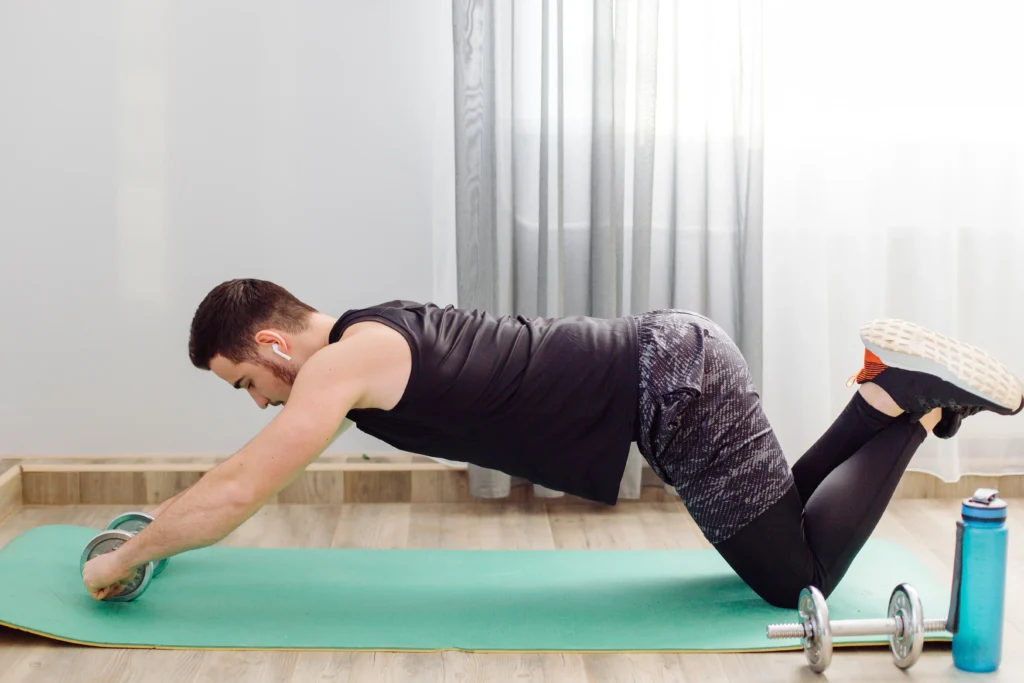
Your abdominal muscles and pelvic floor work together as part of the trunk-pressure system.
However, early after abdominal or laparoscopic surgery, aggressive abdominal exercises can place unnecessary stress on healing tissues.
Initially, your goal should be coordination rather than maximum strength.
Once your surgeon clears you for progressive exercise, a physiotherapist may introduce gentle movements such as:
Diaphragmatic breathing
Lie comfortably and place one hand over your abdomen.
Inhale gently through your nose and allow your abdomen and lower ribs to expand.
Exhale slowly.
This is not simply a relaxation exercise.
Breathing influences intra-abdominal pressure and interacts with pelvic floor activity.
A useful rehabilitation goal is learning to coordinate breathing rather than holding your breath during movement.
Pelvic tilting
Once cleared, gentle pelvic movements can help restore awareness of the trunk and pelvis without requiring heavy loading.
Sit-to-stand
This is one of my favourite functional exercises during later rehabilitation because it resembles an everyday activity.
Start from a stable chair.
Lean slightly forward.
Stand using your legs.
Sit down slowly.
As strength improves, repetitions can increase.
The key is not to hold your breath or strain excessively.
Resistance Training: Yes, But Not Immediately
Many men who were regular gym-goers before prostate surgery understandably want to return quickly.
This is where patience becomes important.
Heavy lifting increases abdominal pressure and can place greater demands on the pelvic floor and healing tissues.
For some prostate procedures, clinicians recommend avoiding heavy lifting for several weeks.
For example, NHS guidance after TURP advises avoiding heavy lifting and intense exercise for around six weeks. ((NHS))
Post-radical-prostatectomy restrictions vary according to surgical approach and individual healing.
Memorial Sloan Kettering advises patients to discuss exercise, sports and lifting restrictions at follow-up rather than assuming that a particular timeline applies to everyone.
When resistance exercise is cleared
Begin with low resistance and controlled movements.
Good early options may include:
- bodyweight sit-to-stand
- light resistance-band exercises
- supported heel raises
- gentle upper-body movements
- controlled step-ups
- light functional strengthening
Progress one variable at a time.
For example:
repetitions → resistance → complexity → intensity
Do not increase everything simultaneously.
Exercises You Should Usually Avoid Early On
Until your surgeon or physiotherapist clears you, avoid jumping straight into:
- heavy squats
- heavy deadlifts
- maximal bench pressing
- heavy leg presses
- intense abdominal crunches
- aggressive planks
- high-impact running
- jumping
- contact sports
- intense cycling if it produces pelvic discomfort
- breath-holding during resistance exercises
This does not mean these activities are permanently forbidden.
It means your tissues need to earn their way back to high loads.
A Surprisingly Important Exercise: Getting Out of a Chair
Functional strengthening is sometimes more useful than traditional gym exercises during early recovery.
Sit-to-stand training works the quadriceps, gluteal muscles and trunk while rehearsing a movement you perform repeatedly throughout the day.
It also gives you an opportunity to practise coordinated breathing.
If you leak urine when standing, you can use the Knack strategy: prepare the pelvic floor before the movement, then relax once the task is complete.
The goal is not to keep the pelvic floor clenched throughout the entire movement.
What About Cycling After Prostate Surgery?
Cycling deserves special consideration.
The saddle places pressure on the perineal region, and that pressure may be uncomfortable during early recovery.
Therefore, I would not use cycling as your first cardiovascular exercise after prostate surgery.
Walking is generally easier to control.
Once healing is satisfactory and your surgeon approves cycling, return gradually.
If pelvic discomfort, urinary symptoms or numbness develops, stop and discuss it with your healthcare professional.
Running: Don’t Use “No Pain” as Your Only Green Light
Running creates repeated impact and increases the physical demand on your pelvic floor.
Before returning to running, I would want to see:
- comfortable walking
- good functional strength
- satisfactory wound healing
- manageable urinary symptoms
- reasonable pelvic floor control
- no concerning postoperative symptoms
- clearance for higher-impact activity
A gradual walk-jog programme is usually more sensible than suddenly returning to your previous running distance.
A Lesser-Known Problem: Constipation Can Make Urinary Recovery Harder
This is one of the rehabilitation points I wish more men were told.
Straining during bowel movements increases pressure through the pelvic region.
The BAUS specifically recommends avoiding constipation during pelvic floor rehabilitation because bowel fullness and straining can worsen urinary symptoms. (BAUS)
So rehabilitation is not just about exercise.
It also involves:
- adequate fluids according to your medical advice
- sufficient dietary fibre
- avoiding prolonged straining
- responding to bowel urges
- maintaining appropriate activity
A smooth bowel movement is surprisingly valuable when your pelvic floor is recovering.
Another Often-Missed Point: Don’t Hold Your Breath During Exercise
When men lift weights, they naturally tend to brace.
Before surgery, this may not have been a problem.
During early postoperative rehabilitation, however, forceful breath-holding can dramatically increase pressure within the trunk.
Instead:
inhale before the movement, then breathe out through the effort.
Your physiotherapist can teach you how to coordinate breathing, abdominal muscles and pelvic floor contraction for progressively heavier exercises.
Can Exercise Help Erectile Function After Prostate Surgery?
Exercise should not be presented as a guaranteed cure for postoperative erectile dysfunction.
Erectile recovery depends on several factors, including nerve preservation, age, vascular health, baseline erectile function, cancer characteristics and the surgical procedure.
However, the broader evidence around exercise is encouraging.
A 2026 systematic review and meta-analysis of 10 randomized trials involving 558 people with prostate cancer found that exercise interventions significantly improved sexual activity and sexual function, although the authors noted variation according to exercise type and prescription. (Oxford Academics)
This does not mean that doing more squats will automatically restore erections.
Rather, regular physical activity can be one component of a broader rehabilitation strategy.
Sexual rehabilitation may also require medical management from a urologist or sexual-medicine specialist.
Exercise Is Bigger Than Urinary Continence
One of the most interesting recent findings is that physical activity after prostate cancer treatment may have benefits extending far beyond bladder control.
A 2026 systematic review and meta-analysis including more than 50,000 prostate cancer survivors found that higher post-diagnosis physical activity was associated with lower all-cause and prostate-cancer-specific mortality.
These are observational associations and do not prove that exercise alone caused the reduction, but the findings reinforce the importance of physical activity as part of survivorship care. (SpringerLink)
So the long-term goal should not be:
“How quickly can I stop using pads?”
It should eventually become:
“How can I safely rebuild my entire physical capacity?”
A Practical Post-Prostate-Surgery Exercise Progression
Your exact timeline should come from your surgical team, but physiotherapy rehabilitation commonly follows this principle.
Early phase: protect and move
Focus on:
- short walks
- gentle breathing
- circulation
- safe transfers
- prescribed pelvic floor exercises
- adequate rest
Avoid:
- heavy lifting
- high-impact exercise
- strenuous abdominal work
- breath-holding
Middle phase: rebuild control
Once medically cleared:
- longer walks
- sit-to-stand
- gentle strengthening
- balance work
- progressive pelvic floor training
- functional movements
Later phase: rebuild fitness
With appropriate clearance:
- resistance training
- longer cardiovascular sessions
- progressive walking or jogging
- recreational activities
- sport-specific conditioning
Long-term phase: become active again
The aim is eventually to return to a sustainable exercise routine rather than remaining permanently cautious.
A systematic review of supervised comprehensive physiotherapy after radical prostatectomy found positive effects across urinary incontinence, physical capacity, physical and emotional functioning and quality of life, although the authors called for better standardized trials. (Elsevier)
When Should You Stop Exercising and Contact Your Doctor?
Do not try to “exercise through” concerning postoperative symptoms.
Contact your medical team if you develop:
- increasing or severe pain
- fever
- worsening wound redness or drainage
- difficulty passing urine
- significant or increasing blood in the urine
- new swelling
- dizziness or unusual shortness of breath
- sudden deterioration in urinary control
- symptoms that consistently worsen after exercise
After prostate surgery, blood in the urine can sometimes occur during recovery, but the amount, timing and associated symptoms matter.
Your surgeon should tell you what is expected for your particular operation.
The Biggest Mistakes I See in Post-Prostate-Surgery Exercise
Doing too many Kegels
The pelvic floor is a muscle group.
Muscles need recovery.
More contractions do not automatically mean faster recovery.
Returning to the gym because the incision looks healed
An incision that looks good externally does not necessarily mean deeper tissues are ready for maximal loading.
Treating leakage as a failure
Urinary leakage after prostatectomy can be part of the recovery process.
Track progress over weeks rather than judging yourself based on one difficult day.
Avoiding all activity because you are afraid of leakage
Complete inactivity can reduce fitness and confidence.
The better approach is graded activity.
Ignoring constipation
Repeated straining can increase pelvic floor stress.
Holding your breath during strengthening
Learn to coordinate breathing with effort.
Comparing your recovery with another man
Two men can have the same operation and completely different recovery trajectories.
Surgical technique, nerve preservation, baseline fitness, age, cancer treatment and pelvic floor function all matter.
Final Takeaways
If you have recently undergone prostate surgery, movement is usually part of recovery, not something you should fear.
But recovery should be progressive.
Start with the basics: walking, breathing, safe movement and correctly performed pelvic floor exercises.
Once your surgeon clears you, gradually rebuild strength and cardiovascular fitness.
Later, resistance training and higher-impact exercise can return when your tissues, pelvic floor and overall function are ready.
Most importantly, don’t turn rehabilitation into a competition.
The strongest pelvic floor is not necessarily the one that can squeeze the hardest.
The better pelvic floor is one that can contract when you need it, relax when you don’t, and coordinate with breathing and movement.
That distinction is particularly important after prostate surgery.
And if urinary leakage is persistent, severe or not improving, don’t simply keep doing more exercises.
A pelvic health physiotherapist can assess whether the problem is weakness, poor coordination, excessive tension, incorrect technique or another issue requiring medical evaluation.
The goal isn’t simply to get through prostate surgery.
The goal is to rebuild confidence, continence, strength and an active life afterward.
Frequently Asked Questions
What is the best exercise after prostate surgery?
Walking is usually one of the safest starting activities after medical clearance. Pelvic floor muscle exercises are particularly important after radical prostatectomy for urinary continence rehabilitation.
When can I exercise after prostate surgery?
The timing depends on the procedure and your recovery. Light walking may begin early, while heavy lifting, strenuous exercise and high-impact activities usually need to wait until your surgeon confirms that they are safe.
Are Kegel exercises safe after prostatectomy?
Pelvic floor exercises are commonly used after radical prostatectomy and are recommended for urinary incontinence rehabilitation. However, technique, dosage and relaxation are important, and excessive contractions can fatigue the muscles.
Can I lift weights after prostate surgery?
Eventually, many men can return to resistance training, but heavy lifting should be avoided during the early healing period. Your surgeon should determine when heavier resistance is appropriate.
Can exercise reduce urine leakage after prostatectomy?
Yes. Pelvic floor muscle training has evidence supporting faster urinary continence recovery after radical prostatectomy, particularly during the early months of rehabilitation.
Can I run after prostate surgery?
Running should generally be introduced only after adequate healing, good walking tolerance and medical clearance. A gradual walk-jog progression is preferable to an immediate return to long-distance running.
Is cycling safe after prostate surgery?
Cycling may eventually be possible, but saddle pressure can be uncomfortable during early recovery. Walking is usually a better initial cardiovascular activity. Obtain medical clearance before returning to cycling.
Why am I leaking urine when I stand up after prostate surgery?
Standing increases abdominal pressure and can challenge the recovering urinary continence mechanism. Pelvic floor coordination and the Knack manoeuvre may help, but persistent leakage should be assessed by a healthcare professional.
Can exercise improve erectile function after prostate surgery?
Exercise may contribute to overall sexual rehabilitation, although erectile recovery depends on several factors including nerve preservation, vascular health and the type of surgery. Medical sexual rehabilitation may also be required.
When should I see a physiotherapist after prostate surgery?
A pelvic health physiotherapist can be useful when urinary leakage persists, pelvic floor exercises are difficult to perform correctly, symptoms worsen with activity, or you need help progressing safely back to exercise.
Stay tuned with us for more health related topics.
Follow us on LinkedIn and Instagram for more.
More Read


Medical Disclaimer!
This article has been reviewed and written under the guidance of our Head Physiotherapist, Dr. Kruti Raj (PT, MUHS,CPT,CMPT). The information shared is intended for educational purposes only and should not be considered a substitute for personalized medical advice, diagnosis, or treatment.
Please consult us or any other qualified healthcare professional before beginning any exercise program, especially if you are experiencing pain, recovering from injury, or managing a medical condition.


