Returning to the gym after breast reconstruction can be an important step toward rebuilding strength, confidence, and independence.
However, it is normal to feel unsure about when to restart exercise, which movements are safe, and how much weight you can lift.
Quick Answer: When Can You Return to the Gym After Breast Reconstruction?
Many women can begin gentle walking soon after breast reconstruction, but returning to regular gym workouts usually requires medical clearance. The timeline depends on the type of reconstruction, wound healing, pain levels, shoulder movement and whether you are receiving chemotherapy or radiation therapy.
- Start with gentle walking and approved mobility exercises.
- Avoid heavy lifting and strenuous upper-body exercises until cleared.
- Increase resistance and workout duration gradually.
- Stop if you experience increasing pain, swelling, wound problems or unusual fatigue.
- Follow the personalised advice of your surgeon and physiotherapist.
Important: Your surgeon’s clearance should guide your return to gym-based exercise.
Breast reconstruction is a major procedure, and recovery varies depending on the surgical technique.
Some people have implant-based reconstruction, while others have reconstruction using their own tissue from the abdomen, back, thigh, or another area of the body.
Your exercise plan may also be affected by mastectomy, lymph node surgery, chemotherapy, radiation therapy, drains, wound healing, fatigue, or shoulder stiffness.
Returning to the gym should be gradual and guided by your surgical team.
Gentle movement may begin early, but heavy lifting, chest exercises, high-impact activity, and intense stretching usually require more recovery time.
The aim is not to return to your previous workout routine immediately.
The aim is to help your body regain mobility, strength, stamina, and confidence safely.
Key Takeaways
Begin with short walks and gentle movements before progressing to gym exercises.
Avoid heavy lifting, forceful pushing, pulling and strenuous chest exercises until cleared.
Implant reconstruction and tissue-flap reconstruction may require different precautions.
Pain, swelling, unusual tightness or wound changes should not be ignored.
Use light resistance first and increase exercise intensity only when your body tolerates it.
Why Exercise After Breast Reconstruction Needs Special Care
Breast reconstruction affects more than the appearance of the breast.
Depending on the procedure, surgery may involve the chest muscles, skin, connective tissues, abdominal muscles, back muscles, or other donor-site tissues.
This means that an exercise that feels easy before surgery may place unexpected stress on the healing body afterward.
For example:
- A chest press may load the pectoral muscles.
- Planks may place pressure on the chest and abdominal region.
- Running may increase breast movement and impact.
- Heavy lifting may strain the surgical area.
- Overhead movements may stretch healing tissues.
- Core exercises may affect the abdomen after flap reconstruction.
- Pulling exercises may challenge the back after donor-site surgery.
Your recovery should therefore be based on the type of reconstruction and the complete surgical history, not simply on how the incision looks from the outside.
When Can You Return to the Gym?
There is no single timeline for everyone.
Your surgeon will decide when you can return based on wound healing, pain, swelling, surgical technique, and any complications.
Some people may be allowed to walk soon after surgery, while a return to structured gym training may take several weeks or longer.
Early recovery: focus on movement
During the early stage, exercise should mean gentle movement rather than formal workouts.
Depending on your medical advice, you may be able to perform:
- Short walks around the home
- Gentle ankle pumps
- Comfortable breathing exercises
- Finger and wrist movements
- Gentle elbow movements
- Short periods of standing
- Easy changes of position
These activities may help maintain circulation and reduce stiffness without placing excessive stress on the reconstructed area.
Avoid heavy household work, lifting full shopping bags, pushing heavy objects, or performing strenuous exercise unless your surgical team has approved it.
As healing progresses
Once your surgeon confirms that healing is progressing well, you may gradually increase walking time and begin selected mobility exercises.
You may still need to avoid:
- Heavy weights
- Vigorous upper-body movements
- Push-ups
- Chest presses
- Deep chest stretches
- High-impact workouts
- Contact sports
- Exercises that cause pulling around the incision
- Positions that place direct pressure on the reconstructed breast
The correct progression depends on your surgery.
Do not use another person’s recovery timeline as a guide for your own.
Walking Is Often the Best First Gym Activity
Walking is usually a practical starting point because it helps rebuild stamina without immediately loading the chest or surgical area.
If your surgeon has cleared you to visit the gym, a treadmill may be useful because you can control the speed and stop easily when needed.
A gentle treadmill plan
Start with:
- Five to ten minutes at a comfortable pace.
- No incline during the first sessions.
- Relaxed shoulders and natural breathing.
- No weights carried in the hands.
- A pace that allows you to speak comfortably.
- Rest before you become exhausted.
If you tolerate the session well, increase the duration slowly.
It may be better to add two or three minutes than to suddenly increase speed or incline.
You can also divide your activity into smaller sessions.
For example, a five-minute walk in the morning and another five-minute walk later may be more manageable than one longer workout.
During chemotherapy or radiation therapy, energy levels may change from day to day.
Adjusting your activity is not a sign of weakness. It is part of responding appropriately to treatment and recovery.
How the Type of Reconstruction Changes Exercise Advice
Implant-based reconstruction
Implant-based reconstruction may involve placing an implant beneath the skin or beneath the chest muscle.
Your surgeon may initially restrict activities that strongly contract or stretch the chest muscles, such as:
- Bench press
- Chest press
- Push-ups
- Dips
- Heavy chest fly exercises
- Heavy overhead pressing
You may also need to avoid movements that cause pressure, friction, or discomfort over the reconstructed breast.
Flap reconstruction
Flap reconstruction uses tissue from another part of the body.
This means you may need to protect both the breast and the donor site.
If tissue was taken from the abdomen, you may need a gradual return to:
- Sit-ups
- Crunches
- Planks
- Heavy lifting
- Deadlifts
- Intense core exercises
If tissue was taken from the back, shoulder and back exercises may need to be progressed carefully.
Your physiotherapist can help identify which muscles require protection and which areas can be strengthened safely during each stage of recovery.
Why You Should Not Rush Into Heavy Lifting
Feeling better does not always mean that the deeper tissues have fully healed.
Skin may appear closed while muscles, connective tissues, and internal surgical areas are still recovering.
Returning too quickly to heavy exercise may increase discomfort and place unnecessary strain on healing tissues.
The American Cancer Society explains that recovery after breast reconstruction can vary, with many people returning to normal activities over several weeks.
Restrictions on heavy lifting and strenuous exercise depend on the procedure and the surgeon’s instructions. (American Cancer Society)
Exercises to Avoid or Modify After Breast Reconstruction

Returning to the gym does not mean returning immediately to every exercise you performed before surgery.
Some movements place pressure on the reconstructed breast, chest muscles, shoulder, abdomen, or donor site.
During the early recovery period, avoid or modify exercises that cause:
- Pulling around the incision
- Pressure over the reconstructed breast
- Sudden stretching of the chest
- Strong contraction of the chest muscles
- Pain or swelling
- Excessive fatigue
- Strain around an abdominal or back donor site
Push-ups and chest presses
Push-ups, bench presses, chest presses, chest fly exercises, and dips can place considerable demand on the chest and shoulder region.
These exercises may be restricted after implant-based reconstruction, particularly when the implant is placed beneath the chest muscle.
Even after clearance, you may need to begin with lighter resistance and a smaller range of movement.
Instead of returning directly to a full push-up, your physiotherapist may suggest:
- Wall push-ups
- Incline push-ups
- Gentle resistance-band movements
- Light rowing exercises
- Controlled shoulder strengthening
Progress only when the movement is comfortable and your surgical team approves it.
Overhead exercises
Overhead presses, lat pulldowns, overhead triceps extensions, and repeated reaching may stretch healing tissues or challenge shoulder mobility.
If your shoulder is stiff after mastectomy or lymph node surgery, forcing the arm overhead may increase discomfort.
Begin with comfortable movements and gradually increase the range as advised.
Planks and abdominal exercises
Planks, sit-ups, crunches, and heavy core exercises require caution after flap reconstruction, especially when tissue was taken from the abdomen.
The abdominal donor site may need time to regain strength.
Returning too quickly to intense core training can increase strain and discomfort.
Your physiotherapist may begin with:
- Gentle abdominal breathing
- Pelvic tilts
- Supported marching
- Low-load abdominal activation
- Controlled functional movements
Avoid holding your breath during strengthening exercises. Exhaling during effort can help reduce unnecessary straining.
When Can You Start Running or High-Impact Exercise?
Running, jumping, aerobics, and high-impact workouts may need to wait until your wounds have healed and your strength and balance have improved.
High-impact movement can increase breast movement, discomfort, and strain on healing tissues.
It may also be unsuitable if you have:
- Persistent pain
- Open or healing wounds
- Swelling
- Poor balance
- Significant fatigue
- Weakness after chemotherapy
- A donor-site complication
- Unhealed surgical areas
A gradual progression may look like:
- Comfortable walking
- Longer walks
- Brisk walking
- Short intervals of faster walking
- Gentle low-impact cardio
- Short jogging intervals, if cleared
- Gradual return to running
You do not need to progress through every stage quickly.
The correct pace depends on your recovery.
Managing Shoulder Stiffness and Chest Tightness
Shoulder stiffness is common after breast surgery, especially when surgery involves the breast, chest wall, or lymph nodes.
Radiation therapy may also contribute to tightness and reduced tissue flexibility.
Limited shoulder movement can make gym exercises such as lat pulldowns, rows, presses, and lifting difficult.
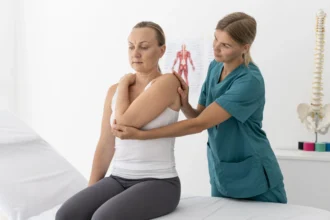
Gentle rehabilitation may include:
- Shoulder rolls
- Elbow bends
- Wall slides
- Supported arm raises
- Scapular setting exercises
- Gentle neck movement
- Posture correction
- Breathing and chest-wall mobility
Do not force a painful stretch. A feeling of mild tightness may be manageable, but sharp pain, burning, pulling, or increasing swelling should be assessed.
Early and appropriately guided exercise may help improve shoulder function after breast cancer surgery.
The PROSPER trial investigated exercise-based rehabilitation for preventing shoulder problems after breast cancer surgery and supports the importance of structured recovery rather than prolonged inactivity. (Bruce et al., 2022)
Watch for Signs of Lymphoedema
Some people develop lymphoedema after lymph node surgery or radiation therapy.
It may cause swelling, heaviness, tightness, or aching in the breast, chest, arm, or hand.
Exercise is not automatically prohibited when lymphoedema is present.
However, resistance training should be introduced gradually and monitored for changes in symptoms.
Contact your healthcare team if you notice:
- New arm or hand swelling
- A feeling of heaviness
- Tight rings or sleeves
- Skin tightness
- Persistent aching
- Increased swelling after exercise
- Reduced movement in the affected arm
A physiotherapist trained in lymphoedema management can help you develop an individual exercise program and monitor your response. (Campbell et al., 2019)
How to Know If Your Workout Is Too Much
Your body may need more recovery time after surgery or during cancer treatment.
Use symptoms as a guide rather than trying to match your previous fitness level.
Reduce or stop the session if you experience:
- Increasing pain around the breast or donor site
- Swelling during or after exercise
- Pulling at the incision
- New redness or warmth
- Unusual breathlessness
- Dizziness
- Severe fatigue
- Nausea
- Chest pain
- New arm or hand swelling
Mild muscle tiredness may be expected, but worsening pain or swelling should not be treated as normal workout soreness.
A Simple Return-to-Gym Structure
Once you receive medical clearance, a session may include:
Warm-up
- Five minutes of gentle walking
- Ankle and wrist movements
- Shoulder rolls within a comfortable range
- Gentle breathing
Main activity
Choose one or two activities such as:
- Treadmill walking
- Stationary cycling
- Gentle lower-body strengthening
- Light resistance exercises approved by your physiotherapist
Cool-down
- Slow walking
- Comfortable breathing
- Gentle mobility
- Rest and hydration
Begin with short sessions and allow recovery time between workouts.
Increase only one factor at a time, such as duration, resistance, or frequency.
The aim is to build consistency without causing a flare-up of pain, swelling, or fatigue.
How to Return to Resistance Training Safely
Once your surgeon and physiotherapist have cleared you for strength training, begin with low resistance and controlled movements.
The aim is to rebuild confidence, strength and shoulder control rather than immediately returning to your previous gym routine.
Start with:
- Light resistance bands
- Very light dumbbells
- Seated or supported exercises
- Short sets of 8–10 repetitions
- Longer rest periods between exercises
Begin with one or two sets and increase gradually only if there is no increase in pain, swelling, tightness or unusual fatigue.
Avoid holding your breath while lifting.
Exhale during the effort and keep your shoulders relaxed.
If you notice pulling across the reconstructed breast, chest wall or armpit, reduce the weight or stop the exercise.
Pay Attention to the Donor Site
If your reconstruction used tissue from the abdomen, back, thigh or another area, that region also needs rehabilitation.
For abdominal flap reconstruction, avoid progressing too quickly into:
- Heavy deadlifts
- Sit-ups and crunches
- Hanging leg raises
- Heavy squats
- High-pressure core exercises
- Exercises that cause abdominal bulging or pulling
For back-flap reconstruction, rowing, lat pulldowns and other pulling exercises may need to be introduced slowly.
Your physiotherapist can assess whether the donor site is strong enough and whether your movement pattern is placing excessive stress on the healing tissues.
The recovery period can be longer for complex reconstruction or high-impact activities.
Some people may need several months before returning to their previous level of exercise (Roubaud et al., 2018)
Choosing Gym Clothing and Support
A well-fitting, supportive sports bra can make exercise more comfortable.
Choose one that:
- Provides support without excessive compression
- Does not rub against scars or the nipple area
- Does not press directly on a healing incision
- Allows comfortable breathing
- Can be adjusted as swelling changes
Avoid exercising in clothing that causes friction around the breast, underarm or donor site.
If you have reduced sensation after surgery, check your skin after exercise because you may not immediately feel rubbing or pressure.
For running, jumping or other high-impact activity, use a supportive sports bra only after your surgical team has cleared you.
Swimming should wait until wounds are fully healed and your surgeon confirms that it is safe.
Exercising During Cancer Treatment
If you are receiving chemotherapy, radiation therapy or hormone therapy, your exercise plan may need to change from week to week.
During treatment, you may experience:
- Fatigue
- Reduced stamina
- Anaemia
- Nausea
- Joint or muscle pain
- Numbness or tingling in the hands and feet
- Reduced balance
- Skin sensitivity during radiation therapy
On difficult days, replace a gym session with gentle walking, breathing exercises or mobility work.
If you have significant fatigue, dizziness, fever, unusual breathlessness or symptoms related to low blood counts, speak with your oncology team before exercising.
Exercise is often beneficial during cancer recovery, but it should be adjusted according to treatment effects, surgical healing and individual tolerance (Campbell et al., 2019).
When Should You Stop Exercising?
Stop the session and contact your surgical or medical team if you notice:
- New or increasing breast swelling
- Sudden or worsening pain
- Redness, warmth or discharge from an incision
- Opening of a wound
- A new fluid-filled area
- Persistent heaviness or swelling in the arm
- Increasing tightness across the chest
- Numbness or weakness that is getting worse
- Fever or unexplained breathlessness
Mild muscle tiredness may be expected, but pain that continues after exercise is not something to push through.
Exercise should feel manageable and should not cause symptoms that remain worse later that day or the following morning (Breast Cancer Now, 2025).
Myth vs Fact: Exercise After Breast Reconstruction
Myth: You should avoid all exercise after breast reconstruction.
Fact: Gentle movement and walking are often encouraged when medically appropriate. Exercise should be introduced gradually and adjusted to your recovery stage.
Myth: If an exercise does not hurt immediately, it is safe.
Fact: Symptoms may appear later in the day or the following morning. Watch for delayed swelling, tightness, pain or unusual fatigue.
Myth: You must immediately return to your previous gym weights.
Fact: Start with lighter resistance, fewer repetitions and longer rest periods. Strength should be rebuilt progressively.
Myth: Breast reconstruction recovery is the same for everyone.
Fact: Recovery varies according to reconstruction type, donor site, healing, cancer treatment and individual fitness.
Lesser-Known Fact: Recovery Is Not Always Linear
A lesser-known fact is that breast reconstruction recovery is often non-linear.
You may feel stronger for several weeks and then experience increased tightness, fatigue or discomfort after treatment, poor sleep or a sudden increase in activity.
This does not always mean that something has gone wrong.
It may mean that your exercise load has increased faster than your tissues can tolerate.
A physiotherapist can help you reduce the workload temporarily and then build it up again safely.
The most successful return to the gym is not the fastest one.
It is the one that allows you to remain active without compromising wound healing, shoulder movement, breast comfort or donor-site recovery.
Final Thoughts
Returning to the gym after breast reconstruction is a gradual process. Your recovery does not need to follow anyone else’s timeline. Begin with gentle movement, respect your surgical restrictions and increase exercise only when your body is ready.
A personalised plan from your surgeon and physiotherapist can help you rebuild strength, improve shoulder mobility and return to activities with greater confidence.
Your goal is not to rush back. Your goal is to return safely, confidently and sustainably.
Conclusion
Returning to the gym after breast reconstruction can help improve strength, mobility, confidence and long-term wellbeing.
However, the right timeline depends on your reconstruction type, healing progress, treatment plan and previous fitness level.
Start with walking and gentle mobility, then gradually introduce resistance training under medical guidance.
Avoid heavy lifting, high-impact exercise and difficult chest or abdominal movements until you are cleared.
Listen to changes in pain, swelling, fatigue and movement, and seek professional advice when symptoms appear.
With patience and a personalised physiotherapy plan, many women can return to regular gym activities while protecting their reconstruction and rebuilding confidence in their bodies.
Frequently Asked Questions
1. How soon can I walk after breast reconstruction?
Gentle walking is often introduced early, depending on your condition and surgical instructions. Begin with short, comfortable walks and increase gradually.
2. When can I lift weights after breast reconstruction?
Weight training should wait until your surgeon or physiotherapist confirms that your wounds and reconstructed tissues have healed sufficiently. Start with light resistance and progress slowly.
3. Can I do push-ups after breast reconstruction?
Push-ups may place significant demand on the chest and shoulder muscles. They should be avoided during early recovery and introduced only after professional clearance, often with modified wall or incline versions first.
4. Can exercise cause problems with breast implants or flap reconstruction?
Appropriate exercise is generally part of long-term recovery, but strenuous activity too early may increase discomfort or place stress on healing tissues. Follow your reconstruction-specific restrictions.
5. Can I exercise during chemotherapy or radiation therapy?
Many people can remain active during treatment, but exercise may need to be reduced or modified because of fatigue, anaemia, nausea, skin sensitivity or other treatment effects. Discuss your plan with your oncology team.
6. When should I stop exercising and contact my doctor?
Stop exercising if you experience increasing pain, new swelling, wound discharge, redness, fever, worsening arm swelling, unusual breathlessness or symptoms that do not settle with rest.
Stay tuned with us for more health related topics.
Follow us on LinkedIn and Instagram for more.
More Read



Medical Disclaimer: This article is for educational purposes only and does not replace advice from your breast surgeon, oncologist or physiotherapist. Always obtain medical clearance before returning to strenuous exercise after breast reconstruction.