An ankle injury may heal, yet problems inside the joint can emerge years later.
Someone who recovered from a fracture or severe sprain may eventually notice stiffness, swelling, pain after walking, or difficulty returning to exercise.
Quick Answer: Can an Old Ankle Injury Cause Arthritis?
Yes, an old ankle injury can contribute to arthritis years later. Post-traumatic ankle arthritis may develop after a fracture, severe ankle sprain, cartilage injury, or damage that affects joint alignment or stability.
Early symptoms may include stiffness after rest, pain after walking, recurrent swelling, reduced ankle movement, and difficulty returning to sport. These symptoms can have other causes, so assessment by a qualified healthcare professional is important. Physiotherapy can help address strength, mobility, balance, and activity limitations, but it cannot restore lost cartilage.
One possible explanation is post-traumatic ankle arthritis.
It develops when an injury contributes to degenerative changes within the joint.
Not everyone with an old ankle injury will develop arthritis, but previous trauma is a major contributor to ankle osteoarthritis.
Recognizing the difference between lingering injury symptoms and developing arthritis can help people seek appropriate assessment and maintain movement and function.
Key Takeaways: Post-Traumatic Ankle Arthritis
- An old injury can have long-term effects: ankle arthritis may develop months or years after significant trauma.
- Fractures and severe sprains matter: cartilage damage, altered alignment, and persistent instability can contribute to joint degeneration.
- Arthritis is not inevitable: many people with previous ankle injuries never develop symptomatic arthritis.
- Symptoms can overlap: stiffness, swelling, and pain may also result from tendon problems, ligament injury, or ankle impingement.
- Diagnosis requires assessment: medical history, physical examination, and appropriate imaging help identify the cause.
- Physiotherapy supports function: treatment may target mobility, strength, balance, walking, and activity tolerance.
- Exercise should be individualized: the right programme depends on symptoms, physical capacity, and functional goals.
What Is Post-Traumatic Ankle Arthritis?
Post-traumatic ankle arthritis is a form of osteoarthritis that develops following an injury to the ankle joint or its supporting structures.
The ankle joint is formed where the tibia and fibula meet the talus.
Smooth articular cartilage covers the joint surfaces, helping them move against each other while distributing forces during walking and other activities.
A fracture involving the joint, cartilage damage, altered alignment, or persistent instability can disrupt this system.
Changes in joint mechanics and biological processes may contribute to cartilage deterioration over time.
Unlike osteoarthritis of the hip and knee, ankle osteoarthritis is particularly associated with previous trauma. (Ewalefo et al., 2018)
Can an Old Ankle Injury Cause Arthritis Years Later?
Yes.
Symptoms of post-traumatic ankle arthritis can appear months or years after an injury, even when the initial recovery seemed successful.
There is no fixed timeline.
Some people develop symptoms relatively early, while others remain comfortable for many years.
The type of injury, extent of cartilage damage, joint alignment, stability, and other individual factors can influence the outcome.
An Old Ankle Fracture
A fracture that extends into the joint can damage the cartilage and alter how forces are distributed across the ankle.
Even when the bone heals, residual irregularities in the joint surface or changes in alignment may affect its function.
This does not mean arthritis is inevitable after a fracture.
The extent of the original damage and the quality of healing both matter.
A Previous Severe Ankle Sprain
A severe sprain can damage the ligaments that help stabilize the ankle.
If instability persists, the joint may move differently during walking, running, or other activities.
Repeated sprains can cause further injury and may contribute to post-traumatic osteoarthritis.
However, an old sprain does not automatically explain current pain.
Persistent ligament injury, tendon problems, impingement, and other conditions can produce similar symptoms.
Cartilage or Joint-Surface Damage
Cartilage damage may occur alongside fractures, dislocations, or other significant injuries.
Substantial cartilage damage has limited capacity for complete structural repair.
Changes in cartilage cells, the underlying bone, and the joint environment can contribute to degeneration.
Post-traumatic osteoarthritis involves interacting biological and mechanical processes rather than simple wear and tear alone. (Nwankwo et al., 2019)
Why Does Arthritis Develop After an Ankle Injury?
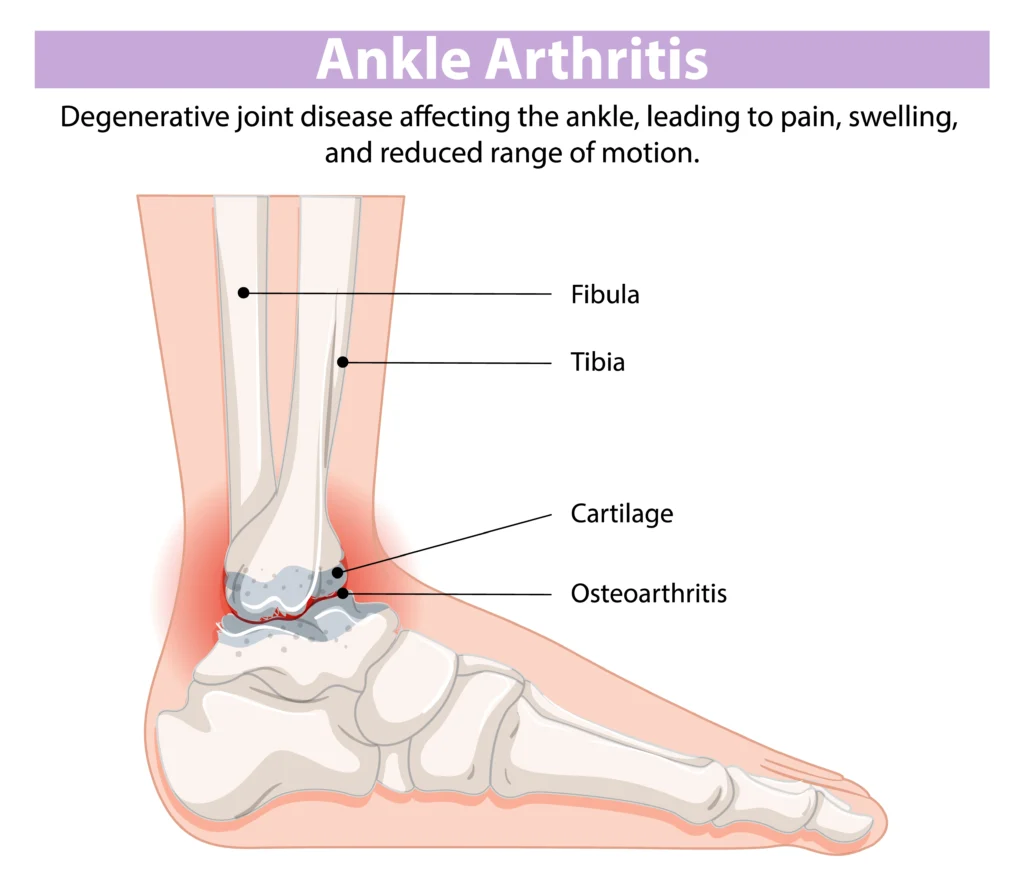
Several factors can contribute to joint degeneration after trauma.
- Cartilage damage: Direct injury can disrupt the smooth surface that helps distribute joint forces.
- Altered alignment: If the joint heals in a different position, loading may become uneven.
- Persistent instability: Repeated episodes of the ankle giving way can expose the joint to further injury.
- Restricted movement: Reduced ankle mobility can change how a person performs everyday movements.
- Changes in loading: Persistent weakness or altered movement strategies may affect function and the demands placed on the ankle.
These factors do not all contribute equally in every person.
Research continues to investigate how injury severity, biomechanics, and biological changes interact in post-traumatic ankle osteoarthritis. (Anderson et al., 2024)
What Are the Early Symptoms of Post-Traumatic Ankle Arthritis?
Early symptoms may be subtle. A gradual change in movement or activity tolerance can be more noticeable than constant pain.
Stiffness After Rest
The ankle may feel stiff when getting out of bed or standing after sitting for a prolonged period.
Movement may become easier after a few minutes, although stiffness can return after inactivity.
Pain After Walking
Discomfort may develop after a long walk, prolonged standing, stair climbing, or exercise.
Initially, symptoms might appear only after demanding activity.
Later, ordinary daily tasks may become more uncomfortable.
Recurrent Swelling
Swelling that repeatedly appears after activity can indicate joint irritation, but it may also arise from other ankle conditions.
New, unexplained, or persistent swelling should not automatically be attributed to arthritis.
Reduced Ankle Movement
You may find it harder to bring your knee forward over your foot, squat deeply, walk downhill, or descend stairs.
Restricted movement can affect daily activities even when pain is relatively mild.
Difficulty Returning to Sport
Running, jumping, rapid changes of direction, and other demanding movements may become uncomfortable.
These limitations can reflect arthritis, residual instability, weakness, or another problem. An assessment is needed to distinguish between them.
How Can You Tell Arthritis Apart From an Old Injury?
Not every ankle that hurts years after an injury has developed arthritis.
| Possible condition | Features that may be present |
|---|---|
| Post-traumatic arthritis | Gradual activity-related pain, stiffness, reduced movement, or recurrent swelling |
| Persistent ligament injury | Giving way, instability, or pain around the affected ligaments |
| Tendon problem | Pain or tenderness along a tendon, often aggravated by particular movements |
| Ankle impingement | Pain during specific ankle movements, especially near the end of the available range |
| Cartilage or other joint injury | Persistent deep joint pain, sometimes with catching or swelling |
These patterns overlap and cannot establish a diagnosis on their own. A previous injury may also contribute to more than one problem at the same time.
Can Post-Traumatic Ankle Arthritis Affect Younger Adults?
Yes.
Ankle arthritis can affect younger and physically active adults because significant trauma may contribute to joint degeneration well before older age.
This is particularly relevant after ankle fractures, injuries involving the joint surface, or repeated sprains associated with chronic instability.
Age alone cannot confirm or exclude arthritis.
Persistent symptoms after an old injury deserve assessment, but other explanations should also be considered.
How Is Post-Traumatic Ankle Arthritis Diagnosed?
Diagnosis usually involves a detailed history, physical examination, and imaging when appropriate.
A clinician may ask about the original injury, previous surgery, immobilization, recurring sprains, pain patterns, stiffness, swelling, and current activity limitations.
The physical examination may assess:
- Ankle range of motion and joint mobility
- Swelling and tenderness
- Muscle strength
- Ligament stability
- Walking mechanics
- Balance and movement control
- Functional movements such as stairs or squatting
Do You Need an X-Ray or MRI?
Weight-bearing X-rays can help assess joint-space narrowing, bone changes, and alignment.
CT may provide more detailed information about bone structure, while MRI can be useful when cartilage, ligaments, tendons, or other soft tissues need further evaluation.
The appropriate investigation depends on the clinical findings and whether the result would change management.
An imaging report should not be treated as the entire diagnosis.
The extent of visible joint changes does not always explain how much pain or disability a person experiences.
Can Physiotherapy Help Post-Traumatic Ankle Arthritis?
Yes.
Physiotherapy can help improve function and address modifiable physical limitations associated with ankle arthritis.
It cannot restore cartilage that has already been lost or guarantee that arthritis will not progress.
Its purpose is to help the person move more comfortably, maintain strength, and manage everyday and recreational activities.
Ankle Mobility Assessment
A physiotherapist checks which movements are restricted and how those restrictions affect walking, stairs, squatting, and other tasks.
Mobility exercises or carefully selected manual techniques may be appropriate when assessment indicates that restricted movement is contributing to symptoms.
Strength and Load Capacity
Weakness in the calf and other lower-limb muscles can make weight-bearing tasks more demanding.
The physiotherapist can assess strength and gradually develop the capacity required for the person’s daily activities and goals.
Balance and Ankle Stability
If the original injury involved ligament damage, persistent instability may require attention.
Balance and movement-control training can be useful when assessment identifies deficits, particularly in people who experience episodes of giving way.
Walking and Functional Movement
The physiotherapist may assess walking speed, movement patterns, stair use, and the ability to manage single-leg loading.
The findings guide treatment rather than relying on a standard exercise list for everyone with ankle arthritis.
What Exercises May Help an Arthritic Ankle?
Exercise selection depends on pain, swelling, available movement, strength, stability, and the person’s goals.
Seated Calf Raises
These allow the calf muscles to work with relatively controlled loading.
Resistance and repetitions can be increased as tolerated.
Supported Sit-to-Stand
This exercise develops functional lower-limb strength for activities such as rising from a chair.
Chair height and hand support can be adjusted to suit the individual.
Low Step-Ups
Low step-ups can help build strength and control for stair climbing.
They should be introduced when the ankle can tolerate the movement without substantial pain or swelling.
Balance Training
When instability or impaired balance is present, appropriately graded balance exercises can help develop movement control.
Low-Impact Cardiovascular Exercise
Cycling or swimming may help maintain fitness when running or prolonged walking is uncomfortable.
Exercises should be adjusted if they produce a marked or persistent increase in pain or swelling.
Rehabilitation should be individualized rather than progressed according to a fixed timetable.
Should You Stop Walking or Exercising?
Not necessarily. Complete inactivity is rarely the long-term goal, but repeatedly pushing through significant symptom flare-ups may not be helpful either.
A physiotherapist can help adjust walking distance, exercise frequency, resistance, impact, and recovery time.
For example, someone who develops pain after a long walk may temporarily shorten the route, take breaks, or choose a better-tolerated activity to maintain fitness.
The aim is to preserve function and participation while respecting the ankle’s current capacity.
Can Post-Traumatic Ankle Arthritis Be Prevented?
Not every case can be prevented, particularly when the original injury caused substantial structural damage.
However, appropriate injury management and rehabilitation can address some modifiable problems.
After a fracture or severe sprain, relevant steps may include:
- Following medical guidance during recovery
- Restoring movement when safe
- Rebuilding strength progressively
- Addressing persistent instability
- Improving balance and movement control when needed
- Returning to sport gradually
- Seeking reassessment for persistent pain, swelling, or giving-way episodes
Research highlights the importance of injury-related changes in alignment and stability, but no single exercise or rehabilitation program has been shown to prevent every case of post-traumatic ankle arthritis. (Anderson et al., 2024)
Myth vs Fact: Old Ankle Injuries and Arthritis
Myth: Every old ankle sprain eventually causes arthritis.
Fact: A previous injury can increase the risk, but arthritis does not develop in everyone who sprains an ankle.
Myth: Arthritis only develops in older adults.
Fact: Post-traumatic arthritis can affect younger adults following significant joint injuries.
Myth: An X-ray tells you exactly how much pain you should have.
Fact: Imaging findings do not always correspond directly with pain or functional limitations.
Myth: Exercise always damages an arthritic ankle.
Fact: Appropriately selected and progressed exercise can support strength, movement, and daily function.
Myth: Physiotherapy can reverse cartilage loss.
Fact: Physiotherapy can address modifiable physical limitations, but it cannot restore cartilage that has already been lost.
What If Physiotherapy Is Not Enough?
Physiotherapy is one part of treatment, not a universal solution.
Depending on symptom severity, structural damage, and personal goals, a doctor may discuss medication, ankle bracing, orthoses, injections, or surgical options.
Surgery may be considered when pain and functional limitations remain substantial despite appropriate conservative treatment, or when a structural problem requires specialist management.
The decision depends on the extent and location of arthritis, alignment, activity demands, general health, and the likely benefits and limitations of the available options. (Ewalefo et al., 2018)
When Should You See a Doctor?
Arrange a medical assessment if ankle pain persists or progressively worsens after an old injury, particularly when it affects walking or everyday activities.
Seek urgent medical evaluation if the ankle becomes suddenly very swollen, hot, or red; if pain is severe; if you cannot bear weight; or if symptoms occur with fever or feeling unwell.
These features may indicate an acute injury, infection, crystal arthritis, or another condition requiring prompt treatment.
Do not assume that every new symptom in a previously injured ankle is caused by arthritis.
A Physiotherapist’s Approach to an Old Ankle Injury
When someone presents with ankle pain years after an injury, the key question is not simply whether arthritis appears on an X-ray.
The clinician needs to understand how the ankle functions now.
Is movement restricted? Does the joint remain unstable? Has strength declined? Is walking limited by pain, or could another condition be responsible?
These findings guide rehabilitation towards the person’s actual limitations.
Physiotherapy may improve mobility, strength, balance, and activity tolerance, while medical assessment establishes the diagnosis and determines whether additional treatment is needed.
Final Thoughts: Can an Old Ankle Injury Cause Arthritis?
An old ankle injury can contribute to arthritis years later, particularly when the original trauma damaged the joint surface, affected alignment, or left persistent instability. However, not everyone who sustains an ankle injury will develop arthritis.
Persistent stiffness, pain after walking, recurrent swelling, reduced movement, or difficulty returning to sport deserves assessment. These symptoms can have several causes, so a previous injury alone does not establish the diagnosis.
Physiotherapy can help address modifiable limitations in strength, mobility, balance, and activity tolerance. The goal is to understand what is affecting the ankle and support the best possible level of movement and function.
Final Thoughts
An old ankle injury can contribute to arthritis years later, particularly when the original trauma damaged the joint surface, affected alignment, or left persistent instability.
Stiffness, activity-related pain, recurrent swelling, reduced movement, and difficulty returning to sport are reasons to seek assessment, although none confirms arthritis on its own.
The goal of early management is to identify the cause of symptoms, address modifiable physical limitations, and preserve movement and function for as long as possible.
A previous ankle injury does not make arthritis inevitable.
If symptoms return or gradually worsen, a proper assessment can help clarify what is happening and which treatment options are appropriate.
Frequently Asked Questions About Post-Traumatic Ankle Arthritis
1. Can an old ankle injury cause arthritis years later?
Yes. A previous fracture, severe sprain, or cartilage injury can contribute to post-traumatic ankle arthritis that becomes symptomatic months or years later. However, arthritis is not inevitable after an injury.
2. What are the early signs of post-traumatic ankle arthritis?
Possible symptoms include stiffness after rest, pain after walking, recurrent swelling, reduced ankle movement, and difficulty with stairs or sport. These symptoms can also occur with other ankle conditions.
3. Can an old ankle sprain cause osteoarthritis?
A significant sprain can contribute to arthritis, particularly when it causes lasting joint instability or occurs repeatedly. Many people with previous sprains do not develop symptomatic osteoarthritis.
4. Can younger adults develop post-traumatic ankle arthritis?
Yes. Significant ankle fractures, joint-surface damage, and persistent instability can contribute to arthritis in younger and physically active adults.
5. Can physiotherapy help post-traumatic ankle arthritis?
Physiotherapy can help improve strength, mobility, balance, walking, and activity tolerance. It cannot reverse established cartilage loss, and the programme should be individualized.
6. Does post-traumatic ankle arthritis require an MRI?
Not always. Weight-bearing X-rays are often useful for assessing joint changes and alignment. MRI or CT may be considered when additional information is needed to clarify the diagnosis or guide treatment.
7. Should I exercise with post-traumatic ankle arthritis?
Many people can continue exercising with suitable modifications. Exercise type and intensity should reflect symptoms, joint irritability, physical capacity, and functional goals.
8. When should I seek medical help for ankle pain?
Seek urgent assessment for sudden severe pain, marked swelling, a hot or red joint, inability to bear weight, or symptoms accompanied by fever or feeling unwell.
Stay tuned with us for more health related topics.
Follow us on LinkedIn and Instagram for more.
More Read



Medical Disclaimer
Disclaimer: This article is intended for general educational and informational purposes only. It does not replace an individual assessment, diagnosis, or treatment plan from a qualified physiotherapist, doctor, or other healthcare professional. Ankle pain and swelling can have several causes and should not be self-diagnosed solely from this information. Seek urgent medical evaluation for severe pain, marked swelling, a hot or red joint, inability to bear weight, symptoms following significant trauma, or ankle symptoms accompanied by fever or feeling unwell.