


Have you noticed that one of your child’s shoulder blades looks more prominent than the other?
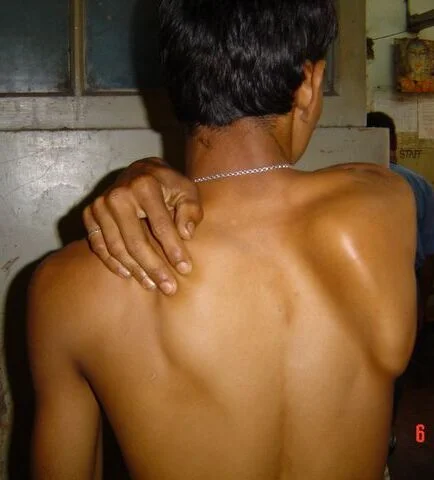
Perhaps the inner edge of the shoulder blade becomes visible when your child pushes against a wall, raises an arm, or bends forward.
Quick Answer
One shoulder blade sticking out in a child may be caused by scapular winging, a condition in which the shoulder blade does not remain properly supported against the rib cage. Common causes include serratus anterior weakness, long thoracic nerve injury, trapezius dysfunction, scoliosis, congenital abnormalities, and certain neuromuscular disorders. Physiotherapy may improve shoulder movement and function, but treatment depends on the underlying cause. Persistent winging, pain, or progressive weakness should be evaluated by a pediatrician or pediatric orthopedic specialist.
While it may initially appear to be a postural problem, a shoulder blade that sticks out can sometimes indicate an underlying muscle, nerve, or skeletal condition.
This appearance is medically known as scapular winging.
It occurs when the shoulder blade (scapula) does not remain adequately supported against the rib cage during movement or at rest.
As a physiotherapist, I would encourage parents not to panic when they notice this difference.
Children naturally have variations in their posture, muscle development, and shoulder alignment.
However, persistent or progressively worsening winging deserves a proper assessment, particularly when accompanied by weakness, pain, or difficulty lifting the arm.
Scapular winging in children is relatively uncommon, and its exact incidence is not well established.
The causes can range from temporary nerve irritation following an injury to less common neuromuscular disorders.
A pediatric review published in the JBJS Reviews discusses the importance of identifying the underlying cause rather than treating every prominent shoulder blade as a simple muscular weakness. (Wolters Kluwer).
Key Takeaways
- Scapular winging occurs when the shoulder blade protrudes abnormally from the back.
- The serratus anterior and long thoracic nerve are commonly involved.
- Progressive shoulder weakness may indicate an underlying neuromuscular condition.
- Scoliosis can cause shoulder blade asymmetry but is not the same as true scapular winging.
- Physiotherapy should be based on an accurate assessment of the child’s muscles, nerves, and shoulder movement.
- Avoid aggressive strengthening exercises before identifying the cause.
- Persistent winging, pain, or difficulty lifting the arm requires professional evaluation.
What Is Scapular Winging in Children?
The scapula is a flat triangular bone situated on the upper back.
It provides a stable platform for shoulder movements and helps the arm move efficiently during activities such as throwing, swimming, climbing, and reaching overhead.
Normally, several muscles work together to keep the shoulder blade closely positioned against the rib cage.
These include:
- Serratus anterior
- Trapezius
- Rhomboid major and minor
- Levator scapulae
When one or more of these muscles become weak, lose their nerve supply, or fail to coordinate properly, the shoulder blade may protrude abnormally.
The condition can be visible in different ways:
- The inner border of the shoulder blade becomes prominent.
- The lower tip of the shoulder blade appears to lift away from the back.
- One shoulder appears lower than the other.
- The shoulder blade moves abnormally when the child raises an arm.
- The prominence becomes more noticeable during pushing activities.
A useful distinction is that scapular winging is a physical sign, not a complete diagnosis.
The physiotherapist or pediatric orthopedic specialist must determine why the shoulder blade is sticking out before recommending exercises. (Martin and Fish)
Why Does One Shoulder Blade Stick Out in Children?
The shoulder blade is supported by muscles, nerves, joints, and surrounding bones.
Problems affecting any of these structures may produce a winged appearance.
1. Serratus Anterior Weakness or Long Thoracic Nerve Injury
The serratus anterior is one of the most important muscles responsible for keeping the shoulder blade against the rib cage.
It originates from the ribs and attaches to the inner surface of the scapula. The long thoracic nerve supplies this muscle.
When the long thoracic nerve is injured, the serratus anterior may become weak or partially paralyzed.
This can produce medial scapular winging, where the inner edge of the shoulder blade becomes particularly prominent.
Possible causes include:
- A fall onto the back or shoulder.
- Contact sports injuries.
- Sudden traction on the shoulder.
- Repetitive overhead activities.
- Nerve irritation following an injury.
A lesser-known fact is that the long thoracic nerve travels along a relatively superficial pathway over the chest wall.
This makes it vulnerable to traction and certain forms of trauma.
A published case report described a four-year-old boy who developed scapular winging after falling onto his back.
Despite physiotherapy, the winging remained at two-year follow-up, demonstrating why persistent symptoms should not be assumed to resolve automatically. (BMJ)
2. Trapezius Muscle Weakness or Spinal Accessory Nerve Injury
The trapezius muscle plays an essential role in controlling the position and movement of the shoulder blade.
It receives its motor supply from the spinal accessory nerve.
When this nerve is injured, the trapezius may become weak, causing:
- Shoulder drooping.
- Difficulty shrugging the shoulder.
- Reduced ability to lift the arm overhead.
- Lateral scapular winging.
- Fatigue during repetitive shoulder movements.
In children, nerve injuries can occasionally occur following trauma or surgical procedures involving the neck.
A particularly important clinical consideration is that the shoulder blade may not appear dramatically winged while the child is standing still.
The abnormal movement may become more evident during arm elevation or resisted shoulder movements. (Oman Medical Journal)
3. Facioscapulohumeral Muscular Dystrophy (FSHD)
One of the less commonly discussed causes of scapular winging in children is facioscapulohumeral muscular dystrophy (FSHD).
FSHD is a genetic muscle disorder that progressively affects selected muscles, particularly those involving the face, shoulder girdle, and upper arms.
In some children, scapular winging may be one of the earliest noticeable signs.
Parents may also observe:
- Difficulty raising both arms overhead.
- Uneven shoulders.
- Weakness while performing activities above head height.
- Difficulty whistling or pursing the lips.
- Incomplete closure of the eyes during sleep.
- Progressive weakness affecting facial expressions.
An important clinical distinction is that FSHD-related winging may involve both shoulders, although the degree of involvement can be asymmetrical.
A two-year prospective study involving 20 children with genetically confirmed FSHD found that symptoms progressed slowly but varied considerably between individuals.
The trapezius and deltoid muscles were among the most frequently affected. (Neurology Journals)
Parents should understand that a prominent shoulder blade alone does not mean their child has muscular dystrophy.
However, progressive weakness involving multiple muscle groups requires medical evaluation.
4. Congenital Muscle or Skeletal Abnormalities
Some children may have shoulder blade prominence because of abnormalities present from birth.
These may involve:
- Abnormal development of the scapula.
- Congenital muscle absence or underdevelopment.
- Structural abnormalities of the chest wall.
- Congenital skeletal disorders.
In these situations, the shoulder blade may appear prominent even without a recent injury.
A pediatric orthopedic assessment helps distinguish congenital structural differences from acquired nerve or muscle dysfunction.
5. Scoliosis and Other Spinal Conditions
Scoliosis is a sideways curvature of the spine accompanied by vertebral rotation.
This rotation can change the shape of the rib cage and the position of the shoulder blades.
Parents may notice:
- One shoulder appearing higher.
- One shoulder blade becoming more prominent.
- Uneven waistlines.
- One side of the back appearing fuller when bending forward.
However, scapular winging and scoliosis are not the same condition.
A child with scoliosis may have shoulder blade asymmetry without true scapular winging.
Conversely, a child with scapular winging may have a relatively straight spine. (AAOS)
6. Rhomboid Muscle Weakness
The rhomboid muscles help retract and stabilize the scapula.
Weakness involving these muscles, sometimes associated with dorsal scapular nerve dysfunction, may contribute to abnormal shoulder blade positioning.
This is less common than serratus anterior dysfunction.
The location and direction of winging can help a physiotherapist determine which muscles or nerves may be involved. (Elsevier)
7. Scapular Osteochondroma or Other Bone Abnormalities
A lesser-known cause of shoulder blade prominence in children is osteochondroma.
An osteochondroma is a benign bone growth that can develop near the scapula.
Depending on its size and location, it may interfere with the normal movement of the shoulder blade against the rib cage.
Some children may experience:
- A visible lump.
- Mechanical clicking.
- Pain during shoulder movement.
- Restricted movement.
- A prominent shoulder blade.
This condition is different from nerve-related scapular winging. A structural abnormality may require imaging rather than a strengthening-only treatment approach. (NIH)
How Can Parents Recognize Scapular Winging at Home?
Parents do not need to perform complicated orthopedic tests.
Simple observations can help identify whether the shoulder blade looks different during movement.
Observe the child from behind
Ask your child to stand comfortably with the arms relaxed.
Look for:
- A shoulder blade that protrudes more than the other.
- A difference in shoulder height.
- Visible asymmetry around the upper back.
- A noticeable change in shoulder blade position.
Do not repeatedly ask the child to correct their posture.
The purpose is observation, not forcing the shoulder into a particular position.
Observe gentle arm elevation
Ask the child to slowly raise both arms forward and overhead, if comfortable.
Notice whether:
- One shoulder blade moves differently.
- The prominent shoulder blade becomes more visible.
- The child struggles to lift one arm.
- The movement causes pain or unusual fatigue.
Observe a gentle wall push
If the child is comfortable, ask them to stand facing a wall and gently push against it with both hands.
A winged shoulder blade may become more visible during this movement because the serratus anterior is involved in stabilizing the scapula.
However, this observation is not a diagnostic test.
A child may have normal variations in scapular movement, and winging can occur for several different reasons.
A laboratory study involving 59 children aged 6-17 years found that scapular positioning and movement characteristics differ slightly between children and adults.
This reinforces the importance of interpreting pediatric shoulder movement using age-appropriate clinical assessment. (PubMed)
When Should Parents Seek Medical Attention?
A shoulder blade that sticks out persistently should be evaluated by a pediatrician, pediatric orthopedic specialist, or qualified physiotherapist.
The urgency depends on the symptoms.
Seek prompt medical assessment if your child has:
- Sudden shoulder blade prominence after a fall or injury.
- Significant shoulder pain.
- New weakness in the arm.
- Difficulty lifting the arm.
- Progressive shoulder asymmetry.
- Visible muscle wasting.
- Winging involving both shoulder blades with increasing weakness.
- Facial weakness or difficulty performing previously easy movements.
Seek urgent medical care if the child develops sudden severe weakness, difficulty breathing, or other acute neurological symptoms.
A particularly important warning sign is progressive weakness.
If the shoulder blade becomes increasingly prominent over several weeks or months, it should not simply be treated as poor posture.
How Is Scapular Winging Diagnosed in Children?
Diagnosis requires identifying the underlying cause.
Physiotherapy assessment
A pediatric physiotherapist may evaluate:
- Shoulder blade position at rest.
- Scapular movement during arm elevation.
- Shoulder range of motion.
- Serratus anterior strength.
- Trapezius and rhomboid function.
- Shoulder muscle endurance.
- Cervical spine movement.
- Postural and spinal alignment.
- Functional activities such as pushing, reaching, and throwing.
The physiotherapist may also assess whether the child has difficulty performing activities such as dressing, swimming, writing, or carrying a schoolbag.
Medical investigations
Depending on the clinical findings, the treating doctor may recommend:
| Investigation | Why it may be needed |
|---|---|
| X-ray | To identify skeletal abnormalities, fractures, or structural differences |
| MRI | To assess selected soft-tissue, muscle, nerve, or structural problems |
| Electromyography (EMG) | To evaluate muscle electrical activity and possible nerve dysfunction |
| Nerve conduction studies | To investigate nerve injury or impaired nerve function |
| Genetic testing | When a hereditary muscle disorder is suspected |
Not every child requires all these investigations.
A careful clinical examination helps determine which tests are appropriate.
Physiotherapy Treatment for Scapular Winging in Children
Physiotherapy can play an important role in improving shoulder function, maintaining mobility, and helping children return to age-appropriate activities.
However, treatment must be individualized.
The most important principle is to treat the cause, not just the appearance of the shoulder blade.
A child with temporary nerve irritation may require a different rehabilitation approach from a child with progressive muscular weakness or a structural bone abnormality.
1. Gentle Shoulder Range-of-Motion Exercises
Maintaining shoulder mobility is important, particularly when the child has pain or reduced arm movement.
A physiotherapist may prescribe:
- Comfortable assisted arm elevation.
- Gentle shoulder flexion.
- Supported shoulder movements.
- Pain-free mobility exercises.
These exercises help prevent stiffness.
The child should not be forced to move through painful ranges.
2. Serratus Anterior Activation
When serratus anterior weakness is present and the treating clinician considers strengthening appropriate, gentle activation exercises may be introduced.
Examples include:
- Wall slides.
- Gentle wall push-up plus.
- Supine serratus punches.
- Supported reaching exercises.
The exercise selection depends on the child’s age, coordination, symptoms, and degree of nerve recovery.
An important lesser-known point is that strengthening a completely denervated muscle aggressively may not be beneficial.
If the long thoracic nerve is injured, rehabilitation must account for the stage of nerve recovery. (PMC)
3. Scapular Stabilization Exercises
Scapular stabilization involves improving the coordinated function of the muscles that control the shoulder blade.
Depending on the diagnosis, a physiotherapist may introduce:
- Low-load scapular control exercises.
- Supported shoulder movements.
- Gentle resistance exercises.
- Functional reaching.
- Gradual upper-limb endurance activities.
These exercises should be progressed according to movement quality rather than simply increasing resistance.
4. Postural and Functional Rehabilitation
Postural rehabilitation may be useful when the child has associated movement-control difficulties.
The focus should not be on keeping the shoulders rigidly pulled backward throughout the day.
Instead, physiotherapy aims to improve comfortable, efficient movement during:
- Sitting in school.
- Playing.
- Writing.
- Reaching overhead.
- Carrying objects.
- Participating in sports.
A child should not be made to feel that their shoulder blade looks abnormal or that they must constantly correct their posture.
5. Return to Sports and Physical Activities
Children with scapular winging may experience difficulty during swimming, gymnastics, throwing, or climbing.
A physiotherapist can help gradually reintroduce these activities.
The return-to-sport plan may consider:
- Pain-free shoulder movement.
- Improving strength.
- Functional endurance.
- Scapular control.
- The underlying nerve or muscle diagnosis.
Contact sports and repetitive overhead activities may need temporary modification when symptoms are aggravated.
6. Does Scapular Winging Require Surgery?
Surgery is not the first treatment for every child with scapular winging.
Many cases involving nerve irritation or temporary weakness are initially managed conservatively.
However, specialist surgical evaluation may be appropriate when:
- A nerve has been significantly damaged.
- Winging persists despite an appropriate rehabilitation period.
- A structural abnormality requires correction.
- There is progressive functional impairment.
- A muscle or nerve injury requires surgical repair.
The timing of surgery depends on the underlying diagnosis. (Wolters Kluwer)
Things Parents Should Do and Avoid
What parents should do
- Arrange a professional assessment if the shoulder blade remains visibly prominent.
- Observe whether the winging changes during arm movement.
- Inform the clinician about previous falls, sports injuries, or neck procedures.
- Encourage comfortable, age-appropriate physical activity.
- Follow the prescribed physiotherapy program.
- Monitor changes in shoulder strength and function.
- Take occasional photographs from the same angle to document changes, if helpful.
- Encourage the child without making them self-conscious about their appearance.
What parents should avoid
- Avoid forcing the shoulder blades backward throughout the day.
- Do not start intense resistance exercises without identifying the cause.
- Avoid aggressive stretching of a weak or potentially denervated muscle.
- Do not repeatedly perform wall push-up tests to check for improvement.
- Avoid prolonged sling use unless medically prescribed.
- Do not assume that carrying a heavy schoolbag is the only cause.
- Do not ignore progressive muscle weakness.
- Avoid purchasing shoulder braces without professional advice.
One important clinical detail: a shoulder brace may provide temporary support in selected cases, but it cannot restore nerve function or correct every underlying cause.
Pediatric use should be guided by the treating clinician.
Can Scapular Winging in Children Be Prevented?
Not every case can be prevented.
Congenital abnormalities, genetic muscle disorders, and certain nerve injuries may develop independently of a child’s posture or daily habits.
However, parents can take steps to reduce avoidable shoulder strain.
Encourage balanced physical activity
Children benefit from activities that develop coordination, strength, and general fitness.
Avoid suddenly introducing excessive overhead exercise or repetitive throwing activities without adequate preparation.
Teach safe sports techniques
Children participating in gymnastics, swimming, cricket, badminton, or throwing sports should learn appropriate movement techniques.
Gradual increases in training intensity can help reduce avoidable overload.
Avoid excessive schoolbag loads
A schoolbag should be comfortable, appropriately fitted, and carried using both shoulder straps.
However, parents should understand that a heavy schoolbag is not an established explanation for true nerve-related scapular winging.
Recognize changes early
The most important preventive strategy is recognizing persistent shoulder blade asymmetry early.
Early identification can help clinicians investigate nerve, muscle, and skeletal conditions before functional difficulties become more significant.
A Unique Physiotherapy Perspective: Why the Shoulder Blade Is More Than a Postural Bone
The scapula is often described as a bone that simply sits on the back.
In reality, it acts as a dynamic foundation for shoulder movement.
When a child raises an arm, the scapula rotates and changes position in coordination with the upper arm. This coordinated movement is known as scapulohumeral rhythm.
If the scapular muscles cannot provide adequate support, the child may experience reduced movement efficiency, fatigue, or difficulty performing overhead tasks.
This is why a physiotherapist does not evaluate the shoulder blade in isolation.
The assessment also considers:
- The cervical spine.
- The thoracic spine.
- Shoulder joint mobility.
- Muscle function.
- Nerve integrity.
- The child’s overall movement pattern.
A recent pediatric orthopedic review, published online in October 2026, emphasizes that scapular disorders in children can involve congenital, neuromuscular, structural, neurogenic, and traumatic causes.
This broad differential diagnosis highlights why individualized assessment is essential. (Science Direct)
Final Word
When one shoulder blade sticks out in a child, the appearance may be harmless, but it can also be an important clinical sign.
As a physiotherapist, I would encourage parents to look beyond posture and identify the underlying reason for the asymmetry.
A careful assessment of the shoulder blade, surrounding muscles, nerves, and spine can help determine whether the child needs observation, physiotherapy, medical investigations, or specialist treatment.
The most important message is simple: do not ignore persistent scapular winging, and do not begin aggressive strengthening exercises before understanding its cause.
Early recognition, an accurate diagnosis, and appropriately planned physiotherapy can help children maintain comfortable shoulder movement and participate in everyday activities with confidence.
Frequently Asked Questions
1. Is it normal for one shoulder blade to stick out in a child?
Mild asymmetry can be normal, but persistent or pronounced winging should be assessed, especially if accompanied by pain or weakness.
2. Can poor posture cause scapular winging in children?
Posture and muscle-control problems may contribute to abnormal scapular movement. However, nerve injuries, muscle disorders, and skeletal abnormalities can also cause winging.
3. Can scapular winging in children be corrected with physiotherapy?
Physiotherapy can improve shoulder mobility, strength, coordination, and function. The results depend on the underlying cause and degree of nerve or muscle recovery.
4. Is scapular winging a sign of muscular dystrophy?
Scapular winging can be an early feature of facioscapulohumeral muscular dystrophy. However, a prominent shoulder blade alone does not establish this diagnosis.
5. Can a child with scapular winging play sports?
Many children can remain active. Painful or repetitive overhead activities may need temporary modification based on the diagnosis.
6. Does scapular winging cause shoulder pain?
It may cause shoulder pain, upper-back discomfort, fatigue, and difficulty raising the arm. Some children have winging without pain.
7. Is scapular winging related to scoliosis?
Scoliosis can cause shoulder blade asymmetry due to spinal and rib cage rotation. However, scoliosis and scapular winging are different conditions.
8. How long does it take for scapular winging to improve?
Recovery varies according to the underlying cause. Nerve-related winging may improve over several months, while other conditions may require longer-term rehabilitation or specialist treatment.
Stay tuned with us for more health related topics.
Follow us on LinkedIn and Instagram for more.
More Read


Medical Disclaimer!
This article has been reviewed and written under the guidance of our Head Physiotherapist, Dr. Kruti Raj (PT, MUHS,CPT,CMPT). The information shared is intended for educational purposes only and should not be considered a substitute for personalized medical advice, diagnosis, or treatment.
Please consult us or any other qualified healthcare professional before beginning any exercise program, especially if you are experiencing pain, recovering from injury, or managing a medical condition.


