


Gymnastics places unusual demands on a child’s wrists.
During handstands, cartwheels, back handsprings and vaulting, young athletes repeatedly use their hands to support, balance and propel their body weight.
Quick Answer: What Is Gymnastics Wrist?
Gymnastics wrist is an overuse injury affecting the growth plate near the end of the radius, one of the forearm bones. It develops when repeated weight-bearing activities such as handstands, cartwheels and vaulting place excessive stress on a young gymnast’s developing wrist.
- Common symptoms: Wrist pain, tenderness, swelling and discomfort during weight-bearing skills.
- Common contributors: Repetitive loading, increased training intensity and inadequate recovery.
- Treatment: Activity modification, medical assessment and protection of the affected growth plate.
- Physiotherapy: Gradual restoration of wrist mobility, strength, upper-limb control and gymnastics-specific function after appropriate medical clearance.
Important: Persistent wrist pain in a young gymnast should not be ignored. Continuing painful wrist-loading activities may increase the risk of growth-plate damage.
When these forces are repeated while the wrist is still developing, they can irritate the growth plate near the end of the radius, one of the two forearm bones.
This overuse injury is commonly known as gymnastics wrist, or gymnast’s wrist.
The condition may begin with mild discomfort during training.
However, continuing to perform painful weight-bearing skills can worsen the injury and, in some cases, interfere with normal bone growth.
Understanding the symptoms, causes and treatment options can help parents recognize when a young gymnast needs medical assessment and how pediatric physiotherapy can support a safe return to sport.
Key Takeaways for Parents
Gymnastics wrist involves the growth plate near the end of the radius, not simply tired wrist muscles.
Discomfort may begin during handstands, cartwheels, back handsprings or vaulting.
Painful wrist-loading activities should be modified or stopped until the injury has been assessed.
A healthcare professional can assess the growth plate and identify other possible wrist injuries.
Individualized rehabilitation helps restore movement, strength, upper-limb control and readiness for gymnastics.
What Is Gymnastics Wrist in Young Athletes?
Gymnastics wrist in young athletes is an overuse injury involving the distal radial physis, the growth plate located near the wrist end of the radius.
Growth plates are areas of developing cartilage that allow children’s bones to grow in length. They gradually become solid bone as skeletal maturity approaches.
During gymnastics, repeated pressure travels through the hands and wrists.
When this loading exceeds the developing growth plate’s ability to tolerate and recover from stress, irritation and structural changes may occur.
The injury is sometimes called distal radial physeal stress injury.
It is most commonly reported in young gymnasts with open growth plates, particularly during periods of rapid growth and increased training demands.
However, age alone does not determine whether a child will develop the condition. (Hart, Bauer and Bae, 2024)
Why Does Gymnastics Put So Much Pressure on the Wrist?
In many sports, the legs perform most of the body’s weight-bearing work. Gymnastics is different because the upper limbs regularly support body weight.
During a handstand, for example, the wrists must help support the gymnast’s entire body. Other skills expose the wrists to repeated compression, extension and rotational forces.
Common wrist-loading movements include:
- Handstands: Transfer body weight through the extended wrists.
- Cartwheels: Create repeated loading as the hands contact the floor.
- Back handsprings: Involve forceful hand contact during the movement.
- Vaulting: Places substantial pressure through the wrists when the hands contact the vault.
- Floor routines: Include repeated hand-supported movements and impact.
- Balance beam skills: May combine wrist extension, rotation and weight-bearing.
The risk is not simply related to how many hours a child trains.
Training intensity, skill difficulty, recovery time, growth and previous symptoms can all influence how much stress the wrist experiences.
What Causes Gymnastics Wrist in Young Athletes?
Gymnastics wrist develops when repetitive loading affects the developing growth plate. Several factors can contribute.
1. Repetitive wrist loading
Repeatedly supporting body weight through the hands creates compressive forces across the distal radius.
Over time, this can irritate the growth plate, particularly when the gymnast performs numerous high-impact or weight-bearing skills.
2. Sudden increases in training intensity
Moving to a higher gymnastics level may introduce more difficult skills, additional repetitions and greater loading demands.
If training volume increases faster than the body can adapt, the wrist may not get enough recovery time.
3. Periods of rapid growth
Children’s bones and surrounding tissues change during growth. The growth plate remains vulnerable to repetitive stress until it closes naturally.
Gymnastics wrist is frequently discussed in athletes around 10-16 years, but younger and older athletes can also be affected if their growth plates remain open.
4. Inadequate recovery
Repeated high-load training without sufficient recovery may allow irritation to persist.
Rest days and appropriate training progression are important parts of managing the physical demands of gymnastics.
5. Continuing to train through pain
Some young athletes believe wrist discomfort is an unavoidable part of gymnastics.
They may hide their symptoms because they are worried about missing training or competitions.
Unfortunately, repeatedly loading an already painful growth plate can allow the injury to progress.
Early Signs of Gymnastics Wrist in Young Athletes?
Symptoms often develop gradually rather than following one obvious accident.
The earliest complaint may be discomfort during handstands or cartwheels. As the injury progresses, pain may begin affecting other activities.
Common symptoms include:
- Pain around the thumb side or back of the wrist.
- Tenderness near the distal radius growth plate.
- Pain during handstands, cartwheels or vaulting.
- Discomfort when bending the wrist backwards.
- Pain when pushing up from the floor.
- Mild swelling around the wrist.
- Reduced wrist extension or difficulty supporting body weight.
- Reduced confidence or performance during gymnastics skills.
In early stages, pain may appear mainly during training and settle with rest.
More advanced injuries can cause discomfort during everyday activities or even at rest.
A child who repeatedly experiences wrist pain during weight-bearing movements should not be encouraged to push through it.
Is Gymnastics Wrist in Young Athletes the Same as a Wrist Sprain?
No. Although both conditions can cause wrist pain, they affect different structures and often develop in different ways.
| Condition | Typical presentation |
|---|---|
| Gymnastics wrist | Gradual pain and tenderness near the distal radius growth plate, often aggravated by weight-bearing |
| Wrist sprain | Pain after a fall, twist or sudden movement, involving supporting ligaments |
| Tendon irritation | Pain around a tendon, often aggravated by specific wrist or finger movements |
| Stress fracture | Localized bone pain associated with repetitive loading |
| TFCC injury | Pain commonly on the little-finger side of the wrist, sometimes with clicking or rotation discomfort |
Gymnasts can develop more than one type of wrist injury. Therefore, the exact location of pain, training history and examination findings are important.
A diagnosis should not be made from the sport alone.
How Is Gymnastics Wrist Diagnosed?
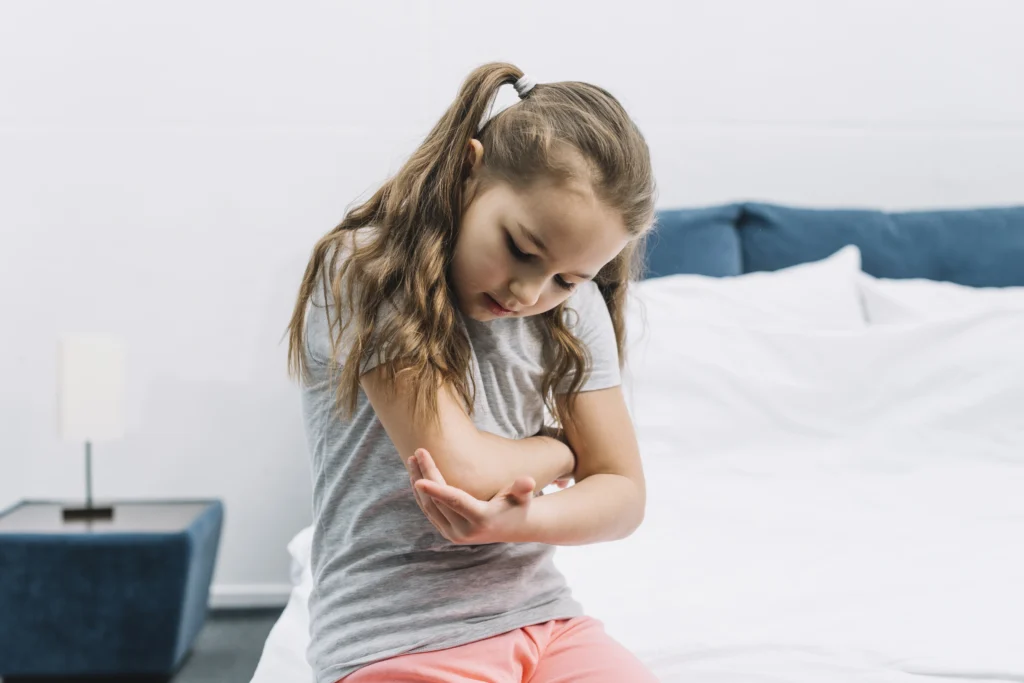
A paediatric sports medicine specialist or orthopaedic clinician will assess the wrist and decide whether imaging is necessary.
Medical and training history
The clinician may ask about:
- When the pain started and how it has changed.
- Which gymnastics skills trigger discomfort.
- Recent changes in training hours or intensity.
- Whether one or both wrists are affected.
- Whether pain improves with rest.
- Previous wrist injuries or treatment.
Physical examination
The examination may include:
- Tenderness around the distal radial growth plate.
- Wrist flexion and extension.
- Forearm rotation.
- Grip strength.
- Pain during carefully selected loading tests.
- Swelling and wrist movement.
- Elbow, shoulder and upper-limb function.
The clinician may also assess whether the symptoms suggest another injury.
X-rays and MRI
X-rays are commonly used to look for changes around the distal radial growth plate. Findings may include growth-plate widening, irregularity, sclerosis or signs of premature closure.
However, early injuries may not produce obvious changes on X-rays.
An MRI scan may be considered when symptoms persist despite normal or inconclusive X-rays, or when the clinician needs to investigate the growth plate and surrounding bone more closely.
Not every child needs an MRI. The decision depends on the clinical findings and the suspected severity of the injury. (Hart, Bauer and Bae, 2024)
How Is Gymnastics Wrist Treated?
Treatment depends on the child’s symptoms, examination findings and the extent of growth-plate involvement.
The main priority is to reduce stress on the affected growth plate and allow it to recover.
1. Stop painful wrist-loading skills
The child may need to temporarily stop activities that reproduce wrist pain.
These commonly include:
- Handstands and handstand walks.
- Cartwheels and handsprings.
- Vaulting.
- Floor routines involving repeated hand contact.
- Other skills that place pressure through the painful wrist.
This does not automatically mean stopping every form of physical activity. A clinician can help identify safer conditioning activities that do not place stress on the injured wrist.
2. Consider a brace or cast when recommended
Some children may require a wrist brace or cast to reduce movement and loading.
Immobilization is not necessary in every case. The decision depends on the severity of the injury, symptoms and the child’s ability to avoid aggravating activities.
3. Manage pain and allow recovery
A healthcare professional may recommend appropriate pain relief and other measures to manage discomfort.
Pain medication should not be used to help a child continue training through an injury.
4. Attend follow-up appointments
Follow-up assessments help monitor pain, wrist movement and recovery.
The time away from gymnastics varies. Some young athletes need several weeks of activity modification or immobilization, while more significant injuries may require a longer recovery period.
A return to training should be based on clinical recovery and clearance, not simply the number of weeks since symptoms began.
Gymnastics Wrist: Myth vs Fact
MYTH: Wrist pain is normal for young gymnasts.
FACT: Repeated wrist pain during gymnastics should be assessed. It may indicate an overuse injury affecting the developing growth plate.
MYTH: Gymnastics wrist is just a muscle problem.
FACT: The condition primarily affects the distal radial growth plate, which is still developing in children and adolescents.
MYTH: A child can continue training if the pain settles after practice.
FACT: Pain that settles with rest can still indicate a growth-plate injury. Repeated loading may aggravate the condition.
MYTH: Physiotherapy exercises can immediately fix gymnastics wrist.
FACT: The growth plate must first be appropriately protected. Physiotherapy progresses gradually when the wrist is ready for rehabilitation.
MYTH: Every child with gymnastics wrist needs surgery.
FACT: Many cases are managed conservatively. Surgery is considered only for selected complications or significant structural problems.
How Can Pediatric Physiotherapy Help?
Pediatric physiotherapy plays an important role in restoring movement, strength and functional control after the growth-plate injury has been assessed and protected.
However, physiotherapy should not be used to load an actively painful growth plate. The rehabilitation programme must follow the treating clinician’s recommendations.
1. Physiotherapy assessment
Before planning exercises, the physiotherapist may assess:
- Wrist flexion, extension and forearm rotation.
- Pain and tenderness.
- Grip and forearm strength.
- Shoulder and scapular control.
- Elbow movement and upper-limb function.
- Trunk stability and movement coordination.
- The gymnast’s usual training demands.
The assessment helps identify physical limitations that may need attention during recovery.
2. Restoring wrist mobility
Once the wrist is ready for rehabilitation, gentle movement exercises may help restore comfortable wrist and forearm mobility.
The aim is to regain movement without irritating the healing growth plate.
Progress should be guided by symptoms and clinical findings rather than forced stretching.
3. Improving wrist and forearm strength
As healing progresses, the physiotherapist may introduce gradual strengthening exercises for the muscles supporting the wrist and forearm.
Depending on the child’s stage of recovery, these may include:
- Gentle wrist flexion and extension.
- Forearm rotation exercises.
- Grip-strengthening activities.
- Hand and finger muscle exercises.
- Controlled resistance exercises.
The load should increase gradually and should not reproduce growth-plate pain.
4. Strengthening the shoulder and upper body
Gymnastics requires coordinated movement across the entire upper limb.
Physiotherapy may therefore address:
- Rotator cuff strength.
- Shoulder stability.
- Scapular control.
- Elbow and upper-arm strength.
- Trunk stability.
These areas support controlled upper-limb movement during gymnastics and help address any associated strength or movement limitations.
5. Improving movement control
Once wrist loading is appropriate, rehabilitation may gradually introduce controlled activities that challenge upper-limb coordination and stability.
The physiotherapist may assess how the gymnast distributes weight through the hands and controls the wrist during functional movements.
The focus is on rebuilding capacity progressively, rather than rushing into difficult skills.
What Does a Safe Return to Gymnastics Look Like?
Returning to gymnastics too early may cause symptoms to recur.
A structured rehabilitation plan can help the athlete progress from basic movement to more demanding gymnastics skills.
A typical progression may involve:
| Stage | Rehabilitation focus |
|---|---|
| Protection and recovery | Avoid painful wrist loading and follow medical treatment |
| Mobility and early strengthening | Restore comfortable movement and begin appropriate strengthening |
| Controlled upper-limb activity | Progress to approved hanging, stability and low-load activities |
| Gradual weight-bearing | Introduce controlled closed-chain and wrist-loading tasks when cleared |
| Gymnastics-specific training | Progress through modified skills, repetitions and impact demands |
| Full participation | Return to normal training and competition after meeting clinical criteria |
Before returning to full training, the gymnast should generally demonstrate:
- No tenderness around the affected growth plate.
- Comfortable wrist movement.
- Adequate strength and upper-limb control.
- No pain during approved weight-bearing activities.
- Ability to complete progressive gymnastics drills without symptom recurrence.
- Medical or rehabilitation-team clearance.
The exact progression must be individualized.
A return-to-gymnastics protocol published by Boston Children’s Hospital also uses staged progression, moving from recovery to controlled exercises and then more demanding wrist-loading skills. (Boston Children’s Hospital, 2024)
What Happens If Gymnastics Wrist In Athletes Is Left Untreated?
Ignoring persistent wrist pain can allow a growth-plate injury to progress.
One important complication is premature closure of the distal radial growth plate.
If part of the radius stops growing too early while the ulna continues to develop, the two forearm bones may grow at different rates.
This can lead to positive ulnar variance, where the ulna becomes relatively longer than the radius.
Possible consequences include:
- Persistent wrist pain.
- Changes in wrist alignment.
- Reduced wrist movement.
- Increased pressure on other wrist structures.
- Difficulty returning to gymnastics.
- Further problems involving the triangular fibrocartilage complex.
Not every gymnast with wrist pain develops these complications.
However, persistent symptoms deserve assessment because growth-related changes can affect wrist function over time. (DiFiori, et al., 2006)
Can Gymnastics Wrist Be Prevented?
There is no guaranteed way to prevent every overuse injury, but sensible training practices can reduce unnecessary stress on developing wrists.
Parents, coaches and young athletes can consider the following:
- Increase training intensity gradually.
- Avoid sudden increases in repetitions or difficult skills.
- Allow adequate recovery between demanding sessions.
- Monitor wrist pain rather than treating it as normal training discomfort.
- Include appropriate strength and conditioning.
- Maintain shoulder, trunk and upper-limb control.
- Use suitable technique and qualified coaching.
- Avoid returning to full wrist-loading skills before recovery.
Coaches should encourage young gymnasts to report discomfort early. Training plans should also account for growth, skill progression and recovery.
When Should Parents Seek Medical Attention?
Arrange a medical assessment if your child experiences:
- Repeated wrist pain during handstands or cartwheels.
- Tenderness near the wrist growth plate.
- Pain that returns whenever training resumes.
- Swelling or reduced wrist movement.
- Difficulty supporting body weight through the hands.
- Pain that begins affecting everyday activities.
Seek prompt medical attention if wrist pain follows a significant fall or injury, particularly when there is severe pain, visible deformity, marked swelling, numbness or an inability to move or use the hand normally.
Do not assume that all wrist pain in a gymnast is gymnastics wrist. Other injuries may need different treatment.
Final Thoughts
Young gymnasts put their wrists through repeated physical demands, but persistent pain should never be considered a normal part of training. Gymnastics wrist can affect the developing growth plate, making early recognition and appropriate medical care important.
With suitable activity modification, medical guidance and a gradual physiotherapy program, many young athletes can rebuild wrist strength and movement before returning to gymnastics.
Remember: Early attention to wrist pain can help protect a young athlete’s developing joints and support a safer return to the sport they enjoy.
Conclusion
Gymnastics wrist is an overuse injury affecting the growth plate near the end of the radius. It develops when repeated weight-bearing and impact place excessive stress on a still-developing wrist.
Early symptoms may include pain during handstands, cartwheels and vaulting, tenderness around the wrist and difficulty supporting body weight through the hands.
The priority is to recognize persistent pain early, arrange medical assessment and reduce the activities that stress the growth plate.
Pediatric physiotherapy can then support the recovery of wrist movement, strength, upper-limb control and gymnastics-specific function.
A gradual, criteria-based return to sport helps young athletes rebuild their capacity without rushing the healing process.
Protecting the developing wrist is essential not only for recovery but also for a child’s long-term participation in gymnastics.
Frequently Asked Questions About Gymnastics Wrist
1. What is gymnastics wrist?
Gymnastics wrist is an overuse injury affecting the growth plate near the end of the radius. It develops due to repetitive stress from weight-bearing gymnastics activities.
2. What causes gymnastics wrist in children?
Repeated wrist loading, sudden increases in training intensity, inadequate recovery and continued training through pain can contribute to gymnastics wrist.
3. What are the early symptoms of gymnastics wrist?
Early symptoms include wrist pain during handstands, cartwheels and vaulting, tenderness near the growth plate, discomfort during wrist extension and difficulty supporting body weight through the hands.
4. At what age does gymnastics wrist usually occur?
It is commonly reported in young gymnasts around 10–16 years, although it can occur at other ages while the wrist growth plate remains open.
5. How is gymnastics wrist diagnosed?
Diagnosis involves a medical history and physical examination. X-rays may identify growth-plate changes, while MRI may be considered when symptoms persist or early injury is suspected.
6. Can gymnastics wrist heal without surgery?
Many cases improve with appropriate activity modification, protection of the growth plate and medical monitoring. Surgery is reserved for selected complications or significant structural problems.
7. Can physiotherapy help gymnastics wrist?
Yes. Once the injury is appropriately protected and rehabilitation is permitted, physiotherapy can help restore wrist mobility, strength, upper-limb control and gymnastics-specific function.
8. How long does gymnastics wrist take to heal?
Recovery varies depending on the severity of the injury and the child’s response to treatment. Some athletes need several weeks away from painful wrist-loading skills, while more significant injuries may take longer.
9. Can a child continue gymnastics with wrist pain?
A child should not continue skills that reproduce wrist pain before medical assessment. The healthcare professional can advise which activities need to stop and when a gradual return is appropriate.
Stay tuned with us for more health related topics.
Follow us on LinkedIn and Instagram for more.
More Read



Medical Disclaimer
This article is intended for general educational and informational purposes only. It does not replace professional medical advice, diagnosis or treatment. Wrist pain in young gymnasts may have several causes, and only a qualified healthcare professional can determine whether it is related to gymnastics wrist or another condition. Consult a pediatrician, sports medicine specialist or orthopedic clinician for persistent or concerning symptoms. Do not start exercises, continue painful training or delay medical assessment based solely on information in this article.


