


You ask your child to put their shoes away, pick up their school bag and wash their hands.
They seem to hear you, but only complete one task, ask you to repeat the instruction or respond as if they did not understand.
Quick Answer
A child who struggles to follow verbal instructions may have difficulty processing and interpreting spoken information, particularly when there is background noise, fast speech or several instructions given together.
One possible explanation is Auditory Processing Disorder (APD), also called Central Auditory Processing Disorder (CAPD). However, similar difficulties can occur with hearing loss, language disorders, ADHD, autism and other developmental differences.
What should parents do? Arrange an appropriate hearing assessment and seek professional advice if listening difficulties persist. An audiologist can assess hearing and determine whether further auditory processing evaluation is appropriate. Speech and language or developmental assessments may also be helpful.
For parents, this can be confusing. Is the child not listening, getting distracted or struggling to understand spoken information?
One possible explanation is Auditory Processing Disorder (APD), a condition associated with difficulties processing and interpreting auditory information.
Children with listening difficulties may hear sounds but struggle to understand spoken messages, particularly when several people are talking or instructions are given quickly.
However, not every child who struggles to follow verbal instructions has APD. Hearing difficulties, language development, attention and memory can produce similar behaviors.
Understanding these differences is important because the right assessment and support depend on what is causing the difficulty.
Key Takeaways
- Auditory Processing Disorder affects how the brain interprets sounds, not necessarily the ability to hear sounds.
- Children may struggle to understand speech in noisy environments or follow multi-step verbal instructions.
- Listening difficulties do not automatically mean a child has APD.
- Hearing loss, ADHD, autism and language difficulties can cause similar challenges.
- Audiological assessment is an important part of investigating persistent listening difficulties.
- Visual instructions, reduced background noise and shorter verbal directions can help children at home and school.
- Speech and language therapy may help when language difficulties are also present.
- Physiotherapy is not a direct treatment for APD, but may support separately identified movement, balance or coordination difficulties.
What Is Auditory Processing Disorder in Children?
Auditory Processing Disorder (APD), also called Central Auditory Processing Disorder (CAPD), describes difficulties in processing auditory information within the central auditory nervous system.
A child may have normal hearing sensitivity but still struggle to interpret certain sounds or understand speech in challenging listening environments.
For example, they may hear their teacher speaking but find it difficult to understand the words when other children are talking nearby.
Auditory processing involves several skills:
- Auditory discrimination: Recognizing differences between similar sounds.
- Auditory figure-ground processing: Focusing on one person’s voice while ignoring background noise.
- Auditory sequencing: Recognizing the order of sounds or spoken information.
- Temporal processing: Understanding the timing and patterns of sounds.
- Binaural processing: Combining information received through both ears.
These skills contribute to listening, communication and classroom participation.
An important clinical distinction: APD is an area of ongoing professional debate. Diagnostic definitions, assessment methods and criteria are not completely consistent across organizations.
Listening difficulties are real, but not every child experiencing them necessarily has a distinct auditory processing disorder. (ASHA)
Why Does A Child Struggle to Follow Verbal Instructions?
Following spoken instructions involves several processes.
A child needs to notice the message, recognize the words, understand their meaning, remember the information and respond appropriately.
Difficulties at any of these stages can affect how a child follows instructions.
1. Difficulty Understanding Speech in Noisy Environments
Some children struggle to separate a person’s voice from background sounds.
For example, your child may understand you clearly at home but have difficulty following the teacher in a busy classroom.
You may notice that they:
- Frequently ask people to repeat themselves.
- Miss parts of conversations.
- Become confused when several people speak together.
- Find group discussions difficult.
Difficulty understanding speech in background noise is a commonly reported listening complaint.
2. Difficulty Following Multi-Step Instructions
A child may understand a simple instruction but struggle when several steps are given together.
For example, they may understand “pick up your bag” but become confused when asked to pick up the bag, put on their shoes and bring their water bottle.
This may involve auditory processing, language comprehension, attention or working memory. These skills are closely related but are not interchangeable.
3. Difficulty Distinguishing Similar Sounds
Some children may struggle to recognize differences between similar speech sounds.
They might misunderstand a word, ask for clarification or respond incorrectly because they did not clearly distinguish the spoken information.
This can also affect phonological awareness, spelling and early reading development.
4. Difficulty Processing Fast Speech
Some children need more time to understand spoken information.
When parents or teachers speak quickly, the child may miss important words or struggle to follow the conversation.
They may respond slowly or ask others to repeat the message at a slower pace.
5. Difficulty Remembering Spoken Information
A child may understand an instruction when it is given but forget part of it before completing the task.
For example, they may remember to bring their notebook but forget that they were also asked to bring a pencil.
Auditory memory and working memory contribute to this process.
However, memory difficulties are not specific to Auditory Processing Disorder in Children and may have other explanations.
6. Difficulty Following Classroom Instructions
Classrooms place considerable demands on listening.
Children need to follow teacher explanations, understand questions, participate in discussions and remember spoken instructions.
A child with listening difficulties may miss important information, watch classmates to understand what to do or perform better when instructions are written or demonstrated.
These difficulties can affect learning even when a child appears attentive.
Signs of Auditory Processing Disorder in Children
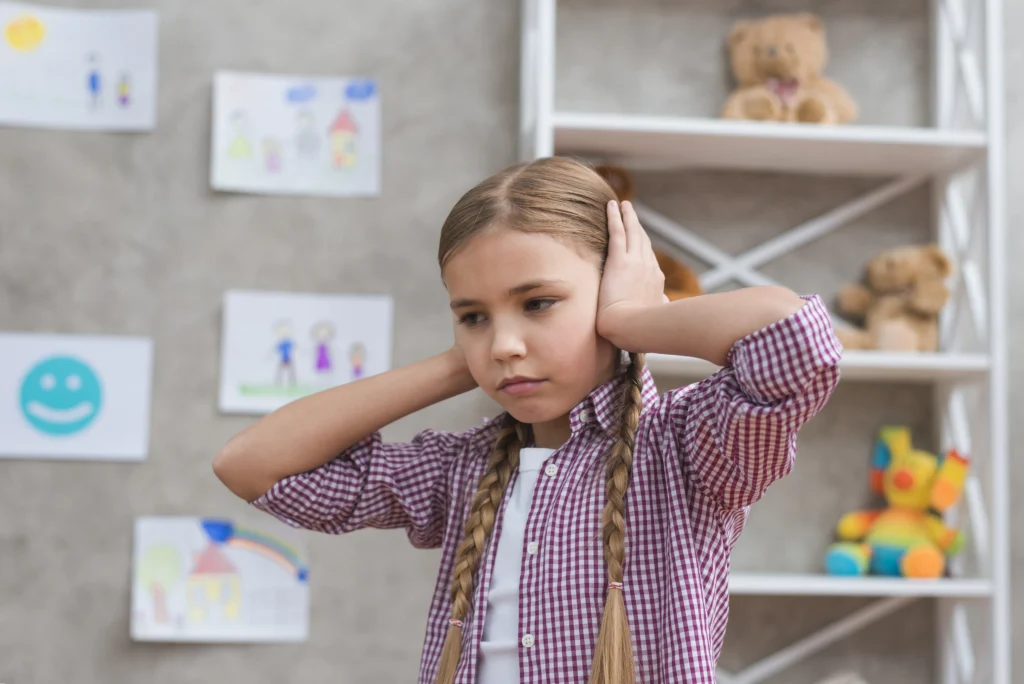
Signs vary between children. Some may struggle mainly in noisy environments, while others find spoken instructions or conversations difficult.
Possible signs include:
- Frequently asking people to repeat what they said.
- Saying “What?” or “Pardon?” regularly.
- Struggling to understand speech in background noise.
- Having difficulty following complex verbal instructions.
- Responding slowly during conversations.
- Confusing similar-sounding words.
- Finding group conversations difficult.
- Missing important information during lessons.
- Struggling to follow rapid speech.
- Having difficulties with listening-based classroom activities.
These signs are not unique to APD.
They can also occur with hearing loss, language disorders, ADHD and other developmental differences.
A symptom checklist cannot confirm the diagnosis.
How Do Listening Difficulties Affect Children at Different Ages?
Listening and communication skills develop throughout childhood. Difficulties may become more noticeable as expectations increase.
Toddlers and Preschool Children
Younger children may struggle to follow simple spoken directions, need gestures or demonstrations to understand activities, or appear not to respond consistently when spoken to.
These behaviors can occur for many reasons during early development.
APD should not be assumed in a toddler based on these signs.
School-Age Children
As classroom demands increase, listening difficulties may become more noticeable.
Children may miss instructions during lessons, struggle with group discussions, frequently ask teachers to repeat information or find it difficult to follow multi-step directions.
Older Children and Teenagers
Older children may struggle with longer conversations, lectures and group activities.
They may find it difficult to take notes while listening, miss details during verbal explanations or become tired after extended listening.
The increasing complexity of communication can make previously unnoticed difficulties more apparent.
Is Auditory Processing Disorder the Same as Hearing Loss?
No.
Hearing loss and Auditory Processing Disorder in Children involve different aspects of the auditory system.
| Hearing loss | Auditory processing difficulties |
|---|---|
| Involves reduced ability to detect sounds. | Involves difficulty processing or interpreting auditory information. |
| May affect hearing speech and environmental sounds. | A child may detect sounds but struggle to understand speech in certain situations. |
| Assessed through hearing tests. | Requires specialized assessment after hearing evaluation. |
| May involve the outer, middle or inner ear, or auditory pathways. | Relates to how auditory information is processed within the central auditory system. |
A child who appears to hear normally may still have a hearing problem that is not obvious during everyday interactions.
That is why a proper hearing assessment is important before considering APD.
APD vs ADHD, Autism and Language Difficulties
One of the most important parts of understanding APD is recognizing that similar symptoms can occur in other developmental conditions.
APD and ADHD
Children with ADHD may struggle to maintain attention during conversations or follow instructions.
They may miss information because their attention shifts, rather than because they cannot process the sounds themselves.
Both conditions may also coexist.
APD and Autism
Some autistic children experience differences in sensory processing and communication.
They may find certain sounds overwhelming or have difficulty understanding spoken information in particular environments.
However, sound sensitivity and communication differences do not automatically indicate APD.
APD and Developmental Language Disorder
Children with Developmental Language Disorder (DLD) may struggle to understand spoken language, follow instructions or learn new vocabulary.
These difficulties can resemble APD, but DLD involves challenges with language development rather than an isolated auditory processing problem.
APD and Dyslexia
Some children with dyslexia have difficulty recognizing and working with speech sounds, which can affect reading and spelling development.
These difficulties may overlap with listening complaints, making careful assessment important.
A systematic review found substantial overlap between children diagnosed with APD and those with other developmental conditions.
This reinforces the importance of looking beyond listening symptoms alone. (de Wit et al., 2018)
Myth vs Fact: Auditory Processing Disorder in Children
MYTH: A child with APD cannot hear properly.
FACT: Many children with APD have normal peripheral hearing but experience difficulty interpreting or processing certain sounds and spoken messages.
MYTH: Every child who ignores instructions has APD.
FACT: Similar behaviors may be associated with attention, language, hearing or other developmental difficulties. Professional assessment is important.
MYTH: APD is caused by learning more than one language.
FACT: Growing up with multiple languages does not cause APD. Assessment should consider the child’s language exposure and experience.
MYTH: Auditory processing difficulties are the same as ADHD.
FACT: APD and ADHD are different conditions, although some difficulties can overlap and may occur together.
MYTH: Physiotherapy can directly treat APD.
FACT: Physiotherapy does not treat auditory processing itself. It may help when a child has additional movement, balance, posture or coordination difficulties.
Can Multilingualism Cause Auditory Processing Difficulties?
No.
Growing up with two or more languages does not cause APD.
However, a child learning multiple languages may have different levels of familiarity with vocabulary, pronunciation and sentence structures across those languages.
This matters during assessment. Professionals should consider the child’s language exposure, language development and opportunities to learn each language.
Assessment materials should be appropriate for the languages the child uses. A difficulty with an unfamiliar word or language should not automatically be interpreted as an auditory processing problem.
How Is Auditory Processing Disorder Diagnosed?
APD cannot be diagnosed through observation alone. A child who frequently asks for repetition or struggles with instructions needs a broader assessment.
1. Hearing Assessment
An audiologist first evaluates the child’s hearing to identify or rule out peripheral hearing loss and other hearing-related problems.
Depending on the child’s needs, testing may include pure-tone audiometry, tympanometry and other hearing assessments.
2. Auditory Processing Assessment
If appropriate, the audiologist may perform specialized tests to examine how the child processes different types of auditory information.
These may assess:
- Understanding speech in background noise.
- Recognizing differences between sounds.
- Processing the order and timing of sounds.
- Listening when different messages compete.
- Identifying patterns in auditory information.
Test selection depends on the child’s age, developmental level, language abilities and presenting difficulties.
Many behavioral APD tests are more suitable for school-age children.
Assessment in younger children can be difficult because attention, language development, maturity and the demands of the tests influence performance.
There is no single age that applies to every test or child.
3. Speech and Language Assessment
A speech-language therapist may assess how the child understands and uses language.
This helps identify difficulties involving language comprehension, vocabulary, sentence structure, speech sounds or phonological processing.
4. Attention and Learning Assessment
When appropriate, a psychologist or other developmental professional may evaluate attention, working memory, learning and related skills.
This is particularly important when symptoms overlap with ADHD or learning difficulties.
The American Academy of Audiology recommends considering the child’s history, language, cognition, attention, age and peripheral hearing when selecting and interpreting auditory processing tests. (American Academy of Audiology, 2010)
How Can Parents Help a Child With Listening Difficulties at Home?
Simple changes in communication can make everyday instructions easier to understand.
1. Get Your Child’s Attention First
Before giving an instruction, make sure your child is ready to listen.
Say their name, move closer and reduce competing noise where possible.
2. Give Short, Clear Instructions
Avoid giving too many instructions at once.
Instead of saying, “Get your bag, put your shoes on, collect your bottle and come downstairs,” break the task into smaller steps.
3. Reduce Background Noise
Turn off the television or music when giving important instructions.
A quieter environment can make spoken information easier to follow.
4. Combine Spoken and Visual Instructions
Use pictures, written notes, gestures or demonstrations to support verbal communication.
For example, a simple morning routine chart can help a child remember what needs to be done.
5. Allow Extra Processing Time
Some children need additional time to understand and respond.
Avoid repeating the same instruction rapidly. Give your child a moment to process the information before offering further help.
6. Check Understanding Gently
Instead of repeatedly asking, “Did you understand?”, encourage your child to explain what they need to do.
This can help you identify whether the message was understood without making the child feel tested.
What Support Can Help Children With APD or Listening Difficulties at School?
Children who struggle to follow spoken instructions may benefit from practical classroom adjustments.
Depending on their assessment findings, useful strategies may include:
- Seating the child where the teacher’s voice is easier to hear.
- Reducing unnecessary background noise.
- Facing the child while speaking.
- Breaking long instructions into smaller steps.
- Repeating or rephrasing important information.
- Providing written instructions or visual reminders.
- Checking understanding before independent work begins.
- Allowing additional time to process spoken information.
In selected cases, an audiologist may recommend a remote microphone system. This technology helps make the speaker’s voice clearer relative to background noise.
A randomized controlled trial found improved classroom listening reported by children using remote microphone hearing devices, although improvements were not seen across every objective listening and attention measure. (Stavrinos et al., 2020)
What Treatments Are Available for Auditory Processing Difficulties?
There is no single treatment that works for every child. Support should be based on the difficulties identified during assessment.
Environmental Modifications
Reducing background noise, improving classroom seating and giving clear instructions can make listening easier.
Speech and Language Therapy
A speech-language therapist may help when the child also has difficulties with language comprehension, vocabulary, speech sounds or communication.
Intervention should target the child’s identified language and communication needs.
Auditory Training
Some children may be offered structured listening activities designed to practice specific auditory skills.
However, evidence for different auditory training approaches varies. Improvement on a particular listening test does not automatically mean that everyday communication or school performance will improve.
Assistive Listening Technology
In selected cases, an audiologist may recommend assistive listening devices, such as remote microphone systems.
These can help improve access to a speaker’s voice in environments where background noise makes listening difficult. They are not necessary or appropriate for every child.
A 2024 review of interventions for school-aged children with APD identified several approaches, but also highlighted differences in intervention methods and the need for stronger evidence on functional outcomes. (Bigras et al., 2024)
Is Physiotherapy Helpful for Auditory Processing Disorder?
Physiotherapy is not a direct treatment for APD.
APD primarily involves listening and auditory information processing.
The main professionals involved in assessment and management are audiologists and, when needed, speech-language therapists, psychologists and educational specialists.
However, some children may have additional developmental or movement-related difficulties that affect everyday participation.
A pediatric physiotherapist may support separately identified concerns involving:
- Gross motor coordination.
- Balance and postural control.
- Motor planning.
- Physical participation in play and school activities.
- Functional movement skills.
For example, a child who has both listening difficulties and challenges with balance or coordination may benefit from a broader developmental assessment and an individualised rehabilitation plan.
Physiotherapy should only be included when these movement-related needs are identified.
It does not directly improve auditory discrimination, speech understanding or the brain’s processing of spoken information.
When Should Parents Seek Professional Advice?
Consider discussing your child’s listening difficulties with a pediatrician or healthcare professional if they:
- Frequently struggle to follow everyday verbal instructions.
- Often ask people to repeat spoken information.
- Have difficulty understanding speech in noisy environments.
- Miss important information during classroom activities.
- Have difficulties with speech, language or communication.
- Show a noticeable change in listening or school performance.
If you suspect a hearing problem, arrange a hearing assessment rather than assuming the child has APD.
Seek prompt medical advice if your child experiences sudden hearing changes, sudden loss of communication abilities or other new neurological symptoms.
Final Thoughts
When a child repeatedly struggles to follow verbal instructions, it is worth looking beyond the assumption that they are not listening. They may be finding it difficult to understand and process spoken information, particularly in busy or noisy environments.
Auditory Processing Disorder is one possible explanation, but similar difficulties can have several causes. A careful assessment helps identify what the child needs rather than relying on symptoms alone.
With appropriate assessment, supportive communication strategies and individualized help, children can develop practical ways to manage listening challenges and participate more confidently at home and school.
Conclusion
When a child struggles to follow verbal instructions, the reason may be more complex than simply not listening.
Auditory processing difficulties can affect how children understand speech, recognize sounds and follow conversations, particularly in noisy environments.
However, hearing loss, language development, attention and memory can produce similar signs.
The most useful first step is to understand what is making listening difficult.
A hearing assessment, followed by appropriate specialist evaluation, can help identify the child’s needs.
With clear communication, suitable classroom adjustments and individualized support, children can develop strategies that make everyday listening and learning more manageable.
Frequently Asked Questions About Auditory Processing Disorder in Children
1. What are the early signs of auditory processing disorder in children?
Possible signs include difficulty following verbal instructions, frequently asking people to repeat themselves, struggling to understand speech in noisy places and confusing similar-sounding words. These signs do not confirm APD and should be assessed in context.
2. Can a child have APD with normal hearing?
Yes. Some children with APD have normal results on routine hearing tests but experience difficulty processing spoken information. A specialist assessment may be needed to investigate these difficulties.
3. At what age can auditory processing disorder be diagnosed?
There is no single age that applies to every child. Many behavioral auditory processing tests are more suitable for school-age children because they require attention, language understanding and reliable responses. The audiologist decides which assessments are appropriate for the child’s developmental level.
4. Is APD the same as ADHD?
No. APD concerns the processing of auditory information, while ADHD involves persistent patterns of inattention and/or hyperactivity-impulsivity. Some behaviors overlap, so careful assessment is important.
5. Can auditory processing disorder affect school performance?
It can. A child may miss spoken instructions, struggle during classroom discussions or find it difficult to follow lessons in noisy environments. Appropriate classroom adjustments can improve access to learning.
6. Does auditory processing disorder improve with therapy?
Some children benefit from individualized interventions, environmental changes and listening support. The effectiveness of auditory training varies, and progress on specific listening tests does not always translate into everyday improvements.
7. Can speech therapy help a child with APD?
Speech and language therapy may help when a child also has difficulties with understanding language, vocabulary, communication or following spoken instructions. The intervention should address the child’s identified needs.
8. Does physiotherapy help children with auditory processing disorder?
Physiotherapy does not directly treat auditory processing difficulties. However, it may support children who also have difficulties with balance, posture, gross motor coordination or movement-related participation.
Stay tuned with us for more health related topics.
Follow us on LinkedIn and Instagram for more.
More Read


Medical Disclaimer
This article is intended for general educational and informational purposes only. It does not replace professional medical advice, diagnosis or treatment. Difficulty following verbal instructions does not necessarily indicate Auditory Processing Disorder. If you have concerns about your child’s hearing, listening, speech, language or development, consult a qualified healthcare professional or audiologist for an appropriate assessment. Do not delay seeking professional advice based on information in this article.


