


Shoulder pain doesn’t have to control your daily life, these best stretches for shoulder impingement can help you regain mobility faster than you expect.
If lifting your arm, reaching behind your back, or even sleeping on one side has started to hurt, you’re not alone.
As a physiotherapist, one of the most common diagnoses I see behind this pattern is shoulder impingement.
What most people don’t realize is this:
It’s rarely just a “shoulder problem.”
It’s a movement problem involving your shoulder blade, rotator cuff, and even your upper back.
And that’s exactly why random stretching doesn’t work, but targeted, science-backed stretching does.
In this detailed guide, I’ll walk you through the 10 best stretches for shoulder impingement, supported by current research, along with lesser-known strategies that dramatically speed up recovery.
Quick Answer
The best stretches for shoulder impingement include cross-body stretch, sleeper stretch, doorway stretch, thoracic extension, and wall slides. These improve mobility, reduce compression, and restore shoulder function when combined with strengthening exercises.
Key Takeaways
- Shoulder impingement is mainly caused by poor movement mechanics
- Stretching must be combined with strengthening
- Thoracic mobility plays a crucial role
- Consistency is key for recovery
- Avoid exercises that compress the shoulder
What Is Shoulder Impingement?
What Is Shoulder Impingement?
Shoulder impingement (subacromial impingement syndrome) occurs when the rotator cuff tendons or subacromial bursa get compressed under the acromion during arm elevation.
This leads to:
- Pain during overhead movement
- Weakness
- Reduced range of motion
- Night discomfort
Research published in the Journal of Orthopaedic & Sports Physical Therapy highlights that altered shoulder mechanics and muscle imbalance, not just structural narrowing, are primary drivers of impingement. (PMC)
The Biomechanics Behind Shoulder Impingement
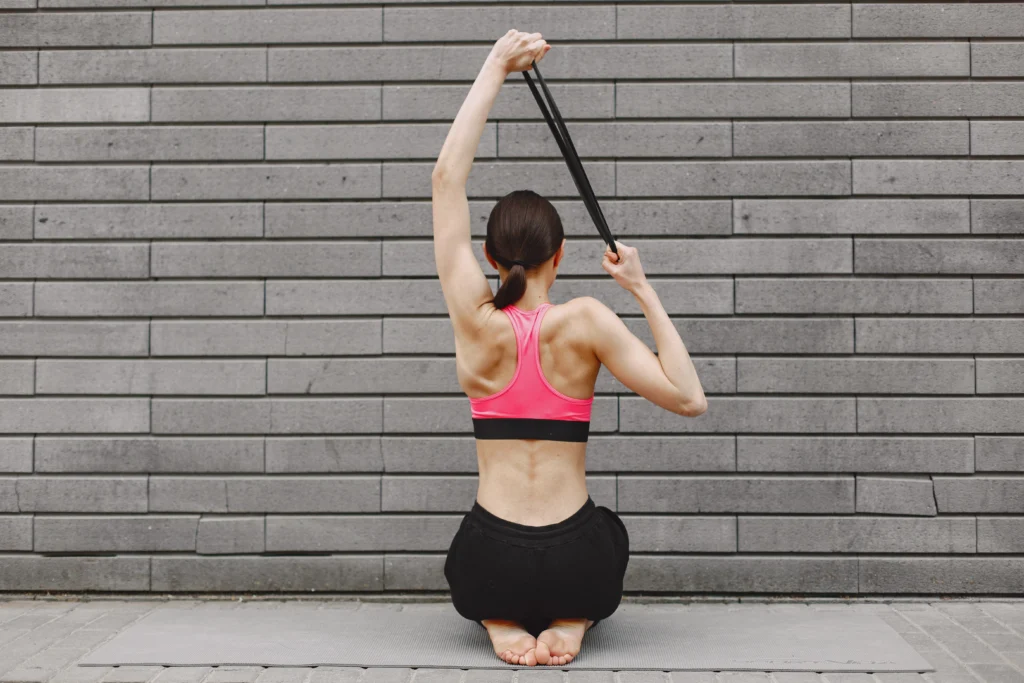
Understanding the biomechanics of the shoulder dramatically improves recovery outcomes.
The shoulder is the most mobile joint in the human body, but that mobility comes at the cost of stability.
Proper coordination between the rotator cuff, scapular stabilizers, and thoracic spine is essential for pain free movement.
When the scapula fails to upwardly rotate or posteriorly tilt during overhead motion, the subacromial space narrows, increasing tendon compression.
This is why modern rehabilitation focuses not just on stretching tight muscles but also on restoring scapulohumeral rhythm.
Correcting movement patterns ensures that stretching provides lasting results rather than temporary relief.
Research confirms that scapular dyskinesis is present in over 60% of shoulder injuries. (PubMed)
The Role of Inflammation and Load Management
Many people assume shoulder impingement is purely a flexibility problem, but inflammation and load management play a critical role.
Repetitive overhead lifting, poor programming in the gym, and sudden spikes in activity volume often overload the rotator cuff tendons.
When tissue capacity is exceeded, irritation develops.
Instead of complete rest, current rehabilitation principles recommend controlled, pain free loading to promote tendon adaptation.
Gradually reintroducing stress allows collagen remodeling and strengthens the tissue over time.
Smart load progression is just as important as the stretches themselves for long term shoulder health.
Why Thoracic Mobility Is Often Overlooked
One of the most overlooked contributors to shoulder impingement is thoracic spine stiffness.
When the upper back lacks extension, the shoulder is forced to compensate during overhead movements.
This compensation increases anterior humeral glide and reduces the available space under the acromion.
Incorporating thoracic extension drills, rotational mobility work, and posture resets into your daily routine can significantly reduce mechanical stress on the shoulder joint.
Addressing thoracic mobility not only improves shoulder comfort but also enhances athletic performance and lifting efficiency.
Study from Manual Therapy Journal shows thoracic mobilization improves shoulder function significantly.(MDPI)
Key Structures Involved
- Rotator cuff tendons
- Subacromial bursa
- Acromion
- Humeral head
- Scapula
When the subacromial space narrows, irritation develops, leading to inflammation and pain.
Types of Shoulder Impingement
Understanding the type helps guide treatment.
1. Primary Impingement
Caused by structural narrowing such as bone spurs.
2. Secondary Impingement
Caused by muscle imbalance, instability, or poor movement mechanics.
Most common in gym goers and desk workers.
3. Internal Impingement
Common in overhead athletes such as throwers.
Common Causes
- Rounded shoulder posture
- Tight chest muscles
- Weak rotator cuff
- Weak lower trapezius
- Weak serratus anterior
- Poor gym technique
- Repetitive overhead activity
- Prolonged desk sitting
A study in British Journal of Sports Medicine confirms that exercise therapy combining mobility + strengthening provides superior outcomes vs passive treatments alone. (BJSM)
Symptoms of Shoulder Impingement
- Pain between 60 and 120 degrees of arm elevation
- Night pain when lying on affected side
- Weakness
- Clicking or catching sensation
- Pain reaching behind back
Seek medical evaluation if you experience sudden weakness or inability to lift the arm.
Why Stretching Is Essential
Posterior capsule tightness and tight pectoralis minor muscles reduce the subacromial space.
Stretching restores mobility, improves scapular positioning, and reduces compression.
However, stretching alone is not enough. It must be paired with strengthening.
10 Best Stretches for Shoulder Impingement
1. Cross-Body Posterior Capsule Stretch
Why This Matters
Posterior capsule tightness is one of the most overlooked causes of impingement.
How to Perform
- Bring affected arm across chest
- Use opposite hand to pull gently
- Hold for 30 seconds
- Repeat 3-4 times
Clinical Tip
Avoid rotating your torso, this reduces effectiveness.
Proven to improve internal rotation deficits (NCBI)
2. Sleeper Stretch (Use With Control)
Why It Works
Targets deep internal rotation restriction.
Steps
- Lie on affected side
- Shoulder at 90°
- Gently press forearm downward
Do NOT push into pain. Gentle tension is enough.
3. Doorway Pectoralis Stretch
Why It Works
Tight chest muscles pull shoulders forward → reduces space.
Steps
- Forearms on doorframe
- Step forward slowly
- Hold 30 seconds
Tight pec minor is directly linked to scapular dysfunction (PMC)
4. Thoracic Extension Over Foam Roller
Why It Works
Restores spinal extension → improves shoulder mechanics.
Steps
- Foam roller under upper back
- Extend gently over it
- Perform 10-12 reps
5. Pendulum Exercise
Why It Works
Improves joint lubrication and reduces pain early.
Steps
- Lean forward
- Let arm hang
- Make small circles
Best during painful stages.
6. Wall Angels
Why It Works
Retrains scapular upward rotation.
Steps
- Back against wall
- Slide arms upward
- Keep core engaged
7. Latissimus Dorsi Stretch
Why It Works
Tight lats limit overhead movement.
Steps
- Hold stable surface
- Sit back into stretch
- Feel stretch along sides
8. Upper Trapezius Stretch
Why It Works
Reduces compensatory neck tension.
Steps
- Tilt head sideways
- Apply gentle pressure
- Hold 20-30 sec
9. Biceps Wall Stretch
Why It Works
Targets anterior shoulder tightness.
Steps
- Palm on wall behind you
- Rotate body away
- Hold stretch
10. Scapular Retraction Stretch
Why It Works
Activates weak postural muscles.
Steps
Repeat 10 times
Pull shoulder blades back
Hold 10 seconds
Essential Strengthening Exercises
Stretching creates space. Strengthening stabilizes it.
Phase 1: Activation
- Isometric external rotation against wall
- Scapular retraction holds
Phase 2: Resistance Band Work
- Band external rotations
- Face pulls
- Serratus wall slides
Phase 3: Functional Strength
- Prone Y raises
- Prone T raises
- Neutral grip dumbbell press
- Landmine press
Exercise therapy shown to reduce pain and improve function significantly (NCBI)
4 Week Progressive Plan
Week 1
Daily stretching. Avoid overhead lifting.
Week 2
Add light resistance bands 3 times weekly.
Week 3
Increase resistance gradually.
Week 4
Return to controlled overhead activity if pain free.
Posture Correction Routine
Perform these posture correction exercises twice daily:
- Chin tucks for 10 seconds
- Scapular squeezes for 10 reps
- Wall posture alignment check
Desk setup tips:
- Screen at eye level
- Elbows at 90 degrees
- Feet flat on floor
Exercises To Avoid During Recovery
- Behind the neck press
- Upright rows
- Deep dips
- Heavy barbell bench press
When To See A Doctor
Consult a healthcare professional if:
- Pain persists beyond 8 weeks
- You notice sudden weakness
- Pain worsens at night
- Limited range of motion does not improve
Recovery Timeline
- Mild cases: 4 to 6 weeks
- Moderate cases: 8 to 12 weeks
- Chronic cases: May require guided physical therapy
Consistency determines success.
Prevention Tips
- Warm up shoulders before workouts
- Strengthen rotator cuff weekly
- Maintain thoracic mobility
- Avoid excessive overhead volume
- Sleep on back or non affected side
Myth vs Reality
Myth: Rest fixes shoulder pain
Reality: Controlled movement heals faster
Final Word
The 10 best stretches for shoulder impingement work, but only when done consistently and combined with strengthening.
Shoulder impingement is one of the most manageable shoulder conditions when approached correctly.
The best stretches for shoulder impingement target posterior capsule tightness, chest tightness, and thoracic stiffness.
When paired with strengthening and posture correction, recovery becomes predictable and sustainable.
Stay consistent, progress gradually, and prioritize movement quality.
Frequently Asked Questions
1. What are the best stretches for shoulder impingement?
The most effective stretches include cross-body stretch, sleeper stretch, doorway stretch, thoracic extension, and wall slides. These improve mobility and reduce tendon compression.
2. How long does shoulder impingement take to heal?
Mild cases may improve in 4–6 weeks, while moderate cases typically take 8–12 weeks with consistent physiotherapy.
3. Can shoulder impingement heal without surgery?
Yes, most cases recover completely with proper stretching, strengthening, and load management without the need for surgery.
4. Is it safe to exercise with shoulder impingement?
Yes, but exercises should be pain-free and controlled. Avoid movements that increase pain or compress the shoulder joint.
5. What causes shoulder impingement?
Common causes include poor posture, tight chest muscles, weak rotator cuff, scapular instability, and repetitive overhead activities.
6. Should I rest or keep moving my shoulder?
Complete rest is not recommended. Gentle, controlled movement helps improve circulation and speeds up recovery.
7. Can poor posture lead to shoulder impingement?
Yes, rounded shoulders and forward head posture reduce subacromial space and increase the risk of impingement.
8. What exercises should I avoid with shoulder impingement?
Avoid behind-the-neck presses, upright rows, deep dips, and heavy overhead lifting during recovery.
9. Does sleeping position affect shoulder pain?
Yes, sleeping on the affected shoulder can worsen pain. It’s better to sleep on your back or the opposite side with support.
10. When should I see a doctor for shoulder impingement?
Consult a healthcare professional if pain persists beyond 8 weeks, worsens at night, or if you experience sudden weakness.
Stay tuned with us for more health related topics.
Follow us on LinkedIn and Instagram for more.
More Read


Medical Disclaimer!
This article has been reviewed and written under the guidance of our Head Physiotherapist, Dr. Kruti Raj (PT, MUHS,CPT,CMPT). The information shared is intended for educational purposes only and should not be considered a substitute for personalized medical advice, diagnosis, or treatment.
Please consult us or any other qualified healthcare professional before beginning any exercise program, especially if you are experiencing pain, recovering from injury, or managing a medical condition.


