


Iniencephaly is a rare congenital neural tube defect involving the skull base and upper spine.
It presents with a very characteristic posture where the head is fixed in extreme backward bending and the neck is either absent or severely shortened.
From a clinical standpoint, this condition is not just a spinal deformity.
It represents a combined failure of cranial and cervical development, where the occipital bone is defective and the cervical vertebrae are malformed or fused.
This results in a posture where the face appears directed upward, often described in clinical literature as a star gazing position (CDC, 2021)
Read about our Complete Neck Pain Guide : Causes, Symptoms, Exercises and Treatment
Quick Answer
Iniencephaly is a rare and severe neural tube defect where the baby’s head is abnormally bent backward due to defects in the skull and cervical spine. It develops very early in pregnancy and is usually associated with other major congenital abnormalities. Early diagnosis through ultrasound is possible, but the condition is often incompatible with life. Prevention through folic acid supplementation remains the most effective strategy.
Read about: Early Signs of Cervical Spine Damage You Should Never Ignore
Key Takeaways
- Iniencephaly is a rare and severe neural tube defect involving the skull and cervical spine.
- It develops very early in pregnancy, often before many women realize they are pregnant.
- The condition is usually associated with multiple congenital abnormalities.
- Early diagnosis is possible through ultrasound and fetal imaging.
- Prognosis is generally poor, with most cases not compatible with long-term survival.
- Physiotherapy plays a role in prevention, support, and parental guidance.
- Folic acid supplementation remains the most effective preventive measure.
Read: What Causes Neck Pain in Children And How To Treat
How Does It Develop?
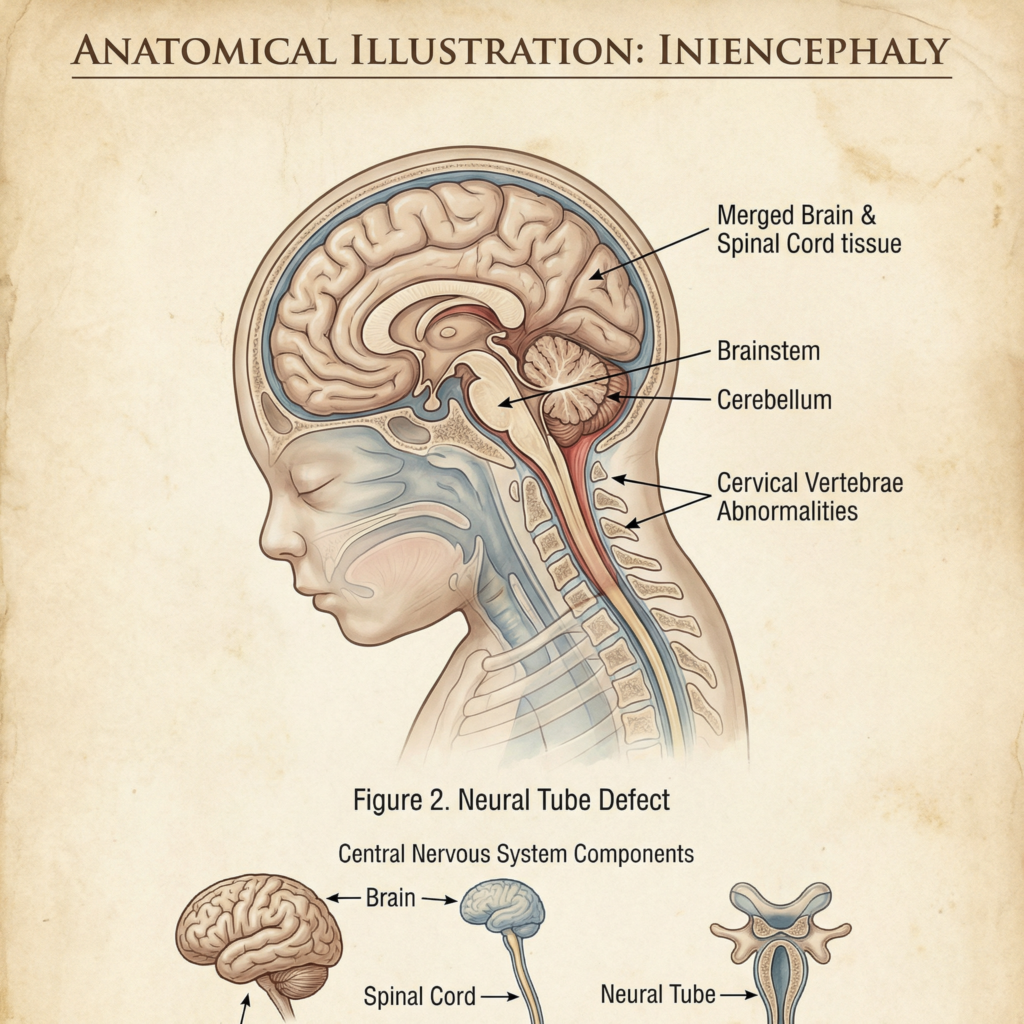
The origin of iniencephaly goes back to very early pregnancy, usually between the third and fourth week of gestation.
During this phase, the neural tube forms and closes. This structure later develops into the brain and spinal cord. In iniencephaly, this process is disrupted at the cranio cervical junction.
Earlier understanding suggested a simple failure of neural tube closure. However, more recent research indicates that the mechanism may be more complex, involving secondary disruption and abnormal spinal biomechanics (Greene et al., 2020)
This explains why both bone defects and severe postural abnormalities coexist.
Read: The Lemierre’s Syndrome: Rare Symptoms and Rehab Plan
Types of Iniencephaly
Clinically, iniencephaly is classified into two types.
Iniencephaly apertus
This type involves an open defect with encephalocele, where brain tissue protrudes through the skull. It is associated with more severe neurological involvement.
Iniencephaly clausus
In this form, the defect is covered by skin and there is no encephalocele. Despite this, structural abnormalities remain significant and prognosis is still poor.
Read: Branchial Cleft Cyst: A Complete Guide To Neck Lump
How Common Is It?
Iniencephaly is rare, with reported incidence ranging between 0.1 to 10 per 10,000 births globally (Blencowe et al., 2018)
Some regional data suggests even lower prevalence, (Singh et al., 2018) but what stands out clinically is:
- Higher occurrence in female fetuses
- Frequent association with multiple anomalies
Read: Understanding Dropped Head Syndrome in Simple Terms
It Rarely Occurs Alone
One important clinical observation is that iniencephaly is usually not an isolated defect.
In many cases, it is associated with:
- Cardiac abnormalities
- Diaphragmatic hernia
- Omphalocele
- Limb deformities
- Central nervous system anomalies
- Holoprosencephaly
- Myelomeningocele
Studies indicate that a large proportion of cases present with multiple anomalies, making it a systemic developmental condition rather than a localized defect (Mendonça et al., 2024)
A recent case report also highlighted coexistence with complex syndromic abnormalities (Minchola Vega et al., 2025)
Read: Understanding Swollen Lymph Nodes In The Neck
Clinical Features
The physical presentation is usually distinctive.
Common features include:
- Extreme backward bending of the head
- Absence or shortening of the neck
- Upward facing facial orientation
- Shortened and deformed spine
- Fixed hyperextension posture
The fixed nature of the deformity helps differentiate it from positional abnormalities.
Read: Pain in the Back Side of the Neck: Causes and Treatment
Diagnosis and Advances in Detection
Advancements in prenatal imaging have significantly improved early detection.
Ultrasound remains the primary screening tool and can identify features as early as the first trimester. Fetal MRI is used for detailed anatomical evaluation.
Recent case reports have shown diagnosis as early as 8 weeks of gestation, allowing earlier clinical decision making (Trivedi et al., 2025)
Key diagnostic findings include:
- Fixed retroflexion of the head
- Abnormal cervical spine
- Skull defects
- Associated anomalies
Read more: Rheumatoid Arthritis Neck: Causes, Symptoms and Treatments
When Should You Suspect or Seek Medical Advice?
In real life, most parents do not come across a term like iniencephaly on their own. It usually comes up during a routine scan. Still, there are a few situations where extra attention is important.
If you are pregnant or planning pregnancy, these are moments where you should not delay medical consultation:
- You missed early antenatal visits and have not had a first trimester scan
- There is a history of neural tube defects in a previous pregnancy
- You have diabetes or are on long term medications
- You were not taking folic acid before or during early pregnancy
- An ultrasound report mentions abnormal fetal posture or spine concerns
Sometimes, parents notice terms in reports like “abnormal curvature” or “fixed head position” and feel confused. This is where early discussion with your doctor becomes important.
From a clinician’s perspective, early detection is not just about diagnosis. It is about giving parents time, clarity, and options.
Read : A Complete Guide To Neck Arthritis
Differentiating from Similar Conditions
Iniencephaly can sometimes be confused with:
- Anencephaly
- Klippel Feil syndrome
- Severe cervical deformities
The distinguishing factor is the combination of fixed head retroflexion and structural fusion of cervical vertebrae.
Read about: What Is Cervical Myofascial Pain Syndrome And How To Relieve Trigger Points
Prognosis
This is one of the most sensitive aspects of the condition.
Iniencephaly is generally considered incompatible with life. Most affected fetuses are stillborn, and live births typically survive only for a short duration (Copp et al., 2015)
While rare survival cases exist, they are exceptional.
Read about: Yoga for Neck Pain: Poses That Actually Work
Physiotherapy Perspective
At first glance, physiotherapy may seem to have a limited role. However, when viewed through a broader clinical lens, the contribution becomes meaningful.
Preventive Role
Physiotherapists involved in community health can:
- Promote folic acid awareness
- Encourage early antenatal care
- Educate on lifestyle factors
Neonatal Support
In rare survival cases:
- Gentle positioning helps reduce discomfort
- Careful handling prevents additional strain
- Supportive care improves comfort
Parental Guidance
Often the most important aspect:
- Teaching safe handling techniques
- Providing reassurance
- Supporting emotional well being
In such situations, physiotherapy shifts from rehabilitation to supportive care.
Read: Lhermitte’s sign- An Electic Shock Sensation Down The Neck
Risk Factors
Several risk factors have been associated with iniencephaly.
These include:
- Folic acid deficiency
- Poor maternal nutrition
- Obesity
- Uncontrolled diabetes
- Exposure to certain medications
It is important to recognize that many cases occur without a clear cause, suggesting a multifactorial origin (Greene et al., 2020)
Read about: Effective Neck Pain Exercises At Home: A Complete Guide to Relief and Improved Mobility
Prevention
Prevention remains the most effective approach.
Folic acid supplementation before conception and during early pregnancy significantly reduces neural tube defects (Blencowe et al., 2018)
Other measures include:
- Regular antenatal checkups
- Managing chronic conditions
- Maintaining proper nutrition
Read: A Complete Guide To Sinuses Related Neck Pain
Lesser Known Clinical Insights
Some important but lesser discussed points include:
- Higher incidence in female fetuses
- Possible recurrence in future pregnancies
- Association with chromosomal abnormalities such as trisomy 13 and 18
- Inclusion within a broader spectrum of craniospinal dysraphism
These details are especially relevant during counseling.
Read: What is Torticollis? How to treat neck tilt condition
What Parents Often Ask During Counseling
Over time, you begin to notice that parents tend to ask similar questions, even if they phrase them differently.
These questions come from fear, confusion, and the need to make sense of something unexpected.
Here are a few that come up often:
“Did we do something wrong?”
In most cases, no. Iniencephaly is usually multifactorial and not caused by a single action.
“Could this have been prevented?”
Folic acid reduces risk, but not all cases are preventable. This is important to explain gently.
“Will this happen again in the next pregnancy?”
The risk is slightly higher than average, but many future pregnancies are completely normal with proper care.
“Is there any treatment after birth?”
Treatment is not curative. Care focuses on comfort and support.
“Should we continue the pregnancy?”
This is a deeply personal decision and should always be guided by medical advice and family values.
As healthcare professionals, including physiotherapists, our role is not just to explain the condition, but to create a space where these questions can be asked without hesitation.
Also Read: Neck Pain with Fever: When To Worry And How To Treat
Emotional and Ethical Considerations
Beyond clinical facts, iniencephaly carries a significant emotional impact.
Families often face:
- Unexpected diagnosis
- Difficult decisions during pregnancy
- Emotional distress
Healthcare professionals must approach such situations with empathy, clarity, and respect.
Also Read: Neck Pain When Coughing: Causes, Relief, and When to Worry
Frequently Asked Questions
1. What is iniencephaly?
It is a rare neural tube defect where the baby’s head is severely bent backward due to skull and spine abnormalities.
2. Can iniencephaly be treated?
There is no curative treatment. Care is mainly supportive.
3. How early can it be detected?
It can be detected in early pregnancy through ultrasound.
4. What causes iniencephaly?
It results from improper neural tube development during early pregnancy.
5. Is folic acid helpful?
Yes, it significantly reduces the risk of neural tube defects.
6. Can physiotherapy help?
It helps with positioning, comfort, and parental guidance.
7. Is it hereditary?
It may have genetic factors but is usually multifactorial.
8. Can future pregnancies be normal?
Yes, with proper care and supplementation, outcomes are often normal.
Stay tuned with us for more health related topics.
Follow us on LinkedIn and Instagram for more.
More Read


Medical Disclaimer!
This article has been reviewed and written under the guidance of our Head Physiotherapist, Dr. Kruti Raj (PT, MUHS,CPT,CMPT). The information shared is intended for educational purposes only and should not be considered a substitute for personalized medical advice, diagnosis, or treatment.
Please consult us or any other qualified healthcare professional before beginning any exercise program, especially if you are experiencing pain, recovering from injury, or managing a medical condition.


