


Pregnancy is a time of excitement, anticipation, and countless questions.
While routine ultrasound scans provide valuable information about your baby’s growth and development,
there are situations where your healthcare provider may recommend an additional imaging test called a fetal magnetic resonance imaging (MRI) scan.
For many expecting parents, hearing the words “fetal MRI” can be worrying.
It is common to wonder whether something is wrong with the baby, whether the scan is safe, or why an MRI is needed when several ultrasound examinations have already been performed.
Quick Answer
A fetal MRI is recommended when a routine pregnancy ultrasound needs additional evaluation or when doctors require more detailed images of your baby’s brain, spine, chest, abdomen, or other organs. It complements ultrasound rather than replacing it and is generally considered safe when performed for appropriate medical reasons.
The reassuring news is that a recommendation for a fetal MRI does not automatically mean that your baby has a serious medical condition.
In many cases, fetal MRI is requested simply because it can provide additional information that may not be clearly visible on ultrasound.
It helps healthcare professionals confirm findings, better understand certain abnormalities, or even provide reassurance when ultrasound images are inconclusive.
Ultrasound remains the first-line imaging technique during pregnancy because it is safe, widely available, and highly effective for monitoring fetal growth and anatomy.
However, ultrasound has limitations.
Factors such as fetal position, maternal body habitus, reduced amniotic fluid, or the complexity of certain fetal conditions can make it difficult to obtain all the information needed.
In these situations, fetal MRI serves as a complementary imaging technique rather than a replacement for ultrasound (Reddy et al. 2008).
Fetal MRI provides highly detailed images of soft tissues, making it particularly useful for evaluating the baby’s brain, spine, chest, abdomen, and certain placental conditions.
It allows specialists to examine fetal anatomy from multiple planes without exposing either the mother or baby to ionizing radiation.
As a physiotherapist,
I often reassure expecting parents that additional imaging is recommended to improve understanding and support the best possible pregnancy care.
More information allows healthcare teams to make better decisions, plan delivery appropriately, and ensure that both mother and baby receive the care they need.
In this article, you’ll learn when fetal MRI is recommended,
how it differs from ultrasound, what conditions it can help diagnose, and what you can expect if your healthcare provider suggests this examination.
Key Takeaways
- Fetal MRI is a specialized imaging test used when ultrasound requires additional evaluation.
- It provides detailed images of the baby’s brain, spine, chest, abdomen, and other soft tissues.
- Fetal MRI complements routine ultrasound rather than replacing it.
- MRI does not use ionizing radiation and is considered appropriate when medically indicated.
- Most fetal MRI examinations are performed after 18–20 weeks of pregnancy.
- The examination helps healthcare professionals improve diagnosis, pregnancy planning, and newborn care.
- Most pregnancies do not require a fetal MRI.
At a Glance
| Question | Answer |
|---|---|
| What is fetal MRI? | A specialised imaging test that provides detailed images of the developing baby. |
| Does it replace ultrasound? | No. It complements routine ultrasound when additional information is needed. |
| Does it use radiation? | No. MRI uses magnetic fields and radiofrequency waves, not ionising radiation. |
| When is it recommended? | When ultrasound findings require further clarification or detailed assessment. |
| Which organs are best evaluated? | Brain, spine, chest, abdomen, placenta, and selected complex conditions. |
What Is Fetal MRI?
Fetal magnetic resonance imaging (MRI) is an advanced prenatal imaging technique that creates:
highly detailed pictures of the developing baby using powerful magnetic fields and radiofrequency waves.
Unlike ultrasound, which uses sound waves to create real-time images, MRI provides exceptional soft tissue contrast.
This makes it particularly valuable when healthcare professionals need a more detailed assessment of structures that may be difficult to evaluate using ultrasound alone.
Rather than replacing routine pregnancy scans, fetal MRI is performed after an ultrasound has identified a finding that requires further investigation or when ultrasound images are limited by technical factors.
Research has consistently shown that fetal MRI is a valuable second-line investigation, particularly for evaluating abnormalities of the central nervous system and other complex fetal structures (Hart et al. 2020).
Why Might Your Doctor Recommend a Fetal MRI?
Your healthcare provider may recommend fetal MRI for several reasons, and in many cases it is performed simply to obtain clearer anatomical information rather than because a serious problem is expected.
Common reasons include:
- An unclear finding on a routine ultrasound.
- Suspected brain or spinal abnormalities.
- Evaluation of congenital diaphragmatic hernia.
- Assessment of fetal chest or lung abnormalities.
- Investigation of complex abdominal conditions.
- Further evaluation of selected placental abnormalities.
- Clarifying findings before delivery planning.
MRI often provides additional anatomical detail that helps clinicians confirm a diagnosis, better understand the extent of a condition, or exclude abnormalities when ultrasound findings are uncertain.
Importantly, many fetal MRI examinations ultimately provide reassurance by confirming that a suspected abnormality is less significant than initially thought or is not present at all.
Common Conditions Where Fetal MRI Is Recommended
Although fetal MRI has many applications, it is most frequently recommended for evaluating specific fetal conditions where detailed soft tissue imaging is beneficial.
Brain Abnormalities
The most common indication for fetal MRI is assessment of the developing brain.
MRI can provide additional information when ultrasound suggests:
- Ventriculomegaly
- Agenesis of the corpus callosum
- Cortical development abnormalities
- Posterior fossa abnormalities
- Intracranial cysts
- Brain haemorrhage
Because MRI offers excellent visualization of soft tissues, it often improves assessment of fetal brain anatomy and supports more accurate prenatal counselling.
Spinal Abnormalities
MRI may also be recommended when spinal abnormalities such as spina bifida or spinal dysraphism are suspected.
It provides additional information about the spinal cord and surrounding soft tissues, helping specialists better understand the extent of the condition and prepare for appropriate postnatal care.
Chest and Lung Conditions
Certain fetal chest abnormalities, including congenital diaphragmatic hernia and congenital lung lesions, may be evaluated more comprehensively using MRI.
Detailed imaging of the lungs and surrounding organs can assist healthcare teams in estimating lung development and planning delivery at centers with specialized neonatal services when necessary.
Complex Abdominal Abnormalities
MRI can also provide valuable information when ultrasound identifies abnormalities involving the fetal abdomen, gastrointestinal tract, or urinary system.
In selected situations, it helps clarify anatomy before birth and assists multidisciplinary teams in planning treatment after delivery.
Ultrasound vs Fetal MRI
Parents often ask why another imaging test is needed after an ultrasound.
The answer is simple: the two examinations provide different types of information and work best together.
| Feature | Ultrasound | Fetal MRI |
|---|---|---|
| First-line pregnancy imaging | Yes | No |
| Real-time imaging | Yes | Limited |
| Soft tissue detail | Good | Excellent |
| Brain assessment | Good | Excellent for selected conditions |
| Uses ionising radiation | No | No |
| Routine pregnancy screening | Yes | No |
Healthcare professionals usually begin with ultrasound because it is quick, accessible, and highly effective.
Fetal MRI is added only when the additional anatomical detail is expected to improve diagnosis or pregnancy management
When During Pregnancy Is Fetal MRI Performed?
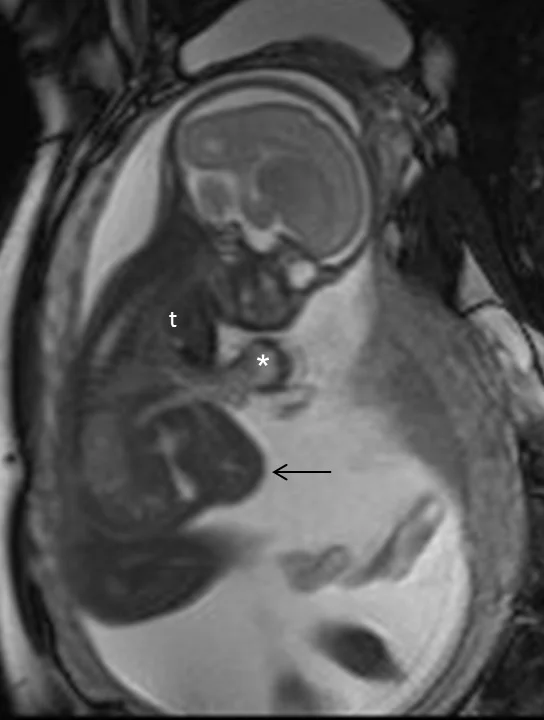
One of the most common questions expecting parents ask is whether there is a “best time” to undergo a fetal MRI.
In most cases, fetal MRI is performed after 18-20 weeks of pregnancy, with many examinations taking place during the second or third trimester.
At this stage, the baby’s organs are more developed, making it easier for specialists to obtain detailed images and evaluate suspected abnormalities.
The exact timing depends on the reason for the examination. If an abnormality is identified during the routine anatomy scan, your obstetrician or fetal medicine specialist may recommend an MRI soon afterwards.
In other situations, the scan may be scheduled later in pregnancy if additional information is needed to guide delivery planning or neonatal care (Levine et al. 2013).
Importantly, fetal MRI is not a routine pregnancy investigation.
It is recommended only when the additional information is expected to improve diagnosis or influence clinical management.
Is Fetal MRI Safe During Pregnancy?
Safety is understandably one of the biggest concerns for parents.
The reassuring news is that fetal MRI does not use ionizing radiation.
Unlike X-rays or CT scans, MRI creates images using powerful magnetic fields and radiofrequency waves.
Because there is no radiation exposure, fetal MRI is considered an appropriate imaging technique when there is a clear medical indication and the expected benefits outweigh any potential risks.
Current international recommendations support the use of fetal MRI during pregnancy when clinically indicated, particularly after the first trimester.
The examination is performed by trained healthcare professionals using established safety protocols to ensure the wellbeing of both mother and baby. (Puris et al. 2025)
Most women do not require any special medication during the scan, and fetal MRI is generally performed without contrast agents. This further supports its favorable safety profile for prenatal imaging.
What Happens During a Fetal MRI Scan?
Knowing what to expect can make the experience much less stressful.
When you arrive for your appointment, the radiology team will explain the procedure and ask a few questions about your pregnancy and general health.
You will usually be asked to remove metal objects such as jewellery, watches, hearing aids, or clothing containing metal fasteners before entering the MRI room.
During the examination, you will lie comfortably on the MRI table, usually on your back or slightly tilted to one side if needed for comfort.
The table then moves slowly into the MRI scanner.
Unlike ultrasound, the MRI scanner does not touch your abdomen.
Instead, it captures detailed images while you remain as still as possible.
You may hear loud knocking or tapping sounds during the examination, which are completely normal.
Most imaging centres provide ear protection to improve comfort.
The examination generally takes 30 to 60 minutes, depending on the reason for the scan and the number of images required.
Because babies naturally move during pregnancy, the radiologist may repeat certain image sequences to obtain the clearest possible pictures.
After the examination, you can usually return to your normal daily activities unless your healthcare provider advises otherwise.
Benefits of Fetal MRI
Fetal MRI has become an important addition to prenatal imaging because it provides information that may not always be available from ultrasound alone.
One of its greatest strengths is its ability to produce high-resolution images of soft tissues.
This allows specialists to examine the fetal brain, spinal cord, lungs, liver, kidneys, bowel, and other organs in greater detail.
Another important benefit is that MRI provides images in multiple planes without being significantly affected by fetal position, maternal body habitus, or reduced amniotic fluid.
In situations where ultrasound images are limited, MRI may help clarify the diagnosis and reduce uncertainty.
Fetal MRI also supports multidisciplinary care.
The detailed images can be reviewed by fetal medicine specialists, radiologists, paediatric neurologists, paediatric surgeons, neonatologists, and genetic specialists,
allowing the healthcare team to develop the most appropriate pregnancy and delivery plan.
For some families, MRI provides reassurance by demonstrating that a suspected abnormality seen on ultrasound is less severe than initially expected or is not present at all.
For others, it confirms the diagnosis and allows appropriate counselling before birth.
Limitations of Fetal MRI
Although fetal MRI is a powerful imaging tool, it also has limitations.
First, it is not a replacement for ultrasound.
Ultrasound remains the first-line investigation because it :
provides real-time imaging, assesses fetal movement, evaluates blood flow using Doppler technology, and is readily available in most healthcare settings.
MRI is also more expensive and less widely available than ultrasound. In many hospitals, it is performed only in specialised centres with expertise in fetal imaging.
Image quality can occasionally be affected by excessive fetal movement.
While modern MRI techniques have significantly improved image acquisition, babies naturally move during pregnancy, which may require certain images to be repeated.
It is also important to remember that no imaging test can diagnose every condition before birth.
MRI findings must always be interpreted alongside ultrasound, maternal history, laboratory investigations, and, where appropriate, genetic testing (Wong et al. 2026)
How Should You Prepare for a Fetal MRI?
In most cases, very little preparation is required.
Your healthcare provider will explain why the scan has been recommended and answer any questions you may have beforehand.
On the day of the examination:
- Wear comfortable clothing.
- Remove all metal objects before entering the MRI suite.
- Inform the radiology team if you have any implanted medical devices or experience severe claustrophobia.
- Follow any instructions provided by your hospital regarding eating or drinking before the examination.
Many women are pleasantly surprised to find that the procedure is straightforward and painless.
Questions to Ask Your Healthcare Provider
If your doctor recommends a fetal MRI, you may wish to ask:
- Why has this scan been recommended?
- What did the ultrasound show?
- What additional information will MRI provide?
- Will the results change my pregnancy care?
- How long will the examination take?
- When will I receive the results?
- Will I need any further tests or specialist consultations?
Having these discussions can help you feel informed and more confident about the next steps in your pregnancy.
Final Thoughts
Being referred for a fetal MRI can feel overwhelming, but remember that the purpose of the examination is to provide more detailed information and help your healthcare team make the best possible decisions for you and your baby. In many cases, the scan offers reassurance by clarifying ultrasound findings or confirming that everything is progressing normally.
If your healthcare provider recommends a fetal MRI, do not hesitate to ask questions about the reason for the scan, what the results may mean, and how they could influence your pregnancy care. Understanding the purpose of the examination can help you feel more confident and supported throughout your pregnancy journey.
Conclusion
A recommendation for fetal MRI can understandably cause anxiety, but it is important to remember that the purpose of the examination is to provide more information, not more worry.
In many cases, the scan offers reassurance by clarifying ultrasound findings or confirming that the baby’s development is progressing as expected.
When additional detail is needed, fetal MRI allows healthcare professionals to evaluate complex fetal conditions with greater confidence and plan the safest care for both mother and baby.
By combining the strengths of ultrasound and MRI, clinicians can make better-informed decisions that support healthy pregnancies and improve outcomes for families.
Frequently Asked Questions
When is a fetal MRI recommended?
A fetal MRI is recommended when a routine ultrasound requires additional evaluation or when doctors need more detailed images of specific fetal organs.
Is fetal MRI safe during pregnancy?
Yes. Fetal MRI does not use ionising radiation and is considered appropriate when performed for medical reasons under specialist guidance.
Can fetal MRI replace ultrasound?
No. Ultrasound remains the primary imaging test during pregnancy. MRI is used only when further anatomical detail is required.
How long does a fetal MRI take?
Most examinations take between 30 and 60 minutes, depending on the reason for the scan.
Does a fetal MRI hurt the baby?
No. A fetal MRI is painless and does not expose the baby to radiation.
Stay tuned with us for more health related topics.
Follow us on LinkedIn and Instagram for more.
More Read


Medical Disclaimer!
This article has been reviewed and written under the guidance of our Head Physiotherapist, Dr. Kruti Raj (PT, MUHS,CPT,CMPT). The information shared is intended for educational purposes only and should not be considered a substitute for personalized medical advice, diagnosis, or treatment.
Please consult us or any other qualified healthcare professional before beginning any exercise program, especially if you are experiencing pain, recovering from injury, or managing a medical condition.


