


Understanding what is the best pillow for neck pain!
Neck pain is one of the most common musculoskeletal complaints worldwide. Many people who visit physiotherapy clinics describe the same experience: they go to bed feeling normal but wake up with stiffness, limited neck movement, or headaches.
Surprisingly, one of the most overlooked causes of this problem is the pillow.
From a physiotherapy perspective, a pillow is not just for comfort. It functions as a support system for the cervical spine during sleep.
Because we spend nearly one-third of our lives sleeping, even small alignment problems sustained for several hours each night can gradually stress the muscles, joints, and ligaments of the neck.
Scientific studies have shown that pillow characteristics such as height, shape, firmness, and material can influence cervical spine alignment and morning symptoms like stiffness and headaches (Gordon et al.,2009).
Understanding how to choose the right pillow can therefore play an important role in reducing neck pain and improving sleep quality.
A Physiotherapist’s quick Answer
The best pillow for neck pain is one that maintains neutral cervical spine alignment during sleep. Medium-height pillows made of memory foam or latex often work well because they support the natural curve of the neck and reduce muscle strain.
Read about our Complete Neck Pain Guide : Causes, Symptoms, Exercises and Treatment
Why Pillow Choice Matters for Neck Pain

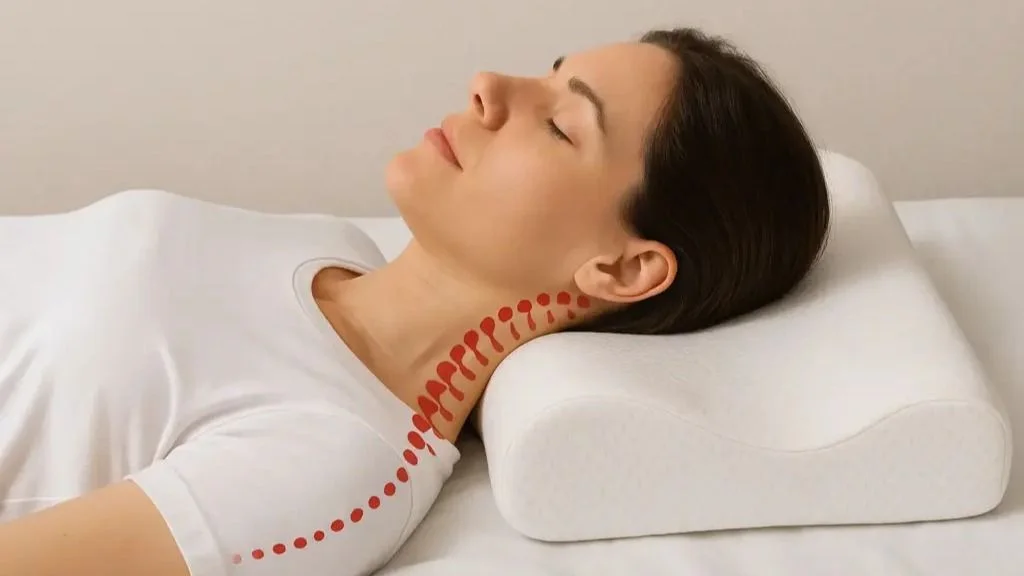
The neck consists of seven cervical vertebrae that form a natural inward curve called cervical lordosis. This curve helps distribute weight and maintain balance.
When lying down, the pillow should support this natural curve so that the neck remains in a neutral alignment with the spine.
If the pillow is too high or too low, the cervical spine may remain bent or extended for hours. This prolonged strain can lead to muscle fatigue and joint stress.
Biomechanical research examining pillow height and spinal posture has demonstrated that incorrect pillow height can significantly alter cervical spine angles during sleep (Liu et al.,).
This explains why some people consistently wake up with neck stiffness or headaches despite having no underlying injury.
Read about : 15 Common Causes of Neck Pain You Should Know
Understanding Cervical Spine Alignment During Sleep

When you stand with good posture, your ears align roughly above your shoulders.
During sleep, a pillow should maintain a similar relationship between the head, neck, and upper spine.
If the pillow is too high, the chin may tilt toward the chest, increasing flexion of the cervical spine.
If the pillow is too low, the neck may extend backward, stretching ligaments and joints.
Researchers studying pillow ergonomics found that changes in pillow height significantly affect neck muscle activity and sleep comfort (Sleep and Breathing,).
The goal of an ideal pillow is therefore simple: maintain neutral spinal alignment and allow the neck muscles to relax during sleep.
Read About: Best Sleeping Position for Neck Pain: A Physiotherapist’s Complete Guide
Signs Your Pillow May Be Causing Neck Pain
Many people continue using the same pillow for years without realizing it may be contributing to their symptoms.
Common warning signs include:
Morning Neck Stiffness
If stiffness improves within 15–20 minutes after getting up and moving around, the pillow may be affecting neck posture during sleep.
Frequent Headaches
Tension headaches often originate from tight muscles in the upper neck.
Shoulder Pain on Waking
Side sleepers frequently experience shoulder discomfort when the pillow is too low.
Restless Sleep
Constantly adjusting the pillow during the night is usually a sign of inadequate support.
Tingling or Numbness in the Arm
Poor neck alignment during sleep may irritate cervical nerves.
Read in detail about: Cervical Radiculopathy: Why Neck Nerve Pain Travels to the Arm
Choosing the Right Pillow Height

Pillow height often called pillow loft is one of the most important factors for neck support.
Research measuring cervical posture during sleep shows that pillow height directly influences spinal alignment and muscle activity (Healthcare, 2021).
The ideal pillow height depends largely on sleep position and body dimensions.
Back Sleepers
Back sleepers usually benefit from medium-height pillows.
The pillow should support the natural curve of the neck without pushing the head forward.
If the pillow is too thick, it may force the neck into flexion, increasing strain on the cervical muscles.
Side Sleepers
Side sleepers typically need higher pillows because the pillow must fill the gap between the head and the shoulder.
If the pillow is too low, the neck bends downward.
If the pillow is too high, the neck tilts upward.
Both positions disrupt spinal alignment.
Studies on pillow ergonomics suggest that the ideal pillow height should roughly match the distance between the ear and the outer shoulder to maintain neutral alignment.
Stomach Sleepers
Physiotherapists generally discourage stomach sleeping because it forces the neck into sustained rotation for several hours.
This position can increase stress on cervical joints and muscles.
If stomach sleeping cannot be avoided, a very thin pillow or no pillow may reduce strain.
Read in detail about: What is Cervical Spondylosis? The Truth Behind Chronic Neck Pain
Best Pillow Materials for Neck Pain
Different pillow materials provide different levels of support, durability, and comfort.
Memory Foam Pillows

Memory foam molds to the shape of the head and neck, helping distribute pressure evenly.
These pillows can support cervical alignment and reduce pressure points, making them a common recommendation for people with neck pain.
However, some people find memory foam warmer than other materials.
Latex Pillows

Latex pillows provide firm but responsive support and maintain their shape over time.
A clinical trial investigating latex pillow use found that participants with chronic neck pain experienced significant improvement in neck disability scores after several weeks of using a latex pillow (Erfanian et al., 2018).
Latex pillows are also naturally breathable and durable.
Feather Pillows

Feather pillows are soft and comfortable but may lack structural support.
Clinical observations suggest feather pillows flatten easily during sleep and may not maintain proper cervical alignment (Gordon et al.,2009).
Polyester Fiber Pillows

These pillows are widely available and inexpensive, but they tend to compress quickly and lose their shape over time.
As support decreases, spinal alignment during sleep may also deteriorate.
Read in detail: Neck Pain from Phone Use? Here’s How to Treat Text Neck Syndrome
Are Cervical Contour Pillows Better?
Cervical contour pillows are designed with raised edges that support the natural neck curve.
Some studies have shown that ergonomic cervical pillows may reduce chronic neck pain and improve sleep quality compared with standard pillows (Lavin et al., 2004).
However, the most important factor is whether the pillow fits the user’s body dimensions and sleeping posture.
Read about: The Best Physiotherapy Exercises for Cervical Spondylosis Relief
The Lesser-Known Factor: Body Dimensions
One fact that many people do not realize is that body shape influences pillow choice.
Shoulder width, neck length, and head size affect how much support the neck needs.
Research on pillow ergonomics indicates that individual body measurements significantly influence optimal pillow height and design (Chiu et al., 2021).
For example:
People with broad shoulders usually need higher pillows
People with narrow shoulders often need lower pillows
This is why the same pillow may feel perfect for one person but uncomfortable for another.
Read abot: Simple Posture Correction Exercises for Forward Head Posture
Temperature Regulation and Sleep Quality
Another lesser-known factor affecting pillow comfort is temperature regulation.
Excess heat around the head and neck can disturb sleep cycles.
Research on sleep environments has shown that thermal comfort plays an important role in sleep quality and nighttime awakenings (Journal of Physiological Anthropology, 2012).
Breathable pillow materials such as latex or ventilated foam may help maintain a comfortable sleep temperature.
Read in detail about: How to Fix Upper Crossed Syndrome Naturally
Common Pillow Mistakes That Cause Neck Pain
Physiotherapists often observe several common mistakes among patients with sleep-related neck pain.
Using Multiple Pillows
Stacking pillows can push the head forward and increase cervical flexion.
Keeping Pillows Too Long
Most pillows lose structural support after 1–2 years of use.
Choosing Pillow Based Only on Softness
Softness does not necessarily provide proper spinal support.
Ignoring Sleeping Position
Back sleepers and side sleepers require different pillow heights.
Read about: Cervical Ligament Injury or Neck Ligament Tear
A Simple Way to Test Your Pillow
A practical test often recommended in physiotherapy clinics is the neutral alignment test.
Lie down in your usual sleeping position while someone observes your posture.
If your head tilts upward, the pillow is too high.
If your head tilts downward, the pillow is too low.
The ideal pillow keeps the head aligned with the spine, forming a straight line.
Learn About: The Ultimate Neck Stretch Routine for Desk Workers in 2026
When Neck Pain Needs Medical Attention
Although changing pillows can help many people, persistent neck pain may indicate underlying conditions such as:
- cervical disc problems
- muscle strain
- cervical spondylosis
- nerve compression
In such cases, physiotherapy treatment may include posture correction, strengthening exercises, manual therapy, and ergonomic advice.
Read about: Top 5 Posture Mistakes Causing Back Pain and How to Fix Them
Recommended Pillow Brands for Neck Pain
Physiotherapist Picks
While choosing the right pillow design and height is more important than the brand itself, some manufacturers consistently produce ergonomic pillows designed to support cervical spine alignment.
Below are some well-known pillow brands that offer models commonly recommended for neck pain.
1. Tempur‑Pedic – Tempur-Neck Pillow
Tempur-Pedic is widely recognized for its high-density memory foam technology, originally developed from NASA research.
Their Tempur-Neck Pillow has an ergonomic contour design that supports the natural curve of the neck.
Independent product testing and sleep reviews frequently rank this pillow among the top options for neck pain relief, mainly because its firm foam maintains shape and keeps the head and neck aligned throughout the night.
This pillow is particularly suitable for:
- Back sleepers
- Side sleepers
- People with chronic neck stiffness
2. Coop Home Goods, Adjustable Memory Foam Pillow
The Coop Home Goods pillow is known for its adjustable fill, allowing users to add or remove foam to customize pillow height.
This adjustability helps maintain neutral cervical alignment, which is crucial for preventing neck strain during sleep.
Consumer testing has found it particularly useful for people who want control over pillow loft and firmness.
It works well for:
- Side sleepers
- Combination sleepers
- People unsure about ideal pillow height
3. Wakefit, Cervical Memory Foam Pillow
Wakefit is a popular sleep brand in India offering orthopedic pillows designed specifically for neck support.
Their cervical memory foam pillow adapts to the shape of the head and neck and distributes pressure evenly, helping maintain proper spinal alignment during sleep.
Benefits include:
- Contoured cervical support
- Pressure distribution
- Affordable price range
4. SleepyCat, Contour Memory Foam Pillow
SleepyCat produces ergonomic memory foam pillows with dual height options, allowing users to choose different support levels depending on sleep position.
The contour design helps reduce pressure on the neck and shoulders while supporting the cervical curve.
Best for:
- Back sleepers
- Side sleepers
- People with mild cervical stiffness
5. Dr. Ortho, Orthopedic Cervical Pillow
Dr. Ortho offers orthopedic pillows specifically designed to improve neck posture during sleep.
These pillows are commonly recommended for people experiencing neck discomfort caused by poor sleeping posture.
Suitable for:
- Cervical spondylosis
- Chronic neck pain
- Posture-related stiffness
6. Sleepwell, Orthopedic Pillows
Sleepwell is one of India’s largest sleep product manufacturers and is part of Sheela Foam Limited, a multinational foam manufacturer founded in 1971.
The brand produces orthopedic pillows designed to support spinal alignment and improve sleep comfort.
Sleepwell products are widely available across India and commonly used in orthopedic bedding systems.
Read about: Effective Neck Pain Exercises At Home: A Complete Guide to Relief and Improved Mobility
Important Note from a Physiotherapist
Even the best pillow brand will not work if the pillow height and firmness do not match your body and sleeping position.
Before buying a pillow, consider:
- your sleep position
- shoulder width
- neck curvature
- preferred firmness
The right pillow should keep your ears aligned with your shoulders, which helps maintain proper cervical spine alignment during sleep.
Tip for readers:
Whenever possible, choose pillows that offer trial periods or adjustable loft, because comfort and spinal support vary between individuals.
Also read: How to Relieve Neck Tightness Without Equipment
Final Advice from a Physiotherapist
The best pillow is not necessarily the most expensive one.
It is the pillow that:
- maintains neutral cervical alignment
- matches your sleeping position
- supports the natural curve of the neck
- remains comfortable throughout the night
When chosen correctly, a pillow becomes more than a comfort item. It becomes a night-time support system for your cervical spine.
Improving pillow ergonomics may help reduce morning stiffness, improve sleep quality, and support long-term neck health.
Learn About: The Ultimate Neck Stretch Routine for Desk Workers in 2026
Frequently Asked Questions
1. Can the wrong pillow cause neck pain?
Yes. A pillow that does not support the cervical spine properly can place the neck in an unnatural position for several hours during sleep, leading to stiffness, headaches, and muscle strain.
2. What type of pillow is best for neck pain?
Pillows that support the natural curve of the cervical spine are generally recommended. Memory foam, latex, and ergonomic cervical pillows often provide better support than soft feather pillows.
3. How high should a pillow be for neck pain?
The correct pillow height depends on sleeping position. Back sleepers usually need medium-height pillows, while side sleepers may require higher pillows to maintain proper spinal alignment.
4. How often should pillows be replaced?
Most pillows should be replaced every one to two years because they gradually lose shape and support.
5. Is sleeping without a pillow good for neck pain?
Sleeping without a pillow may strain the neck for many people. However, stomach sleepers may benefit from using a very thin pillow.
Stay tuned with us for more health related topics.
Follow us on LinkedIn and Instagram for more.
More Read


Medical Disclaimer!
This article has been reviewed and written under the guidance of our Head Physiotherapist, Dr. Kruti Raj (PT, MUHS,CPT,CMPT). The information shared is intended for educational purposes only and should not be considered a substitute for personalized medical advice, diagnosis, or treatment.
Please consult us or any other qualified healthcare professional before beginning any exercise program, especially if you are experiencing pain, recovering from injury, or managing a medical condition.


