


IUD benefits and side effects can vary depending on whether you choose a copper or hormonal IUD, so understanding how each type works can help you know what to expect.
An intrauterine device, commonly called an IUD, is a small contraceptive device placed inside the uterus to prevent pregnancy.
It is highly effective, long-lasting and reversible, which makes it a popular option for women who do not want to take a contraceptive pill every day.
Quick Answer
An IUD is a highly effective, long-lasting and reversible form of contraception. There are two main types: copper IUDs, which are hormone-free, and hormonal IUDs, which release levonorgestrel.
Common side effects can include cramping, spotting and changes in menstrual bleeding. Copper IUDs may make periods heavier, while hormonal IUDs usually make periods lighter over time.
Persistent pelvic pain, severe bleeding or painful sex should not automatically be blamed on the IUD. Medical assessment may be needed to identify the cause, while pelvic-health physiotherapy can help when pelvic-floor or musculoskeletal factors contribute to ongoing symptoms.
But contraception is only one part of the story.
Some women notice heavier periods, spotting, cramping or changes in their menstrual pattern after getting an IUD.
Others may experience pelvic discomfort or pain during sex and wonder whether the device is responsible.
From a women’s health physiotherapy perspective, pelvic symptoms deserve a little more attention than simply asking whether the IUD is causing them.
Pelvic pain can influence breathing, abdominal pressure, pelvic-floor muscle activity, hip movement and sexual comfort. In some women, the pelvic-floor muscles may become overactive or difficult to relax when pain persists.
That does not mean that every IUD-related symptom is a physiotherapy problem.
An IUD that has moved, an infection, pregnancy or another gynecologic condition requires medical assessment first.
Physiotherapy becomes relevant when pelvic-floor or musculoskeletal factors are contributing to ongoing symptoms.
Understanding that difference can help women know what is expected, what needs medical attention and where physiotherapy may actually fit into their care.
Key Takeaways
- IUDs are highly effective and provide long-lasting, reversible contraception.
- Copper IUDs are hormone-free but may cause heavier periods and stronger cramps, particularly during the early months.
- Hormonal IUDs may cause spotting initially but often make periods lighter over time.
- Pelvic pain or painful sex should not automatically be attributed to the IUD.
- Severe pain, heavy bleeding, fever, unusual discharge or concerns about IUD position require medical assessment.
- Pelvic-health physiotherapy may help when pelvic-floor tension, poor coordination or musculoskeletal factors contribute to pain.
- Kegel exercises are not automatically appropriate for every woman with pelvic pain; treatment should be based on assessment.
What Is an IUD?
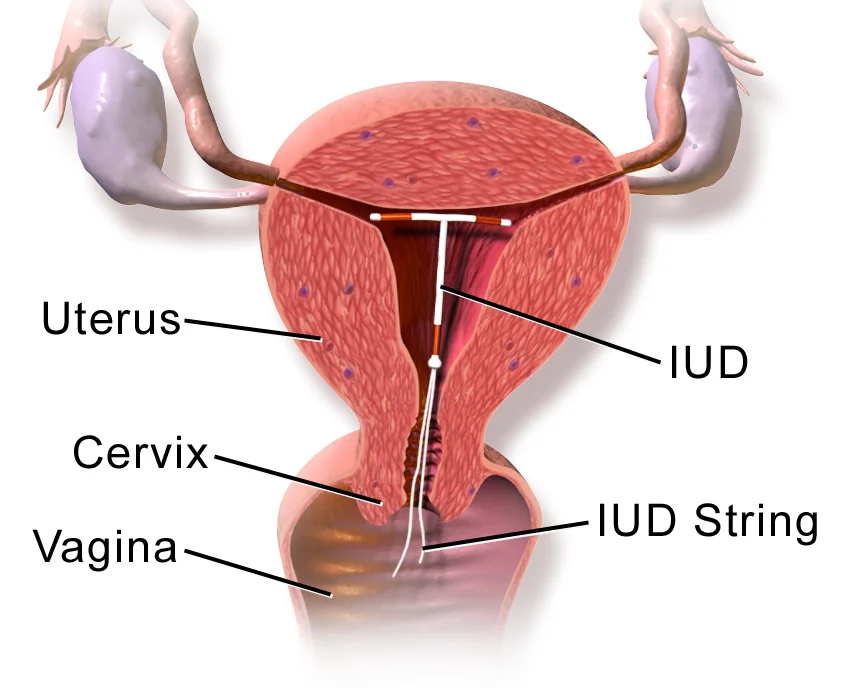
An IUD is a small, usually T-shaped device that is inserted into the uterus by a trained healthcare professional.
There are two main types.
Copper IUD
A copper IUD is hormone-free.
It uses copper to create an environment that interferes with sperm function and prevents pregnancy.
Hormonal IUD
A hormonal IUD releases levonorgestrel, a progestin hormone, inside the uterus.
Both types are long-acting and reversible.
Fewer than 1 in 100 IUD users become pregnant during the first year of typical use.
IUDs do not protect against sexually transmitted infections (Centers for Disease Control and Prevention, 2024).
What Are the Benefits of an IUD?
Highly Effective Contraception
One of the biggest advantages of an IUD is its effectiveness.
Once inserted correctly, it provides continuous contraception without requiring a daily pill or regular action from the user.
Long-Lasting Protection
Depending on the specific device, an IUD can provide contraception for several years.
This can be convenient for women who want reliable contraception without having to remember it every day.
Reversible
An IUD is not permanent contraception.
A healthcare professional can remove it when pregnancy is desired or when the woman decides to use another contraceptive method.
No Daily Contraceptive Pill
Because the device works continuously, there is no daily tablet to remember.
This can eliminate one common reason for contraceptive failure: missed doses.
Copper IUD Is Hormone-Free
The copper IUD provides a non-hormonal contraceptive option.
This can be useful for women who prefer to avoid hormonal contraception.
Hormonal IUD Can Reduce Period Bleeding
Hormonal IUDs commonly change menstrual bleeding.
Spotting and irregular bleeding are expected during the first few months, but bleeding generally becomes lighter with continued use.
Some women eventually experience very light periods or no menstrual bleeding (Centers for Disease Control and Prevention, 2024).
What Are the Common Side Effects of an IUD?
The side effects depend partly on the type of IUD.
Cramping
Cramping is common around the time of insertion.
Some women may continue to experience intermittent cramps during the early adjustment period.
Mild cramping is different from severe or persistent pelvic pain.
Pain that is worsening or interfering significantly with daily activities deserves assessment.
Spotting and Irregular Bleeding
Irregular bleeding and spotting are common after insertion.
With hormonal IUDs, this pattern is particularly common during the first 3-6 months and usually becomes less noticeable over time (Centers for Disease Control and Prevention, 2024).
Heavier Periods With a Copper IUD
Copper IUDs can cause heavier or prolonged menstrual bleeding, particularly during the first few months.
For some women, menstrual cramps may also become stronger.
If heavy bleeding develops after several months of previously stable use, another cause may need to be considered rather than automatically assuming that the IUD is responsible.
Lighter Periods With a Hormonal IUD
Hormonal IUDs generally have the opposite effect.
Menstrual bleeding often decreases with time, and some women eventually experience amenorrhea, meaning they stop having menstrual bleeding.
This can be an expected effect of the hormonal IUD.
Can an IUD Cause Pelvic Pain?
An IUD can be associated with pelvic discomfort, especially around insertion or when menstrual cramping increases.
However, persistent pelvic pain should not automatically be attributed to the device.
Other causes can include pelvic infection, IUD displacement, endometriosis, adenomyosis, ovarian conditions or pelvic-floor dysfunction.
If there is concern that the IUD has moved, imaging such as ultrasound can be used to assess its position (Nowitzki et al., 2015).
Can an IUD Cause Pain During Sex?
Pain during sex is not an inevitable consequence of having an IUD.
Research examining IUD use and female sexual function has generally found neutral effects across most areas of sexual function.
The evidence also suggests that levonorgestrel IUDs may improve sexual pain in some women, although more research is needed. (Ogle & Handy et al., 2024).
If pain develops after insertion, the first step is to determine why.
IUD position, infection and other gynecologic conditions should be considered when clinically appropriate.
If these causes are excluded and pelvic-floor muscle overactivity is present, pelvic-health physiotherapy may become part of the treatment plan.
Can an IUD Affect Your Hormones?
The answer depends on the type.
A copper IUD does not contain hormones.
A hormonal IUD releases levonorgestrel.
Although its main contraceptive effects occur within the reproductive tract, some hormone enters the bloodstream.
Some women report symptoms such as breast tenderness, headaches or acne.
Individual responses vary, and a new symptom should not automatically be assumed to be caused by the IUD.
Can an IUD Cause Weight Gain?
Weight gain is a common concern surrounding hormonal contraception.
However, it would be inaccurate to say that an IUD directly causes significant weight gain in every woman.
Body weight and body composition can change because of many factors, including nutrition, physical activity, sleep, stress, age and medications.
If there is a substantial or unexplained change in weight, it is better to discuss it with a healthcare professional rather than assuming the IUD is the only explanation.
Can an IUD Cause an Infection?
IUDs do not protect against sexually transmitted infections.
The overall risk of pelvic inflammatory disease associated with IUD use is low, but an untreated sexually transmitted infection around the time of insertion is an important consideration.
A systematic review found that the absolute risk remained low but was higher among women with an STI at insertion (Mohllajee et al., 2006).
Symptoms such as fever, unusual vaginal discharge, persistent pelvic pain or significant pain during sex should be medically assessed.
What Are the Less Common IUD Complications?
Serious complications are uncommon, but they are worth understanding.
IUD Expulsion
An IUD can sometimes partially or completely come out of the uterus.
This is called expulsion.
Possible signs include:
- New or unusual cramping
- Unexpected bleeding
- A change in the length of the strings
- Difficulty feeling strings that were previously detectable
- Feeling the device in the vagina
Expulsion can reduce contraceptive protection and should be assessed by a healthcare professional.
Risk varies according to individual circumstances and type of insertion.
Evidence suggests that expulsion can be more common in certain younger populations and after some postpartum insertions (Jatlaoui et al., 2017).
Uterine Perforation
Very rarely, an IUD can pass through the uterine wall during insertion.
This is called uterine perforation.
It is uncommon, but significant or persistent pain after insertion requires appropriate medical assessment.
The CDC describes perforation as a rare event.
Does an IUD Affect Fertility?
One important benefit of an IUD is that it is reversible.
Current evidence is reassuring that fertility generally returns after IUD removal.
A review of the available evidence found high pregnancy rates after removal, with time-to-pregnancy broadly similar to the general population. (Skjeldestad et al., 2008).
However, fertility depends on many factors, including age, ovulation, reproductive health and sperm health.
Does an IUD Affect Exercise?
For most women, an IUD does not require stopping regular physical activity.
Walking, running, resistance training, yoga and other forms of exercise can generally continue according to individual comfort.
The main issue is usually symptom management rather than the IUD itself.
For example, heavier menstrual bleeding may make some women feel more tired, while cramping may temporarily affect exercise tolerance.
A physiotherapist can help modify exercise volume, intensity, recovery and movement strategies when symptoms interfere with physical activity.
Where Does Physiotherapy Fit In?
This is an important distinction.
Physiotherapy does not treat an IUD that has moved, an infection or uterine perforation.
Those conditions require appropriate medical assessment.
Physiotherapy becomes relevant when the pelvic-floor muscles or surrounding musculoskeletal system are contributing to symptoms such as pelvic pain, painful sex or difficulty relaxing the pelvic floor.
Persistent pain can sometimes be accompanied by increased pelvic-floor muscle tone or overactivity.
A systematic review found evidence of increased pelvic-floor muscle tone or overactivity across several pelvic-health conditions, including pain and sexual dysfunction. (Worman et al., 2023).
This does not mean that every woman with an IUD has an overactive pelvic floor.
It means that when pelvic-floor dysfunction is identified as part of the problem, physiotherapy may be useful.
What Can a Pelvic-Health Physiotherapist Assess?
A pelvic-health physiotherapy assessment may look at:
- Pelvic-floor muscle relaxation and coordination
- Breathing patterns
- Abdominal pressure management
- Hip and pelvic movement
- Musculoskeletal contributors to pain
- Pain triggers and aggravating activities
- Sexual positions or movements that reproduce symptoms
The treatment depends on what the assessment finds.
It may include breathing and relaxation training, mobility exercises, graded activity, manual therapy when appropriate, education and individualized pelvic-floor exercises.
Evidence suggests pelvic-floor physical therapy can be beneficial for pelvic-floor hypertonicity and related conditions, including dyspareunia, although the available studies vary in quality and treatment protocols. (van Reijn-Baggen et al., 2022).
A systematic review and meta-analysis of physiotherapy interventions for dyspareunia also reported improvements in pain and quality of life, although the interventions and evidence quality varied between studies. (Fernández-Pérez et al., 2023).
Do You Always Need Kegel Exercises?
No.
This is particularly important when pain is involved.
Kegel exercises are designed to strengthen the pelvic-floor muscles.
But pelvic-floor rehabilitation is not simply about making these muscles stronger.
Some women with pelvic pain have muscles that are already overactive or have difficulty relaxing them.
In such cases, treatment may focus more on relaxation, coordination and reducing unnecessary muscle guarding rather than immediately prescribing repeated contractions.
A recent systematic review also found substantial variation in pelvic-floor muscle-training protocols used for women with dyspareunia, highlighting the importance of individualized treatment rather than applying one exercise program to everyone. (Cavalcanti et al., 2025).
When Should You Have Your IUD Checked?
Medical assessment is important if you experience:
- Severe or worsening pelvic pain
- Very heavy or prolonged bleeding
- Fever or chills
- Foul-smelling vaginal discharge
- New or persistent pain during sex
- A positive pregnancy test while using an IUD
- A sudden change in the IUD strings
- Inability to feel the strings when they were previously detectable
- The device being felt in the vagina
These symptoms do not automatically mean there is a serious complication.
They simply indicate that the cause should be properly assessed instead of assuming it is a normal side effect.
IUD Side Effects: Copper vs Hormonal
| Feature | Copper IUD | Hormonal IUD |
|---|---|---|
| Hormones | No | Levonorgestrel |
| Pregnancy prevention | Highly effective | Highly effective |
| Periods | May become heavier | Usually become lighter |
| Early spotting | Possible | Common |
| Cramping | May increase | Possible |
| Periods may stop | Uncommon | Can occur |
| STI protection | No | No |
| Reversible | Yes | Yes |
These are general patterns. Individual experiences can be different.
IUD: Myth vs Fact
Myth: An IUD always causes painful sex.
Fact: Pain during sex is not an inevitable effect of an IUD. If it develops, medical and pelvic-floor causes should be considered.
Myth: All IUDs contain hormones.
Fact: Copper IUDs are hormone-free. Hormonal IUDs release levonorgestrel.
Myth: Pelvic pain after an IUD always means the IUD has moved.
Fact: Pelvic pain has many possible causes. IUD position, infection, gynecologic conditions and pelvic-floor dysfunction may all need consideration.
Myth: Every pelvic-floor problem needs Kegel exercises.
Fact: Some women with pelvic pain have overactive pelvic-floor muscles that need better relaxation and coordination rather than more strengthening.
Myth: Having an IUD means you need to stop exercising.
Fact: Most women can continue normal physical activity. Exercise may simply need temporary modification if cramping, bleeding or discomfort affects tolerance.
Lesser-Known Fact
The timing of a symptom can provide an important clue.
For example, heavier or prolonged bleeding during the first few months of copper-IUD use can be an expected change.
But if a woman has been using the same IUD for months with a stable bleeding pattern and suddenly develops heavy bleeding, clinicians may consider other causes such as IUD displacement, pregnancy, thyroid disorders or uterine conditions.
The same principle applies to pelvic pain: the onset, severity, duration and associated symptoms all matter.
When Should Physiotherapy Be Considered?
Physiotherapy may be worth considering when:
- Pelvic pain continues after medical causes have been assessed
- Pain occurs during or after sexual activity
- The pelvic floor feels difficult to relax
- Certain movements or positions repeatedly trigger symptoms
- Pelvic or hip movement appears restricted
- Pain is affecting exercise or everyday physical activity
- There is a suspected pelvic-floor muscle contribution to symptoms
The aim is not to treat the IUD itself.
The aim is to address the physical factors contributing to pain or movement limitation.
Final Thoughts
An IUD can provide highly effective, long-lasting and reversible contraception, but every woman’s experience can be different.
Copper IUDs may increase menstrual bleeding and cramping, while hormonal IUDs commonly cause early spotting and tend to make periods lighter over time.
Pelvic pain or painful sex should not automatically be considered a normal consequence of having an IUD. Medical causes should be assessed when symptoms are severe, persistent or unusual.
When pelvic-floor tension, poor muscle coordination or other musculoskeletal factors contribute to symptoms, pelvic-health physiotherapy can be a valuable part of the treatment plan. The goal is to identify what is actually contributing to the symptoms and address that cause appropriately.
Final Thoughts
An IUD can provide highly effective, long-lasting and reversible contraception, but the experience is not identical for every woman.
Copper IUDs can increase menstrual bleeding and cramping, while hormonal IUDs commonly cause early spotting and tend to make periods lighter over time.
Pelvic pain or painful sex should not automatically be labelled as an IUD side effect.
Medical causes such as infection or IUD displacement need to be considered first.
When pelvic-floor tension, poor muscle coordination or other musculoskeletal factors are contributing to persistent symptoms, pelvic-health physiotherapy can become a useful part of the treatment plan.
The most important point is simple: you do not have to choose between “the IUD is causing everything” and “the pain is normal.”
A proper assessment can help identify what is actually contributing to your symptoms and guide the right treatment.
Frequently Asked Questions About IUDs
1. What are the main benefits of an IUD?
IUDs provide highly effective, long-lasting and reversible contraception. They do not require daily contraceptive pills, and copper IUDs provide a hormone-free option.
2. What are the common side effects of an IUD?
Common effects can include cramping, spotting and changes in menstrual bleeding. Copper IUDs may make periods heavier, while hormonal IUDs often make periods lighter over time.
3. Can an IUD cause painful sex?
Pain during sex is not an inevitable effect of an IUD. If it develops, IUD position, infection, gynaecological conditions and pelvic-floor factors may need to be considered.
4. Can an IUD cause pelvic pain?
Some pelvic discomfort can occur around insertion or with increased menstrual cramping. Persistent or severe pelvic pain should be assessed rather than automatically attributed to the IUD.
5. Can an IUD affect fertility?
IUDs are reversible contraceptives. Fertility generally returns after removal, although the time required to conceive varies between individuals.
6. Can I exercise with an IUD?
Most women can continue regular physical activity with an IUD. Exercise may need temporary modification if cramping, bleeding or discomfort affects tolerance.
7. Can physiotherapy help with IUD-related pain?
Physiotherapy does not treat an IUD that has moved or an infection. However, pelvic-health physiotherapy may help when pelvic-floor tension, poor muscle coordination or other musculoskeletal factors contribute to pelvic pain or painful sex.
8. When should I have my IUD checked?
Seek medical assessment for severe or worsening pelvic pain, very heavy bleeding, fever, unusual discharge, a positive pregnancy test, sudden changes in the IUD strings or if the device can be felt in the vagina.
Stay tuned with us for more health related topics.
Follow us on LinkedIn and Instagram for more.
More Read


Medical Disclaimer
This article is intended for general educational and informational purposes only and does not replace individual medical advice, diagnosis or treatment. If you experience severe or worsening pelvic pain, very heavy bleeding, fever, unusual vaginal discharge, suspected pregnancy or concerns about IUD position, consult a qualified healthcare professional promptly. Pelvic-health physiotherapy should complement, not replace, appropriate medical or gynaecological assessment.


