


Testicular pain is one of those symptoms men often try to explain away.
Maybe it happened after exercise, sitting too long, sex, a minor bump, or “just a muscle strain.”
Sometimes that explanation is correct.
But sometimes pain in or around the testicle is the first warning of a condition that needs urgent medical attention.
The important point is that the location of pain does not always reveal its source.
The testicle can hurt because of a problem inside the scrotum, but pain can also be referred from the groin, abdomen, ureter, nerves, pelvic floor, hip, or lower back.
As a physiotherapist, this distinction matters to me.
I do see men with persistent groin or scrotal discomfort where the musculoskeletal and pelvic-floor system contributes to the pain.
But physiotherapy should never be used to “treat” unexplained acute testicular pain before dangerous causes have been excluded.
A 2025 American Urological Association guideline on chronic scrotal-content pain emphasizes that persistent scrotal pain can have multiple causes and may require a multidisciplinary approach rather than a single treatment. (PubMed)
So, if you are experiencing testicular pain, don’t simply ask, “How can I make it stop?”
First ask:
“Why is it happening?”
When testicular pain is an emergency
Before discussing the 10 causes, I want every man reading this to remember one rule:
Sudden, severe testicular pain should be treated as an emergency until testicular torsion has been ruled out.
Testicular torsion occurs when the spermatic cord twists and compromises blood flow to the testicle.
The classic presentation is sudden unilateral scrotal pain, often accompanied by nausea or vomiting.
The testicle may sit higher than usual or appear rotated horizontally. (NIH)
This is not a condition to monitor overnight.
Research consistently shows that the likelihood of saving the affected testicle decreases as ischemia continues.
A recent 2026 study reported markedly better salvage when treatment occurred within six hours compared with later presentation. (PMC)
Therefore, sudden severe pain, especially with swelling, nausea, vomiting, or a high-riding testicle, warrants immediate emergency evaluation.
- Do not wait for a physiotherapy appointment.
- Do not massage the area.
- Do not perform stretching exercises.
- Do not assume it is a groin strain.
1. Testicular torsion
Testicular torsion is the cause of testicular pain that men absolutely should not ignore.
The spermatic cord contains the blood vessels supplying the testicle.
When the cord twists, circulation can become impaired. If the twist persists, the testicular tissue becomes ischemic.
What does torsion feel like?
Typical features include:
- Sudden severe pain in one testicle
- Rapid swelling
- Nausea or vomiting
- Pain that may extend into the lower abdomen or groin
- A testicle positioned higher than usual
- Significant tenderness
- Sometimes no urinary symptoms at all
One lesser-known point is that torsion does not require an obvious injury.
A man can wake up with it, experience it during sleep, or develop it without remembering any specific trigger.
Another important point: pain can occasionally be felt predominantly in the abdomen rather than directly in the scrotum, which can delay recognition.
Studies of acute scrotal presentations have found abdominal pain and nausea/vomiting particularly relevant in torsion cases. (NCBI)
What should you do?
If torsion is suspected, go to an emergency department immediately.
Doppler ultrasound is commonly used to evaluate blood flow, but testing should not create dangerous delays when clinical suspicion is high.
Surgical assessment may be required urgently. (AFP)
Physiotherapy perspective: This is not a condition for exercises, manual therapy, or observation.
2. Epididymitis or epididymo-orchitis
The epididymis is a coiled structure located behind each testicle where sperm mature and are stored.
Inflammation of this structure is called epididymitis.
When inflammation spreads to the testicle, it can become epididymo-orchitis.
Pain often develops more gradually than torsion and may occur with:
- Scrotal swelling
- Tenderness
- Warmth or redness
- Burning during urination
- Urinary frequency
- Penile discharge
- Fever
- Pain during ejaculation
The cause can vary according to age and circumstances.
Sexually transmitted infections such as chlamydia and gonorrhea are important causes in sexually active men, while enteric bacteria can be involved in other situations. (KJU)
An important mistake to avoid
A man with scrotal pain should not assume that “it must be an infection” simply because the epididymis feels tender.
The CDC specifically stresses maintaining suspicion for testicular torsion when symptoms have a sudden onset because torsion is a surgical emergency.
If epididymitis is diagnosed, treatment depends on the suspected organism and clinical situation.
Antibiotics may be necessary, and supportive measures such as scrotal support and activity modification can be recommended.
If symptoms are not improving within approximately 72 hours after treatment begins, reassessment is important because another diagnosis may be responsible.
3. Varicocele
A varicocele is an enlargement of the veins within the scrotum.
Think of it as a network of veins becoming dilated instead of efficiently returning blood.
Varicoceles are common, but only a proportion of men with them experience pain.
A review reported that approximately 15% of men have a scrotal varicocele, while roughly 2-10% of those men report pain. (World Journal of Men’s Health)
The typical pain pattern is very different from torsion.
Men often describe it as:
- A dull ache
- Heaviness
- Dragging discomfort
- Throbbing
- Pain that becomes more noticeable after prolonged standing or physical activity
Interestingly, varicocele-related pain may sometimes extend toward the groin.
A useful observation
If your scrotal discomfort consistently increases after standing for long periods and feels better when lying down, mention that pattern to your doctor.
A clinically significant varicocele may sometimes be associated with fertility concerns as well as discomfort.
Physiotherapy perspective: Exercise modification may help reduce symptom aggravation, but a physiotherapist cannot determine from pain alone whether a varicocele is present.
A medical examination and, when appropriate, ultrasound are needed.
4. Inguinal hernia
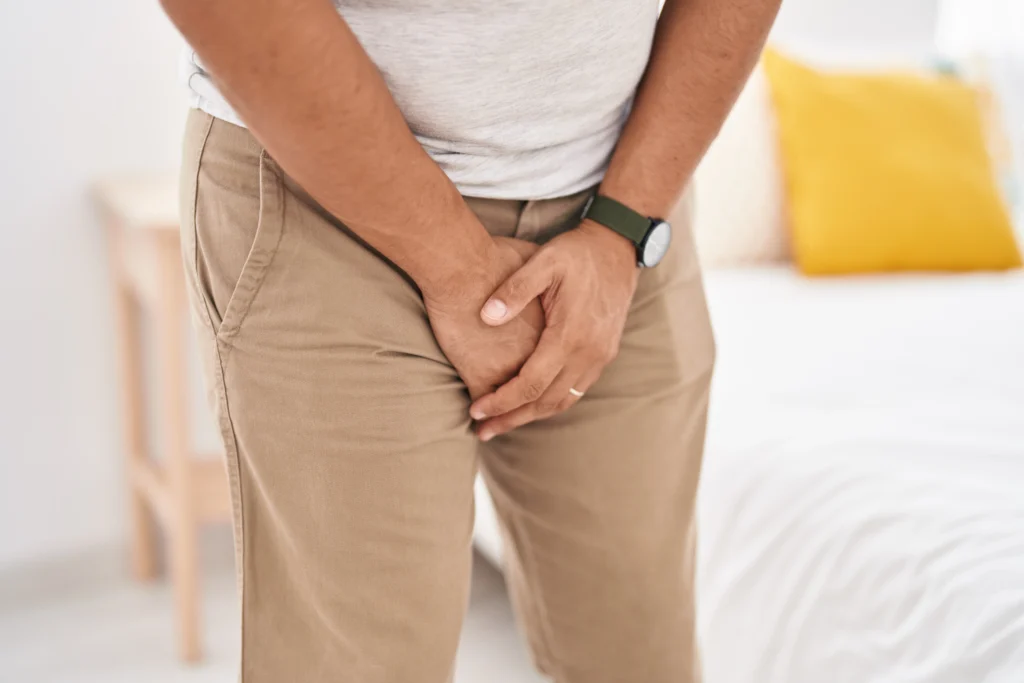
Not all “testicular pain” originates in the testicle.
An inguinal hernia occurs when tissue pushes through a weakened area of the abdominal wall in the groin.
The protruding tissue can sometimes extend toward the scrotum, producing groin or testicular discomfort. (Mayo Clinic)
You may notice:
- Groin pressure
- A bulge in the groin
- Scrotal swelling
- Discomfort when coughing
- Pain while lifting
- A dragging sensation
- Symptoms that increase after prolonged standing
One of the clues I look for from a physiotherapy perspective is whether the pain changes with movement, coughing, lifting, or abdominal pressure.
But this does not mean movement-related pain is automatically muscular.
A hernia can also be aggravated by physical activity.
When it becomes urgent
Sudden severe pain associated with a firm or irreducible groin/scrotal bulge, vomiting, or abdominal symptoms requires urgent medical evaluation because a trapped or strangulated hernia can become dangerous.
Do not repeatedly push a painful swelling back into place yourself.
5. Kidney or ureteric stone
This is one of the most overlooked causes.
A kidney stone does not necessarily produce pain where you expect it.
A stone moving through the ureter can cause pain that travels from the flank or abdomen toward the groin and sometimes the testicle.
This happens because different structures share overlapping sensory nerve pathways. (StatPearls)
Typical symptoms can include:
- Severe flank pain
- Urinary urgency or frequency
- Groin or testicular pain
- Pain that comes in waves
- Nausea or vomiting
- Blood in the urine
But here is a lesser-known fact: isolated testicular pain can occasionally be the presenting symptom of a distal ureteric stone, even without obvious flank pain or urinary symptoms.
A recent case report described exactly this unusual presentation. (NCBI)
This is why a normal scrotal examination does not always end the investigation.
If testicular ultrasound is normal but pain persists and the clinical pattern suggests referred pain, your doctor may consider urinary or abdominal causes.
6. Testicular cancer
Many men assume testicular cancer must cause severe pain.
That is not necessarily true.
One of the classic presentations is actually a painless lump or change in the testicle.
However, the National Cancer Institute also lists testicular or scrotal discomfort, dull aching in the lower abdomen or groin, and sudden fluid accumulation among possible symptoms. (National Cancer Institute)
Watch for:
- A new lump
- Change in testicular size
- Change in firmness
- A heavy sensation
- Persistent swelling
- Dull groin discomfort
- Persistent testicular discomfort
Do not try to diagnose a lump by repeatedly squeezing or comparing it yourself.
A new or persistent testicular change deserves medical assessment.
An important distinction
Pain does not automatically mean cancer.
In fact, many other conditions are much more common causes of scrotal discomfort.
But the reverse is also true:
Absence of pain does not rule out testicular cancer.
That is why noticing a new lump or structural change matters even if you feel perfectly well.
7. Trauma or sports-related testicular injury
The testicles are vulnerable during cycling, football, cricket, martial arts, gym training, contact sports, falls, and direct blows.
A minor injury may produce temporary soreness.
However, significant trauma can cause:
- Hematoma
- Hematocele
- Testicular contusion
- Testicular rupture
- Traumatic torsion
Severe swelling after trauma should not automatically be labelled a simple bruise.
Ultrasound with Doppler is an important part of evaluating significant scrotal trauma, while suspected rupture or a large hematocele may require surgical management. (SpringerLink)
A physiotherapy tip
If pain started after a sports injury, don’t immediately return to running, cycling, squats, or heavy lifting simply because you can tolerate the movement.
The first question is whether the testicle itself has been injured.
Once serious injury has been excluded, rehabilitation can focus on gradually restoring normal movement and activity.
8. Pelvic floor muscle overactivity
This is where the physiotherapy perspective becomes particularly important.
Not every case of persistent testicular pain is caused by damage to the testicle itself.
Some men develop chronic scrotal-content pain associated with pelvic-floor muscle dysfunction.
The pelvic floor is a group of muscles involved in urinary control, bowel function and sexual function.
These muscles can become excessively tense or poorly coordinated.
Pain may be associated with:
- Long periods of sitting
- Pelvic pressure
- Pain after ejaculation
- Urinary symptoms
- Perineal discomfort
- Groin pain
- Lower abdominal discomfort
- Symptoms that fluctuate with stress or muscle tension
The 2025 AUA guideline recognizes the potential role of multidisciplinary management in chronic scrotal-content pain. (Wolters Kluwer)
More specifically, a study of men with chronic scrotal pain and pelvic-floor abnormalities found meaningful improvement after pelvic-floor physical therapy.
In that cohort, 50% experienced pain improvement, with a median pain reduction of 4.5/10 after an average of 12 therapy sessions. (CJU)
This does not mean every man with testicular pain needs pelvic-floor exercises.
In fact, that can be counterproductive.
If the pelvic floor is already overactive, repeatedly performing aggressive Kegels may increase muscle tension rather than relieve symptoms.
What physiotherapy may involve
Depending on the assessment, treatment may include:
- Breathing-based relaxation
- Pelvic-floor down-training
- Hip mobility work
- Gentle abdominal and pelvic mobility
- Myofascial techniques
- Posture and sitting modifications
- Gradual return to exercise
- Education about pain sensitivity
This should come after appropriate medical assessment, particularly when the pain is new or unexplained.
9. Nerve-related or referred pain from the back, hip or groin
This is one of the most interesting and under-recognized possibilities.
The testicle shares sensory connections with structures in the lower abdomen, groin and spinal region.
Consequently, irritation of nerves or musculoskeletal structures can sometimes create pain that feels as though it is coming directly from the testicle.
Possible sources include:
- Lumbar spine problems
- Hip pathology
- Ilioinguinal nerve irritation
- Genitofemoral nerve irritation
- Previous groin surgery
- Post-hernia-repair pain
- Pelvic musculoskeletal dysfunction
Research into chronic scrotal-content pain recognizes referred pain from the spine, abdomen and retroperitoneum as part of the differential diagnosis. (PMC)
A newer 2025 study of men with chronic scrotal-content pain found associations between greater scrotal pain severity and worse back, hip, urinary, sexual and psychological symptoms. (Sage Journals)
What this means clinically
If your scrotal ultrasound is normal but you continue to experience pain, the answer is not necessarily “nothing is wrong.”
Sometimes the next question should be:
“Could the pain be coming from somewhere else?”
That is where a properly trained physiotherapist can contribute to the multidisciplinary assessment.
10. Hydrocele and other scrotal fluid or structural problems
A hydrocele occurs when fluid accumulates around the testicle.
Many hydroceles cause painless swelling rather than severe pain.
However, increasing size can produce heaviness, pressure or discomfort. (Mayo Clinic)
A hydrocele may also occur alongside another condition, which is why a new scrotal swelling should not simply be assumed to be harmless.
Other possibilities that doctors may consider include:
- Spermatocele
- Epididymal cyst
- Hematocele
- Inflammation
- Scrotal masses
- Post-surgical changes
Ultrasound can help distinguish among several of these conditions.
The important takeaway is simple:
A new scrotal swelling deserves an examination even when it isn’t painful.
Testicular pain that actually comes from somewhere else
One of the biggest misconceptions surrounding male pelvic pain is that the painful structure must be the damaged structure.
It isn’t always.
A man can have pain in the testicle while the source is:
Kidney → ureter → groin → testicle
or
Lower back → nerve pathway → groin → scrotum
or
Hip/groin muscles → pelvic region → scrotal pain
or
Pelvic-floor muscle tension → referred scrotal discomfort
This is why chronic scrotal-content pain can be challenging to diagnose.
Reviews describe infection, trauma, referred pain and cases in which no obvious cause can initially be identified. (NIH)
What not to do when your testicle hurts
There are several mistakes I would strongly discourage.
Don’t massage sudden severe testicular pain
Massage is appropriate for certain musculoskeletal problems.
It is not an appropriate first response to possible torsion, infection, trauma or an undiagnosed scrotal mass.
Don’t perform aggressive stretching
Groin stretching may be helpful for selected musculoskeletal conditions, but it is not a diagnostic treatment.
Don’t repeatedly check the testicle by squeezing it
Repeated palpation can increase irritation and anxiety without telling you what the underlying problem is.
Don’t take leftover antibiotics
Different causes of epididymitis require different treatment strategies, and antibiotics do not treat torsion, cancer, hernia or most musculoskeletal causes.
Don’t wait several days if pain appeared suddenly
This is particularly important.
The “I’ll see how I feel tomorrow” approach can be dangerous in testicular torsion.
What can you do to reduce preventable testicular and pelvic pain?
You cannot prevent every cause, but several habits can reduce avoidable aggravation.
Protect yourself during sport
Use appropriate protective equipment for contact sports and activities where direct trauma is possible.
Avoid sudden increases in training load
A sudden jump in cycling, running, squatting or heavy lifting can aggravate the groin and pelvic region.
Increase exercise progressively.
Take sitting breaks
If prolonged sitting aggravates pelvic or scrotal discomfort, stand, walk and change positions regularly.
Don’t ignore urinary or sexual symptoms
Burning urination, discharge, pelvic discomfort or pain during ejaculation can provide useful clues about the underlying cause.
Pay attention to patterns
Before your appointment, note:
- Which side hurts
- Whether pain is sudden or gradual
- Whether standing worsens it
- Whether lying down helps
- Whether exercise changes it
- Whether urination affects it
- Whether ejaculation affects it
- Whether back or hip movement reproduces it
- Whether swelling or a lump is present
This information can make the medical assessment much more useful.
When should you see a doctor?
Seek emergency care immediately for:
- Sudden severe testicular pain
- Sudden swelling
- Testicular pain with nausea or vomiting
- A high-riding or unusually positioned testicle
- Severe pain after significant trauma
- Severe pain with a painful groin/scrotal bulge
- Rapidly worsening symptoms
Arrange prompt medical evaluation for:
- A new lump
- Persistent swelling
- Recurrent testicular pain
- Unexplained pain lasting weeks
- Pain associated with urinary symptoms
- Penile discharge
- Fever
- A change in testicular size or firmness
Persistent scrotal pain lasting at least three months is generally considered chronic scrotal-content pain and deserves a structured evaluation rather than endless trial-and-error treatment. (NCBI)
How is testicular pain evaluated?
Depending on the symptoms, a clinician may use:
- Physical examination
- Urinalysis
- Urine culture
- STI testing when appropriate
- Scrotal Doppler ultrasound
- Blood tests
- Abdominal or urinary imaging
- Urological assessment
The correct investigation depends on the clinical picture.
There is no single “testicular pain test” that identifies every cause.
Where physiotherapy fits into testicular pain treatment
Physiotherapy has a role, but the timing matters.
For acute unexplained testicular pain, the priority is medical assessment.
For chronic pain after dangerous conditions have been excluded, physiotherapy may become useful when examination suggests:
- Pelvic-floor overactivity
- Hip mobility restrictions
- Muscular trigger points
- Abdominal wall dysfunction
- Lumbar referred pain
- Poor movement patterns
- Persistent guarding
- Exercise-related aggravation
The goal is not simply to “strengthen the pelvis.”
Sometimes the most appropriate treatment is actually teaching the pelvic floor to relax.
That distinction is particularly important in men with chronic pelvic pain.
Current AUA guidance supports individualized, multidisciplinary care for chronic scrotal-content pain, while acknowledging that evidence for many treatment approaches is still evolving. (AUA)
The bottom line
Testicular pain can be caused by something relatively manageable, such as a varicocele or musculoskeletal referral.
But it can also signal testicular torsion, infection, trauma, hernia, a urinary stone or a testicular tumor.
The most important lesson is not to diagnose yourself from the pain pattern.
Sudden severe testicular pain is an emergency until torsion has been excluded.
If serious causes have been ruled out and pain persists, don’t stop at “your ultrasound is normal.”
Chronic scrotal pain can involve nerves, the pelvic floor, spine, hip and other structures, and a multidisciplinary approach may be more appropriate.
As a physiotherapist, my advice is simple: don’t ignore persistent testicular pain, but don’t assume every testicular pain problem needs an exercise either.
First identify the cause. Then treat the cause.
Stay tuned with us for more health related topics.
Follow us on LinkedIn and Instagram for more.
More Read


Medical Disclaimer!
This article has been reviewed and written under the guidance of our Head Physiotherapist, Dr. Kruti Raj (PT, MUHS,CPT,CMPT). The information shared is intended for educational purposes only and should not be considered a substitute for personalized medical advice, diagnosis, or treatment.
Please consult us or any other qualified healthcare professional before beginning any exercise program, especially if you are experiencing pain, recovering from injury, or managing a medical condition.


