


Pregnancy changes the way your body moves in ways most women never expect.
One week you feel normal.
A few weeks later, rolling in bed suddenly feels awkward, your lower back starts aching after standing too long, and even sitting on the sofa feels different.
A lot of women think this is simply part of pregnancy and something they have to tolerate.
Quick Answer
Safe abs exercises during pregnancy focus on stability, breathing, posture, and pressure management rather than intense abdominal workouts. Gentle movements such as pelvic tilts, bird dog exercises, deep breathing, seated knee lifts, and side-lying core activation may help support the spine, reduce back pain, and improve core coordination safely during pregnancy.
Pregnancy-safe core exercises should never cause abdominal doming, pelvic heaviness, sharp pain, or breath-holding. A physiotherapist-guided approach is often the safest and most effective way to strengthen the core during pregnancy.
But very often, I notice something else in clinic.
The deep core muscles stop working efficiently as the belly grows, posture changes, and breathing patterns shift upward into the chest.
That does not mean pregnant women need intense ab workouts.
It means the body usually benefits from learning how to manage pressure better.
Key Takeaways
- Safe pregnancy core exercises focus more on pressure management than intense strengthening.
- Deep breathing and posture correction are often as important as abdominal exercises.
- Pelvic tilts, bird dog exercises, walking, and side-lying core activation are commonly recommended during pregnancy.
- Abdominal doming, pelvic heaviness, and breath-holding may indicate excessive pressure during workouts.
- Some degree of abdominal separation during pregnancy is common and often normal.
- Pregnancy workouts should feel supportive and sustainable, not exhausting or painful.
- Modified exercise programs may help reduce lower back pain and improve stability during pregnancy.
- Every pregnancy responds differently, so exercises should always be individualized.
As a physiotherapist, I spend far more time teaching women how to breathe, move, roll, stand, and stabilize comfortably than teaching traditional “core workouts.”
And honestly, many women are surprised by that.
Most online pregnancy fitness advice focuses either on completely avoiding abdominal exercises or pushing through trendy prenatal workouts that ignore pressure symptoms altogether.
The truth sits somewhere in the middle.
Safe abs exercises during pregnancy are not about building visible abs.
They are about helping the body stay supported while everything is changing rapidly. (NIH)
Regular physical activity during pregnancy is associated with better overall maternal health, improved function, and reduced discomfort in many pregnancies.
Why Core Strength During Pregnancy Matters More Than Most Women Realize
A lot of people think the core only means the six-pack muscles.
In reality, your core is more like a pressure management system.
It includes:
- Deep abdominal muscles
- Pelvic floor
- Diaphragm
- Lower back muscles
- Hip stabilizers
These muscles constantly communicate with each other.
When breathing becomes shallow, the pelvic floor often tightens.
When posture changes, the abdominal wall starts handling pressure differently.
When women hold tension in the ribs and upper body, the lower back usually compensates.
This is why pregnancy-related back pain is not always “just because of the bump.”
Sometimes the body simply loses coordination.
One thing many women notice around the second trimester is that they start leaning backward while standing.
The growing belly shifts the center of gravity, and the spine adapts automatically.
Unfortunately, that posture also compresses the lower back.
That is where gentle core training can help.
Not by making the stomach “stronger” in a gym-style way, but by improving stability, breathing, posture, and movement efficiency.
The Part Nobody Talks About Enough: Pressure
Most pregnancy exercise mistakes come down to pressure.
Not weakness.
Pressure.
I often explain it this way to patients.
Imagine squeezing a balloon from the middle.
Pressure has to move somewhere.
During pregnancy, if pressure is not managed well, women may notice:
- Bulging through the abdomen
- Pelvic heaviness
- Rib discomfort
- Back pain
- Urine leakage
- A dragging sensation downward
And surprisingly, even very fit women can struggle with this.
In fact, highly athletic women sometimes find pregnancy harder emotionally because they are used to pushing through workouts, but pregnancy responds better to adaptation than intensity.
Understanding Diastasis Recti Without Fear
One of the biggest fears women develop during pregnancy is abdominal separation.
Diastasis recti refers to the widening of connective tissue between the abdominal muscles as the uterus expands.
Some degree of separation is extremely common and often completely normal. (Cleveland Clinic 2025)
What matters more is how the body manages pressure during movement.
This is important because many women panic the moment they hear the term “diastasis.”
Then they stop moving completely.
Ironically, complete inactivity sometimes worsens stiffness, posture, weakness, and discomfort.
Current evidence suggests appropriately modified exercise does not automatically worsen abdominal separation. (Gluppe et al. 2024)
A recent trial found that abdominal and pelvic floor exercises during pregnancy did not significantly worsen diastasis recti in most participants.
That is a really important conversation shift.
The focus is slowly moving away from fear and toward better pressure management.
Signs Your Abs Exercises May Be Too Intense
Pregnancy-safe workouts are not one-size-fits-all.
An exercise that feels fine for one woman may feel awful for another.
A few things I tell women to watch for:
- Doming through the midline
- Breath-holding
- Pelvic pressure
- Heaviness downward
- Rib pain
- Sharp back discomfort
- Neck tension during exercises
- Feeling “pushed down” afterward
These signs matter more than the exercise name itself.
I have seen women tolerate modified planks beautifully and struggle badly with simple seated exercises because they were unknowingly holding their breath the entire time.
Safe Abs Exercises During Pregnancy
Deep Core Breathing
This is probably the most overlooked prenatal exercise.
And honestly, it is one of the most effective.
Most pregnant women gradually shift into shallow chest breathing because the rib cage tightens and the baby pushes upward.
The problem is that shallow breathing changes pressure throughout the trunk.
Breathing mechanics are closely connected to spinal stability and deep core activation.
How to Practice
- Sit comfortably with relaxed shoulders.
- Place hands around the lower ribs.
- Inhale slowly through the nose.
- Feel the ribs widen sideways.
- Exhale gently through the mouth.
- Lightly engage the lower abdomen without sucking inward aggressively.
One thing women often notice after practicing this consistently is reduced rib tightness and less upper-body tension.
Pelvic Tilts
This exercise looks simple, but it is incredibly useful during pregnancy.
Why It Helps
Pelvic tilts can:
- Reduce back stiffness
- Improve spinal movement
- Encourage gentle abdominal activation
- Improve awareness of pelvic positioning
How to Perform
- Come onto hands and knees.
- Slowly tuck the pelvis inward.
- Round the lower back gently.
- Return to neutral slowly.
A common mistake is rushing through repetitions.
Slow movement works better.
Especially during pregnancy.
Bird Dog Exercise
I use this exercise constantly in prenatal physiotherapy because it trains coordination without excessive abdominal pressure.
Steps
- Start on hands and knees.
- Extend one arm forward.
- Extend the opposite leg backward.
- Hold briefly.
- Return slowly.
The goal is not lifting the leg high.
The goal is maintaining control.
A lot of women are surprised by how challenging balance suddenly feels during pregnancy.
That happens because the body is constantly adapting to weight shifts.
Heel Slides
This is a gentle way to activate the lower abdominal muscles without aggressive strain.
How to Perform
- Lie with knees bent.
- Keep the pelvis neutral.
- Slowly slide one heel outward.
- Return slowly.
- Alternate sides.
If lying flat feels uncomfortable, elevating the upper body slightly with pillows usually helps.
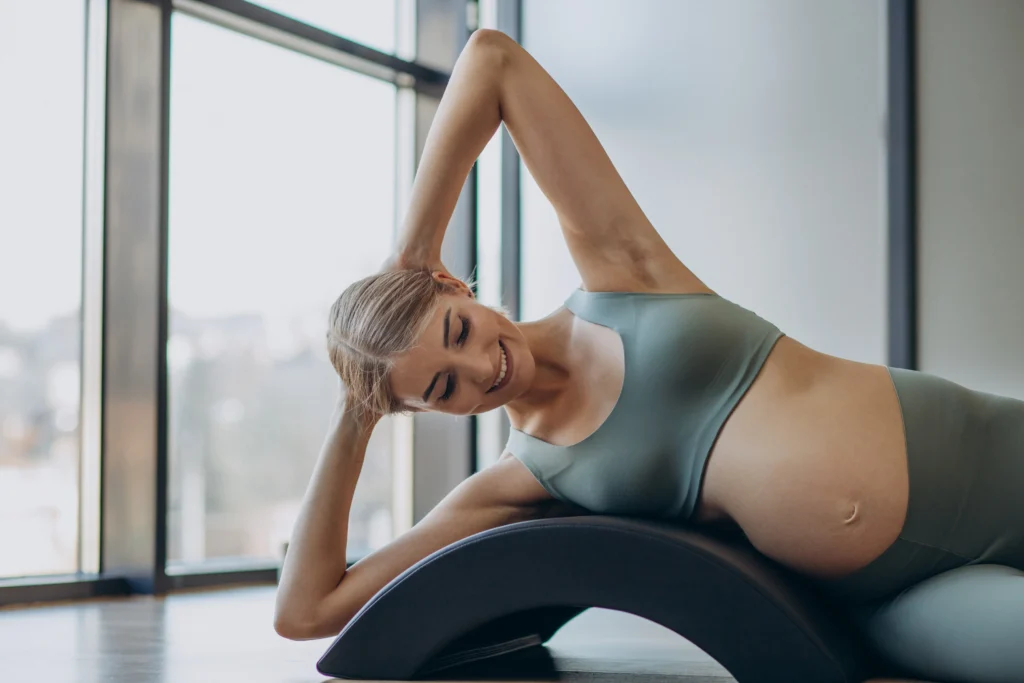
Side-Lying Core Activation
Late pregnancy often makes floor exercises uncomfortable.
That is why side-lying work becomes useful.
Steps
- Lie on your side with knees bent.
- Place a pillow under the head.
- Exhale gently.
- Lightly engage the lower abdomen.
- Relax completely.
Many women unknowingly over-tighten their abs.
This exercise teaches gentle activation instead of gripping.
Seated Knee Lifts
This exercise works well for women who dislike floor exercises.
How to Perform
- Sit tall on a chair or birth ball.
- Relax the shoulders.
- Slowly lift one knee.
- Lower with control.
- Alternate sides.
It looks easy.
But done properly, it improves coordination between the hips, lower abs, and spinal stabilizers.
Walking Is Still One of the Best Prenatal Exercises
Walking gets underestimated because it seems too basic.
But walking supports:
- Pelvic movement
- Circulation
- Core coordination
- Hip mobility
- Posture
One thing I notice often is that pregnant women start leaning backward while walking without realizing it.
That backward lean increases spinal compression.
A small posture adjustment can change comfort significantly.
The Truth About Planks During Pregnancy
This topic causes endless confusion online.
Some women tolerate modified planks well.
Others develop pressure symptoms quickly.
The real question is not:
“Are planks bad?”
The better question is:
“Can your body manage pressure well during this movement?”
If you notice:
- Bulging
- Breath-holding
- Pelvic heaviness
- Lower back pain
the exercise probably needs modification.
Incline planks are often better tolerated than floor planks.
Exercises Commonly Modified During Pregnancy
Certain movements increase abdominal pressure more aggressively.
These often include:
- Traditional crunches
- Sit-ups
- Double leg lifts
- Intense twisting
- High-impact ab circuits
- Aggressive planking
International prenatal exercise guidelines emphasize modification and individualized exercise selection during pregnancy. (Mottola et al. 2019)
A Lesser-Known Reason Some Women Feel Worse After “Safe” Workouts
Fatigue changes posture more than most people realize.
When muscles become tired, many women:
- Grip through the ribs
- Clench the jaw
- Hold their breath
- Tighten the pelvic floor
Interestingly, jaw tension and pelvic floor tension are neurologically connected.
This is one reason breathing exercises matter so much.
Pregnancy exercise should not leave women feeling compressed or braced all day afterward.
Constipation and Core Pressure
This topic almost never gets discussed in fitness articles.
But constipation changes pressure management significantly.
Straining repeatedly increases downward pressure through the pelvic floor and abdominal wall.
Hydration, walking, breathing mechanics, and posture all influence bowel function during pregnancy.
That matters more than people think.
Why Rib Mobility Matters During Pregnancy
As pregnancy progresses, the rib cage expands to accommodate breathing changes.
When ribs become stiff, breathing usually shifts upward into the neck and shoulders.
Then women often complain about:
- Tight traps
- Mid-back tension
- Rib pain
- Poor posture
- Difficulty taking deep breaths
Sometimes improving rib mobility helps the core function better without directly training the abs harder.
Social Media Has Created Unrealistic Expectations
This needs to be said honestly.
A lot of prenatal fitness content online is performative.
Women see influencers doing advanced workouts deep into pregnancy and assume they should tolerate the same thing.
But symptoms matter more than appearances.
I have worked with women who looked “fit” online while privately dealing with severe pelvic heaviness, leaking, or pain.
Pregnancy is not a performance.
Your body does not need to prove anything.
What Research Says About Prenatal Exercise
Modern research strongly supports appropriately modified physical activity during pregnancy. (PubMed)
Prenatal exercise has been associated with:
- Reduced back pain
- Improved functional capacity
- Better overall wellbeing
- Lower risk of certain pregnancy complications
Another important shift in research is the growing focus on pressure management rather than simply “tightening the core.”
That is a much healthier approach for pregnant women physically and mentally.
A Simple Pregnancy Core Routine That Feels Realistic
A lot of women do not need a complicated 45-minute routine.
A simple approach often works better.
Morning
- Deep breathing
- Gentle walking
- Pelvic tilts
Afternoon
- Posture reset breaks
- Seated knee lifts
- Stretching hips gently
Evening
- Bird dog exercise
- Side-lying breathing
- Relaxation work
Consistency matters more than intensity.
Common Mistakes I See Frequently
Holding the Breath During Movement
This increases pressure immediately.
Especially while:
- Getting out of bed
- Standing up
- Lifting things
- Exercising
Thinking More Intensity Means Better Results
Pregnancy responds better to control than force.
Ignoring Pressure Symptoms
Leaking, heaviness, or doming are useful signals.
Not something to push through.
Comparing Yourself to Other Pregnant Women
Every pregnancy adapts differently.
Symptoms vary hugely between women.
When to Stop Exercising and Contact Your Doctor
Stop exercising and seek medical advice if you experience:
- Vaginal bleeding
- Fluid leakage
- Dizziness
- Chest pain
- Severe pelvic pain
- Contractions
- Significant shortness of breath
- Reduced fetal movement
Safety comes first.
Always.
Final Thoughts
Safe abs exercises during pregnancy are not about shrinking your waist or “staying toned.”
They are about helping the body feel supported while it adapts to enormous physical change.
And honestly, sometimes the smallest changes help the most.
Learning how to breathe better.
Rolling out of bed differently.
Relaxing the ribs.
Stopping breath-holding.
Improving posture.
These things matter.
Pregnancy is not the time to punish the body.
It is the time to support it intelligently.
Frequently Asked Questions
Are abs exercises safe during pregnancy?
Yes, many gentle core exercises are considered safe during pregnancy when modified properly and approved by your healthcare provider.
What core exercises are safest during pregnancy?
Deep breathing exercises, pelvic tilts, bird dog exercises, walking, and seated knee lifts are commonly recommended by physiotherapists.
Should I avoid crunches during pregnancy?
Traditional crunches and aggressive sit-ups are often modified or avoided because they may increase abdominal pressure.
Can core exercises help reduce pregnancy back pain?
Yes, safe core exercises may improve spinal support, posture, and pelvic stability, which can help reduce lower back discomfort.
Can pregnancy exercises prevent diastasis recti?
No exercise can completely prevent abdominal separation, but proper pressure management and modified movement may reduce excessive strain.
Is walking considered a core exercise during pregnancy?
Walking supports posture, pelvic mobility, circulation, and core coordination, making it one of the most beneficial prenatal exercises.
When should I stop exercising during pregnancy?
Stop exercising and contact your doctor if you experience bleeding, dizziness, contractions, fluid leakage, severe pain, or reduced fetal movement.
Stay tuned with us for more health related topics.
Follow us on LinkedIn and Instagram for more.
More Read


Medical Disclaimer!
This article has been reviewed and written under the guidance of our Head Physiotherapist, Dr. Kruti Raj (PT, MUHS,CPT,CMPT). The information shared is intended for educational purposes only and should not be considered a substitute for personalized medical advice, diagnosis, or treatment.
Please consult us or any other qualified healthcare professional before beginning any exercise program, especially if you are experiencing pain, recovering from injury, or managing a medical condition.


