


It was a sunny Sunday morning when Rohan, a 28-year-old software engineer and weekend adventurer, decided to join his friends for a quick football match. A mistimed fall later, he clutched his wrist in agony — swollen, misshapen, and throbbing with a strange heat.
Little did he know, this simple fall had given him a wrist fracture, one of the most common orthopedic injuries worldwide.
What Exactly Is a Wrist Fracture?
A wrist fracture occurs when one or more bones in the wrist break.
Your wrist isn’t just a simple joint — it’s a complex structure made of eight small carpal bones plus the ends of the radius and ulna (forearm bones).
A break can happen in any of these, but the distal radius fracture (near the wrist end of the radius) is the most common type.
Types of Wrist Fractures (And How They Differ)
- Distal Radius Fracture (Colles’ or Smith’s)
- Most common type, especially after falls on outstretched hand.
- Colles’ fracture: bone shifts backward.
- Smith’s fracture: bone shifts forward.
- Healing time: 6–8 weeks for mild cases; 10–12 weeks if displaced or surgical.
- Scaphoid Fracture
- A tiny bone at the base of the thumb. Often missed in X-rays.
- Pain near the base of the thumb is a red flag.
- Healing time: 6–20 weeks. Poor blood supply can delay healing or cause non-union.
- Barton’s Fracture
- Intra-articular fracture (goes into the wrist joint) with dislocation.
- Requires surgical fixation.
- Healing time: 10–12 weeks, plus longer rehab for wrist mobility.
- Chauffeur’s Fracture
- A break in the radial styloid process, often from a sudden twisting force.
- Named after old car crank injuries!
- Healing time: 8–10 weeks.
- Greenstick Fracture (Children)
- The bone bends and cracks, not fully broken.
- Common in kids due to softer bones.
- Healing time: 4–6 weeks.
Rare Fact:
Scaphoid fractures are often missed on initial X-rays, leading to poor healing if undetected!
How Does It Happen?
- Falls — landing awkwardly on an outstretched hand (like Rohan did)
- Sports Injuries — football, skating, snowboarding accidents
- Car or bike crashes
- Osteoporosis — weaker bones mean easier fractures, even with minor trauma
Immediate Signs You Should Never Ignore
- Visible deformity
- Swelling and bruising
- Severe pain, especially with wrist movement
- Numbness or tingling (suggests nerve involvement)
What to Do Immediately After a Wrist Fracture
- Immobilize the wrist with a splint.
- Keep it elevated to minimize inflammation.
- Apply ice to reduce swelling.
- Do not try to adjust the wrist yourself. Head to an emergency room immediately.
- Seek emergency care — X-rays are critical to confirm the diagnosis.
Lesser-Known Tip:
Avoid removing jewelry (rings, bracelets) after swelling starts. Do it immediately or risk cutting them off later at the ER.
Lesser-Known Yet Effective Treatment Options
- Low-Intensity Pulsed Ultrasound (LIPUS)
- Stimulates bone healing at the fracture site.
- Especially useful for non-union fractures like the scaphoid.
- Bone Stimulators (PEMF Devices)
- Pulsed electromagnetic fields to accelerate bone repair.
- Often used post-surgery or for delayed healing.
- PRP (Platelet-Rich Plasma) Therapy
- Emerging treatment where patient’s own platelets are injected to promote healing.
- Still under research, but some orthopedists use it for faster recovery.
- 3D-Printed Custom Splints
- Lightweight, breathable, and designed to improve comfort during immobilization.
Surgical vs Non-Surgical Options
- Non-Surgical:
For non-displaced or minimally displaced fractures.
➔ Cast or splint for 4–8 weeks. - Surgical:
Required if the bones are misaligned or shattered.
➔ Metal pins, plates, or screws are inserted.
➔ Sometimes external fixation frames are used for complex breaks.
Physiotherapy: The Unsung Hero of Recovery
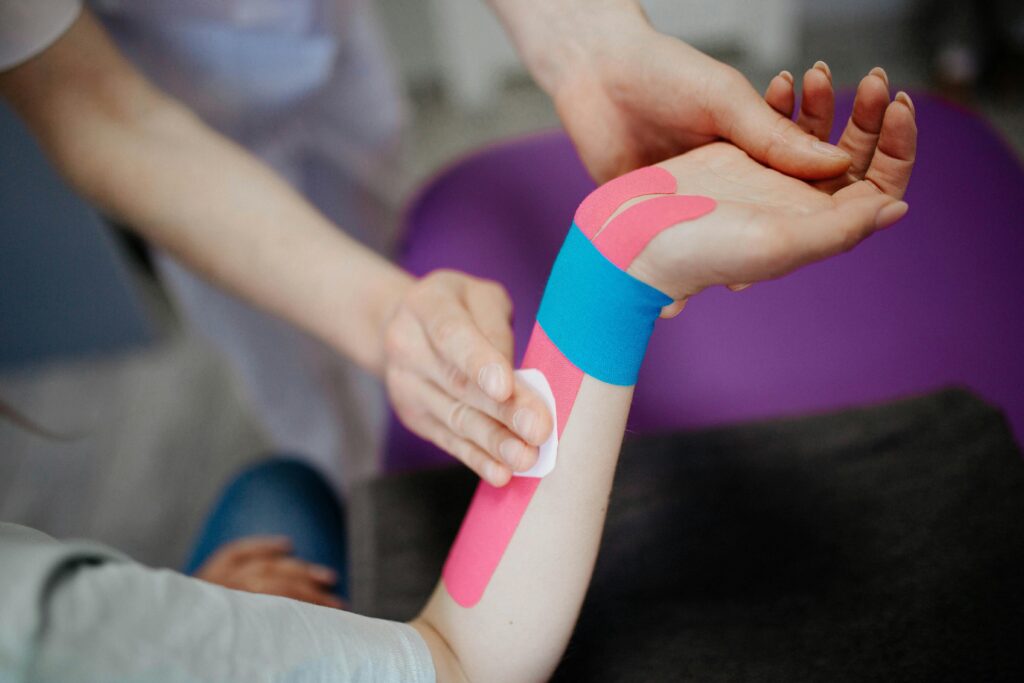
After weeks of immobilization, stiffness and weakness creep in.
That’s where physiotherapy becomes life-changing:
Early Stage (Weeks 4–6):
- Passive and gentle wrist stretches
- Finger mobility exercises to avoid stiffness
Middle Stage (Weeks 6–10):
- Active wrist movements (flexion, extension, supination, pronation)
- Grip strengthening with putty or soft balls
Advanced Stage (After 10 weeks):
- Resistance band exercises
- Weight-bearing activities like wall push-ups
- Proprioception drills (balance training for hands!)
New Advances:
Shockwave therapy and low-level laser therapy (LLLT) are being explored for faster bone healing and pain management!
Home Remedies for Comfort (Not a Substitute for Treatment)
- Turmeric Milk: Anti-inflammatory properties may help mild swelling.
- Arnica Creams: Traditional remedy for bruising.
- Epsom Salt Soaks: For overall relaxation once the fracture is stable (after cast removal).
- Omega-3 rich foods (salmon, walnuts) for joint health.
- Vitamin D + Calcium supplements under doctor supervision.
- Ergonomic wrist supports during sleep.
Potential Complications If Not Managed Properly
- Chronic stiffness and reduced wrist motion
- Nerve compression (like carpal tunnel syndrome)
- Complex Regional Pain Syndrome (CRPS) — severe pain and sensitivity
- Malunion (bone heals incorrectly)
- Osteoarthritis years later
Rohan’s Happy Ending
Thanks to a great surgeon and a diligent physiotherapy regimen, Rohan was back typing away at work (and carefully playing football!) within six months.
His wrist wasn’t just healed — it was stronger, more aware, and a reminder that healing isn’t passive; it’s active work.
Final Thought
A broken wrist isn’t just a break; it’s a signal — a chance to rebuild yourself better, stronger, and smarter.
Listen to it. Heal it right.
Need help healing your wrist?
📞 Call us at 7021231689 or
📩 Email us at vcure03@gmail.com
Book your online or offline appointment today and recover under the expert care of our highly experienced physiotherapists.
Your recovery starts here — don’t wait, let’s heal together!
Also Read About : Fracture Recovery: Know How Physiotherapy Speeds Up Healing!
Visit Our Doctors At : https://g.co/kgs/rTqAjgt


