If you’re searching for shoulder impingement exercises at home, your shoulder is already warning you.
And doing the wrong ones now could make the pain last much longer than it should.
If you’ve ever felt a sharp or nagging pain while lifting your arm, reaching overhead, or even putting on a shirt, you’re not alone.
This is one of the most common shoulder pain complaints I see in clinic, and in many cases, it turns out to be shoulder impingement syndrome.
But here is something most people are not told early enough.
It is not just about inflammation or something getting stuck.
It is more about how your shoulder is moving and how well your muscles are working together.
Let me walk you through this the same way I explain it to my patients.
Quick Answer
Shoulder impingement syndrome happens when the rotator cuff tendons get compressed in a narrow space inside the shoulder during arm movement.
Main causes:
Poor shoulder blade control, posture issues, muscle imbalance, and repeated overhead activity.
Best way to fix it:
Focus on scapular control, improve mobility, and gradually strengthen the rotator cuff with proper technique.
Recovery time:
Usually 4 to 8 weeks with consistent physiotherapy-based exercises.
Key tip: It is not just about rest. It is about correcting how your shoulder moves.
Key Takeaways
- Shoulder impingement is mainly a movement and control issue, not just inflammation
- Scapular control plays a major role in reducing pain and improving function
- Strength alone is not enough. Timing and coordination matter more
- Poor posture can silently contribute to shoulder pain
- Random exercises often fail without proper structure
- Consistency in rehab is more important than intensity
- Early correction prevents long-term shoulder problems
What Shoulder Impingement Actually Is
Your shoulder is built for movement first, stability second.
That is why you can reach overhead, behind your back, and across your body with ease.
But this wide range comes at a cost. The joint depends heavily on muscles to stay centered and controlled.
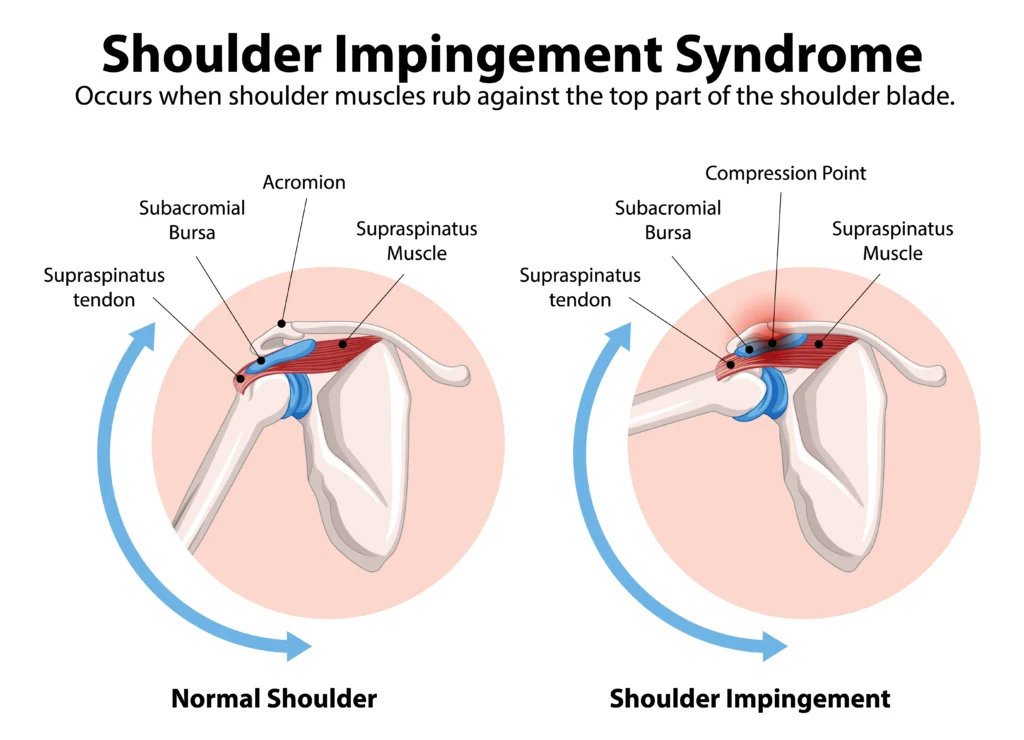
Inside the shoulder, there is a small but important space called the subacromial space.
This space sits between:
- The top bone of your arm (humerus)
- A bony roof called the acromion
In between these structures, you have:
- Rotator cuff tendons
- A fluid-filled sac called the bursa
These tissues are soft and sensitive. They are meant to glide smoothly when you move your arm.
What Happens During Normal Movement
When everything is working well:
- The rotator cuff keeps the ball of the joint centered
- The shoulder blade rotates smoothly
- The space remains open
This allows pain-free movement.
What Changes in Impingement
Now imagine this sequence:
- The shoulder blade does not move properly
- The rotator cuff is not controlling the joint well
- The arm bone shifts slightly upward
Even a small shift is enough.
That narrow space becomes tighter.
And when you lift your arm:
The tendons get compressed repeatedly. The bursa gets irritated
Friction increases with every movement
Why It Becomes Painful Over Time
At first, you may only feel mild discomfort.
But with repeated compression:
- The tendons become inflamed
- The bursa swells
- The space reduces even more
This creates a cycle:
Pain → altered movement → more compression → more pain
Research has shown that altered shoulder mechanics and reduced subacromial space are strongly linked with pain and dysfunction. (Michener et al. 2003)
A Simple Way to Visualize It
Think of it like a rope moving through a narrow tunnel.
- When the tunnel is wide, the rope moves freely
- When the tunnel narrows, the rope rubs and gets irritated
Your rotator cuff tendons are that rope.
Important Point Most People Miss
Impingement is not always due to a structural problem.
In many cases, it is a movement problem.
That means:
- Nothing is “broken”
- But the way your shoulder moves needs correction
And that is exactly why physiotherapy works so well when done correctly.
Why It Happens in Real Life
Poor Coordination, Not Just Overuse
Many people think this happens because they use their shoulder too much.
That is not entirely true.
In most cases, I see a coordination issue.
The shoulder blade and the arm are not moving in sync.
The humeral head shifts slightly upward instead of staying centered.
Even small delays in muscle activation can change shoulder mechanics and increase stress on the tendons. (Ludewig and Reynolds 2009)
Your Shoulder Blade Is the Key Player
Most people focus only on the arm.
But your shoulder blade controls the position of the joint.
If it does not rotate or stabilize properly, the space for your tendons reduces before you even start lifting your arm.
Recent studies show that exercises targeting scapular control improve pain and function better than general strengthening. (dos Santos et al. 2025)
Posture Plays a Bigger Role Than You Think
If you sit for long hours, especially on a laptop or phone, your posture slowly shifts.
- Shoulders round forward
- Chest becomes tight
- Upper back becomes stiff
This position narrows the shoulder space even at rest.
So when you lift your arm, there is already less room available.
Strength Alone Is Not Enough
This is something that surprises a lot of people.
You can be strong and still have shoulder pain.
Because the issue is not just strength. It is timing and control.
If the rotator cuff activates late and the deltoid takes over, the joint gets pulled upward.
That increases compression.
Gym Training Can Contribute
I see this often in active individuals.
Common patterns include:
- Too much pressing and front shoulder work
- Poor control during overhead exercises
- Neglecting stabilizing muscles like lower trapezius and serratus anterior
It is not the gym that causes the problem. It is imbalance.
Age and Tissue Changes
As we grow older, tendons naturally lose elasticity and blood supply reduces.
This does not cause impingement on its own, but it makes the shoulder less tolerant to poor mechanics.
Symptoms Patients Usually Describe
Instead of textbook descriptions, here is what people actually say:
- Pain when lifting the arm sideways
- Discomfort while reaching overhead
- Pain at night, especially when lying on that side
- Feeling of weakness without a clear injury
- Occasional clicking
If your pain behaves like this, it is often a movement-related issue rather than a structural tear.
A Quick Self-Check
Try this simple check at home:
- Lift your arm slowly to the side
- Notice if pain appears between shoulder height and above
- Try placing your hand behind your back
If you feel:
- Pain in mid-range movement
- Discomfort when reaching overhead
- Tightness behind the shoulder
It often points toward impingement.
This is not a diagnosis.
But it helps you understand if you are on the right track.
What Most People Get Wrong
Let me be very clear here.
Rest alone does not fix this.
It may reduce pain temporarily, but the underlying movement problem stays.
Also, random exercises from the internet often miss the actual cause.
Rehab needs to be specific.
Pain vs Damage: What You Should Not Panic About
Pain does not always mean damage.
In many cases:
- Tendons are irritated, not torn
- Movement is inefficient, not broken
This is why:
- You can still move the arm
- Pain comes and goes
- Strength feels inconsistent
Understanding this reduces fear and improves recovery.
Shoulder Impingement Exercises At Home: Physiotherapy Insight
Phase 1: Reduce Irritation
The goal is to calm things down without making the shoulder stiff.
- Avoid painful overhead movements
- Keep gentle movement going
- Modify activity instead of stopping everything
Complete rest often delays recovery.
Phase 2: Restore Mobility
Thoracic Spine Mobility
A stiff upper back forces your shoulder to compensate.
Simple drill:
- Sit or lie with support behind your upper back
- Gently extend backward
- Repeat slowly
This alone can improve shoulder movement significantly.
Posterior Shoulder Tightness
Tightness at the back of the shoulder can push the joint forward.
Exercise:
- Cross-body stretch
- Hold comfortably without forcing
Phase 3: Scapular Control
This is the most important phase.
Without proper shoulder blade control, strengthening will not work.
Exercises like:
- Scapular setting
- Wall slides
- Controlled shoulder blade movement
Studies show targeted scapular exercises improve pain and muscle balance more effectively than general programs. (Yuksel et al. 2024)
Phase 4: Rotator Cuff Strengthening
Now we add controlled strengthening.
Example:
External rotation with resistance band
- Keep elbow close to body
- Move slowly
- Focus on control, not speed
This helps balance the forces around the joint.
Phase 5: Functional Movement
This is where recovery becomes practical.
- Gradual return to overhead movement
- Controlled lifting patterns
- Sport or work-specific tasks
Rehabilitation should match your daily demands.
A Simple 10-Minute Shoulder Routine
You can follow this daily:
- 2 minutes thoracic mobility
- 2 minutes cross-body stretch
- 2 minutes scapular setting
- 2 minutes wall slides
- 2 minutes resistance band external rotation
Keep it slow.
No pain. No rush.
Consistency beats intensity.
Exercises to Avoid
These often make symptoms worse early on:
- Overhead press with heavy weight
- Upright rows
- Deep dips
- Behind-the-neck exercises
- Fast or uncontrolled lifting
It is not forever.
Just until your shoulder regains control.
What to Do Instead
If certain exercises trigger pain, try this:
- Replace overhead press with incline press
- Replace dips with supported push-ups
- Replace heavy lifting with slow resistance bands
- Replace aggressive workouts with controlled movements
The goal is simple.
Keep moving, but move smarter.
Lesser Known but Important Insights
From both clinical practice and recent research:
- Lower trapezius weakness is very common
- Tight lat muscles can limit overhead motion
- Breathing patterns influence shoulder mechanics
- Movement quality matters more than heavy resistance early on
Some recent evidence also suggests that exercise improves function consistently, but pain reduction varies depending on individual factors. (Solana Tramunt et al. 2026)
Common Mistakes That Slow Down Recovery
These are things I see very often:
- Jumping into strengthening too early
- Skipping scapular exercises
- Ignoring posture completely
- Training through pain
- Expecting quick results
Fixing these alone can speed up recovery.
Recovery Timeline
This depends on severity and consistency.
- Mild cases may improve in 3 to 4 weeks
- Moderate cases take around 6 to 8 weeks
- Long-standing cases can take longer
Consistency matters more than intensity.
Sleeping Position Tips for Shoulder Pain
If your shoulder hurts at night:
- Avoid sleeping directly on that side
- Use a pillow to support your arm
- Keep your arm slightly forward, not tucked in
- Try sleeping on your back if possible
Small changes here make a big difference.
When You Should Seek Help
- Pain lasting more than a few weeks
- Night pain disturbing sleep
- Increasing weakness
- Difficulty with daily activities
Early guidance can prevent chronic problems.
When It Might Not Be Shoulder Impingement
Sometimes symptoms look similar but are different.
Watch for:
- Pain going below the elbow
- Tingling or numbness
- Neck pain with shoulder pain
- Sudden loss of strength
These may indicate a different issue.
Better to get assessed early.
How to Prevent Shoulder Impingement from Returning
Once pain improves, focus on this:
- Maintain upper back mobility
- Keep scapular exercises in your routine
- Balance pushing and pulling workouts
- Avoid long hours of poor posture
- Progress exercises gradually
Prevention is simpler than rehab.
Final Thoughts
Shoulder impingement exercises at home can be incredibly effective, but only when they’re done with the right technique, timing, and progression.
Rushing into strengthening too early, ignoring posture, or copying random routines can delay healing instead of helping it.
Focus on pain-free movement first, then gradually build strength and control.
Stay consistent, listen to your shoulder, and remember, small, correct steps daily will always outperform aggressive, inconsistent efforts.
Your shoulder doesn’t need more exercises, it needs the right shoulder impingement exercises at home, done the right way.
The right shoulder impingement exercises at home can fix your pain, but the wrong ones can quietly make it worse, so choose wisely before your shoulder pays the price.
Frequently Asked Questions
What is shoulder impingement syndrome?
It is a condition where rotator cuff tendons get compressed during arm movement, leading to pain and irritation.
Can shoulder impingement heal on its own?
Mild cases may improve, but most require targeted exercises to fix movement issues.
How long does recovery take?
Most people recover within 4 to 8 weeks if they follow a proper rehab routine.
Should I stop gym workouts?
No, but you should avoid painful movements and modify exercises until your shoulder improves.
Which exercise helps the most?
Scapular stabilization exercises are the most important for recovery.
Why does shoulder pain increase at night?
Certain sleeping positions increase pressure on the shoulder structures.
Can poor posture cause this condition?
Yes, poor posture reduces space in the shoulder and contributes to impingement.
Stay tuned with us for more health related topics.
Follow us on LinkedIn and Instagram for more.
More Read






Medical Disclaimer!
This article has been reviewed and written under the guidance of our Head Physiotherapist, Dr. Kruti Raj (PT, MUHS,CPT,CMPT). The information shared is intended for educational purposes only and should not be considered a substitute for personalized medical advice, diagnosis, or treatment.
Please consult us or any other qualified healthcare professional before beginning any exercise program, especially if you are experiencing pain, recovering from injury, or managing a medical condition.