


Shoulder pain from driving long hours may seem harmless at first.
But your driving posture could be slowly straining your shoulder muscles and nerves.
Most people blame the shoulder.
But in clinic, shoulder pain from driving is rarely just a shoulder problem.
Sometimes it starts in the neck.
Sometimes in the upper back.
In many drivers, the real issue is how the body stays frozen in one position for hours while the brain stays alert and tense.
Add traffic stress, poor seat setup, tight chest muscles, lack of movement, and long commuting hours, and the shoulder quietly begins absorbing the load.
Quick Answer
Shoulder pain from driving long hours is commonly linked to prolonged sitting posture, neck strain, muscle guarding, stress-related tension, poor steering wheel positioning, and reduced upper back mobility. Physiotherapy treatment usually focuses on posture correction, thoracic mobility, scapular strengthening, movement breaks, breathing mechanics, and ergonomic driving adjustments. Early intervention often prevents chronic stiffness and recurring pain.
What surprises many people is how slowly this develops.
A person drives for years without any issue.
Then one day, they notice discomfort while reversing the car.
Reaching for the seatbelt feels awkward.
Sleeping on one side becomes irritating.
Some even feel a dull ache between the shoulder blade and spine after highway driving.
That pattern is incredibly common in physiotherapy clinics today.
The modern driving lifestyle has changed body mechanics more than most people realize.
Cars are more comfortable than before, but many seats still encourage slouched posture, rounded shoulders, and reduced spinal movement.
Long daily commutes are making neck and shoulder stiffness increasingly common even in younger adults.
A 2023 study published in the journal Applied Ergonomics discussed how prolonged driving exposure and static posture contribute significantly to musculoskeletal discomfort in drivers, especially around the neck and shoulders. (Liu et al. 2023)
This article looks at shoulder pain from a practical physiotherapy perspective.
Not textbook theory. Not generic posture advice repeated everywhere online.
Just realistic explanations, updated evidence, and strategies that actually help people who spend long hours behind the wheel.
Key Takeaways
- Driving-related shoulder pain is often connected to neck and upper back stiffness.
- Traffic stress can increase shoulder muscle tension without people realizing it.
- One-hand steering habits may slowly create muscular imbalance.
- Modern car seats can encourage slouched posture and reduced thoracic mobility.
- Shoulder pain while driving is commonly linked to prolonged static positioning rather than injury alone.
- Breathing mechanics and stress management play an important role in muscle relaxation.
- Regular movement breaks are often more effective than excessive stretching alone.
- Physiotherapy focuses on mobility, strength, posture awareness, and load management.
- Night pain or arm numbness should never be ignored.
- Early physiotherapy intervention usually improves recovery outcomes significantly.
Why Driving Affects the Shoulder More Than People Think
The shoulder is designed for movement.
Driving does the opposite.
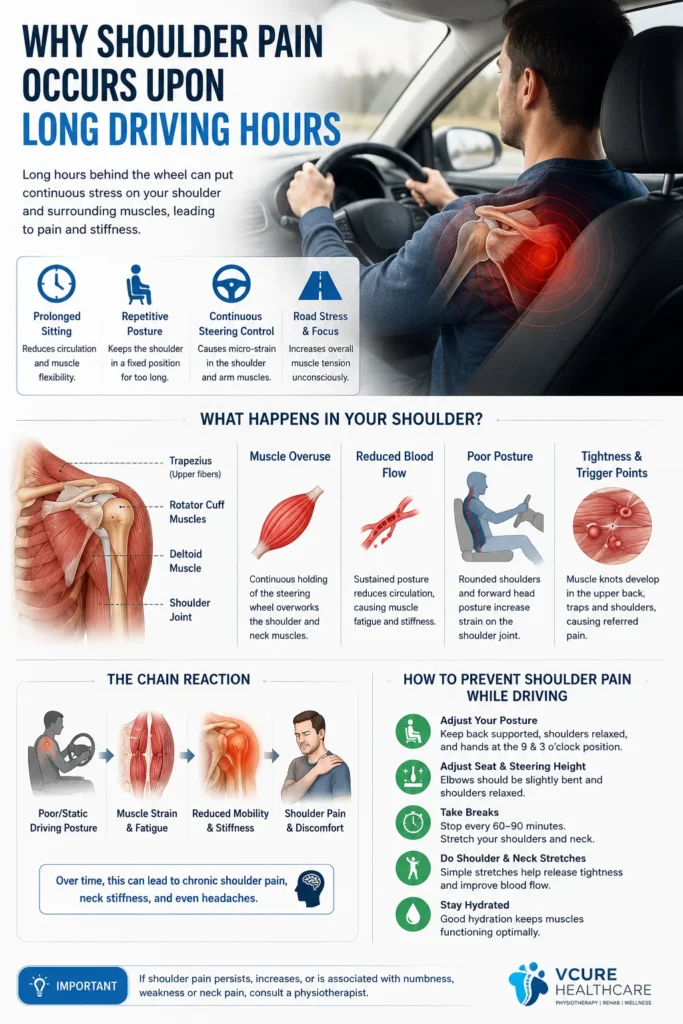
For long periods, the arms stay fixed in front of the body while small stabilizing muscles work continuously without rest.
Even though the movement looks minimal, the muscles around the neck and shoulder blades remain active the entire time.
That constant low-level tension becomes exhausting after a while.
One thing many drivers never notice is shoulder elevation.
During stressful traffic or highway concentration, people unconsciously lift their shoulders slightly toward their ears.
They may hold that tension for one or two hours without realizing it.
Over time, this overloads the upper trapezius and levator scapulae muscles.
The result is usually:
- Tightness near the neck
- Burning around the shoulder blade
- Stiffness after getting out of the car
- Pain during overhead movement
- Headaches starting from the base of the skull
Physiotherapists often call this “postural guarding.” The muscles never truly relax.
The Hidden Role of Stress While Driving

This part is often ignored in health articles.
Driving is not passive for the nervous system.
Heavy traffic, unpredictable braking, poor roads, aggressive driving environments, and long commutes increase muscle tension automatically.
Many people clench their jaw, tighten their grip on the steering wheel, or raise their shoulders during stressful driving situations.
That stress response changes muscle behavior.
Researchers have observed increased trapezius muscle activity during mentally stressful tasks, even when physical movement is minimal. (Lundberg et al. 1994)
This explains why some people feel more shoulder pain during traffic jams than during shorter city drives.
The body stays in a low-grade defensive state.
Why One-Hand Driving Can Slowly Create Imbalances
A surprisingly common clinic observation is asymmetrical shoulder pain from one-hand steering habits.
Many drivers:
- Rest one elbow near the window
- Lean slightly to one side
- Drive mostly with the right hand
- Shift body weight unevenly
At first, it feels comfortable.
Months later, the body adapts to that asymmetry.
One shoulder becomes tighter.
The opposite shoulder becomes weaker.
The upper back loses balance.
The neck starts compensating.
This is one reason why some people only develop pain on one side despite driving daily with both arms.
Shoulder Pain Is Sometimes Actually Coming From the Neck
This is probably one of the most misunderstood issues.
Many patients point directly to the shoulder, but the true source is cervical irritation.
When the neck stays forward for long periods, the joints and nerves around the cervical spine become irritated.
That irritation may refer pain into:
- The shoulder blade
- The outer shoulder
- The upper arm
- Occasionally the forearm
A person may think they have a shoulder injury when the shoulder itself is completely normal.
Signs the neck may be involved:
- Tingling
- Burning pain
- Pain traveling below the elbow
- Symptoms changing when turning the head
- Morning neck stiffness
A systematic review in BMC Musculoskeletal Disorders found strong associations between prolonged sitting posture and neck-shoulder symptoms in workers exposed to static positions. (Janwantanakul et al. 2008)
Modern Car Seats Are Comfortable, But Not Always Good for the Spine
This surprises people.
Soft seats are not automatically healthier.
Many modern car seats encourage:
- Rounded shoulders
- Thoracic stiffness
- Posterior pelvic tilt
- Forward head posture
The body gradually collapses into flexion.
After enough hours, the upper back becomes stiff and the shoulder blades lose efficient movement.
Once that happens, shoulder muscles begin compensating excessively.
Physiotherapists frequently notice limited thoracic extension in people with chronic driving-related shoulder pain.
In simple terms, the upper back stops moving well, so the shoulder works harder.
The “Traffic Shoulder” Pattern
There is a pattern many clinicians recognize.
The patient usually says:
“It feels worse during traffic.”
Not during short drives. Not while walking.
Not necessarily during exercise.
Traffic.
That is because stop-start driving increases:
- Shoulder gripping
- Steering adjustments
- Mental stress
- Static arm positioning
The shoulder muscles never get a chance to reset.
Long highway drives can create stiffness too, but heavy traffic often creates more muscular guarding.
Why Night Pain After Driving Should Not Be Ignored
Pain at night changes the conversation.
Simple muscular fatigue usually settles with rest.
But if pain becomes worse:
- While sleeping
- When lying on one shoulder
- During overhead movement
- While reaching backward
then the rotator cuff may be getting irritated.
Rotator cuff tendons dislike prolonged compression and poor posture.
Subacromial shoulder pain is one of the most common musculoskeletal conditions globally. (Littlewood et al. 2013)
This does not always mean a “tear.” Many people panic unnecessarily after reading MRI reports.
Often, movement quality and muscle balance matter more than imaging findings.
Small Driving Habits That Quietly Worsen Shoulder Pain
Driving Too Far From the Steering Wheel
This forces the arms to reach forward constantly.
The shoulder blades lose support, and the neck muscles start overworking.
Gripping the Wheel Too Hard
This is extremely common during anxiety or highway driving.
A tight grip increases forearm and shoulder tension dramatically.
Resting the Arm Incorrectly
Armrests sometimes help, but sometimes they encourage shoulder elevation depending on height.
Keeping the Wallet in the Back Pocket
Physiotherapists still see this regularly.
It changes pelvic alignment during sitting, which affects spinal posture all the way upward.
Looking Slightly Forward While Driving
Many people lean toward the windshield subconsciously.
That forward-head posture increases cervical loading significantly.
A famous biomechanical analysis showed that forward head posture dramatically increases stress on the cervical spine. (Hansraj 2014)
Drivers Often Ignore Breathing Mechanics
This is one of the lesser-known contributors.
People under stress tend to breathe shallowly from the upper chest.
When that happens:
- Accessory neck muscles become overactive
- Upper trapezius tightens
- Rib mobility decreases
- Shoulder tension increases
Good breathing mechanics matter more than most drivers realize.
Physiotherapists increasingly include breathing retraining in chronic neck and shoulder rehabilitation programs.
What Physiotherapists Actually Check During Assessment
A proper physiotherapy assessment is not just:
“Raise your arm. Does it hurt?”
A good assessment usually examines:
- Neck mobility
- Thoracic spine movement
- Scapular control
- Rib movement
- Breathing pattern
- Muscle endurance
- Shoulder strength
- Driving posture habits
- Workstation setup
- Sleep position
Because the pain source is often multifactorial.
The shoulder may simply be the final area getting overloaded.
The Most Effective Physiotherapy Strategies for Drivers
Movement Breaks Matter More Than Fancy Exercises
One of the biggest mistakes drivers make is waiting too long before moving.
Even 2 to 3 minutes of walking every hour helps circulation and reduces stiffness.
This is especially important during long highway trips.
Thoracic Mobility Work
Many drivers stretch the neck repeatedly while ignoring the upper back.
But improving thoracic mobility often reduces shoulder strain significantly.
Simple extension exercises over a rolled towel or foam roller can help.
Scapular Strengthening
Weak scapular stabilizers force the upper trapezius to compensate.
Exercises targeting:
- Lower trapezius
- Serratus anterior
- Rhomboids
can improve shoulder mechanics over time.
Deep Neck Flexor Training
People with forward head posture often have poor endurance in the deep cervical stabilizers.
Gentle chin-tuck exercises may help restore support.
Load Management
Sometimes the body simply needs temporary reduction in aggravating activities.
Not complete rest. Just smarter loading.
Heat or Ice? Drivers Ask This Constantly
For most driving-related tightness, heat tends to help more.
Heat improves:
- Blood flow
- Muscle relaxation
- Tissue mobility
Ice is usually more useful during acute flare-ups or sharp inflammatory pain.
Many chronic drivers actually respond best to movement plus heat rather than passive rest.
Can Shoulder Pain From Driving Become Chronic?
Yes, especially when people ignore the early signs.
The body adapts to repeated stress patterns.
Over time:
- Muscles become sensitive
- Movement changes
- Fear of movement develops
- Pain thresholds reduce
This is why early physiotherapy intervention matters.
Persistent pain is not always about tissue damage.
Sometimes the nervous system itself becomes more sensitive.
Modern pain science recognizes this clearly.
Why Sleep Quality Affects Driving-Related Shoulder Pain
Poor sleep changes pain sensitivity.
People sleeping poorly often report:
- Increased stiffness
- More muscular tension
- Lower pain tolerance
Sleep position matters too.
Many drivers sleep with the arm overhead after long workdays, which may further compress irritated shoulder tissues.
Calculate your ideal sleep timings here: “Sleep Calculator“
Dehydration and Long Drives
Another overlooked factor.
Long drives often involve:
- Excess caffeine
- Low water intake
- Reduced movement
- Muscle fatigue
Fascial tissues and muscles do not respond well to dehydration.
Some people notice their stiffness is dramatically worse after road trips simply because they barely hydrated.
Exercises Drivers Usually Benefit From
Not aggressive workouts.
Usually simple, consistent movement works best.
Helpful categories include:
- Chin tucks
- Thoracic extension mobility
- Chest opening stretches
- Scapular retraction drills
- Resistance band rows
- Shoulder external rotation exercises
- Walking programs
The key is consistency, not intensity.
When You Should Stop Self-Treating
Not every shoulder pain problem is simple muscular tension.
See a healthcare professional if you notice:
- Progressive weakness
- Arm numbness
- Severe night pain
- Loss of grip strength
- Sudden restriction in movement
- Pain after trauma
- Symptoms lasting several weeks
Persistent symptoms deserve proper evaluation.
What Most Drivers Actually Need
Not perfect posture.
That idea is outdated.
The body tolerates different postures reasonably well when movement variability exists.
The real issue is staying in one position for too long.
Modern physiotherapy focuses less on “perfect sitting” and more on:
- Movement variety
- Tissue capacity
- Strength
- Recovery
- Stress management
- Load tolerance
That approach is usually far more realistic for drivers.
Final Thoughts From a Physiotherapist
The shoulder usually gives warnings long before serious pain develops.
A pulling sensation near the neck.
A stiff shoulder after traffic.
Discomfort while reversing.
Pain when reaching into the back seat.
Those signs matter.
Most driving-related shoulder pain improves well when addressed early with:
- Better movement habits
- Smarter seat setup
- Reduced muscle tension
- Strengthening work
- Thoracic mobility
- Stress awareness
- Consistent recovery strategies
The goal is not to stop driving.
The goal is teaching the body how to tolerate driving without constantly staying tense.
Ignoring shoulder pain from driving long hours can gradually affect your posture, movement, and long-term shoulder health.
Frequently Asked Questions
Why does my shoulder hurt more during traffic driving?
Traffic driving increases muscle tension because drivers unconsciously grip the steering wheel harder, elevate their shoulders, and stay mentally alert for longer periods. This creates continuous muscle guarding around the neck and shoulders.
Can driving posture really affect shoulder pain?
Yes. Poor seat positioning, forward head posture, rounded shoulders, and reaching too far toward the steering wheel can overload the neck and shoulder muscles over time.
Is shoulder pain from driving actually coming from the neck?
Very often, yes. Cervical spine stiffness or nerve irritation may refer pain into the shoulder blade, upper arm, or shoulder region.
How often should I stop during long drives?
Most physiotherapists recommend getting out of the car every 45 to 90 minutes for brief walking and stretching breaks.
Can stress while driving tighten shoulder muscles?
Yes. Mental stress activates upper trapezius muscles and may increase neck and shoulder tension even without major physical movement.
What exercises help shoulder pain from driving?
Thoracic mobility exercises, chin tucks, scapular strengthening, chest-opening stretches, and resistance band exercises are commonly recommended in physiotherapy.
When should I see a physiotherapist?
You should seek professional assessment if pain lasts several weeks, interrupts sleep, causes arm weakness, or includes numbness and tingling.
Can long road trips worsen existing shoulder problems?
Yes. Long periods without movement can aggravate rotator cuff irritation, neck stiffness, and upper back tightness.
Stay tuned with us for more health related topics.
Follow us on LinkedIn and Instagram for more.
More Read


Medical Disclaimer!
This article has been reviewed and written under the guidance of our Head Physiotherapist, Dr. Kruti Raj (PT, MUHS,CPT,CMPT). The information shared is intended for educational purposes only and should not be considered a substitute for personalized medical advice, diagnosis, or treatment.
Please consult us or any other qualified healthcare professional before beginning any exercise program, especially if you are experiencing pain, recovering from injury, or managing a medical condition.


