


Shoulder pain after vaccination is usually mild, but in some cases the discomfort can last longer than expected.
Most people expect a sore arm after a vaccine.
What they do not expect is :
waking up two weeks later unable to lift a coffee mug comfortably, sleep on one side, or pull a T-shirt overhead without pain shooting through the shoulder.
In physiotherapy clinics, this situation is more common than many realize.
Quick Answer
Shoulder pain after vaccination is usually mild and temporary, but persistent pain, stiffness, weakness, or difficulty lifting the arm may indicate deeper shoulder irritation such as SIRVA (Shoulder Injury Related to Vaccine Administration). Physiotherapy can help reduce pain, restore mobility, improve shoulder mechanics, and prevent long-term stiffness. Early treatment often leads to faster recovery and better shoulder function.
- Mild soreness usually settles within 2 to 3 days
- Persistent pain may involve bursitis, tendon irritation, or frozen shoulder
- Night pain and restricted arm movement should not be ignored
- Gentle movement is usually better than complete rest
- Physiotherapy helps restore mobility and reduce stiffness safely
Some patients describe it as a “deep pinch” inside the shoulder.
Others say the pain feels strange because it is not just surface soreness around the injection site.
A few notice stiffness creeping in slowly over several weeks.
By the time they seek help, even simple things like reaching for a seatbelt or washing their hair have become frustrating.
The important thing to understand is this.
Mild soreness after vaccination is normal.
Severe pain that keeps getting worse is not.
As physiotherapists, we often see people wait too long because they assume the discomfort will disappear on its own.
Sometimes it does.
Sometimes the shoulder becomes progressively irritated and stiff because movement patterns start changing in response to pain.
That is where proper assessment and early rehabilitation matter.
Key Takeaways
Pain lasting beyond a few days may indicate deeper shoulder irritation rather than temporary injection soreness.
Complete rest can sometimes worsen stiffness. Gentle guided movement usually helps recovery.
Difficulty sleeping on the affected shoulder may suggest inflammation involving deeper structures.
Poor posture and protective muscle guarding can prolong discomfort and limit mobility.
Timely rehabilitation may reduce stiffness, improve strength, and prevent long-term shoulder dysfunction.
Why Does the Shoulder Hurt After Vaccination?
For most people, post-vaccine soreness is simply the immune system doing its job.
The body creates a temporary inflammatory response around the injection area, which can lead to aching, heaviness, warmth, or tenderness for a couple of days.
That kind of soreness is expected.
But persistent shoulder pain after vaccination is a different story altogether.
Recent research suggests many prolonged cases are linked more to injection technique than to the vaccine ingredients themselves.
(Atanasoff et al. 2010) discussed how incorrect vaccine placement can irritate structures underneath the deltoid muscle, leading to what is now commonly called SIRVA.
When the injection is placed too high or too deep, the needle may irritate:
- the subacromial bursa
- rotator cuff tendons
- joint capsule
- surrounding connective tissue
The shoulder reacts aggressively when these structures become inflamed.
And unlike regular muscle soreness, joint-related inflammation tends to linger.
The Part Most People Miss
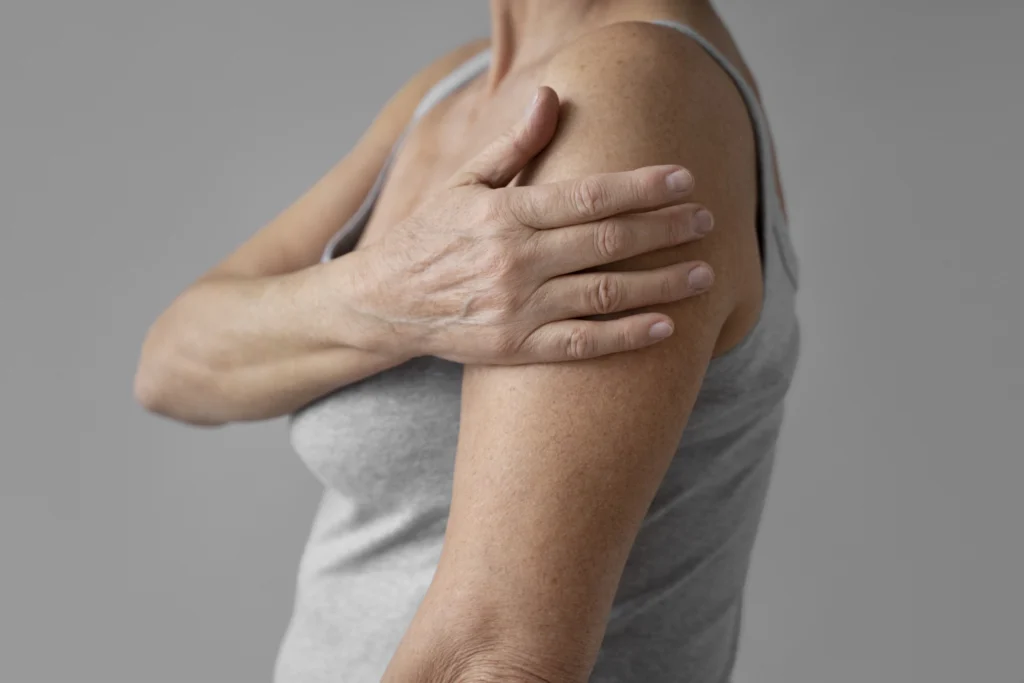
Many patients already have mild shoulder dysfunction before vaccination without knowing it.
This is incredibly common after the age of 35.
A person may already have:
- mild rotator cuff irritation
- poor scapular control
- tight chest muscles
- posture-related impingement syndrome
- early tendon degeneration
But because the symptoms were silent or manageable, they never noticed.
Then comes the injection.
Suddenly, an already sensitive shoulder becomes reactive.
This explains why two people can receive the same vaccine and have completely different experiences afterward.
When Shoulder Soreness Stops Feeling “Normal”
Normal vaccine soreness usually:
- improves within 48 to 72 hours
- stays localized around the injection site
- feels more muscular than joint-related
- does not severely restrict movement
The warning signs are different.
Patients with more significant shoulder irritation often say:
- “I cannot sleep on that side anymore.”
- “Reaching overhead suddenly hurts.”
- “The pain feels deeper inside the shoulder.”
- “My arm feels weak.”
- “It actually got worse after the third or fourth day.”
That pattern deserves attention.
(NCBI) found that prolonged shoulder symptoms after vaccination were frequently associated with reduced mobility and inflammatory shoulder conditions rather than simple muscle soreness.
What Is SIRVA?
SIRVA stands for Shoulder Injury Related to Vaccine Administration.
It sounds dramatic, but it simply describes shoulder injury caused by improper vaccine placement.
The condition is still underdiagnosed because many people assume the pain is a normal vaccine reaction.
In reality, SIRVA can involve:
- bursitis
- tendon irritation
- adhesive capsulitis
- impingement symptoms
- inflammatory joint irritation
Some patients develop symptoms within hours.
Others notice progressive stiffness over days or weeks.
One thing physiotherapists often observe is guarding behavior.
The shoulder hurts, so the person stops moving it normally.
Then the muscles around the joint tighten protectively.
Then stiffness increases.
Then movement becomes even more painful.
It becomes a cycle.
Why Night Pain Happens
Night pain is one of the biggest clues that the issue may involve deeper shoulder structures rather than simple injection soreness.
When lying on the affected side, inflamed tissues become compressed.
Even sleeping on the opposite side can pull irritated tissues enough to trigger discomfort.
Patients often describe:
- difficulty finding a sleeping position
- waking up from sudden pain
- shoulder throbbing at night
- stiffness first thing in the morning
This is especially common when bursitis or capsular irritation develops.
A Lesser-Known Problem: Frozen Shoulder After Vaccination
One of the more frustrating complications is adhesive capsulitis, also known as frozen shoulder.
This does not happen to everyone, but physiotherapists see it more often in:
- adults over 40
- diabetics
- people with previous shoulder issues
- individuals who stop moving the arm because of pain
What makes frozen shoulder tricky is that it can start quietly.
Initially, the shoulder just feels sore.
Then reaching overhead becomes difficult.
Then rotational movements become limited.
Then stiffness gradually takes over daily activities.
Why Some People Develop Neck Pain Too
This surprises many patients.
The original problem starts in the shoulder, but after a few weeks the neck begins tightening too.
That happens because the body changes movement patterns to avoid painful shoulder motion.
Instead of smoothly lifting the arm, people start:
- shrugging the shoulder upward
- overusing upper trapezius muscles
- leaning the trunk sideways
- reducing arm swing while walking
Over time, this compensation creates muscular tension around the neck and shoulder blade.
Physiotherapists see this pattern constantly.
What Physiotherapists Look For
A proper shoulder assessment is not just about checking pain.
We observe:
- movement quality
- shoulder blade control
- posture
- compensation patterns
- muscle guarding
- joint stiffness
- sleep-related pain behavior
Sometimes the arm technically “moves,” but the movement is completely altered.
One common example is scapular hiking.
Instead of the shoulder moving smoothly, the entire shoulder blade lifts upward during arm elevation.
That usually signals weakness, irritation, or protective guarding.
Why Early Physiotherapy Matters
One of the biggest mistakes people make is complete rest.
Short-term rest helps during severe pain.
But prolonged immobility usually backfires.
The shoulder joint loves movement.
Without movement:
- circulation reduces
- stiffness increases
- muscles weaken
- joint capsules tighten
Early physiotherapy helps maintain mobility while calming irritated tissues.
Research increasingly supports rehabilitation-focused management for persistent post-vaccine shoulder dysfunction.
What Treatment Usually Involves
Treatment depends on what structure is irritated.
Some people mainly need pain reduction.
Others need mobility restoration.
Others require progressive strengthening because weakness develops after weeks of guarded movement.
A physiotherapy plan may include:
- gentle mobility drills
- rotator cuff activation
- scapular stabilization
- posture correction
- thoracic mobility work
- soft tissue release
- graded strengthening
The key word is graded.
Trying to aggressively “stretch out” an angry shoulder too early often makes symptoms worse.
The Mistake Gym-Goers Often Make
People who exercise regularly sometimes return to overhead workouts too quickly.
Bench presses, shoulder presses, lateral raises, and heavy push workouts can continue irritating inflamed tissues if introduced too early.
Many gym-goers assume:
“If I push through it, it will loosen up.”
Sometimes the opposite happens.
Persistent overload can narrow the subacromial space further and maintain irritation around the rotator cuff.
This is where guided rehabilitation becomes important.
Exercises That Usually Help
Not every shoulder responds to the same exercises, but a few movements are commonly well tolerated during recovery.
Pendulum Swings
Gentle swinging motions help reduce stiffness without aggressive loading.
Pendulum Swings are especially useful during painful early phases.
Wall Crawls
Using the fingers to slowly “walk” up a wall encourages gradual overhead mobility.
Patients often tolerate this better than unsupported arm raises.
Scapular Retraction
Simple shoulder blade control exercises improve mechanics surprisingly well.
Many painful shoulders are actually moving poorly long before they become weak.
Thoracic Mobility Work
This gets overlooked constantly.
A stiff upper back changes shoulder positioning dramatically.
Improving thoracic extension often reduces shoulder strain more than people expect.
Ice or Heat?
Patients ask this all the time. They are always confused between ice or heat?
Ice usually helps more during:
- sharp pain
- recent inflammation
- throbbing discomfort
- post-activity flare-ups
Heat tends to help later when:
- stiffness dominates
- muscles feel tight
- movement feels restricted
The mistake is using excessive heat during an actively inflamed phase.
That sometimes aggravates symptoms.
The Psychological Side Nobody Talks About
Persistent shoulder pain becomes mentally exhausting.
Especially when the original trigger was “just a vaccine.”
Patients often become anxious because:
- the pain lasts longer than expected
- online information feels conflicting
- movement starts feeling unreliable
- sleep quality drops
- exercise routines get disrupted
Some begin catastrophizing small movements.
Others become fearful of lifting the arm entirely.
This fear-avoidance cycle is one reason stiffness progresses.
Good rehabilitation is not only physical.
Education matters too.
Can Imaging Help?
Sometimes.
If symptoms persist or worsen, doctors may request:
- ultrasound
- MRI
- X-rays
Imaging may show:
- bursitis
- tendon inflammation
- capsular thickening
- impingement findings
But an important clinical point often missed is this:
Imaging findings do not always perfectly match symptom severity.
Some people have dramatic pain with minimal imaging changes.
Others show degenerative findings that were present long before the injection.
That is why clinical assessment matters just as much as scans.
Prevention Matters More Than People Think
Research increasingly emphasizes proper injection technique.
(PMC) highlighted the importance of correct landmarking and injection placement in preventing avoidable shoulder injuries.
The safest injection placement is generally within the central deltoid muscle rather than too close to the upper shoulder joint.
Small technique differences matter more than many realize.
What Recovery Usually Looks Like
Most mild cases improve fairly quickly.
More irritated shoulders may take:
- several weeks
- occasionally months
The biggest recovery factor is often not the severity of the injection itself.
It is how quickly:
- stiffness is addressed
- movement patterns normalize
- fear of movement decreases
- rehabilitation begins
That is why early management tends to produce better outcomes.
Final Thoughts From a Physiotherapist
Persistent shoulder pain after vaccination should not be ignored if movement becomes increasingly limited or painful.
Most post-vaccine shoulder soreness is harmless.
But persistent pain should not be dismissed simply because it started after an injection.
The shoulder is a highly mobile joint that depends on smooth coordination between muscles, tendons, posture, and movement control.
Once pain disrupts that system, compensation patterns begin quickly.
The good news is that most people improve well with the right approach.
Not aggressive exercise.
Not total rest.
Usually something in between.
Gentle movement. Gradual strengthening. Better mechanics. Patience.
And perhaps most importantly, understanding that persistent shoulder pain after vaccination is real, treatable, and far more common than many people think.
Frequently Asked Questions
1. Is shoulder pain after vaccination normal?
Yes, mild soreness for a few days is common after vaccination. However, severe pain, stiffness, or difficulty lifting the arm may need medical or physiotherapy assessment.
2. What is SIRVA?
SIRVA stands for Shoulder Injury Related to Vaccine Administration. It can happen when the injection is placed too high or too deep into the shoulder area.
3. How long can shoulder pain last after a vaccine?
Typical soreness improves within 48 to 72 hours. More significant shoulder irritation may last several weeks if not treated properly.
4. Can physiotherapy help vaccine-related shoulder pain?
Yes, physiotherapy can help reduce pain, improve movement, restore strength, and prevent shoulder stiffness from worsening.
5. Why does shoulder pain feel worse at night?
Inflamed shoulder tissues may become compressed during sleep, especially when lying on the affected side.
6. Should I stop exercising completely?
Heavy lifting may need temporary modification, but gentle movement and guided exercises are usually beneficial during recovery.
7. Can shoulder pain after vaccination cause frozen shoulder?
In some individuals, especially adults over 40 or people with diabetes, prolonged inflammation may contribute to frozen shoulder development.
8. When should I see a doctor?
Seek medical advice if pain becomes severe, movement is restricted, symptoms worsen over time, or numbness and weakness develop.
Stay tuned with us for more health related topics.
Follow us on LinkedIn and Instagram for more.
More Read


Medical Disclaimer!
This article has been reviewed and written under the guidance of our Head Physiotherapist, Dr. Kruti Raj (PT, MUHS,CPT,CMPT). The information shared is intended for educational purposes only and should not be considered a substitute for personalized medical advice, diagnosis, or treatment.
Please consult us or any other qualified healthcare professional before beginning any exercise program, especially if you are experiencing pain, recovering from injury, or managing a medical condition.


