Pelvic girdle pain during pregnancy can make walking, sleeping, and daily movement uncomfortable.
Pregnancy changes the body in ways that can feel both amazing and overwhelming at the same time.
One week you feel normal, and suddenly simple things like walking through the grocery store, turning in bed, climbing stairs, or standing while cooking start hurting.
For many women, that pain settles around the pelvis.
Sometimes it feels sharp near the pubic bone.
Sometimes it travels into the hips, groin, buttocks, or lower back.
Some women describe it as a pulling sensation.
Others say it feels like their pelvis is “splitting apart” while walking.
This is commonly called pelvic girdle pain, or PGP.
And despite how common it is, many pregnant women are still told:
“Pregnancy pain is normal.”
Quick Answer
Pelvic girdle pain during pregnancy is a common musculoskeletal condition that affects the pelvic joints, hips, groin, and lower back. It often worsens during walking, climbing stairs, standing on one leg, or turning in bed. Physiotherapy, movement modification, pelvic stability exercises, proper sleep positioning, and load management can significantly reduce symptoms and improve daily function during pregnancy.
Many women unknowingly worsen pelvic pain by standing on one leg while dressing or carrying weight unevenly. Keeping movements symmetrical can reduce irritation around the pelvic joints.
As a physiotherapist, I can tell you this clearly.
Pelvic girdle pain may be common, but struggling through severe pain is not something you simply have to accept.
The good news is that most women improve significantly when they understand what is actually happening in the body and start managing movement differently.
This article is not just another textbook explanation of pelvic pain during pregnancy.
We are going to talk about :
the real reasons symptoms flare up, the mistakes that unknowingly make pain worse, evidence-based physiotherapy strategies that actually help, and some lesser-known things many women are never told.
Key Takeaways
- Pelvic girdle pain is common during pregnancy but severe pain should never be ignored.
- Pain usually worsens during walking, stair climbing, turning in bed, or standing on one leg.
- Weak glutes, poor pelvic stability, altered posture, and movement habits often contribute more than hormones alone.
- Physiotherapy can help improve movement control, reduce pain, and support safer daily activity.
- Keeping knees together while turning in bed may significantly reduce nighttime pain.
- Aggressive stretching is not always helpful and may worsen symptoms in unstable joints.
- Breathing mechanics and pelvic floor coordination play an important role in pelvic support.
- Small daily movement modifications often make a bigger difference than intense exercise programs.
- Postpartum rehabilitation is important because pelvic pain can continue after childbirth in some women.
- Early physiotherapy support improves recovery outcomes and helps women stay active safely during pregnancy.
What Exactly Is Pelvic Girdle Pain?
Pelvic girdle pain is pain coming from the joints and muscles that support the pelvis during pregnancy.
It commonly affects:
- The pubic symphysis at the front
- The sacroiliac joints at the back
- The surrounding hip and pelvic muscles
Unlike ordinary back pain, pelvic girdle pain is usually linked to movement.
Many women notice it during:
- Walking
- Turning in bed
- Getting out of the car
- Standing on one leg
- Wearing pants
- Climbing stairs
- Carrying older children
One interesting thing I often notice in clinic is that women can sometimes point to the exact movement that triggers pain.
That is because pelvic girdle pain is heavily influenced by load transfer and movement mechanics.
(Vleeming et al. 2008) explained that pelvic girdle pain is closely related to impaired force transfer through the pelvic joints during movement.
Why Does Pelvic Girdle Pain Happen During Pregnancy?
Many people blame hormones alone.
Yes, hormones like relaxin and progesterone increase ligament laxity during pregnancy, but that is only part of the story.
If hormones were the only reason, every pregnant woman would experience disabling pelvic pain.
That does not happen.
What matters more is how the muscles, joints, breathing system, and posture adapt to the changing body.
Your Body Starts Moving Differently Without You Realizing It
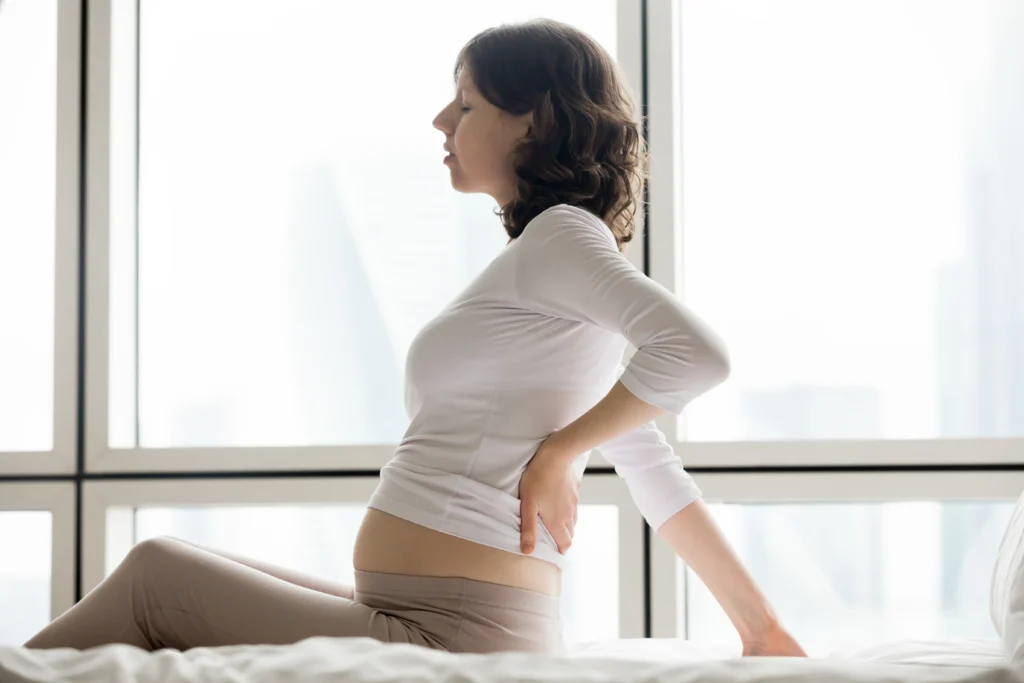
As the baby grows:
- Your center of gravity shifts forward
- The rib cage changes position
- The abdominal wall stretches
- Glute muscles often become less efficient
- Walking mechanics change
This creates more stress around the pelvic joints.
Many women unknowingly begin:
- Taking shorter unstable steps
- Leaning backward while standing
- Locking the knees
- Hanging onto one hip
- Using the lower back instead of glutes
Over time, the body becomes irritated from repeated strain.
(NIH) reported that pregnancy-related pelvic girdle pain is multifactorial and influenced by biomechanical, hormonal, and metabolic factors.
One Lesser-Known Trigger Is Single-Leg Loading
This surprises many pregnant women.
Pelvic girdle pain is often aggravated not by big movements, but by tiny everyday asymmetrical movements.
For example:
- Standing on one leg while getting dressed
- Carrying a toddler on one side
- Climbing stairs repeatedly
- Sitting cross-legged
- Pushing a shopping cart unevenly
- Twisting while lifting laundry
The pelvis dislikes uneven loading when stability is reduced.
That is why many women feel better when keeping movements symmetrical.
Why Turning in Bed Hurts So Much
Night pain is one of the biggest complaints I hear from pregnant women with pelvic girdle pain.
The reason is simple.
Turning in bed separates the knees and rotates the pelvis.
When the pelvic joints are irritated, that movement becomes painful.
A small change often helps:
- Keep knees together while turning
- Use a pillow between the thighs and ankles
- Move the shoulders and pelvis together as one unit
Some women notice improvement within days after changing this habit alone.
Tightness Is Not Always the Real Problem
A lot of women start aggressively stretching during pregnancy because they feel stiff.
But here is something many people do not realize.
The sensation of “tightness” is often the body trying to create stability.
In many cases, weak glutes and poor deep core coordination are bigger problems than actual muscle tightness.
Overstretching unstable joints can sometimes make symptoms worse.
Modern physiotherapy has shifted away from excessive stretching and toward improving muscular support and movement control.
Pelvic Floor Muscles Matter More Than Most Women Think
The pelvic floor is not working alone during pregnancy.
It functions together with:
- The diaphragm
- Deep abdominal muscles
- Spinal stabilizers
- Hip muscles
This system helps transfer pressure and stabilize the pelvis.
If breathing becomes shallow and upper-chest dominant, pressure management changes and pelvic stability can decrease.
That is why many physiotherapists now include breathing retraining in pregnancy rehabilitation.
Women are often surprised by how much calmer and more supported the body feels after improving breathing mechanics.
Stress Can Increase Pelvic Pain
This is something many women feel guilty admitting.
Pain often worsens during stressful weeks.
That does not mean the pain is “in your head.”
Stress changes:
- Muscle tension
- Breathing patterns
- Pain sensitivity
- Sleep quality
- Recovery capacity
Recent studies have shown strong associations between pregnancy-related pelvic pain and emotional distress.
(Wuytack et al. 2024) found that women with pregnancy-related pelvic girdle pain had significantly higher risks of anxiety and depressive symptoms.
Symptoms That Commonly Point Toward Pelvic Girdle Pain
Women describe pelvic girdle pain very differently.
Some say:
- “It feels like grinding.”
- “My hips feel unstable.”
- “I cannot walk properly after sitting.”
- “It feels like pressure between my legs.”
- “Turning in bed is the worst part.”
Common symptoms include:
- Pain near the pubic bone
- Hip pain
- Groin pain
- Buttock pain
- Difficulty walking
- Clicking sensations
- Pain while rolling in bed
- Pain climbing stairs
- Waddling gait
Some women also feel pain radiating into the thighs.
What Usually Makes It Worse?
The biggest aggravating factor is repeated uneven loading.
Symptoms often worsen with:
- Long walks
- Carrying heavy bags
- Standing for long periods
- Wide leg positions
- Deep squats
- Lunges
- Sudden twisting
- Vacuuming
- High-impact workouts
One thing many women notice is that pain fluctuates day to day.
That is very common.
Pelvic girdle pain is highly activity-dependent.
Is Exercise Safe?
Usually yes.
But the type of exercise matters enormously.
One major mistake is following generic pregnancy workouts online without considering pelvic symptoms.
Some exercises may overload already irritated joints.
The goal is not to “push through pain.”
The goal is restoring support, coordination, and confidence in movement.
Recent evidence supports individualized exercise programs over generalized routines. (ACOG)
Physiotherapy Approaches That Actually Help
There is no magical single exercise.
Good physiotherapy focuses on:
- Movement quality
- Load management
- Stability
- Pain reduction
- Functional confidence
And most importantly, treatment should fit the individual woman.
Small Movement Changes
Small Movement Changes Often Work Better Than Aggressive Treatments
Sometimes the biggest improvements come from tiny modifications.
For example:
- Sitting down to wear pants
- Avoiding standing on one leg
- Taking smaller steps
- Keeping knees together during bed mobility
- Using both shoulders while carrying bags
- Reducing repeated stair trips
These sound simple, but they reduce repeated pelvic irritation throughout the day.
Glute Strength Is Extremely Important
Weak glutes force the pelvis and lower back to compensate excessively.
One thing I commonly notice is that many pregnant women unknowingly stop using their glutes effectively as the abdomen grows.
This shifts stress into the pelvic joints.
Gentle glute activation work can improve walking tolerance significantly.
Helpful Physiotherapy Exercises
Side-Lying Clamshells
These target the gluteus medius, which helps stabilize the pelvis during walking.
Tips:
- Keep the pelvis steady
- Use slow controlled movement
- Avoid rolling backward
Supported Glute Bridges
Bridges help activate the posterior chain without excessive pelvic strain.
Important:
- Lift only to a comfortable range
- Avoid pushing into pain
- Focus on glute activation rather than height
Deep Breathing With Rib Expansion
This sounds simple but can be surprisingly effective.
Many pregnant women breathe mostly into the upper chest without realizing it.
Try:
- Slow nasal inhalation
- Rib cage expansion sideways
- Gentle relaxed exhalation
This improves diaphragm function and pressure regulation.
Pelvic Tilts
Pelvic tilts may help reduce lower back tension and improve pelvic mobility.
Small controlled movements work best.
Exercises That Sometimes Make Symptoms Worse
Not every popular prenatal exercise is pelvic-friendly.
Women with significant pelvic girdle pain often struggle with:
- Deep lunges
- Single-leg balance work
- Wide squats
- Jumping
- Running
- Aggressive stretching classes
Pain during exercise is not something to ignore.
Pelvic Belts Can Help Some Women
Pelvic support belts are not a cure, but some women feel noticeably more stable while walking.
They may help reduce excessive pelvic movement temporarily.
However, relying only on a belt without improving muscular support usually does not solve the underlying issue.
Walking Is Not Always Harmful
Many women become afraid of movement after pain begins.
That fear is understandable.
But complete rest can sometimes worsen stiffness, weakness, and sensitivity.
The key is finding a tolerable movement level.
Often this means:
- Shorter walks
- More frequent breaks
- Flat surfaces
- Supportive footwear
- Avoiding overexertion
Movement should feel manageable, not punishing.
Sleep Is a Bigger Factor Than People Realize
Poor sleep increases pain sensitivity.
And unfortunately, pelvic girdle pain itself disrupts sleep.
It becomes a frustrating cycle.
Women who improve nighttime positioning often notice:
- Less morning stiffness
- Better walking tolerance
- Lower daily pain levels
Small sleep adjustments can genuinely matter.
Can Pelvic Girdle Pain Continue After Delivery?
Yes, sometimes.
Many women improve naturally after childbirth, but not everyone recovers immediately.
Persistent symptoms are more likely when:
- Pain was severe during pregnancy
- Activity was heavily reduced
- Core and glute weakness remain
- Sleep deprivation becomes extreme postpartum
- Baby carrying mechanics overload one side repeatedly
This is why postpartum rehabilitation matters.
What Many New Mothers Accidentally Do Postpartum
One-sided baby carrying becomes a huge issue.
Most mothers:
- Carry the baby on one hip
- Twist during feeding
- Stay in rounded positions for long periods
- Lift without proper support
Over weeks, symptoms can continue even after pregnancy hormones settle.
Postpartum physiotherapy is often overlooked but extremely valuable.
Nutrition and Recovery Also Matter
Emerging research suggests inflammation, low vitamin D, and poor recovery habits may influence musculoskeletal pain during pregnancy.
Women who are:
- chronically sleep deprived
- under high stress
- poorly nourished
- extremely inactive
often report higher pain sensitivity.
Good rehabilitation is never just about exercises.
When You Should Seek Medical Attention
Pelvic girdle pain should still be medically assessed if symptoms include:
- Fever
- Vaginal bleeding
- Severe abdominal pain
- Sudden swelling
- Numbness
- Loss of bladder control
- Reduced fetal movement
Not all pelvic pain during pregnancy is musculoskeletal.
A Final Thought From a Physiotherapist
One of the hardest things about pelvic girdle pain during pregnancy is that other people often cannot see it.
You may look “fine” while struggling to roll over in bed or walk through a parking lot comfortably.
And because pregnancy discomfort is normalized so heavily, many women delay getting help.
But pelvic girdle pain responds best when addressed early.
The goal is not perfect posture or intense workouts.
The goal is helping the body feel supported again.
Sometimes the most effective changes are surprisingly small:
- moving differently
- breathing differently
- pacing activity better
- reducing asymmetrical strain
- rebuilding confidence in movement
Most importantly, pain during pregnancy should not make you feel helpless.
With proper guidance, many women regain comfort, improve mobility, and feel far more in control of their bodies again.
Frequently Asked Questions
How do I know if I have pelvic girdle pain during pregnancy?
Pelvic girdle pain usually causes discomfort around the pubic bone, hips, groin, buttocks, or lower back. Many women notice pain while walking, climbing stairs, rolling in bed, or standing on one leg.
Can pelvic girdle pain go away on its own?
Some women improve after delivery, but symptoms can persist if muscle weakness and movement dysfunction are not addressed. Physiotherapy often helps speed recovery and improve mobility.
What sleeping position is best for pelvic girdle pain?
Sleeping on your side with a pillow between the knees and ankles may reduce strain on the pelvis. Keeping the knees together while turning in bed can also help.
Is walking good for pelvic girdle pain?
Gentle walking is usually safe, but long walks or uneven surfaces may aggravate symptoms. Shorter walks with rest breaks are often better tolerated.
Can exercise make pelvic girdle pain worse?
Yes, certain exercises like deep lunges, high-impact workouts, or wide squats may increase irritation. Exercises should be individualized and pain-free.
Do pelvic support belts actually help?
Pelvic support belts may temporarily improve stability and reduce discomfort while walking or standing, especially when combined with physiotherapy exercises.
When should I see a physiotherapist for pelvic pain?
You should seek help if pain affects walking, sleep, daily movement, or continues getting worse during pregnancy.
Can pelvic girdle pain continue after childbirth?
Yes, some women continue experiencing pelvic pain postpartum, especially if muscle weakness, poor posture, and asymmetrical baby carrying habits are not corrected.
Stay tuned with us for more health related topics.
Follow us on LinkedIn and Instagram for more.
More Read



Medical Disclaimer!
This article has been reviewed and written under the guidance of our Head Physiotherapist, Dr. Kruti Raj (PT, MUHS,CPT,CMPT). The information shared is intended for educational purposes only and should not be considered a substitute for personalized medical advice, diagnosis, or treatment.
Please consult us or any other qualified healthcare professional before beginning any exercise program, especially if you are experiencing pain, recovering from injury, or managing a medical condition.