


Signs of overexercising during pregnancy may include:
dizziness, extreme fatigue, pelvic pain, shortness of breath, or unusual discomfort.
Most pregnant women today already know that movement is good for them.
Doctors recommend it, fitness influencers promote it, and pregnancy apps send daily reminders to stay active. But there is one thing very few people talk about honestly.
Some women are not under-exercising during pregnancy.
They are actually doing too much.
Quick Answer
Overexercising during pregnancy can show up as extreme fatigue, pelvic heaviness, urinary leakage during workouts, worsening soreness, dizziness, breathlessness, poor recovery, and increased Braxton Hicks contractions. While staying active during pregnancy is healthy for most women, excessive workouts without proper recovery may overload the pelvic floor, joints, muscles, and nervous system. If exercise consistently leaves you exhausted instead of energized, your body may be asking you to slow down.
And the tricky part is this.
Signs of overexercising during pregnancy rarely looks dramatic in the beginning.
It often starts quietly.
You feel more exhausted than usual but assume it is normal pregnancy fatigue.
Your hips ache after walks, but everyone says pregnancy pain is expected.
You feel pelvic heaviness after workouts, but social media keeps telling you to “stay strong during pregnancy.”
Key Takeaways
- Pregnancy changes recovery capacity more than workout performance.
- Pelvic heaviness and urinary leakage after exercise should not be ignored.
- Extreme fatigue after workouts may signal overtraining during pregnancy.
- Shortness of breath that makes conversation difficult can indicate excessive workout intensity.
- Recovery matters just as much as movement during pregnancy.
- Social media pregnancy fitness trends may create unrealistic expectations.
- Safe prenatal exercise should support the body, not constantly exhaust it.
- Walking, swimming, prenatal strength training, and pelvic floor-focused exercises are usually safer choices.
As a physiotherapist, I see this more often now than I did a few years ago.
Pregnant women today are more health conscious, more active, and in many cases, harder on themselves. Some are trying to maintain their pre-pregnancy fitness levels.
Others are afraid of excessive weight gain. Some simply do not want to slow down.
The body, however, has different priorities during pregnancy.
Your body is building a baby, increasing blood volume, adapting your breathing mechanics, softening ligaments, shifting posture, and loading the pelvic floor every single day.
Even before a workout begins, your system is already working overtime.
That is why recognizing the signs of overexercising during pregnancy matters.
Not because exercise is bad.
But because too much stress without enough recovery can push the body into a place where symptoms start showing up quietly.
Pregnancy Changes How Your Body Handles Exercise
One of the biggest misconceptions I hear is:
“I was fit before pregnancy, so my body can handle this.”
Sometimes yes. Sometimes not.
Pregnancy changes recovery more than performance.
That means many women can still complete workouts while their joints, pelvic floor, and nervous system are already struggling behind the scenes.
According to the American College of Obstetricians and Gynecologists,
moderate physical activity during pregnancy is beneficial for most women and may help reduce gestational diabetes risk, improve circulation, reduce back pain, and support mental health. (ACOG 2020)
But guidelines are not the same as unlimited tolerance.
Pregnancy naturally causes:
- increased joint laxity
- altered balance
- increased oxygen demand
- pelvic floor pressure
- posture changes
- slower recovery capacity
This is why some women suddenly struggle with workouts they tolerated easily before pregnancy.
The First Sign Is Often Not Pain
Most people expect pain as one of the signs of overexercising during pregnancy.
In pregnancy, the first warning sign is usually fatigue that feels different.
Not sleepy.
Not lazy.
More like your body feels “drained from the inside.”
Women often describe it as:
- heavy legs all day
- feeling exhausted after normal walks
- needing hours to recover from workouts
- feeling physically tired but mentally restless
- waking up already fatigued
That kind of fatigue should not be ignored.
A properly dosed prenatal workout usually leaves you feeling better afterward, not flattened for the rest of the day.
Recent pregnancy exercise reviews also suggest that recovery tolerance varies significantly between women, even when fitness levels appear similar. (Silveira et al., 2025)
Pelvic Heaviness Is One of the Most Ignored Signs
This is something many women never hear about until after delivery.
A dragging, heavy, or pressure-like feeling in the pelvis after exercise is not something to simply push through.
Some women notice:
- heaviness after long walks
- vaginal pressure after workouts
- discomfort turning in bed
- groin pain climbing stairs
- pelvic aching after standing too long
This can happen because pregnancy already increases downward pressure on the pelvic floor.
Adding repetitive impact, poor breathing mechanics, heavy lifting, or excessive walking may overload those tissues further.
What makes this tricky is that many active women still feel strong.
So they assume the pressure sensation is harmless.
But from a physiotherapy perspective, pelvic heaviness is often an early load-management issue.
Newer pelvic floor research is increasingly emphasizing that urinary leakage and pelvic pressure during pregnancy should not simply be dismissed as “normal.” (Rørtveit et al., 2025)
Constant Soreness Is Not a Badge of Honor During Pregnancy
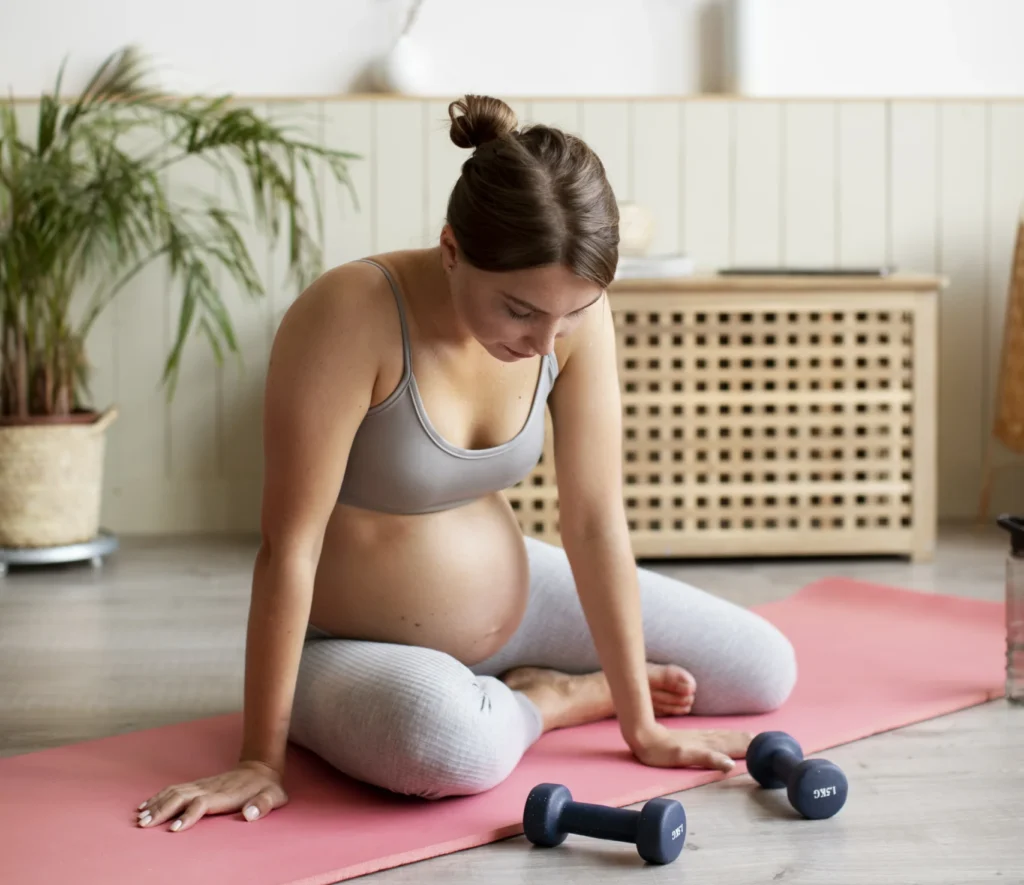
There is a fitness culture online that normalizes soreness.
Pregnancy is different.
If your muscles stay sore for days after exercise, your body may not be recovering properly.
I usually tell pregnant patients this:
You should not feel like you need to recover from your recovery routine.
Common signs include:
- soreness lasting more than 48 hours
- worsening hip pain
- increasing back tightness
- feeling weaker instead of stronger
- dreading workouts you normally enjoy
This becomes even more important during the second and third trimesters when the center of gravity shifts more dramatically.
Some Women Become Breathless Much Earlier Than Expected
Shortness of breath during pregnancy can be normal.
Extreme breathlessness is not.
A simple physiotherapy rule I often use is the talk test.
If you cannot comfortably speak while exercising, intensity is probably too high for your current condition.
Many pregnant women rely too heavily on fitness watches and calorie trackers.
But devices do not always reflect how hard pregnancy itself is already working your cardiovascular system.
One lesser-known fact is that blood volume increases significantly during pregnancy to support fetal growth.
The heart is already under greater demand before exercise even starts.
That is why some women suddenly feel overwhelmed doing routines they handled easily pre-pregnancy.
Braxton Hicks After Workouts
Braxton Hicks After Workouts May Be Your Body Asking You to Slow Down
This surprises many women.
They finish a workout and notice their abdomen tightening repeatedly afterward.
Sometimes it settles with rest and hydration.
Sometimes it keeps happening.
Occasional Braxton Hicks contractions can be normal.
But if exercise repeatedly triggers uterine tightening, your body may be signaling that the workload is too aggressive.
Dehydration can also make this worse.
This is especially common during:
- long outdoor walks
- overheating
- high-intensity intervals
- inadequate hydration
- back-to-back workout days
Pregnancy Hormones Can Hide Instability
This is one of the most misunderstood parts of prenatal exercise.
Pregnancy hormones like relaxin increase ligament laxity.
Many women feel surprisingly flexible during pregnancy and think their mobility is improving.
But flexibility without stability can become a problem.
I often see:
- overstretching during yoga
- aggressive mobility work
- deep squats without pelvic control
- unstable single-leg exercises
- hip pain from excessive stretching
The body may allow movement ranges that the joints cannot actually support well anymore.
That is why pregnancy exercise should focus more on controlled stability than chasing flexibility.
Urinary Leakage During Workouts Should Not Be Normalized
A lot of women laugh this off.
“I pee a little when I exercise now.”
But urine leakage during pregnancy workouts can be a sign that the pelvic floor is struggling with pressure management.
This often happens during:
- jumping
- running
- burpees
- heavy lifting
- high-impact cardio
Just because something is common does not mean it should be ignored.
Pelvic floor symptoms during pregnancy deserve attention early, not only after childbirth.
One of the Biggest Red Flags Is Needing More and More Rest
Healthy movement usually improves energy over time.
Overtraining creates the opposite pattern.
You may notice:
- workouts wiping you out
- needing naps daily
- feeling unmotivated to exercise
- worse recovery each week
- exhaustion that keeps building
Some women continue increasing exercise because they think they are becoming less fit.
In reality, the body may simply be overloaded.
Social Media Has Changed Pregnancy Fitness in a Big Way
This honestly needs to be discussed more openly.
Many pregnant women now compare themselves to highly athletic pregnancy content online.
You see:
- women lifting heavy weights at 38 weeks
- intense cardio workouts
- “no excuses” pregnancy routines
- unrealistic bounce-back culture
What those videos rarely show:
- recovery support
- genetics
- medical supervision
- symptom history
- pelvic floor condition
- modifications happening off-camera
Pregnancy should not become a performance competition.
Athletes and Highly Active Women Need Different Advice
This is important.
Not every active pregnant woman needs to stop intense exercise completely.
But athletic pregnancies require individualized planning.
Current exercise guidelines increasingly support personalized approaches rather than rigid universal recommendations. (Canadian Society for Exercise Physiology, 2024)
Some women tolerate strength training extremely well throughout pregnancy.
Others struggle with basic walking by the third trimester.
Neither situation makes someone better or weaker.
The goal is not proving fitness during pregnancy.
The goal is supporting maternal and fetal health safely.
Signs You Should Stop Exercising Immediately
Some symptoms should never be brushed aside.
Stop exercising and contact your healthcare provider if you experience:
- vaginal bleeding
- chest pain
- severe dizziness
- fluid leakage
- painful contractions
- severe calf swelling
- fainting
- sudden shortness of breath
- reduced fetal movement
- severe headache
These symptoms require proper medical assessment.
What I Usually Recommend as a Physiotherapist
Pregnancy exercise does not need to be extreme to be effective.
In most cases, the safest routines are also the most sustainable ones.
I usually encourage:
- walking
- controlled strength training
- breathing-focused core work
- pelvic floor coordination
- gentle mobility work
- swimming
- prenatal yoga with modifications
But the biggest thing I focus on is recovery.
Not just movement.
Recovery.
Because recovery is where adaptation actually happens.
Hydration Matters More Than Most Women Realize
Even mild dehydration during pregnancy can worsen:
- dizziness
- muscle cramping
- contractions
- fatigue
- headaches
Many pregnant women underestimate how much fluid they actually need, especially in warmer climates or after exercise.
Hydration becomes even more important if:
- you sweat heavily
- you walk outdoors often
- you exercise daily
- you experience Braxton Hicks contractions
Sleep and Exercise Are Closely Connected
Sometimes women try exercising harder because they feel tired all the time.
Ironically, excessive exercise can worsen sleep quality.
Overloaded nervous systems often create:
- restless sleep
- nighttime waking
- racing thoughts
- physical exhaustion with poor recovery
If exercise consistently leaves you feeling more depleted instead of restored, the program may need modification.
Calculate your ideal sleep timings here: “Sleep Calculator“
The Real Goal of Prenatal Exercise
The healthiest pregnancy exercise routine is usually not the hardest one.
It is the one your body can recover from consistently.
That is the difference many women miss.
A good prenatal exercise plan should help you:
- move better
- breathe better
- recover better
- feel supported
- reduce pain
- maintain function
Not leave you physically wrecked by the end of the week.
Final Thoughts
Signs of overexercising during pregnancy does not always look dramatic.
Sometimes it looks like:
- constant fatigue
- pelvic heaviness
- worsening soreness
- irritability
- feeling drained after healthy workouts
- increasing discomfort that never fully settles
And many women ignore these signs because they think slowing down means becoming weak.
It does not.
Pregnancy is one of the most physically demanding things the human body can do.
Respecting recovery during this phase is not laziness. It is intelligent body awareness.
The women who usually do best long term are not the ones who push hardest through pregnancy.
They are the ones who learn when their body needs support instead of pressure.
Thus, recognizing signs of overexercising during pregnancy can help improve exercise safety and overall comfort.
Frequently Asked Questions
How do I know if I am overexercising during pregnancy?
Common signs include severe fatigue, pelvic pressure, dizziness, soreness lasting several days, urinary leakage during workouts, and feeling exhausted instead of refreshed after exercise.
Can too much exercise affect my pregnancy?
Moderate exercise is beneficial for most pregnancies, but excessive physical stress, poor hydration, and inadequate recovery may overload the body and increase discomfort or fatigue.
Is pelvic pressure after walking normal during pregnancy?
Occasional mild pressure can happen, but persistent pelvic heaviness or dragging sensations after activity may indicate pelvic floor strain.
Can exercise trigger Braxton Hicks contractions?
Yes. Intense workouts, dehydration, overheating, and inadequate recovery can sometimes increase Braxton Hicks contractions.
Should I stop strength training during pregnancy?
Not always. Many women continue modified strength training safely during pregnancy with proper breathing, load management, and professional guidance.
Why do I feel extremely tired after prenatal workouts?
Pregnancy already places high physical demands on the body. If exercise exceeds recovery capacity, exhaustion may build instead of improving energy levels.
What are the safest exercises during pregnancy?
Walking, swimming, prenatal yoga, controlled strength training, and pelvic floor-focused physiotherapy exercises are generally considered safer options for most pregnant women.
Stay tuned with us for more health related topics.
Follow us on LinkedIn and Instagram for more.
More Read


Medical Disclaimer!
This article has been reviewed and written under the guidance of our Head Physiotherapist, Dr. Kruti Raj (PT, MUHS,CPT,CMPT). The information shared is intended for educational purposes only and should not be considered a substitute for personalized medical advice, diagnosis, or treatment.
Please consult us or any other qualified healthcare professional before beginning any exercise program, especially if you are experiencing pain, recovering from injury, or managing a medical condition.


