


Birth control options have come a long way, and choosing the right method is very important.
Birth control refers to methods used to prevent pregnancy.
Today, there are several options, ranging from short-term methods such as condoms and birth control pills to long-acting reversible contraception such as intrauterine devices (IUDs) and contraceptive implants.
Quick Answer
Birth control includes methods such as condoms, pills, patches, vaginal rings, injections, implants, IUDs, fertility-awareness methods and permanent contraception. The best option depends on effectiveness, health considerations, convenience, side effects, future pregnancy plans and whether STI protection is also needed. Condoms can help reduce STI risk, while most other contraceptive methods do not.
No single birth control method is ideal for everyone.
The best choice depends on factors such as effectiveness, convenience, side effects, health history, future pregnancy plans, comfort with hormones, and whether protection against sexually transmitted infections (STIs) is also needed.
Some methods require action every time you have sex, while others work continuously for months or years.
Understanding these differences can make it easier to compare your options and discuss them with a healthcare professional.
Key Takeaways
- No single birth control method is best for everyone.
- IUDs and implants are among the most effective reversible options.
- Pills, patches, rings and injections use hormones to prevent pregnancy.
- Condoms can provide both pregnancy prevention and STI risk reduction.
- Most hormonal methods and IUDs do not protect against STIs.
- Permanent contraception is intended for people who do not want future pregnancies.
- Your health, preferences and reproductive goals should be considered when choosing contraception.
How Does Birth Control Work?
Different contraceptive methods prevent pregnancy in different ways.
Some methods primarily prevent sperm from reaching an egg.
Others prevent or delay ovulation, thicken cervical mucus, or create changes in the reproductive tract that make fertilization less likely.
The main categories include:
- Barrier methods
- Hormonal methods
- Intrauterine devices
- Fertility-awareness methods
- Permanent contraception
- Emergency contraception
According to the World Health Organization, a wide range of contraceptive methods are available, and choosing a method should take individual preferences, health considerations, effectiveness, and reproductive goals into account. (World Health Organization)
How Effective Are Different Birth Control Methods?
Effectiveness is one of the most important factors when comparing contraception, but there is a difference between perfect use and typical use.
Perfect use describes how well a method works when it is used exactly as directed every time.
Typical use reflects how the method performs in real life, including missed pills, incorrect condom use, delayed injections, or other user-related factors.
Long-acting methods such as implants and IUDs generally have very high effectiveness because they do not require daily or every-intercourse action.
Methods such as condoms and pills can also be highly effective when used correctly, but their effectiveness can be affected by mistakes or missed doses.
The CDC explains that contraceptive effectiveness varies according to the method and how consistently and correctly it is used. (Centers for Disease Control and Prevention)
Barrier Methods
Barrier methods physically prevent sperm from reaching the reproductive tract.
Common examples include:
- External condoms
- Internal condoms
- Diaphragms
- Cervical caps
- Spermicides
External Condoms
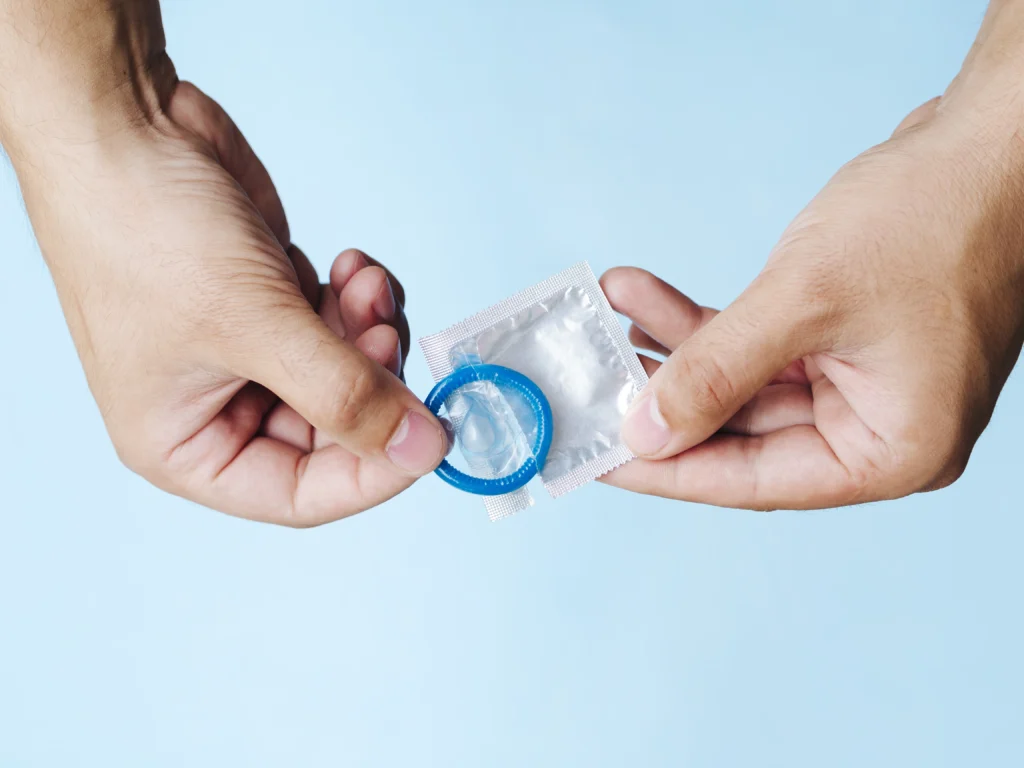
External condoms are worn over the penis during sexual activity.
They help prevent sperm from entering the vagina and also provide an important advantage that most other contraceptive methods do not:
they can reduce the risk of many STIs when used correctly and consistently.
Condoms are also widely available, do not require hormones, and can be used only when needed.
However, correct use is important.
A condom can break, slip, or be used incorrectly, and it needs to be used during every act of vaginal sex when pregnancy prevention is the goal.
Internal Condoms
An internal condom is placed inside the vagina before sex.
It provides a physical barrier that helps prevent sperm from entering the reproductive tract.
It can also provide protection against some STIs.
Internal condoms may be an option for people who prefer to control insertion themselves or who do not want to rely on an external condom.
Hormonal Birth Control
Hormonal contraception uses hormones to prevent pregnancy, primarily by suppressing ovulation and changing cervical mucus.
Common hormonal options include:
- Birth control pills
- Contraceptive patches
- Vaginal rings
- Hormonal injections
- Contraceptive implants
- Hormonal IUDs
Hormonal methods vary considerably in how often they need to be used.
For example, a pill generally requires regular daily use, while an implant can provide contraception for several years.
Long-Acting Birth Control Options
If convenience is a major priority, long-acting reversible contraception can be an attractive option.
These methods work continuously for months or years without requiring daily or every-intercourse action.
Contraceptive Implant
The contraceptive implant is a small, flexible rod placed under the skin of the upper arm.
It releases a progestin hormone that helps prevent pregnancy, primarily by suppressing ovulation and thickening cervical mucus.
The implant is among the most effective reversible contraceptive methods.
Because it does not depend on remembering a pill or using a barrier correctly every time, its effectiveness is less affected by user error.
Possible advantages include:
- Very high effectiveness
- Long-lasting pregnancy prevention
- No daily routine
- Fertility can return after removal
- Suitable for people who prefer a method they do not have to think about regularly
A common consideration is a change in menstrual bleeding.
Some people experience irregular bleeding, spotting, lighter periods, or changes in their usual cycle pattern.
The CDC reports a typical-use failure rate of about 0.1% for the contraceptive implant. (Centers for Disease Control and Prevention)
Intrauterine Devices
An intrauterine device, or IUD, is a small device placed inside the uterus by a trained healthcare professional. There are two main types: copper IUDs and hormonal IUDs.
Copper IUD
The copper IUD does not contain hormones. Copper affects sperm movement and fertilization, helping prevent pregnancy.
It can provide contraception for many years, depending on the specific product.
It can also be used as emergency contraception when inserted within the appropriate timeframe after unprotected sex.
One potential disadvantage is that periods may become heavier or cramps may become stronger, particularly during the first few months.
Hormonal IUD
The hormonal IUD releases levonorgestrel, a type of progestin.
It thickens cervical mucus and creates local changes that make pregnancy unlikely.
Hormonal IUDs can also change menstrual bleeding. Some users experience lighter periods, while others may eventually have very little or no menstrual bleeding.
WHO states that both copper and hormonal IUDs are highly effective, with fewer than one pregnancy occurring per 100 users during the first year of use. (World Health Organization)
Short-Acting Hormonal Birth Control
Shorter-acting hormonal methods can be effective while giving the user more control over when to start, stop, or change contraception.
Birth Control Pills
Birth control pills are taken regularly to prevent pregnancy.
There are different formulations, including combined pills containing estrogen and progestin and progestin-only pills.
Their main advantage is flexibility.
A person can stop taking the pill when they decide they no longer want to use it.
The main challenge is consistency.
Missing pills, taking them late when timing matters for a particular formulation, or failing to follow the prescribed schedule can reduce protection.
Contraceptive Patch
The contraceptive patch is placed on the skin and releases hormones into the body.
It generally requires less frequent attention than a daily pill because the patch is changed according to a weekly schedule.
Some people prefer it because they do not have to remember a pill every day.
However, it may not be suitable for everyone, particularly people with certain medical conditions or risk factors.
Vaginal Ring
The vaginal ring is a flexible hormonal device placed inside the vagina.
Depending on the product and regimen, it is changed on a regular schedule, often monthly.
It can be useful for someone who wants hormonal contraception without taking a daily pill.
Like other combined hormonal methods, the vaginal ring contains estrogen and progestin in many formulations, so individual medical factors should be considered before choosing it.
Birth Control Injection
The contraceptive injection delivers a progestin hormone that helps prevent pregnancy.
It does not require daily action, but repeat injections are needed at regular intervals to maintain protection.
Some people appreciate the convenience of not having to remember contraception every day.
Others may prefer a method that does not require repeated appointments or injections.
Changes in menstrual bleeding can occur, and fertility may take some time to return after stopping the method.
According to the CDC, the contraceptive injection has a typical-use failure rate of about 4%, while the pill, patch, and vaginal ring each have a typical-use failure rate of about 7% in its current U.S. guidance. (Centers for Disease Control and Prevention)
Permanent Birth Control
Permanent contraception may be considered by people who are confident that they do not want future pregnancies.
Female Sterilization
Female sterilization involves blocking or otherwise interrupting the fallopian tubes so sperm and egg cannot meet.
It is intended to be permanent, so it is generally not appropriate for someone who may want to become pregnant in the future.
Vasectomy
A vasectomy is a permanent contraceptive procedure for a person who produces sperm.
It prevents sperm from being present in semen by interrupting the tubes that carry sperm.
A vasectomy is not immediately effective.
Another contraceptive method is generally needed until testing confirms that the procedure has successfully reduced sperm to the required level.
Fertility Awareness-Based Methods
Fertility awareness-based methods involve tracking signs associated with the menstrual cycle to identify days when pregnancy is more or less likely.
Depending on the specific method, tracking may involve:
- Menstrual cycle patterns
- Cervical mucus
- Basal body temperature
- Other fertility indicators
These methods require learning the technique and consistently monitoring fertility signs.
They may appeal to people who prefer to avoid hormones or devices, but their effectiveness can vary considerably depending on the method and how consistently it is followed.
Withdrawal
Withdrawal involves removing the penis from the vagina before ejaculation.
It does not require medication, devices, or a prescription, but it is less reliable than many modern contraceptive methods.
It also does not protect against STIs.
Withdrawal may therefore be considered by some couples, but it is generally not the preferred option when avoiding pregnancy is a high priority.
Birth Control and STI Protection Are Different
One of the most important distinctions when comparing contraceptive methods is that preventing pregnancy and preventing STIs are not the same thing.
Most hormonal methods, IUDs, implants, injections, fertility-awareness methods, and sterilization do not protect against STIs.
Condoms are different because they can provide protection against pregnancy while also reducing the risk of many STIs when used correctly and consistently.
WHO identifies condoms as the only contraceptive method that also provides protection against both pregnancy and sexually transmitted infections, including HIV. (World Health Organization)
How Do You Choose the Right Birth Control Method?
There is no single birth control method that is best for everyone.
The right option depends on your pregnancy-prevention goals, health history, lifestyle, comfort, relationship circumstances, and whether STI protection is also important.
Consider How Often You Want to Think About Birth Control
If you do not want to remember contraception regularly, an implant or IUD may be convenient because protection continues without daily or every-sexual-activity action.
If you prefer more control over when you use contraception, condoms, pills, patches, or vaginal rings may feel more suitable.
Consider Whether You Want Hormones
Some people prefer hormonal contraception because of its effectiveness and convenience, while others would rather avoid hormones.
Non-hormonal options include:
- Copper IUD
- External condoms
- Internal condoms
- Diaphragm
- Cervical cap
- Fertility awareness-based methods
- Withdrawal
- Permanent contraception
Choosing a non-hormonal method does not necessarily mean choosing a less effective method.
The copper IUD, for example, is a highly effective long-acting option.
Consider Your Future Pregnancy Plans
If you may want to become pregnant relatively soon, a reversible method may be preferable to permanent contraception.
Methods such as pills, condoms, implants, IUDs, patches, rings, and injections can be discontinued, although the time for fertility to return can vary between methods.
Sterilization and vasectomy are intended to be permanent and should therefore be considered carefully.
Birth Control Comparison at a Glance
| Method | Hormonal? | How Often Used | STI Protection? | Reversible? |
|---|---|---|---|---|
| External condom | No | Every sexual act | Yes, reduces risk | Yes |
| Internal condom | No | Every sexual act | Yes, reduces risk | Yes |
| Birth control pill | Usually yes | Daily | No | Yes |
| Patch | Yes | Weekly | No | Yes |
| Vaginal ring | Usually yes | Monthly or according to product | No | Yes |
| Injection | Yes | Every few months, depending on product | No | Yes |
| Implant | Yes | Long-term | No | Yes |
| Hormonal IUD | Yes | Long-term | No | Yes |
| Copper IUD | No | Long-term | No | Yes |
| Fertility awareness | No | Regular cycle tracking | No | Yes |
| Sterilization | No | Permanent | No | No |
| Vasectomy | No | Permanent | No | No |
Effectiveness and duration can vary by the specific product and individual use.
A healthcare professional can help determine which options are appropriate for you.
Can You Use More Than One Birth Control Method?
Yes. Using more than one method can provide additional protection.
For example, someone may use a hormonal contraceptive to prevent pregnancy while also using condoms to reduce STI risk.
This approach is sometimes described as dual protection.
Using condoms alongside another contraceptive method can be particularly useful when both pregnancy prevention and STI prevention are priorities.
However, combining methods does not mean every combination is automatically appropriate.
Follow the instructions for each method and discuss potential interactions or medical considerations with a healthcare professional when necessary.
Which Birth Control Method Is Most Effective?
Long-acting reversible contraceptives, including implants and IUDs, are among the most effective reversible contraceptive options because they require little ongoing user action.
Permanent contraception is also highly effective, but it is intended to be irreversible or extremely difficult to reverse.
Methods that require action each day or during every sexual encounter can still work very well, but their real-world effectiveness may be more affected by missed doses or incorrect use.
The CDC notes that long-acting reversible contraceptive methods have very low typical-use failure rates, while methods requiring regular user action generally have higher typical-use failure rates. (Centers for Disease Control and Prevention)
What Are the Possible Side Effects of Birth Control?
Side effects depend on the specific method.
Hormonal contraception can sometimes cause:
- Changes in menstrual bleeding
- Spotting
- Nausea
- Headaches
- Breast tenderness
- Mood changes
- Acne or changes in skin
- Changes in menstrual patterns
IUDs can also cause changes in bleeding and cramping, particularly after insertion.
Barrier methods may occasionally cause irritation or allergic reactions, particularly when someone is sensitive to latex or certain lubricants.
Side effects do not necessarily mean that a method is unsafe for everyone.
However, new, severe, or persistent symptoms should be discussed with a healthcare professional.
Can Birth Control Affect Your Fertility?
Most reversible contraceptive methods do not permanently reduce fertility.
Fertility generally returns after stopping reversible contraception, although the timing can vary depending on the method.
For example, fertility can return quickly after removal of an implant or IUD, while fertility after contraceptive injections may take longer to return for some people.
Permanent contraception is different because sterilization and vasectomy are intended to provide permanent pregnancy prevention.
If having children in the future is important to you, discuss the long-term implications of a method before choosing it.
What If Your Birth Control Fails?
No contraceptive method is completely perfect.
A condom may break or slip, a pill may be missed, or a contraceptive method may not be used as directed.
If unprotected sex or contraceptive failure occurs and pregnancy is not desired, emergency contraception may be an option depending on the circumstances and timing.
Emergency contraception is different from routine birth control and is designed to reduce the chance of pregnancy after unprotected sex or contraceptive failure.
Lesser-Known Fact
The Most Effective Method Is Not Always the Best Personal Choice
A method can have an excellent effectiveness rate and still be unsuitable for an individual if it does not fit their preferences, health circumstances, lifestyle, or ability to use it consistently.
For example, someone may prefer a method that does not involve hormones, while another person may prioritize a method that requires almost no regular attention.
This is why contraceptive decisions are better approached as a personal choice based on effectiveness, safety, convenience, preferences, and reproductive goals, rather than simply choosing the method with the highest effectiveness percentage.
Birth Control: Myth vs Fact
| Myth | Fact |
|---|---|
| The most effective method is automatically the best choice. | The best method also needs to fit your health, preferences, lifestyle and reproductive goals. |
| All birth control protects against STIs. | Most contraceptive methods do not protect against STIs. Condoms can reduce the risk of many STIs. |
| IUDs always contain hormones. | Copper IUDs are non-hormonal, while hormonal IUDs release a progestin. |
| Birth control permanently affects fertility. | Most reversible methods do not permanently reduce fertility. |
| Contraception is only the woman’s responsibility. | Pregnancy prevention can involve shared decisions, condoms, vasectomy and other options. |
When Should You Talk to a Healthcare Professional?
Consider discussing birth control with a healthcare professional if:
- You are starting contraception for the first time.
- You want to switch from your current method.
- You are experiencing troublesome side effects.
- You have a medical condition that may affect contraceptive choices.
- You take medications that could affect contraception.
- You are unsure whether a hormonal method is appropriate for you.
- You want a long-acting contraceptive.
- You are considering permanent contraception.
- You want to become pregnant after using contraception.
- You need emergency contraception after contraceptive failure.
A healthcare professional can review your medical history and help you compare suitable options.
Final Thoughts
Birth control offers many choices, from condoms and pills to implants, IUDs and permanent contraception. The right method depends on more than effectiveness alone.
Choose a method that fits your health, lifestyle, preferences and reproductive goals. If STI protection is also important, consider adding condoms even when using another contraceptive method.
Conclusion
Birth control is not a one-size-fits-all decision. Options range from condoms and fertility-awareness methods to pills, patches, vaginal rings, injections, implants, IUDs, and permanent contraception.
The major differences involve effectiveness, how frequently the method needs to be used, whether hormones are involved, how quickly fertility can return, possible side effects, and whether the method provides STI protection.
If preventing both pregnancy and STIs is important, condoms can be combined with another contraceptive method for broader protection.
If convenience is the priority, an implant or IUD may reduce the need for frequent action.
If avoiding hormones is important, options such as condoms, a copper IUD, or fertility-awareness methods may be considered.
The best contraceptive method is ultimately the one that is medically appropriate, practical for your life, and aligned with your reproductive goals.
Frequently Asked Questions About Birth Control
1. What is the most effective birth control method?
Implants and IUDs are among the most effective reversible contraceptive methods because they require little ongoing user action.
2. Which birth control methods protect against STIs?
Condoms can reduce the risk of many STIs when used correctly and consistently. Most hormonal methods, IUDs and permanent contraception do not provide STI protection.
3. Is there a non-hormonal birth control option?
Yes. Options include condoms, copper IUDs, fertility-awareness methods and permanent contraception.
4. Can birth control affect fertility?
Most reversible contraceptive methods do not permanently reduce fertility. The timing of fertility return can vary between methods.
5. Can you use two birth control methods together?
Yes. For example, condoms can be combined with hormonal contraception to provide pregnancy prevention while also reducing STI risk.
6. How do I choose the right birth control?
Consider effectiveness, hormones, side effects, convenience, health history, future pregnancy plans and whether STI protection is important to you.
Stay tuned with us for more health related topics.
Follow us on LinkedIn and Instagram for more.
More Read


Medical Disclaimer!
This article has been reviewed and written under the guidance of our Head Physiotherapist, Dr. Kruti Raj (PT, MUHS,CPT,CMPT). The information shared is intended for educational purposes only and should not be considered a substitute for personalized medical advice, diagnosis, or treatment.
Please consult us or any other qualified healthcare professional before beginning any exercise program, especially if you are experiencing pain, recovering from injury, or managing a medical condition.


