


Exercises for women with large breasts should not be about avoiding movement; the right combination of breast support, exercise selection, strength and gradual progression can make workouts more comfortable and sustainable.
Having larger breasts should not prevent you from exercising, although certain activities can become uncomfortable because of breast movement, inadequate support, or existing neck, shoulder and back symptoms.
Quick Answer: What Are the Best Exercises for Women With Large Breasts?
Women with larger breasts can benefit from a combination of low-impact cardiovascular exercise, upper-back and shoulder strengthening, thoracic mobility and whole-body resistance training. Walking, cycling, swimming, resistance-band rows, wall push-ups, thoracic mobility exercises, glute bridges and bird dogs can all be useful depending on individual fitness, symptoms and goals. A physiotherapist can help select and progress exercises when back, neck or shoulder discomfort makes exercise difficult.
Exercise can still play an important role in maintaining strength, cardiovascular fitness and physical function.
For women experiencing musculoskeletal discomfort, the focus should be on choosing activities that can be performed comfortably and progressed gradually.
From a physiotherapy perspective, the goal is not to “fix” breast size.
Instead, treatment and exercise should focus on improving strength, mobility, endurance, movement confidence and tolerance to physical activity.
Key Takeaways
- Women with larger breasts do not need to avoid exercise.
- Walking, cycling and swimming can provide lower-impact cardiovascular options.
- Upper-back and shoulder strengthening can help build physical capacity.
- Thoracic mobility exercises can complement a strengthening programme.
- Whole-body exercises should include the hips, legs and trunk as well as the upper body.
- A supportive sports bra can improve comfort during activities involving greater breast movement.
- Exercise should be progressed gradually according to individual tolerance.
- Persistent or significant pain may benefit from a physiotherapy assessment.
Can Exercise Help Women With Large Breasts?
Yes. Exercise can help improve muscular strength, physical capacity and overall function.
For women experiencing symptoms associated with larger breasts, strengthening the upper back and shoulders may be particularly useful when reduced muscular capacity is contributing to discomfort.
Research on symptomatic breast hypertrophy has found that physical symptoms can affect quality of life and that conservative and surgical approaches may both have a role depending on the individual (Widmark-Jensen et al., 2021)
However, exercise does not directly reduce breast size.
The aim is to improve the body’s ability to tolerate everyday activities and exercise while reducing avoidable discomfort.
What Should Women With Large Breasts Consider Before Exercising?
Breast support is particularly important during activities involving running, jumping or repeated bouncing.
Research examining breast movement during exercise has shown that breast support can influence breast movement and exercise-related discomfort (McGhee et al., 2020)
This does not mean that every woman needs the same level of support.
The appropriate choice depends on the activity, breast size, individual comfort and the amount of movement involved.
1. Walking
Walking is one of the simplest ways to maintain cardiovascular fitness without the repeated impact associated with running.
It can be a useful starting point if high-impact exercise causes breast discomfort or aggravates existing musculoskeletal symptoms.
Start with a comfortable duration and pace.
As your fitness improves, you can gradually increase your walking time, speed or incline.
2. Cycling
Cycling provides cardiovascular exercise while keeping impact relatively low.
It can be a useful alternative for women who find running uncomfortable because of breast movement or back and shoulder symptoms.
However, cycling position matters.
If you experience neck or shoulder discomfort while cycling, a physiotherapist can assess whether your bike position, mobility or movement habits may be contributing to the problem.
3. Swimming
Swimming provides cardiovascular and whole-body exercise with relatively low impact.
The water also provides support during movement, which can make it appealing for people who find weight-bearing exercise uncomfortable.
However, swimming is not automatically suitable for every shoulder.
If you already have shoulder pain or limited shoulder movement, stroke selection and training volume may need to be modified.
4. Resistance-Band Rows
Resistance-band rows strengthen muscles around the upper back and shoulders.
These muscles contribute to shoulder-blade control and upper-body movement.
Strengthening exercises can form an important part of rehabilitation when reduced strength or endurance contributes to musculoskeletal symptoms.
How to Perform
Secure a resistance band safely in front of you.
Hold the band with both hands and gently pull it towards your body.
Allow the shoulder blades to move naturally rather than forcefully squeezing them together.
Slowly return to the starting position.
Choose a resistance that allows you to maintain controlled technique.
5. Wall Push-Ups
Wall push-ups provide a simple way to strengthen the chest, shoulders and arms.
They are generally easier to modify than floor push-ups because less body weight is being moved.
How to Perform
Stand facing a wall with your hands around shoulder height.
Bend your elbows and slowly bring your body towards the wall.
Push through your hands to return to the starting position.
As your strength improves, the exercise can be progressed to a lower, stable surface.
6. Thoracic Extension
The thoracic spine forms the middle section of the spine and contributes to upper-body movement.
Maintaining thoracic mobility can be useful when stiffness or prolonged positioning is contributing to discomfort.
How to Perform
Sit comfortably with your feet supported.
Place your hands behind your head or across your chest.
Gently extend your upper back over the back of a suitable chair.
Return to the starting position and repeat slowly.
The movement should feel controlled and comfortable rather than forced.
7. Thoracic Rotation
Thoracic rotation exercises encourage movement through the upper back.
They can be useful for people who spend long periods sitting or performing activities with limited trunk movement.
How to Perform
Sit upright with your feet supported.
Cross your arms over your chest.
Slowly rotate your upper body to one side.
Return to the centre and repeat on the other side.
Avoid forcing the rotation or using momentum.
8. Wall Angels
Wall angels combine shoulder movement with upper-back control.
They can be useful for developing comfortable shoulder movement and improving awareness of upper-body positioning.
How to Perform
Stand with your back comfortably against a wall.
Position your arms like a goalpost.
Slowly move your arms upwards and then back down.
Keep the movement within a comfortable range.
If you experience pain, reduce the range or choose a different exercise.
9. Glute Bridges
Exercise for women with larger breasts should not focus exclusively on the upper body.
The hips and trunk also contribute to whole-body movement and load management.
Glute bridges strengthen the muscles around the hips and can form part of a balanced full-body exercise programme.
How to Perform
Lie on your back with your knees bent and feet supported on the floor.
Gently engage your trunk and lift your hips.
Pause briefly before lowering slowly.
Keep the movement controlled throughout.
10. Bird Dog
The bird dog combines trunk control with movement of the arms and legs.
It can help develop coordination and strength without requiring high-impact movement.
How to Perform
Begin on your hands and knees.
Slowly extend one arm and the opposite leg.
Keep your trunk controlled rather than allowing your body to rotate.
Return to the starting position and alternate sides.
Begin with a smaller range if maintaining balance is difficult.
Why Should Exercise Be Full-Body?
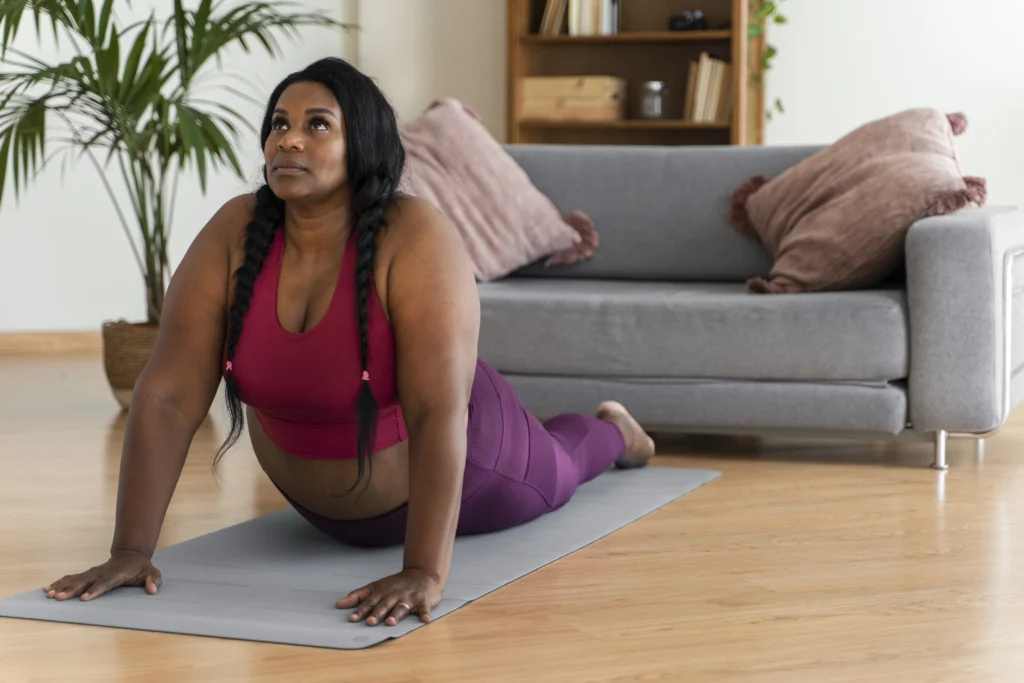
It can be tempting to focus only on the shoulders and upper back when larger breasts are associated with discomfort.
However, movement involves the entire body.
A balanced program can include the legs, hips, trunk, upper back and shoulders, rather than concentrating on a single area.
This approach can help build general strength and physical capacity while keeping exercise varied and sustainable.
How Should You Start?
You do not need to perform all ten exercises in one session.
Choose a few movements that match your current fitness level and gradually increase the workload.
A useful starting point is to prioritize comfort, consistency and controlled movement rather than trying to exercise as intensely as possible.
If an exercise repeatedly causes significant pain, stop and reassess it rather than simply pushing through.
If pain persists or limits your ability to exercise, a physiotherapist can assess your movement, strength, mobility and exercise tolerance and help develop an appropriate programme.
How Should You Structure an Exercise Routine?
The best routine is not necessarily the one with the most exercises.
For women with larger breasts, a useful program should balance strength, cardiovascular fitness, mobility and recovery while considering any pain or discomfort.
A physiotherapist can help determine which areas need more attention and how quickly exercises should be progressed.
How Many Days a Week Should You Exercise?
Your exercise frequency should depend on your current fitness, symptoms and goals.
If you are starting from a low activity level, begin with manageable sessions and gradually build up rather than suddenly increasing your workload.
For general health, adults are commonly advised to accumulate at least 150 minutes of moderate-intensity aerobic activity per week, together with muscle-strengthening activities on at least two days, when appropriate for their health status (World Health Organization)
You do not have to achieve this target immediately.
Think of it as a longer-term goal that can be approached progressively.
How Can You Modify Exercise If Your Breasts Hurt?
Pain during exercise does not always mean that you need to stop being active altogether.
Instead, consider modifying the intensity, duration, impact, movement or equipment involved.
For example, you could replace running with brisk walking or cycling temporarily if repetitive breast movement aggravates symptoms.
You can then gradually reintroduce higher-impact activity as your tolerance improves.
What If Running Causes Pain?
Running involves repeated impact and breast movement, which can make it uncomfortable for some women.
Research has demonstrated substantial breast movement during running and has highlighted the importance of appropriate breast support during high-impact activity (McGhee et al., 2020)
If running causes discomfort, first consider whether your sports bra provides adequate support.
You can also temporarily reduce running duration or alternate running with walking.
Should You Stop Running Completely?
Not necessarily.
If the discomfort is mild and does not worsen progressively, modifying your running programme may be enough.
For example, try shorter intervals of running separated by walking.
Gradually increase the running component as your body becomes accustomed to the activity.
However, persistent or significant pain should not simply be ignored.
How Important Is a Sports Bra?
For high-impact exercise, breast support can have a substantial effect on comfort.
A well-fitted sports bra should provide secure support without causing excessive pressure, restricted breathing or painful digging around the shoulders or chest.
The level of support required can vary depending on the activity.
Walking generally produces different demands from running, jumping or court sports.
Can a Sports Bra Reduce Breast Pain?
It may.
Research examining breast support during exercise has found that sports-bra design can influence breast movement and exercise-related discomfort (Burnett et al., 2015)
However, a sports bra should not be considered a treatment for every type of breast or back pain.
If pain persists despite appropriate support, other factors should be assessed.
How Can You Tell If Your Sports Bra Fits Properly?
A sports bra should feel supportive without creating excessive pressure.
The band should remain relatively stable during movement.
The breasts should be comfortably contained without significant spillage or excessive movement.
The straps should provide support without digging painfully into the shoulders.
If you are constantly adjusting the bra while exercising, the fit may need to be reassessed.
What If Exercise Causes Back or Shoulder Pain?
If the pain is coming from the neck, shoulders or upper back rather than the breast tissue itself, changing the exercise may not be enough.
The problem could involve factors such as reduced strength, limited mobility, exercise technique or insufficient tolerance to the workload.
A physiotherapy assessment can help identify which factors may be contributing.
Should You Strengthen Your Upper Back?
For many women, upper-back strengthening can be a useful component of a broader exercise programme.
Exercises such as rows, resistance-band pulls and controlled shoulder movements can develop strength and endurance around the shoulder girdle.
The purpose is not to “pull the shoulders back” permanently.
It is to improve the body’s ability to move and tolerate different physical demands.
What About Core Exercises?
Core training can complement upper-body strengthening.
Exercises such as bird dogs, dead bugs and bridges can develop trunk control without requiring high-impact movement.
A stronger trunk does not guarantee that breast-related discomfort will disappear.
But improving overall physical capacity can make everyday activities and exercise easier to manage.
Can Yoga or Pilates Help?
Yoga and Pilates can provide opportunities to work on mobility, strength, breathing and body awareness.
They may be useful additions to an exercise programme when appropriately selected.
However, there is no specific yoga or Pilates exercise that can reduce breast size or guarantee relief from breast-related pain.
Choose movements based on your symptoms and goals rather than assuming that a particular exercise style is automatically better.
What Exercises Should You Avoid?
There is no universal list of exercises that women with larger breasts must avoid.
An exercise should generally be modified or temporarily avoided if it consistently produces significant pain or symptoms that worsen afterwards.
High-impact activities such as jumping, running and certain sports may require greater breast support.
But avoiding all high-impact exercise unnecessarily can also reduce fitness and confidence.
The better approach is usually modify, adapt and gradually progress.
How Can You Progress Safely?
Progress one variable at a time.
You could increase:
- Exercise duration
- Number of repetitions
- Resistance
- Walking distance
- Running intervals
- Training frequency
- Movement complexity
Increasing everything simultaneously makes it harder to determine what your body is responding to.
Gradual progression gives your muscles and other tissues time to adapt.
What If You Have Pain During Exercise?
A mild increase in muscular effort or temporary discomfort does not automatically mean that tissue is being damaged.
However, sharp, severe or progressively worsening pain should not be ignored.
If symptoms repeatedly interfere with exercise, daily activities or sleep, seek an appropriate clinical assessment.
A physiotherapist can help distinguish between a problem with exercise load, movement, strength or another musculoskeletal factor.
Can Physiotherapy Create a Personalised Exercise Programme?
Yes.
This is where physiotherapy can provide more value than following a generic list of exercises online.
A physiotherapist can assess your movement, strength, mobility, exercise technique, symptoms and functional goals.
The programme can then be adjusted according to what you can currently tolerate.
As your capacity improves, exercises can be progressed rather than keeping you on the same routine indefinitely.
A Simple Starting Routine
If you are generally healthy and comfortable exercising, you could begin with a simple combination of:
Cardio: Walking or cycling
Upper body: Resistance-band rows and wall push-ups
Mobility: Thoracic rotation and thoracic extension
Whole body: Glute bridges and bird dogs
Start at an intensity that feels manageable.
The routine should complement your fitness level rather than leave you excessively fatigued or in significant pain.
When Should You Get Physiotherapy Advice?
Consider a physiotherapy assessment if back, neck or shoulder symptoms:
- Keep returning during exercise
- Limit your ability to work out
- Affect daily activities
- Persist despite modifying activity
- Make certain movements difficult
- Are associated with weakness or reduced mobility
A physiotherapist can help determine whether the problem is primarily related to exercise load, strength, mobility, movement patterns or another musculoskeletal factor.
Common Exercise Mistakes Women With Large Breasts Should Avoid
Exercising with larger breasts is not about avoiding movement.
The bigger priority is finding the right combination of support, exercise selection, intensity and progression for your body.
Exercising Without Adequate Support
High-impact movement can increase breast movement and discomfort.
If running, jumping or similar activities are uncomfortable, reassess your sports-bra support before assuming that you need to stop exercising.
Increasing Exercise Too Quickly
Going from very little activity to intense workouts can place a sudden increase in demand on your muscles and joints.
Progress gradually instead.
Focusing Only on Posture
Trying to keep your shoulders pulled back all day is not a complete solution.
Your body needs the ability to move through different positions and tolerate different loads.
Only Training the Upper Body
Back and shoulder exercises can be useful, but your programme should not ignore the hips, legs and trunk.
Whole-body strength supports overall movement capacity.
Pushing Through Significant Pain
Exercise should challenge you, but persistent or worsening pain deserves attention.
If a particular movement repeatedly aggravates your symptoms, modify it rather than repeatedly forcing yourself through it.
How Can You Make Exercise More Comfortable?
Small adjustments can make a significant difference.
Choose supportive exercise clothing, start with manageable workloads and select activities that allow you to remain consistent.
You can also experiment with exercise timing, duration and intensity.
For example, instead of completing a long high-impact workout, you might combine shorter periods of higher-impact activity with lower-impact exercises.
Can Weight Loss Reduce Breast-Related Discomfort?
Weight loss may reduce breast size for some women, but the relationship between body weight, breast size and musculoskeletal symptoms is individual.
Exercise should therefore not be viewed solely as a method of changing breast size.
Improving strength and cardiovascular fitness can have benefits regardless of whether breast size changes.
Can Breast Reduction Help With Back and Shoulder Symptoms?
For some women with symptomatic breast hypertrophy, breast reduction can significantly improve physical symptoms and quality of life.
However, surgery is not automatically necessary for everyone experiencing back or shoulder discomfort.
A medical professional can assess whether symptoms are sufficiently persistent or limiting to consider this option.
Physiotherapy can also play an important role in conservative management and may be useful before or after surgery depending on individual circumstances.
Myth vs Fact
Myth: Women with large breasts should avoid running.
Fact: Running is not automatically inappropriate. Appropriate breast support, gradual progression and individual tolerance should guide exercise choices.
Myth: Breast exercises can reduce breast size.
Fact: Exercises can strengthen the muscles around the chest and upper body, but they do not selectively reduce breast tissue.
Myth: You need to keep your shoulders pulled back all the time.
Fact: Constantly holding the shoulders in one position is unnecessary. Strength, mobility and the ability to move through different positions are more useful goals.
Myth: Back pain means you should stop exercising.
Fact: Depending on the cause and severity of symptoms, modifying exercise may allow you to remain active while gradually improving physical capacity.
Myth: Every woman with large breasts needs the same exercise programme.
Fact: Exercise should be adapted to individual symptoms, fitness, goals, movement capacity and tolerance.
What Are Some Lesser-Known Facts About Exercising With Large Breasts?
Breast Movement Can Influence Exercise Participation
Discomfort from breast movement can make some women avoid running, jumping or other activities.
This can create a cycle in which avoiding exercise reduces fitness and physical confidence.
Finding comfortable ways to remain active can help break that cycle.
Bigger Breasts Do Not Mean Weaker Muscles
Breast size does not determine how strong your back or shoulders are.
Two women with similar breast sizes can have very different strength, fitness levels and symptoms.
You Don’t Need “Perfect Posture”
There is no single posture that you must maintain throughout the day.
A more useful goal is developing the strength and mobility to move comfortably through different positions.
High-Impact Exercise Is Not Automatically Bad
Running and jumping are not inherently harmful for women with larger breasts.
The key considerations are individual tolerance, appropriate support and gradual progression.
Exercise Selection Should Be Individualised
An exercise that feels excellent for one woman may aggravate symptoms in another.
This is one reason a physiotherapy assessment can be valuable when pain keeps returning.
Final Thoughts
Having larger breasts does not mean you need to give up exercise or limit yourself to a particular type of workout.
The right combination of support, strength training, mobility work and gradual progression can help you exercise more comfortably and confidently.
If back, neck or shoulder pain continues to interfere with exercise, a physiotherapy assessment can help identify contributing factors and create a programme around your individual needs.
Conclusion
Women with larger breasts do not need to avoid exercise.
The most useful approach is to build strength, cardiovascular fitness, mobility and exercise tolerance while selecting activities that suit your individual body and symptoms.
Walking, cycling, swimming, resistance training, upper-back exercises and trunk strengthening can all form part of a well-rounded programme.
If exercise repeatedly causes back, neck or shoulder pain, simply pushing harder is not the answer.
A physiotherapist can assess the underlying musculoskeletal factors and help you develop a progressive programme that supports your goals.
The aim is not perfect posture or changing your body.
It is to help you move more comfortably, exercise with confidence and build a body that can handle the activities you want to do.
Frequently Asked Questions
What are the best exercises for women with large breasts?
Walking, cycling, swimming, resistance training, upper-back strengthening, thoracic mobility and whole-body exercises can all be useful. The best choices depend on your symptoms, fitness and goals.
Can exercise reduce breast size?
Exercise does not selectively reduce breast tissue. Changes in overall body weight may affect breast size in some women, but this varies between individuals.
Is running bad for women with large breasts?
No. Running is not inherently bad for women with larger breasts. However, breast movement and inadequate support can make running uncomfortable, so activity may need to be modified.
Can physiotherapy help women with large breasts?
Yes. Physiotherapy can address factors such as strength, mobility, movement patterns, exercise tolerance and musculoskeletal symptoms.
Should I wear a sports bra when exercising?
For activities involving significant breast movement, a properly fitted sports bra can improve support and comfort.
Stay tuned with us for more health related topics.
Follow us on LinkedIn and Instagram for more.
More Read


Medical Disclaimer!
This article has been reviewed and written under the guidance of our Head Physiotherapist, Dr. Kruti Raj (PT, MUHS,CPT,CMPT). The information shared is intended for educational purposes only and should not be considered a substitute for personalized medical advice, diagnosis, or treatment.
Please consult us or any other qualified healthcare professional before beginning any exercise program, especially if you are experiencing pain, recovering from injury, or managing a medical condition.


