


Iliopsoas Bursitis vs Hip Labral Tear: Symptoms, Differences & Treatment
Pain at the front of your hip or deep in your groin can make walking, climbing stairs, exercising, and getting up from a chair uncomfortable.
Two possible causes are iliopsoas bursitis and a hip labral tear.
Although both can produce similar symptoms, they affect different structures and may require different rehabilitation approaches.
Quick Answer: Bursitis vs Labral Tear
Iliopsoas bursitis affects a fluid-filled sac near the front of the hip, while a hip labral tear affects the cartilage surrounding the hip socket. Both can cause pain in the groin or front of the hip, so symptoms alone cannot confirm the diagnosis.
May cause pain during hip-flexor activity and, in some cases, visible groin swelling.
May cause deep groin pain, clicking, catching, or discomfort with twisting and deep hip flexion.
What should you do? A clinical assessment can help identify the likely cause. Physiotherapy may help improve movement, strength, and activity tolerance when appropriate.
Iliopsoas bursitis involves irritation or enlargement of a fluid-filled sac near the hip-flexor tendon.
A hip labral tear affects the ring of cartilage surrounding the hip socket.
Understanding their differences can help you recognize possible symptoms and know when to seek assessment.
Key Takeaways
Iliopsoas bursitis affects a bursa near the hip-flexor tendon. A labral tear affects cartilage around the hip socket.
Groin pain, pain with hip flexion, and clicking do not independently confirm either diagnosis.
Ultrasound or MRI may be useful when indicated, but scan findings must be matched to symptoms and examination results.
Activity modification, progressive strengthening, and movement retraining can support recovery according to the underlying problem.
Some people with labral tears improve with conservative management. Persistent symptoms may warrant specialist assessment.
What Is Iliopsoas Bursitis?
The iliopsoas bursa is a fluid-filled sac near the front of the hip, between the iliopsoas tendon and neighboring structures.
It helps reduce friction as the hip moves.
The iliopsoas muscle group helps lift the thigh during walking, climbing stairs, and moving from sitting to standing.
When the nearby bursa becomes irritated or enlarged, it may cause pain in the front of the hip or groin.
Possible contributing factors include repetitive hip movement, local mechanical irritation, trauma, and underlying hip joint conditions.
Iliopsoas bursitis is relatively uncommon, and a significantly enlarged bursa can sometimes cause a noticeable groin lump or compress nearby structures. (Jonczy et al., 2025)
What Is a Hip Labral Tear?
The hip labrum is a ring of fibrocartilage around the acetabulum, the socket that holds the head of the thigh bone.
It helps deepen the socket, distribute pressure, and contribute to joint stability.
A labral tear may develop following an injury, repetitive loading, degenerative changes, or in association with femoroacetabular impingement, a condition involving the shape and movement of the hip bones.
Some people experience deep groin pain, clicking, catching, or discomfort during twisting and deep hip flexion.
Others have few or no symptoms despite a tear appearing on imaging. (Groh & Herrera, 2009)
Iliopsoas Bursitis vs Hip Labral Tear: Key Differences
| Feature | Iliopsoas bursitis | Hip labral tear |
|---|---|---|
| Main structure affected | Bursa near the iliopsoas tendon | Cartilage around the hip socket |
| Typical pain location | Front of the hip or groin | Deep groin or front of the hip |
| Hip flexion | May aggravate symptoms | May aggravate symptoms, particularly in deep positions |
| Clicking or catching | Can occur with associated iliopsoas snapping | Can occur, but is not diagnostic |
| Visible swelling | Possible if the bursa enlarges | Not usually a typical feature |
| Common associations | Mechanical irritation and underlying hip disease | Hip impingement, injury, or degenerative changes |
| Assessment | Clinical examination; ultrasound or MRI when indicated | Clinical examination; imaging when indicated |
| Physiotherapy focus | Modify aggravating loads and restore comfortable hip movement | Manage joint irritation, build strength, and improve movement control |
These are general patterns, not diagnostic rules.
The conditions can coexist, and other problems, including hip osteoarthritis, adductor-related groin pain, and referred pain from the lower back, can produce similar symptoms.
Symptoms of Iliopsoas Bursitis
Pain at the front of the hip
Discomfort may occur in the groin or front of the hip and become more noticeable during activities involving repeated hip flexion.
Pain when lifting the knee
Climbing stairs, getting into a car, or lifting the thigh against resistance may reproduce symptoms.
However, pain during hip flexion alone cannot confirm bursitis.
Discomfort after repetitive activity
Running, repeated stair climbing, and some gym exercises may aggravate symptoms, particularly when activity increases suddenly.
Groin swelling or a lump
An enlarged iliopsoas bursa can sometimes cause fullness or a palpable lump in the groin.
A new lump requires medical assessment because a hernia, vascular problem, or another condition may cause similar symptoms.
Symptoms of a Hip Labral Tear
Deep groin pain
Pain is often felt deep in the front of the hip or groin. It may worsen during prolonged sitting, deep squatting, pivoting, or repeated hip flexion.
Clicking, catching, or locking
Some people notice clicking or catching during hip movement.
These symptoms may occur with a labral tear, but they can also arise from snapping of the iliopsoas tendon or other hip conditions.
Pain during twisting
Changing direction during sport, rotating the hip under load, or moving into deep hip positions may reproduce discomfort.
Reduced movement or sporting performance
Some people experience stiffness or difficulty with running, kicking, dancing, or other demanding activities.
Symptoms vary according to the affected structures and any associated hip condition.
Why the Symptoms Can Be Confusing
The iliopsoas tendon and bursa lie close to the front of the hip joint. Pain from the bursa, tendon, and labrum can therefore overlap.
A person with a labral tear may report pain when lifting the knee. Someone with iliopsoas-related pain may also experience clicking or snapping.
Clinical tests can help guide the assessment, but no single test reliably identifies every labral tear or confirms bursitis on its own.
The clinician must consider the person’s history, examination findings, activity limitations, and other possible causes. (Anderson, 2016)
How Are These Conditions Diagnosed?
A physiotherapist or doctor will ask when the symptoms started, what aggravates them, whether there was an injury, and how the pain affects walking, work, sleep, or sport.
The examination may include:
- Assessing hip range of motion and strength.
- Checking hip-flexor, gluteal, and surrounding muscle function.
- Examining walking, squatting, and other relevant movements.
- Using selected clinical tests to investigate possible joint involvement.
- Assessing the lower back and other potential sources of referred pain.
When Is Imaging Needed?
Imaging is not automatically required for every person with hip pain.
A clinician may recommend it if symptoms persist, the diagnosis remains uncertain, or a significant injury or other condition is suspected.
Ultrasound can help assess iliopsoas bursal enlargement and nearby soft tissues.
MRI can examine the bursa, tendons, muscles, and structures within the hip joint.
MR arthrography may be considered in selected cases to assess the labrum using contrast injected into the joint.
A scan must be interpreted alongside symptoms and examination findings.
A systematic review found that labral abnormalities were also common in people without hip pain, demonstrating why an imaging finding does not automatically explain a person’s symptoms. (Heerey et al., 2018)
Physiotherapy for Iliopsoas Bursitis
Physiotherapy aims to reduce aggravating loads, improve comfortable movement, and restore the strength needed for daily activities.
The program should reflect the underlying cause and the person’s response to movement.
1. Modify aggravating activities
Temporarily reduce activities that consistently reproduce pain, such as repeated high knee lifts, deep lunges, or demanding hip-flexor exercises.
Complete rest is not always necessary if comfortable movement remains possible.
2. Restore comfortable movement
A physiotherapist may introduce gentle hip movement exercises according to symptom irritability.
Avoid forcing stretches or movements that reproduce sharp groin pain.
3. Rebuild strength gradually
Depending on the assessment, rehabilitation may include graded hip-flexor exercises, gluteal strengthening, trunk control, and exercises for the surrounding hip muscles.
Resistance, repetitions, and movement range should progress according to symptom response and functional ability.
4. Return to daily activities and sport
Walking, running, gym training, and sport can be reintroduced progressively.
If symptoms continue despite appropriate adjustments, further medical assessment may be needed rather than repeatedly increasing exercise intensity.
Research specific to iliopsoas bursitis remains limited, so rehabilitation should be individualized and guided by clinical findings. (Frans-Jozef et al., 2026)
Physiotherapy for a Hip Labral Tear
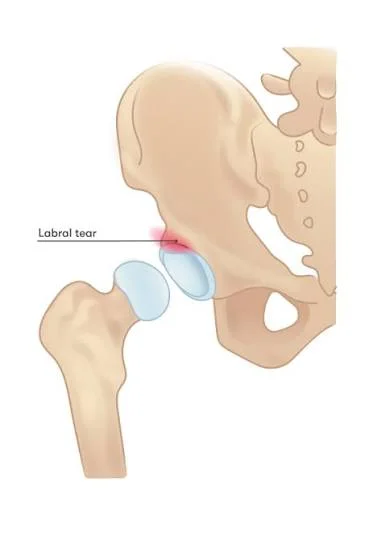
A labral tear does not automatically mean surgery is necessary.
Treatment depends on symptom severity, associated hip conditions, functional goals, and response to conservative management.
1. Adjust painful positions
Temporarily modify deep squats, repeated pivoting, or prolonged hip-flexed positions if they consistently reproduce symptoms.
The aim is to manage irritation without unnecessarily avoiding all activity.
2. Strengthen the hip and trunk
A physiotherapist may prescribe progressive strengthening for the gluteal muscles, hip rotators, hip flexors, and trunk.
Exercises should target identified deficits rather than follow a fixed routine.
3. Improve movement control
Depending on individual needs, rehabilitation may include controlled step-ups, squats within a comfortable range, balance exercises, and task-specific movement training.
4. Monitor progress
Physiotherapists can track pain, hip movement, muscle strength, and functional activities to assess progress.
If symptoms continue to restrict normal activities despite an appropriate rehabilitation program, a sports medicine doctor or orthopedic specialist may discuss further investigation or surgical options.
Clinical practice guidance supports individualized, multimodal rehabilitation for non-arthritic hip joint pain, including some labral and impingement-related presentations. (Enseki et al., 2023)
Can Iliopsoas Bursitis and a Labral Tear Occur Together?
Yes. An enlarged iliopsoas bursa may occur alongside an underlying hip joint condition, and more than one structure can contribute to pain.
When symptoms do not fit a single diagnosis, clinicians may investigate several possible sources.
Treatment should focus on findings that are relevant to the person’s symptoms and function rather than every abnormality seen on a scan.
When Should You Seek Medical Advice?
Arrange an assessment if hip or groin pain persists, repeatedly returns, limits walking, or interferes with everyday activities.
Seek urgent medical attention if you experience:
- Severe hip pain after an injury or an inability to bear weight.
- Fever with a hot, red, or severely painful hip.
- Sudden or rapidly increasing groin swelling.
- Sudden leg swelling, particularly with pain or warmth.
- New significant weakness or concerning neurological symptoms.
Do not assume that a new groin lump or sudden swelling is simply bursitis.
These symptoms can have other causes that require prompt investigation.
Myth vs Fact: Hip Pain
MYTH: Groin pain means you have a labral tear.
FACT: Iliopsoas-related pain, hip joint disorders, adductor problems, and referred pain can produce similar symptoms.
MYTH: Clicking confirms a labral tear.
FACT: Clicking can occur with several hip conditions, including iliopsoas tendon snapping. It is not diagnostic on its own.
MYTH: Every labral tear needs surgery.
FACT: Treatment depends on symptoms, function, associated conditions, and response to conservative management.
MYTH: An MRI finding always explains the pain.
FACT: Labral abnormalities can occur without symptoms. Imaging must be interpreted alongside the clinical assessment.
A Lesser-Known Fact About Hip Labral Tears
A labral tear on an MRI does not necessarily mean it is the source of pain.
Some people have labral abnormalities without symptoms, while others experience substantial pain from a combination of joint, tendon, and movement-related problems.
This is why treatment should not be based on a scan report alone.
Matching imaging findings to symptoms, examination results, and functional limitations helps clinicians select an appropriate treatment plan.
Final Thoughts
Pain at the front of the hip or in the groin can come from several structures. Iliopsoas bursitis affects a bursa near the hip-flexor tendon, whereas a labral tear affects cartilage around the hip socket. Their symptoms can overlap, so pain location or clicking alone cannot establish the diagnosis.
An appropriate clinical assessment helps guide treatment. Physiotherapy may support recovery through activity modification, progressive strengthening, and movement retraining tailored to the person’s symptoms and functional goals.
Remember: An imaging finding does not always explain hip pain. The best treatment plan considers symptoms, examination findings, and how the hip functions in everyday activities.
Conclusion
Iliopsoas bursitis and hip labral tears can both cause pain at the front of the hip or in the groin, but they affect different structures.
Bursitis may cause pain during hip-flexor activity and occasionally groin swelling, while a labral tear may cause deep groin pain and mechanical symptoms such as catching or clicking.
Neither symptom pattern confirms a diagnosis on its own.
A clinical assessment helps determine whether the bursa, labrum, tendon, or another structure is contributing to the problem.
Physiotherapy can support recovery through activity modification, progressive strengthening, and movement retraining tailored to the diagnosis. Persistent symptoms or warning signs warrant medical evaluation.
Frequently Asked Questions
1. Does iliopsoas bursitis cause clicking in the hip?
It may occur alongside snapping of the iliopsoas tendon, but clicking can also have other causes. Clicking alone cannot confirm bursitis or a labral tear.
2. Can physiotherapy help a hip labral tear?
Physiotherapy may improve strength, movement control, and activity tolerance. Results depend on the person’s symptoms, associated hip conditions, and rehabilitation goals.
3. Does every hip labral tear require surgery?
No. Some people manage their symptoms with activity modification and physiotherapy. Specialist assessment may be appropriate if symptoms persist or significantly restrict daily activities.
4. Which scan is best for diagnosing these conditions?
The choice depends on the suspected problem. Ultrasound can help assess the iliopsoas bursa, while MRI or MR arthrography may be considered for suspected labral pathology. A clinician should decide whether imaging is necessary.
5. Can iliopsoas bursitis and a labral tear occur together?
Yes. Both may be present at the same time. A clinical assessment helps determine which structures are likely contributing to symptoms and guiding treatment.
Stay tuned with us for more health related topics.
Follow us on LinkedIn and Instagram for more.
More Read


Medical Disclaimer
This article is intended for general educational purposes only and does not replace professional medical advice, diagnosis, or treatment. Hip and groin pain can have several causes, and the information provided here cannot confirm whether you have iliopsoas bursitis, a hip labral tear, or another condition.
Consult a qualified healthcare professional if your symptoms persist, worsen, or interfere with daily activities. Seek urgent medical attention for severe pain after an injury, inability to bear weight, fever with a severely painful hip, or sudden leg swelling. Do not delay assessment because of information in this article.


