


Motor planning difficulties in children can make everyday movements, coordination, and learning new physical tasks unexpectedly challenging.
Have you noticed that your child takes longer than other children to learn how to ride a bicycle, catch a ball, climb playground equipment or follow a new movement sequence?
They may understand what they need to do but struggle to organise their body movements to complete the task.
Quick Answer: What Are Motor Planning Difficulties?
Motor planning difficulties occur when a child finds it challenging to organize, sequence and carry out unfamiliar movements. They may understand what they need to do but struggle to coordinate the actions required.
This can affect activities such as hopping, catching a ball, climbing, dressing and learning new physical skills. It may occur as part of Developmental Coordination Disorder (DCD) or other developmental conditions, but difficulty with motor planning alone does not establish a diagnosis.
How can physiotherapy help?
Pediatric physiotherapy can assess balance, coordination, postural control and functional movement, then use meaningful, task-specific activities to help children develop motor skills and confidence.
This can sometimes be related to motor planning difficulties, also known as difficulties with praxis.
Motor planning helps children work out how to perform unfamiliar movements, organise the steps involved and adjust their actions as they practise.
Some variation in learning new physical skills is normal.
However, persistent difficulties across different activities can affect a child’s independence, confidence and participation in play, school and everyday routines.
Paediatric physiotherapy can help identify the movement skills involved and support children through structured, meaningful practice.
Key Takeaways for Parents
Motor planning helps children organize and perform movements in the correct sequence.
Difficulties may affect jumping, catching, climbing, dressing and learning unfamiliar activities.
Motor planning difficulties are not automatically a diagnosis of dyspraxia or DCD.
Assessment may involve a pediatric physiotherapist, occupational therapist or pediatrician, depending on the child’s difficulties.
Task-specific practice can help children develop movement skills that are useful in everyday life.
Early assessment can help identify support needs and improve participation in play, school and daily activities.
What Is Motor Planning in Children?
Motor planning is the process of organizing and carrying out a physical movement.
It involves working out what the body needs to do, how to perform the action and how to adjust it using feedback.
For example, when learning to climb a playground ladder, a child needs to:
- Work out where to place their hands and feet.
- Shift their body weight safely.
- Coordinate their arms and legs.
- Judge how much force to use.
- Adjust their position as they move upwards.
The child gradually learns to perform the activity more smoothly through experience and practice.
Motor planning is closely connected to coordination, balance, body awareness, attention and sensory feedback.
These abilities interact, but they are not identical.
A child may have adequate muscle strength and still find it difficult to organize an unfamiliar movement.
Motor Planning Difficulties: Myth vs Fact
Myth: A child who struggles with new movements is simply lazy.
Fact: Some children genuinely find it difficult to organize and coordinate unfamiliar movements, even when they are motivated to participate.
Myth: Motor planning difficulties always mean a child has DCD.
Fact: Motor planning difficulties can occur for different reasons. DCD requires a broader clinical assessment and specific diagnostic criteria.
Myth: Children with motor planning difficulties cannot learn new skills.
Fact: Many children can develop motor skills through appropriate instruction, repeated practice and individualized support.
Myth: Only muscle strengthening can improve movement planning.
Fact: Treatment may include task-specific movement practice, balance, coordination, sequencing and strengthening when needed.
Myth: Motor planning difficulties only affect sports and playground activities.
Fact: They may also affect dressing, using cutlery, handwriting, self-care and other everyday activities.
How Does Motor Planning Develop?
Motor planning develops throughout childhood as children explore their surroundings, practice movements and learn from experience.
Early activities such as reaching for toys, rolling, crawling, standing and walking provide opportunities to develop body awareness and movement control.
As children grow, they learn to:
- Combine several movements into a sequence.
- Adjust speed and force according to an activity.
- Coordinate both sides of the body.
- Imitate unfamiliar actions.
- Adapt movements when the environment changes.
- Perform familiar tasks with greater efficiency.
Learning a new skill usually involves trial and error.
A child may initially move slowly, need repeated demonstrations or make mistakes before becoming more confident.
However, some children continue to find unfamiliar movements unusually difficult, even when they understand the instructions and have opportunities to practice.
Signs of Motor Planning Difficulties in Children
Motor planning difficulties can affect different areas of a child’s life.
Some children struggle mainly with gross motor activities, while others experience challenges with fine motor tasks or everyday routines.
1. Difficulty Learning New Physical Activities
A child may need more demonstrations and practice before learning activities such as:
- Riding a bicycle or scooter.
- Skipping or hopping.
- Catching or throwing a ball.
- Climbing playground equipment.
- Learning dance steps or sports movements.
They may understand what they are expected to do but find it difficult to coordinate the movements.
2. Trouble Following Movement Sequences
Some children struggle when an activity requires several movements in a particular order.
For example, they may find it difficult to jump, turn and then catch a ball.
They might pause between steps, forget the next movement or repeatedly restart the activity.
3. Poor Coordination During Play
Motor planning difficulties may affect how children coordinate their arms, legs and trunk.
Parents may notice that their child:
- Frequently bumps into objects.
- Struggles with ball games.
- Finds obstacle courses difficult.
- Has trouble coordinating both sides of the body.
- Uses awkward or inefficient movement patterns.
These signs can overlap with other coordination difficulties, so they should be considered as part of the child’s overall development.
4. Difficulty With Everyday Activities
Motor planning is not limited to sports and playground activities. It also contributes to everyday tasks such as:
- Putting on clothes in the correct sequence.
- Using cutlery during meals.
- Brushing teeth.
- Managing buttons, zips and shoelaces.
- Organizing school materials.
- Completing activities that require several physical steps.
A child may know what needs to be done but struggle to organize the actions required.
5. Taking Longer to Copy or Imitate Movements
Children often learn new movements by watching adults, teachers or other children.
A child with motor planning difficulties may find it challenging to copy an unfamiliar posture, follow an exercise demonstration or reproduce a sequence of movements.
They may need the activity broken into smaller steps and demonstrated several times.
6. Avoiding Activities That Feel Difficult
Repeated difficulty can affect a child’s confidence.
Some children may avoid sports, playground games, dancing or physical education because they feel slower than their peers.
Others may become frustrated when they cannot perform a movement despite trying.
Avoidance does not necessarily indicate a motor planning problem, but it can be an important sign that an activity is becoming difficult or stressful.
What Causes Motor Planning Difficulties?
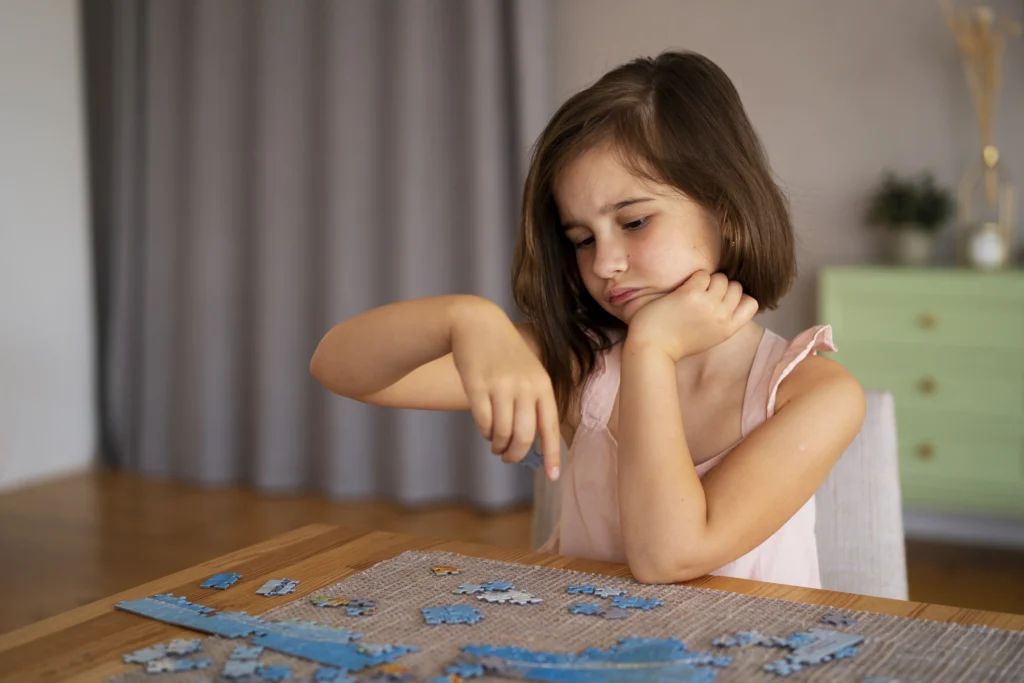
Motor planning involves several areas of the nervous system working together.
The brain uses information from the senses, previous movement experiences and feedback from the body to organize an action.
There is no single cause of motor planning difficulties.
They may occur as part of a broader developmental coordination difficulty or alongside a neurological or developmental condition.
1. Developmental Coordination Disorder
Developmental Coordination Disorder (DCD) is a neurodevelopmental condition that affects the acquisition and performance of coordinated movements.
Children may find it difficult to learn activities such as hopping, catching, handwriting, dressing or using playground equipment, even when they have opportunities to practice.
Motor planning can be one part of the difficulty, alongside balance, timing, coordination and movement control.
However, motor planning difficulties and DCD are not interchangeable terms.
2. Differences in Sensory Feedback
Children use information from vision, touch, proprioception and the vestibular system to guide movement.
Proprioception helps a child sense the position and movement of their joints.
The vestibular system contributes to balance and awareness of head movement.
Differences in how a child receives or uses this information may affect certain movement tasks.
However, sensory processing difficulties should not automatically be assumed in every child who struggles with motor planning.
3. Neurological or Developmental Conditions
Some neurological and developmental conditions can affect how the brain controls and organizes movement.
For example, children with cerebral palsy may experience differences in muscle tone, selective motor control, balance and coordination.
These can make unfamiliar movement sequences more difficult.
The nature of the difficulty varies considerably between children and depends on the underlying condition.
4. Limited Experience With Particular Activities
Not every child who struggles with a new movement has an underlying developmental difficulty.
A child who has had fewer opportunities to practice climbing, ball games, cycling or playground activities may simply be unfamiliar with those movements.
Confidence, motivation, fear of falling and the complexity of the task can also influence performance.
These factors should be considered before assuming a clinical problem.
Is Motor Planning Difficulty the Same as Dyspraxia?
The terms are related, but they do not mean exactly the same thing.
Motor planning difficulty describes a problem organizing and carrying out movements.
It can be an observed difficulty or part of a broader developmental or neurological condition.
Dyspraxia is commonly used to describe developmental movement and coordination difficulties, particularly in the UK.
Healthcare professionals generally use the formal diagnostic term Developmental Coordination Disorder (DCD) when the relevant diagnostic criteria are met.
A child should not be diagnosed with DCD simply because they struggle to copy movements or learn a new physical skill.
Diagnosis involves assessing motor performance, the impact on everyday activities, developmental history and other possible explanations.
A formal DCD diagnosis is generally made cautiously in younger children, particularly those under five.
However, concerns can be assessed and appropriate support can begin earlier. (NHS, 2023)
How Are Motor Planning Difficulties Assessed?
Assessment looks at how a child learns, organizes and performs different movements. A single activity is not enough to identify the cause.
Depending on the child’s needs, the assessment may involve a pediatric physiotherapist, occupational therapist, pediatrician or other developmental specialist.
A physiotherapy assessment may include:
- Gross motor skills: Running, jumping, hopping, climbing and changing direction.
- Balance and postural control: Maintaining stability while standing, reaching and moving.
- Bilateral coordination: Using both sides of the body together.
- Movement sequencing: Performing actions in the correct order.
- Motor imitation: Copying unfamiliar movements and postures.
- Strength and joint mobility: Checking whether physical limitations affect movement.
- Functional activities: Observing how the child manages play, stairs, sports and everyday routines.
Standardized assessments such as the Movement Assessment Battery for Children, Second Edition (MABC-2), or the Bruininks-Oseretsky Test of Motor Proficiency, Second Edition (BOT-2), may be used when broader motor coordination difficulties are suspected.
These tests help measure motor performance against age-based expectations.
They do not independently identify the underlying cause of every movement difficulty.
An occupational therapist may additionally assess fine motor skills, dressing, handwriting, utensil use and other daily activities. (Blank et al., 2019)
How Does Pediatric Physiotherapy Help With Motor Planning?
Pediatric physiotherapy focuses on helping children develop the movement skills needed for daily activities, play and participation.
Treatment is based on the child’s assessment. Instead of practicing unrelated exercises, the physiotherapist selects activities that address the child’s specific difficulties and goals.
1. Breaking Movements Into Smaller Steps
Complex activities can be divided into manageable parts.
For example, learning to jump over an obstacle may involve practicing the starting position, bending the knees, pushing off, clearing the obstacle and landing safely.
Once the child becomes more comfortable with each part, the movements can be combined into the complete activity.
2. Task-Specific Movement Practice
Children learn movement skills by practicing meaningful activities.
A physiotherapist may use ball games, obstacle courses, stepping activities, climbing or jumping tasks depending on the child’s goals.
If a child struggles to catch a ball, practice may begin with a larger, slower-moving ball at a short distance before progressing to smaller or faster-moving balls.
3. Improving Balance and Postural Control
Balance activities help children maintain stability while changing positions or moving their limbs.
Examples include:
- Standing on one foot with support.
- Walking along a marked pathway.
- Stepping over low obstacles.
- Reaching for objects while standing.
- Changing direction during simple movement games.
These activities help the child control their body while performing unfamiliar movements.
4. Developing Bilateral Coordination
Some activities require both sides of the body to work together.
A physiotherapist may use:
- Crawling through a play tunnel.
- Climbing over soft, stable equipment.
- Throwing and catching a ball with both hands.
- Alternating foot movements during stepping games.
- Activities involving opposite arm and leg movements.
The level of difficulty should be adjusted to the child’s current abilities.
5. Improving Strength and Movement Control
Strength and joint control can support more efficient movement.
Activities may include squatting, stepping onto a low platform, rising from the floor and controlled jumping.
Strengthening is particularly useful when reduced muscle capacity contributes to the child’s movement difficulties.
However, strength exercises alone are unlikely to resolve every motor planning problem.
6. Practicing Movement Sequences
Children may benefit from practicing short, predictable movement sequences.
For example, a simple activity might involve stepping over a marker, picking up a beanbag and placing it in a basket.
The sequence can initially be demonstrated and supported with verbal or visual cues.
As the child becomes more familiar with it, prompts can be gradually reduced.
Evidence supports activity-oriented and task-specific approaches for children with DCD.
These approaches focus on practicing meaningful skills that can be used in everyday settings, rather than relying exclusively on exercises targeting underlying body functions. (Iwamoto et al., 2025)
Why Repetition and Practice Matter
Learning a new movement takes time. Repeated practice gives children opportunities to understand the task, adjust their movements and become more efficient.
A child may initially need demonstrations, verbal instructions or physical support.
As the movement becomes familiar, the therapist can gradually reduce these prompts and introduce small changes to the activity.
A 2025 systematic review and meta-analysis found that motor-based interventions improved several measured motor outcomes in children with DCD.
However, the studies varied in their methods and results, so improvements cannot be guaranteed for every child or every activity. (Gao et al., 2025)
Simple Activities Parents Can Try at Home
Parents can encourage motor learning through everyday play.
Activities should be enjoyable, safe and appropriate for the child’s developmental level.
Consider trying:
- Follow-the-leader games: Ask your child to copy simple actions such as clapping, stepping or turning.
- Obstacle courses: Use soft cushions, floor markers and low, stable obstacles to practice movement sequences.
- Ball games: Roll, throw, catch or kick a ball, gradually changing the distance and direction.
- Action songs: Use songs that involve predictable movements such as clapping, marching and reaching.
- Building activities: Encourage stacking blocks, arranging toys and following simple construction patterns.
- Movement imitation: Demonstrate simple animal movements, such as walking like a bear or hopping like a frog, when age-appropriate.
Start with one or two instructions at a time. Give your child enough time to process the movement rather than repeatedly correcting them.
Avoid comparing their performance with siblings or classmates. Encourage effort and celebrate gradual improvements.
When Should Parents Seek Professional Help?
Consider seeking an assessment if your child:
- Consistently struggles to learn new movements despite repeated opportunities to practice.
- Has difficulty with several activities involving coordination or movement sequences.
- Finds dressing, feeding or other daily physical tasks unusually challenging.
- Avoids playground games, sports or physical education because of movement difficulties.
- Shows persistent difficulties with balance, coordination or using both sides of the body.
- Experiences motor difficulties that interfere with school, independence or social participation.
A pediatrician can help determine whether further developmental or neurological assessment is needed.
A physiotherapist or occupational therapist can evaluate the functional difficulties and recommend appropriate support.
Seek prompt medical assessment if your child suddenly develops coordination problems, loses previously acquired motor skills, develops new weakness or experiences a sudden change in walking or balance.
These changes should not be assumed to be developmental motor planning difficulties.
Final Thoughts
Learning a new movement can take time, and every child develops at their own pace. However, when unfamiliar activities repeatedly feel difficult, it is worth understanding what may be affecting the child’s movement.
Motor planning difficulties should not be mistaken for laziness or a lack of effort. Children may need clearer demonstrations, smaller learning steps and opportunities to practice movements in a supportive environment.
With appropriate assessment and individualized pediatric physiotherapy, children can work towards better movement control, greater independence and more confident participation in everyday activities.
Every small step in movement learning matters.
Conclusion
Motor planning helps children organize and carry out movements, from learning to ride a bicycle to completing everyday tasks such as dressing and playing.
Some children need more time, demonstrations and practice to learn unfamiliar movements.
However, persistent difficulties across different activities may indicate a broader motor coordination or developmental concern.
Pediatric physiotherapy can help identify the movement skills that need support and develop a structured program based on meaningful activities.
With appropriate guidance, repetition and encouragement, children can work towards greater movement confidence, independence and participation.
Frequently Asked Questions About Motor Planning Difficulties
1. What are the early signs of motor planning difficulties in children?
Early signs may include difficulty copying movements, learning new physical activities, following movement sequences and coordinating everyday tasks. These signs need to be considered alongside the child’s overall development.
2. Is motor planning difficulty the same as dyspraxia?
No. Motor planning difficulty describes a challenge with organising movements. Dyspraxia is a commonly used term for developmental coordination difficulties, while Developmental Coordination Disorder (DCD) is the formal clinical diagnosis when diagnostic criteria are met.
3. Can a child have motor planning difficulties without DCD?
Yes. Motor planning difficulties can occur in different developmental or neurological conditions and may also be observed without a formal DCD diagnosis.
4. Can motor planning difficulties affect handwriting and dressing?
Yes. Activities such as handwriting, managing buttons, tying shoelaces and dressing involve organizing and coordinating movements. Occupational therapy may help with these functional tasks.
5. Can physiotherapy help children with motor planning difficulties?
Pediatric physiotherapy can help children practise meaningful movement tasks and develop balance, coordination, strength and movement control according to their individual needs.
6. What activities can parents try at home?
Simple activities include obstacle courses, ball games, movement imitation, action songs and building games. Start with easy instructions and increase the challenge gradually.
7. When should parents seek an assessment?
Seek professional advice when movement difficulties persist across different activities, affect everyday independence or interfere with play and school participation. Sudden coordination changes, weakness or loss of previously acquired skills need prompt medical assessment.
Stay tuned with us for more health related topics.
Follow us on LinkedIn and Instagram for more.
More Read


Medical Disclaimer
The information in this article is intended for general educational purposes only. It is not a substitute for professional medical advice, diagnosis or individualized treatment.
Motor planning difficulties can have different underlying causes. A child’s movement concerns should be assessed by an appropriately qualified healthcare professional before making decisions about treatment.
If your child experiences sudden coordination problems, new weakness, loss of previously acquired skills or an unexpected change in walking or balance, seek prompt medical assessment.


