


Imagine your toddler suddenly stops using one arm. This could be nursemaid’s elbow in children, also known as pulled elbow.
They refuse to pick up toys, avoid reaching for objects and cry when you try to move their elbow.
Yet, there is no obvious swelling, bruising or visible injury.
Quick Answer: What Is Nursemaid’s Elbow?
Nursemaid’s elbow, also called pulled elbow or radial head subluxation, is a common injury in toddlers where the annular ligament around the elbow becomes displaced and trapped following a pulling force on the arm.
- Common age: Usually between 1 and 4 years.
- Main symptom: Sudden refusal to use one arm.
- Typical signs: Arm held relatively straight and palm turned downwards, usually without significant swelling.
- Treatment: Gentle closed reduction performed by a trained healthcare professional.
- Recovery: Most children resume using the arm within minutes after successful treatment.
Important: Never try to manipulate the elbow at home. Sudden refusal to use an arm needs medical assessment to rule out a fracture or another injury.
One possible cause is nursemaid’s elbow, also known as pulled elbow or radial head subluxation.
This common childhood injury usually affects children between 1 and 4 years of age.
It occurs when a sudden pulling force affects the developing structures around the elbow, causing the child to experience discomfort and temporarily stop using the arm.
The good news is that most uncomplicated cases respond quickly to treatment by a trained healthcare professional.
Understanding the causes, symptoms, treatment options and recovery process can help parents recognize the condition and know when to seek medical attention.
Key Takeaways for Parents
Nursemaid’s elbow commonly affects children between 1 and 4 years of age.
A sudden pulling force on the hand, wrist or forearm can cause the injury.
Children may suddenly stop using one arm, even without visible swelling or bruising.
Treatment involves a reduction procedure performed by a trained healthcare professional.
Routine physiotherapy is usually unnecessary after an uncomplicated successful reduction.
Parents can reduce recurrence risk by avoiding lifting or swinging children by their hands and wrists.
What Is Nursemaid’s Elbow?
Nursemaid’s elbow is an injury involving the annular ligament, a ring-shaped ligament that helps hold the radial head in position near the elbow joint.
The radial head is the rounded upper end of the radius, one of the two bones in the forearm.
In young children, the supporting ligaments and surrounding structures are still developing.
A sudden pulling force on the hand, wrist or forearm can cause the annular ligament to stretch and slip over the radial head, becoming trapped within the joint.
This is called radial head subluxation.
The trapped ligament makes certain movements uncomfortable, particularly when the child tries to rotate the forearm.
Nursemaid’s elbow most commonly occurs between 1 and 4 years of age.
It is generally a temporary injury, and most children recover quickly after successful treatment.
What Causes Nursemaid’s Elbow in Toddlers?
The most common cause is a sudden pulling force applied to a child’s arm while the elbow is relatively straight.
Young children’s elbow structures are more vulnerable to this type of traction because their supporting tissues are still developing.
Common situations include:
1. Pulling a Child by the Hand or Wrist
A toddler may suddenly resist while walking with an adult.
If the adult continues holding the child’s hand and pulls, the force can travel through the forearm towards the elbow.
2. Lifting a Child by One Arm
Lifting a toddler by one hand or wrist places unnecessary stress on the developing elbow structures.
Parents should lift young children by supporting their bodies under the arms.
3. Swinging a Child by the Arms
Swinging a toddler while holding both hands may create sudden traction around the elbow.
Although this may seem like harmless play, it can sometimes cause a pulled elbow.
4. Pulling a Child Away From Danger
An adult may instinctively pull a child by the arm to prevent a fall or move them away from danger.
A sudden forceful movement can sometimes trigger the injury.
5. No Obvious Pulling Incident
Not every child has a clear history of being pulled by the arm.
Some parents only notice that their toddler has suddenly stopped using one arm.
The absence of a known pulling incident does not rule out nursemaid’s elbow.
Clinical guidance indicates that approximately half of affected children may have no recognized pulling mechanism.
What Are the Signs and Symptoms of Nursemaid’s Elbow?
The most noticeable symptom is a sudden refusal to use one arm.
Unlike many other elbow injuries, uncomplicated nursemaid’s elbow usually causes little visible swelling or bruising.
Common symptoms include:
Sudden Refusal to Use One Arm
The child may stop reaching for toys, holding objects or using the affected hand during play.
They may keep the arm close to their body and avoid moving it.
Holding the Arm in an Unusual Position
Many children hold the affected arm relatively straight, with the forearm turned downwards and the palm facing the body or floor.
They may resist attempts to bend the elbow or turn the palm upwards.
Pain When the Arm Is Moved
The child may cry or become distressed when someone tries to move the elbow.
Turning the palm upwards may be particularly uncomfortable.
Difficulty Reaching and Grasping Objects
A toddler may stop using the affected arm to pick up toys, hold a cup or participate in everyday activities.
Little or No Visible Swelling
A typical pulled elbow does not usually cause significant swelling, bruising or deformity.
If these signs are present, another injury, including a fracture, should be considered.
How Does Nursemaid’s Elbow Affect Normal Arm Movement?
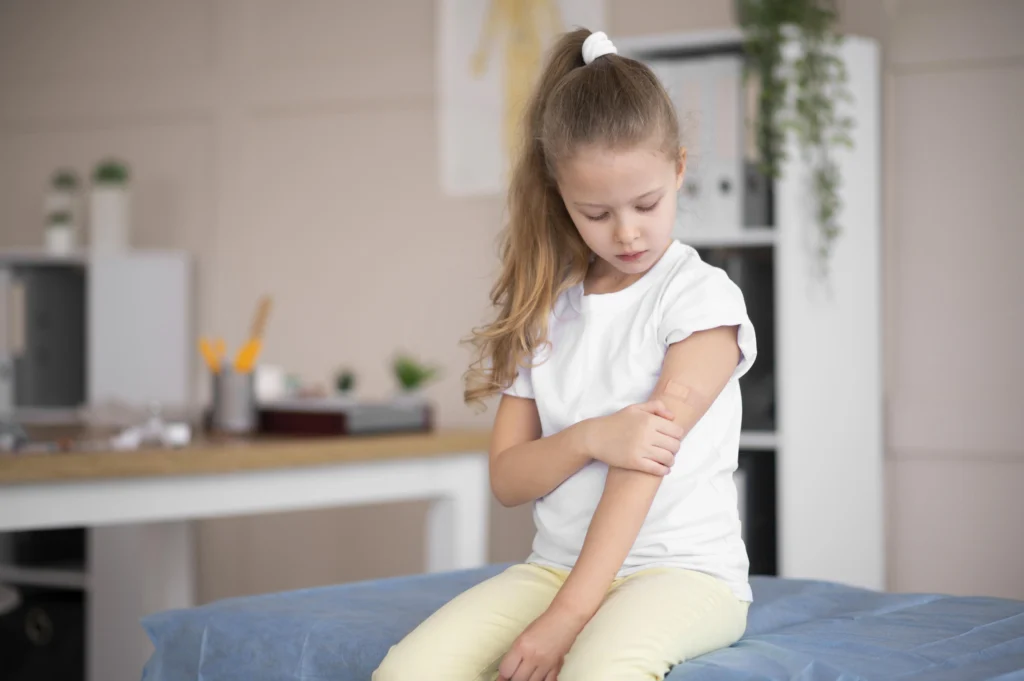
Nursemaid’s elbow mainly interferes with comfortable movement around the elbow and forearm.
Two important movements are involved:
- Pronation: Turning the forearm so the palm faces downwards.
- Supination: Turning the forearm so the palm faces upwards.
When the annular ligament becomes trapped around the radial head, these movements may become painful.
As a result, the child may avoid:
- Reaching for toys.
- Picking up food or a cup.
- Holding objects with the affected hand.
- Bending or straightening the elbow.
- Turning the palm upwards.
The child may appear unable or unwilling to move the arm.
However, this is generally a protective response to discomfort rather than true muscle weakness.
Is Nursemaid’s Elbow Different From an Elbow Fracture?
Yes. Nursemaid’s elbow and an elbow fracture are different conditions, although both can cause a child to stop using one arm.
Recognizing the difference is important because fractures may require immobilization or other orthopedic treatment.
| Feature | Nursemaid’s elbow | Possible elbow fracture |
|---|---|---|
| Common mechanism | Pulling or traction | Fall or direct impact |
| Arm position | Often held relatively straight and palm-down | Variable |
| Swelling | Usually absent | May be present |
| Bruising | Usually absent | May be present |
| Bony tenderness | Usually minimal | May be noticeable |
| Treatment | Reduction by trained professional | Depends on fracture type |
These are typical patterns, not diagnostic rules. A fracture can sometimes occur without obvious swelling or bruising.
A healthcare professional should assess a child who suddenly stops using an arm, particularly when symptoms follow a fall or direct injury.
How Is Nursemaid’s Elbow Diagnosed?
Diagnosis is generally based on the child’s medical history and physical examination.
A pediatrician or emergency healthcare professional will assess the affected arm and determine whether the symptoms are consistent with radial head subluxation.
Clinical Examination
The assessment may include:
- How the injury occurred, if known.
- The position in which the child holds the arm.
- Elbow and forearm movement.
- Tenderness around the elbow and other parts of the arm.
- Swelling, bruising or visible deformity.
- Hand movement, circulation and sensation.
The healthcare professional will also consider other possible injuries involving the wrist, shoulder, collarbone and upper arm.
Are X-rays Necessary?
X-rays are not routinely required when the history and examination strongly suggest uncomplicated nursemaid’s elbow.
However, imaging may be recommended when:
- There is significant swelling or bruising.
- The child has tenderness over a bone.
- The injury followed a fall or direct impact.
- The arm looks deformed.
- The diagnosis is uncertain.
- Reduction attempts are unsuccessful.
- The child continues refusing to use the arm after treatment.
Imaging helps identify fractures and other conditions that can resemble a pulled elbow.
What Is the Treatment for Nursemaid’s Elbow?
The standard treatment is a procedure called closed reduction.
A trained healthcare professional gently moves the child’s forearm and elbow to release the trapped annular ligament and restore the normal relationship of the joint structures.
Two commonly used techniques are:
Hyper pronation Technique
The healthcare professional supports the child’s elbow and rotates the forearm into pronation.
This movement helps release the trapped ligament.
Supination-Flexion Technique
The healthcare professional rotates the forearm into supination and bends the elbow.
Both techniques are used in clinical practice.
Research comparing these methods suggests that hyper pronation may have a higher first-attempt success rate than supination-flexion.
However, the available studies have limitations, so the choice of technique remains a clinical decision.
Parents should never attempt to manipulate or put the elbow back into position themselves. A trained professional must assess the child and consider whether another injury could be responsible.
How Quickly Does a Child Recover After Treatment?
Most children begin using the affected arm again within a few minutes after successful reduction.
Many regain comfortable movement within approximately 5 to 30 minutes.
However, recovery may take longer when the injury occurred many hours before treatment. Some children may need one or two days to resume normal arm use.
The healthcare professional may observe the child reaching for a toy or lifting an object to confirm that normal movement has returned.
If the child continues refusing to use the arm, further medical assessment is necessary. An unsuccessful reduction or an alternative diagnosis must be considered.
Does Nursemaid’s Elbow Require Physiotherapy?
In most uncomplicated cases, routine physiotherapy is not required after successful reduction.
Once the ligament returns to its normal position, discomfort usually settles and the child gradually resumes normal arm movement.
There is generally no need for a structured strengthening or stretching program.
However, physiotherapy may help in selected situations.
When Can Physiotherapy Be Helpful?
A pediatric physiotherapist may become involved when:
- Movement difficulties persist after medical reassessment.
- Another injury, such as a fracture, requires rehabilitation.
- The child has ongoing stiffness or difficulty using the arm after an associated injury.
- Rehabilitation is required following orthopedic treatment.
What Does Physiotherapy Focus On?
When rehabilitation is medically appropriate, treatment may include:
Restoring comfortable movement: Gradually improving permitted elbow, wrist and forearm movements according to the injury and medical advice.
Functional arm use: Encouraging age-appropriate reaching, grasping, holding and playing activities.
Strength and movement control: Introducing progressive exercises when weakness or functional limitations are identified and the treating clinician permits them.
Returning to normal activities: Helping the child gradually resume everyday play, dressing and other age-appropriate activities.
Physiotherapy should always be guided by the child’s diagnosis and recovery needs.
It cannot independently correct the original ligament displacement, and it should not replace medical reduction.
Nursemaid’s Elbow: Myth vs Fact
MYTH: Nursemaid’s elbow always happens after a parent pulls a child’s arm.
FACT: Many children have no recognized history of pulling. A clear pulling incident is not necessary for diagnosis.
MYTH: A child with nursemaid’s elbow will always have swelling.
FACT: Typical nursemaid’s elbow usually causes little or no visible swelling or bruising. Significant swelling should prompt assessment for another injury.
MYTH: Every child needs physiotherapy after a pulled elbow.
FACT: Most children recover normal arm use after successful reduction and do not require routine physiotherapy.
MYTH: Parents can put the elbow back into position at home.
FACT: Reduction should only be performed by a trained healthcare professional after assessing the injury.
MYTH: Once treated, nursemaid’s elbow can never happen again.
FACT: Recurrence is possible, especially in younger children whose elbow structures are still developing.
Can Nursemaid’s Elbow Happen Again?
Yes. Nursemaid’s elbow can recur, particularly in younger children.
The supporting structures around the elbow are still developing, making the joint more vulnerable to traction injuries.
Some children experience repeated episodes before these structures mature.
Recurrence does not necessarily mean that the previous treatment was unsuccessful.
If a child repeatedly develops symptoms, a healthcare professional should reassess the diagnosis and consider whether another condition could be contributing to the problem.
How Can Parents Prevent Nursemaid’s Elbow?
Simple changes in how adults lift and handle toddlers can reduce the risk of a pulled elbow.
Lift Children Under Their Arms
Support a toddler by placing your hands under their armpits or around their torso instead of lifting them by their hands or wrists.
Avoid Swinging Children by Their Arms
Do not swing, lift or spin young children while holding their hands or wrists.
Avoid Sudden Pulling
If a toddler resists while walking, avoid pulling forcefully on their arm.
Move closer, support their body and encourage them to walk safely.
Use Safe Ways to Prevent Falls
If a child loses balance, try to support their body rather than catching or pulling them forcefully by one arm.
These precautions are especially important for children who have previously experienced nursemaid’s elbow.
When Should Parents Seek Medical Attention?
A toddler who suddenly stops using one arm should be assessed by a healthcare professional.
Although nursemaid’s elbow is common, other injuries can cause similar symptoms.
Seek prompt medical attention if your child has:
- Sudden refusal to move one arm.
- Significant pain around the elbow, wrist or shoulder.
- Swelling or bruising.
- Visible deformity.
- Tenderness over a bone.
- Symptoms following a fall or direct impact.
- Redness, warmth or fever associated with joint pain.
- A cold, pale or unusually discolored hand.
A child who continues refusing to use the arm after treatment also needs reassessment.
Do not assume that every sudden arm injury is nursemaid’s elbow. Fractures and other conditions must be considered when the presentation is not typical.
Final Thoughts
Nursemaid’s elbow can be frightening when a toddler suddenly stops using one arm. However, most uncomplicated cases respond well to treatment by a trained healthcare professional.
Parents should avoid pulling, lifting or swinging young children by their hands and wrists. If a child suddenly refuses to use an arm, seek medical assessment rather than attempting to move the elbow back into position.
Early assessment, appropriate treatment and simple prevention measures can help protect your child’s comfort and normal movement.
Conclusion
Nursemaid’s elbow is a common childhood injury that can cause a toddler to suddenly stop using one arm.
It usually occurs when a pulling force causes the annular ligament around the radial head to become displaced and trapped.
Although the injury can be painful, most uncomplicated cases respond quickly to a reduction procedure performed by a trained healthcare professional.
Physiotherapy is not usually necessary after successful treatment, but it may support recovery when movement difficulties persist or another injury requires rehabilitation.
Parents can reduce the risk of recurrence by avoiding pulling, lifting or swinging children by their hands and wrists.
Most importantly, sudden refusal to use an arm deserves proper assessment so that fractures and other injuries are not overlooked.
Frequently Asked Questions About Nursemaid’s Elbow
1. What is nursemaid’s elbow in toddlers?
Nursemaid’s elbow is an injury in which the annular ligament around the radial head becomes displaced and trapped. It commonly occurs in children aged 1-4 years following a pulling force on the arm.
2. What are the early signs of nursemaid’s elbow?
The most common sign is sudden refusal to use one arm. A child may hold the arm relatively straight with the forearm turned downwards and resist attempts to move it.
3. What causes pulled elbow in toddlers?
It commonly occurs when a child’s hand, wrist or forearm is pulled suddenly. Pulling a child while walking, lifting by one arm or swinging by the hands can trigger the injury.
4. Does nursemaid’s elbow cause swelling?
Typical nursemaid’s elbow usually causes little or no visible swelling or bruising. Significant swelling, deformity or bony tenderness should be assessed because another injury, such as a fracture, may be present.
5. How is nursemaid’s elbow treated?
A trained healthcare professional treats nursemaid’s elbow using a closed reduction procedure. This releases the trapped ligament and usually allows the child to resume normal arm use.
6. How long does recovery from nursemaid’s elbow take?
Many children start using the arm again within 5-30 minutes after successful reduction. Recovery may take longer when treatment is delayed. Persistent non-use needs medical reassessment.
7. Does a child need physiotherapy after nursemaid’s elbow?
Routine physiotherapy is usually unnecessary after uncomplicated successful reduction. Rehabilitation may be appropriate if another injury or persistent movement limitation is identified.
8. Can nursemaid’s elbow happen again?
Yes. Recurrence can occur, particularly in younger children. Avoid lifting or swinging children by their hands or wrists to reduce the risk.
9. When should parents seek medical attention?
Seek prompt assessment if your child suddenly stops using an arm. Swelling, bruising, deformity, severe pain, fever, a cold or pale hand, or continued refusal to use the arm after treatment requires further medical attention.
Stay tuned with us for more health related topics.
Follow us on LinkedIn and Instagram for more.
More Read



Medical Disclaimer
The information provided in this article is intended for general educational purposes only. It should not be considered a substitute for professional medical advice, diagnosis or treatment.
Nursemaid’s elbow and other childhood arm injuries require appropriate assessment by a qualified healthcare professional. Parents should never attempt to manipulate or reposition a child’s elbow at home.
Always consult a pediatrician or qualified healthcare professional if your child suddenly stops using an arm, experiences significant pain or develops swelling, bruising, fever or other concerning symptoms.


