Ankylosing spondylitis (AS) is a chronic inflammatory condition that primarily affects the spine, but as the disease progresses, the cervical spine (neck) often becomes involved.
Unlike typical neck pain caused by posture or muscle strain, AS-related neck pain is inflammatory, progressive, and deeply linked to the immune system.
Research shows that AS causes inflammation in spinal joints and ligaments, leading to stiffness, pain, and eventually fusion of vertebrae (ankylosis) if untreated. (Lippincott Journals)
Read about our Complete Neck Pain Guide : Causes, Symptoms, Exercises and Treatment
Quick Answer
Ankylosing spondylitis neck pain is caused by inflammation of the cervical spine leading to stiffness and reduced mobility. Physiotherapy, including mobility exercises, posture correction, and strengthening, is the most effective long-term treatment to maintain neck function and prevent spinal fusion.
Read about : 15 Common Causes of Neck Pain You Should Know
What makes AS neck pain different?
- Worse in the morning or after rest
- Improves with movement (key clinical clue)
- Associated with stiffness rather than just pain
- Gradually reduces neck mobility
As a physiotherapist, I often tell my patients:
If your neck pain improves when you move, don’t ignore it, it may not be mechanical.
Read about: Cervical Ligament Injury or Neck Ligament Tear
Why the Neck Gets Affected in Ankylosing Spondylitis

AS typically begins in the lower back but gradually ascends to the thoracic and cervical spine.
Key pathological changes in the neck:
- Inflammation of facet joints
- Ligament calcification
- Reduced disc flexibility
- Formation of syndesmophytes (bony growths)
- Progressive spinal fusion (bamboo spine)
Over time, this leads to:
- Reduced rotation (turning head)
- Difficulty looking up/down
- Fixed forward head posture
A classic study showed significant restriction in cervical movements, especially lateral flexion in AS patients.(ScienceDirect)
Read about: The Best Physiotherapy Exercises for Cervical Spondylosis Relief
Neck Symptoms in AS
Early Stage
- Mild stiffness in neck
- Occasional deep ache
- Fatigue in upper back
Progressive Stage
- Reduced range of motion
- Difficulty driving (turning head)
- Pain radiating to shoulders
Advanced Stage
- Fixed neck posture
- Severe mobility loss
- Increased fracture risk
Read : Simple Posture Correction Exercises for Forward Head Posture
Lesser-Known Clinical Facts
- Neck involvement may appear later but progress rapidly
- Women may present more with neck pain than low back pain, leading to delayed diagnosis
- Cervical spine fusion increases risk of serious injury even with minor trauma
- Poor posture accelerates structural deformity
Read more: Cervical Disc Bulge: Causes, symptoms and treatment
Evidence-Based Physiotherapy Techniques for Neck Pain
Physiotherapy is not optional in AS, it is essential and lifelong.
A systematic review of randomized controlled trials found that supervised physiotherapy significantly improves pain, disease activity, and functional capacity in AS patients. (MDPI)
Goals
- Maintain cervical mobility
- Prevent deformity
- Reduce stiffness and pain
- Improve posture
- Enhance breathing mechanics
Read in detail: Whiplash Injury After An Accident? Here’s Treatment And Expert Rehab Guide
Advanced Physiotherapy Management for Ankylosing Spondylitis Neck Pain
Why Standard Neck Exercises Are Not Enough in AS
AS neck pain is not just stiffness, it involves:
- Inflammatory joint restriction
- Ligament ossification
- Muscle inhibition + overcompensation
That’s why treatment must be multi-layered:
- Mobility
- Motor control
- Strength
- Breathing
- Neuromuscular retraining
Research confirms that structured physiotherapy programs significantly improve disease activity and function, especially when supervised. (MDPI)
Read in detail about: Cervical Radiculopathy: Why Neck Nerve Pain Travels to the Arm
Phase 1: Pain Reduction & Mobility Restoration
1. Cervical Segmental Mobility
Instead of general neck rotations, focus on segmental movement:
Exercise: Controlled Cervical Rotation with Axial Elongation
- Sit tall, imagine growing taller
- Slowly rotate head
- Avoid collapsing posture
Why this works:
- Reduces joint compression
- Improves vertebral glide
2. Cervical Extension Bias Training
AS causes flexion deformity, so extension must be trained daily.
Exercise: Prone Neck Extension
- Lie prone
- Lift head gently
- Hold 5-10 sec
Prevents forward head deformity and maintains visual horizon (critical functional goal)
3. Thoracic Mobility
Most neck pain in AS is actually due to thoracic stiffness.
Exercise: Thoracic Foam Roll Extension
- Place roller mid-back
- Extend over it
Reduces load on cervical spine
Read in detail about: Cervical Disc Degeneration: The Hidden Cause of your Neck Pain
Phase 2: Neuromuscular Control & Stability
4. Deep Cervical Flexor Activation
AS patients often overuse superficial muscles.
Exercise: Chin Nod (NOT Chin Tuck)
- Gentle nod (like saying yes)
- Avoid pressing neck down
Activates longus colli and improves spinal alignment
5. Scapular-Neck Integration Training
Neck cannot be treated in isolation.
Exercise: Wall Angels
- Back against wall
- Arms move up/down
- Maintain neck alignment
Improves posture + reduces strain
6. Proprioception Training
AS reduces joint awareness.
Exercise: Laser Pointer Training
- Laser on head
- Trace patterns on wall
Improves movement accuracy and reduces stiffness perception
Read about : What is Cervical Facet Joint Pain, how it causes cervicogenic headaches and how to correct it naturally
Phase 3: Strength + Endurance
7. Isometric Neck Strengthening
Directions:
- Press head into hand (all directions)
- Hold 5-8 sec
Builds stability without stressing joints
8. Functional Movement Integration
Exercise: Sit-to-Stand with Head Control
- Maintain neutral neck
- Avoid forward head
Transfers training to daily life
Read about: What Is Cervical Myofascial Pain Syndrome And How To Relieve Trigger Points
Phase 4: Breathing & Rib Cage Expansion
AS affects rib joints → reduced lung capacity.
9. 3D Breathing Training
Exercise: Lateral Rib Expansion
- Hands on ribs
- Expand sideways while inhaling
Improves oxygenation and reduces stiffness
Read more: Cervical Vertigo Explained: Why Neck Pain Make You Feel Dizzy
Emerging Physiotherapy Treatments
1. Soft Tissue Mobilization + Stretch Combo
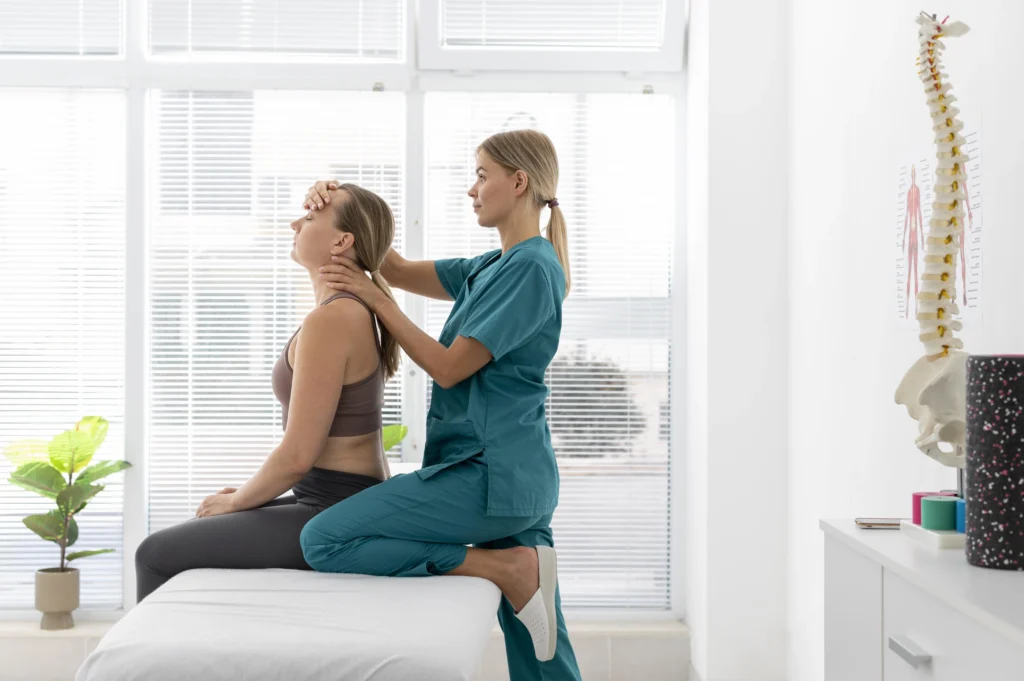
New 2025 clinical data shows that adding soft tissue release before stretching improves mobility and pain outcomes significantly. (Resolve360)
Target areas:
- Upper trapezius
- SCM
- Suboccipitals
2. Tele-Rehabilitation
Recent research shows tele-physiotherapy can be as effective as in-person rehab when guided properly. (PubMed)
Ideal for:
- Daily monitoring
- Exercise compliance
- Rural/remote patients
3. Hydrotherapy
- Warm water reduces stiffness
- Improves spinal movement
Especially useful in:
- Morning stiffness
- Severe cases
4. Yoga-Based Rehabilitation
Yoga improves:
- Flexibility
- Breathing
- Mental health
Effective poses:
- Cat-Cow
- Cobra
- Sphinx
Movement-based therapies like yoga help reduce stiffness and improve quality of life in AS. (Verywell Health)
5. Combined Multidisciplinary Rehab
A 2024 study showed that physiotherapy + occupational therapy + behavioral therapy improved spinal mobility significantly within 2 weeks. (Ankylosing Spondylitis News)
Read in detail about: How to Fix Upper Crossed Syndrome Naturally
Home Exercise Program
Morning Routine
- Neck rotations (5 reps each side)
- Chin nods (10 reps)
- Thoracic extension (10 reps)
- Breathing exercises (5 min)
Done within 30 minutes of waking
Mid-Day Reset (Posture Break)
- Wall posture correction (2 min)
- Scapular squeezes (10 reps)
- Neck extension stretch
Evening Routine
- Stretching + mobility
- Isometric strengthening
- Relaxation breathing
Read more: Cervical Myelopathy: The Hidden Neck Condition Affecting Your Walking
Lifestyle Changes
1. “Motion Over Rest” Rule
Patients who stay active have:
- Less stiffness
- Better mobility
Exercise-based programs improve spinal function and daily activity levels. (IJCMPH)
2. Posture Is a Long-Term Treatment
- Avoid slouching
- Use ergonomic setups
- Screen at eye level
3. Sleep Optimization
- Thin pillow
- Supine or prone (if tolerated)
- Avoid fetal position
4. Anti-Inflammatory Lifestyle
- Regular movement
- Adequate protein
- Omega-3 rich diet
- Quit smoking (very important)
5. Heat vs Cold Strategy
- Heat therapy for stiffness
- Cold therapy for inflammation flare
6. Consistency > Intensity
From both research and real-world experience:
Patients who do 15 minutes daily do better than those doing 1 hour occasionally
Patients Insights
From community experiences:
“I swim… I can tell the difference”
“Walking daily helps a lot” (Reddit)
Practical takeaway:
- Walking + swimming are underrated but very powerful
Read about: What Is Military Neck Or Cervical Kyphosis And How To Treat It
What to Avoid
- Aggressive neck manipulation
- High-impact sports
- Prolonged immobility
- Overstretching during flare
Massage can help, but aggressive techniques may worsen symptoms or cause injury in advanced cases. (Verywell Health)
Read: Lhermitte’s sign- An Electic Shock Sensation Down The Neck
Medical Management
While physiotherapy is essential, medical treatment may include:
Medications:
- NSAIDs (first-line)
- Biologics (TNF inhibitors)
- DMARDs (in some cases)
Surgical Options:
- Spinal osteotomy (severe deformity)
- Joint replacement
Physiotherapy continues before and after surgery.
Read about: Which Is The Best Sitting Posture To Avoid Neck Pain And How To Achieve It
Red Flags You Should Never Ignore
- Sudden severe neck pain after minor fall
- Neurological symptoms (numbness, weakness)
- Loss of bladder/bowel control
- Rapid loss of mobility
These require immediate medical attention.
Read in detail: Best Desk Setup to Reduce Neck and Back Pain
My Clinical Insight
In my clinical experience, the biggest mistake patients make is waiting for pain to worsen before starting physiotherapy.
AS is a condition where:
- Early movement = long-term mobility
- Delayed rehab = irreversible stiffness
Consistency matters more than intensity.
In AS neck pain, the real problem is not stiffness, it is loss of movement variability.
Patients move in fewer patterns, joints stiffen faster.
So a physiotherapist’s goal should always be:
- Restore variability
- Train movement diversity
- Not just increase range
Read About: How to Choose the Right and Best Pillow for Neck Pain
Myth vs Reality
Myth: Rest helps ankylosing spondylitis
Reality: Movement is the best treatment
Myth: Neck pain is always due to posture
Reality: In AS, inflammation is the primary cause
Read about: Yoga for Neck Pain: Poses That Actually Work
Frequently Asked Questions
1. Can ankylosing spondylitis affect the neck?
Yes, AS commonly progresses to involve the cervical spine, causing stiffness and reduced mobility.
2. What is the best exercise for AS neck pain?
Neck mobility exercises, chin tucks, and posture correction exercises are most effective.
3. Is neck pain in AS permanent?
It can become permanent if untreated, but physiotherapy can slow progression.
4. Should I rest during neck pain?
No, movement is essential. Rest can worsen stiffness in AS.
Read about: Neck And Jaw Pain Together? Here’s The Full Clinical Picture
Final Word
Ankylosing spondylitis neck pain is not just “neck pain”, it is a progressive spinal condition that demands proactive care.
With the right physiotherapy approach, you can:
- Preserve mobility
- Reduce pain
- Prevent deformity
- Maintain independence
Read about: The Most Effective McKenzie Exercises For Neck Pain
Key Takeaways
- Ankylosing spondylitis causes inflammatory neck pain and stiffness.
- Neck pain improves with movement, not rest.
- Physiotherapy is essential to prevent spinal fusion.
- Posture correction and mobility exercises are critical.
- Early intervention can prevent permanent deformity.
Stay tuned with us for more health related topics.
Follow us on LinkedIn and Instagram for more.